Frank Gehry (1929 -2025): His Dreams Built the Future of Architecture

Frank Gehry (1929–2025):

His Dreams Built the Future of Architecture


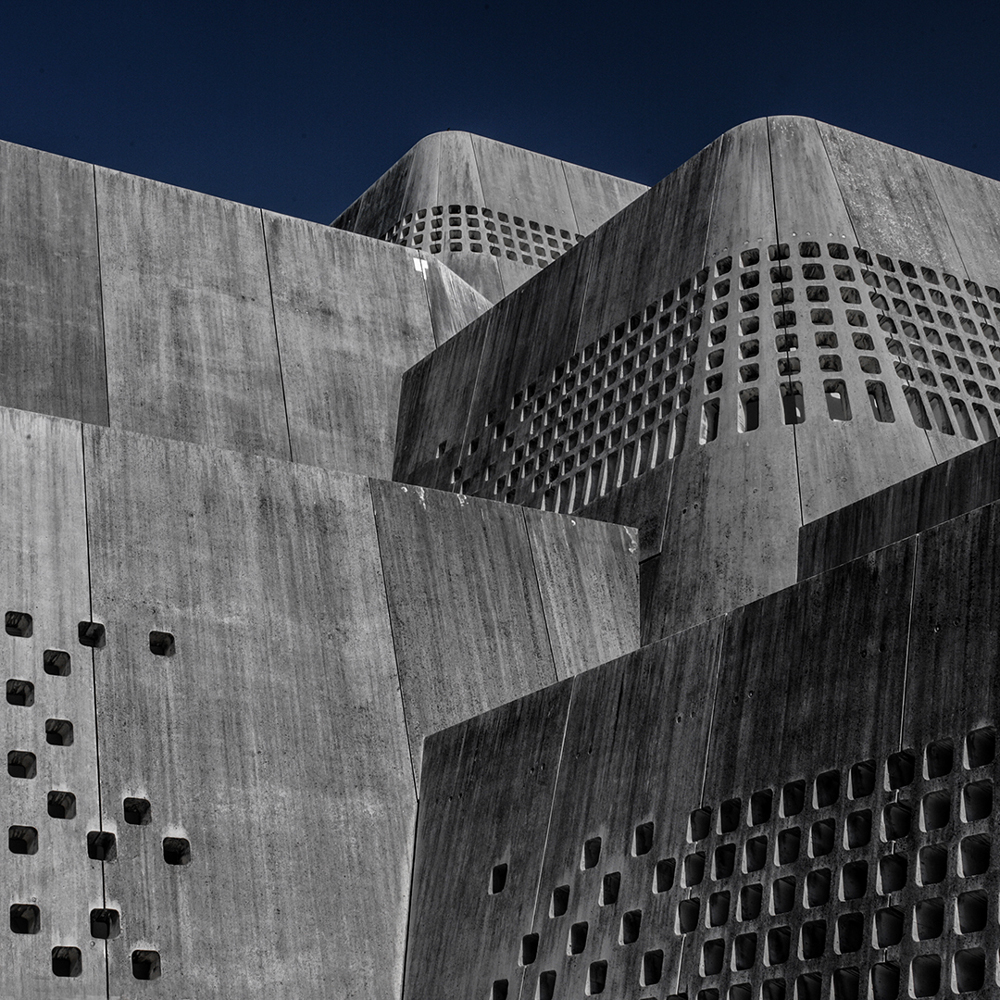
Frederick R. Weisman Art Museum, Minneapolis, Minnesota

Frederick R. Weisman Art Museum, Minneapolis, Minnesota Image Carol M. Highsmith – Library of Congress


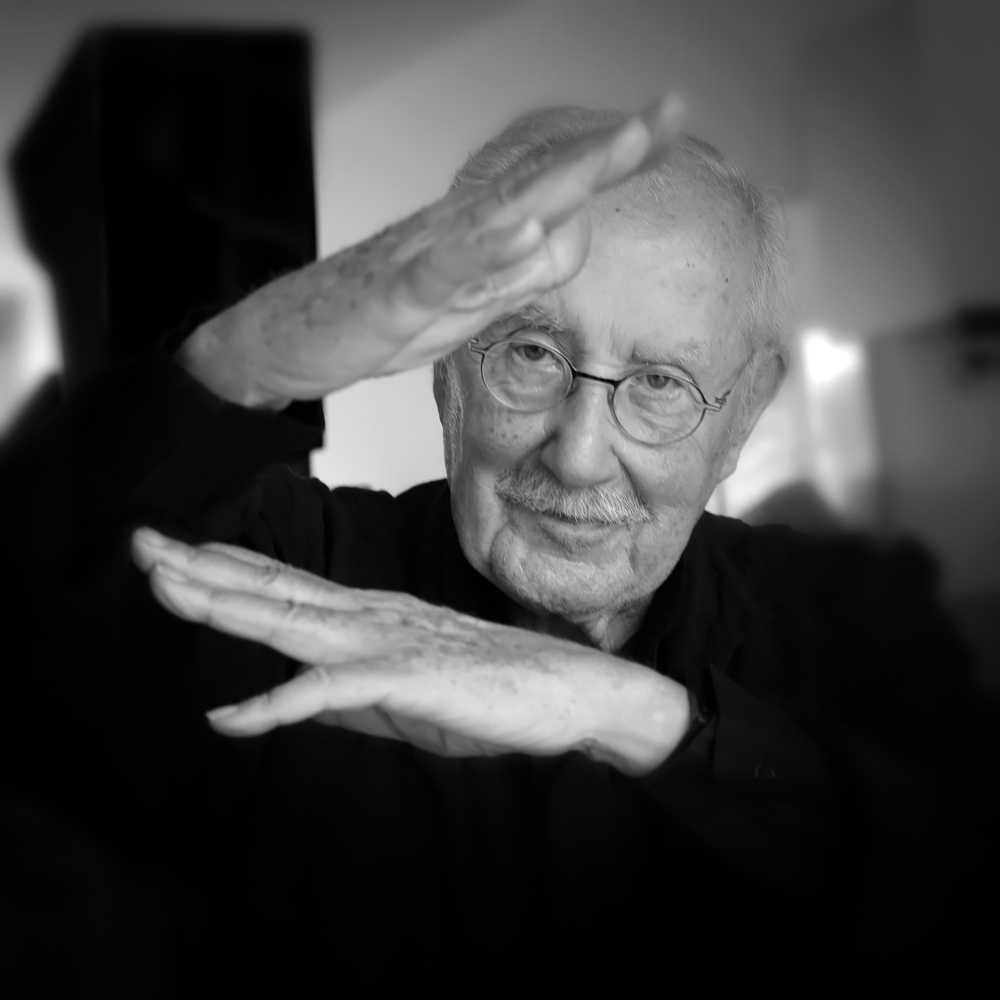
Born Frank Owen Goldberg in Toronto, Frank Gehry has passed away at the age of 96. Widely regarded as one of the most influential architects of the contemporary era, his buildings, lyrical, unconventional and instantly recognisable, reshaped skylines and the public imagination alike.

The intentive mind that later revolutionised architecture first emerged in the 1930s on the kitchen floor of his grandmother, Leah Caplan’s Toronto Home.


‘..one of the first architects to grasp the liberating potential of computer design, went on to create a host of other celebrated buildings, many of them widely regarded as masterpieces, that in their sculptural bravura and visceral power matched or even surpassed the Baroque architecture of the 17th century’

Nicolai Ouroussoff, The New York Times


As Paul Goldberger recounts in Building Art: The Life and Work of Frank Gehry, young Frank and Leah built fantastical structures from odd scraps of wood collected from his grandfather’s hardware store. Gehry later said, “There were round pieces that looked like bridges and freeways before there were freeways. She would play with me on an equal level like an adult.” Those early hours constructing miniature worlds felt, in retrospect, like his first Gehry buildings.

Gehry grew up in a traditional Jewish family whose journey from Łódź, Poland, through New York’s Hell’s Kitchen and Cleveland to Toronto brought with it the textures of Eastern European Jewish life. Among the memories that stayed with him was the family carp, kept swimming in the bathtub until its weekly and mysterious disappearance, always just before gefilte fish appeared on the Friday night table. He would later speak often of how that childhood shock shaped his lifelong fascination with fish forms, curves, and fluidity in his designs.

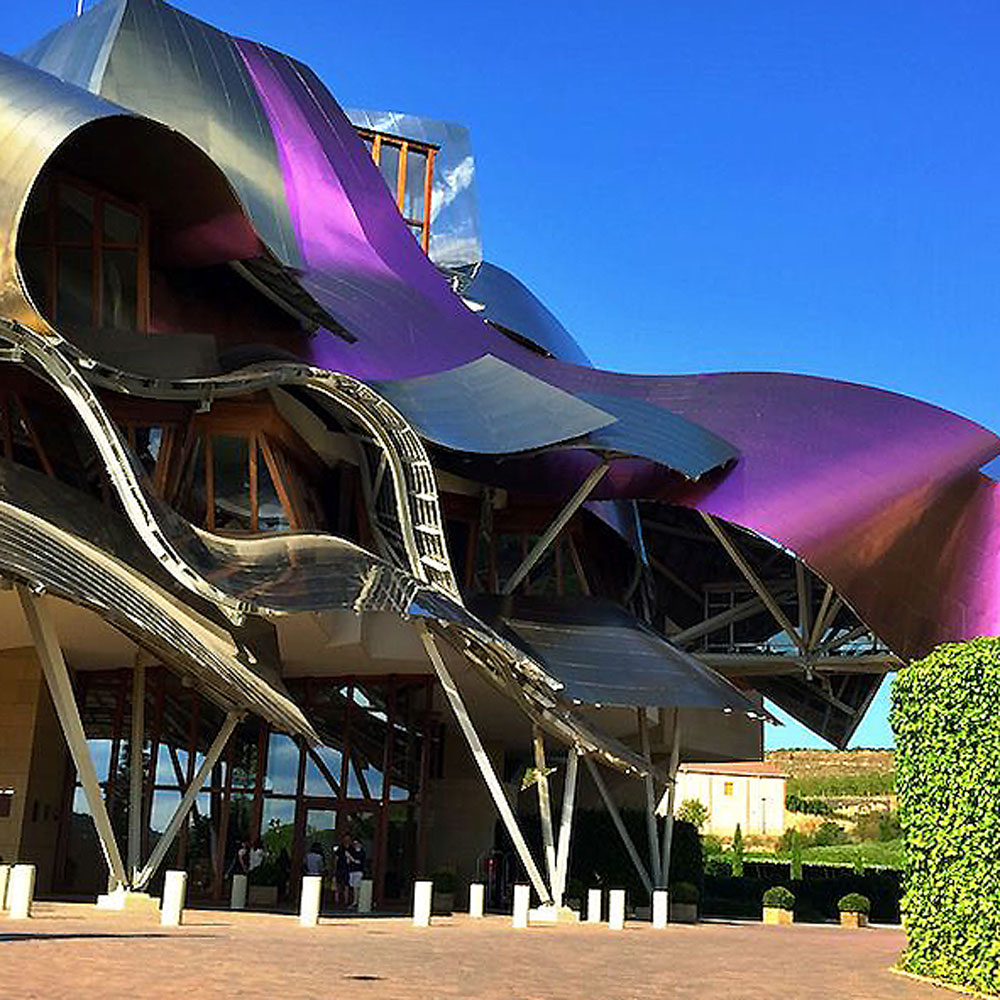
Hotel Marques de Riscal in Spain Frank Gehry design

Hotel Marques de Riscal Rioja

Artistic curiosity was recognised early. A pivotal moment came at 16, when he attended a lecture at the Art Gallery of Toronto. Only later did he realise that the quiet, white-haired man showing curved plywood furniture was Alvar Aalto—whom Gehry would come to regard, alongside Erich Mendelsohn and Le Corbusier, as one of the greatest modern architects. That evening, he quietly set his course.


His courage to challenge tradition shaped skylines and minds alike, setting a new standard for creativity in our field. Frank’s legacy lives on in every architect he inspires and every city forever changed by his work.”

Stephen Ayres AIA


When his father became seriously ill, the family moved to California in search of better prospects. Money was scarce. Gehry drove trucks by day and studied at Los Angeles City College at night, where he rediscovered art and architecture. USC soon followed, along with a ceramics class that brought him into contact with real architects for the first time. As he later joked, he was mesmerised by “a guy in a black suit and black beret telling contractors what to do and railing against Frank Lloyd Wright.”

After graduating from USC’s School of Architecture and becoming an American citizen, Gehry worked a range of jobs to support his young family. In 1956, he briefly attended the Harvard Graduate School of Design to study city planning, but left disillusioned, returning to Los Angeles to work with Victor Gruen Associates. His first private commission—the David Cabin—arrived soon after.


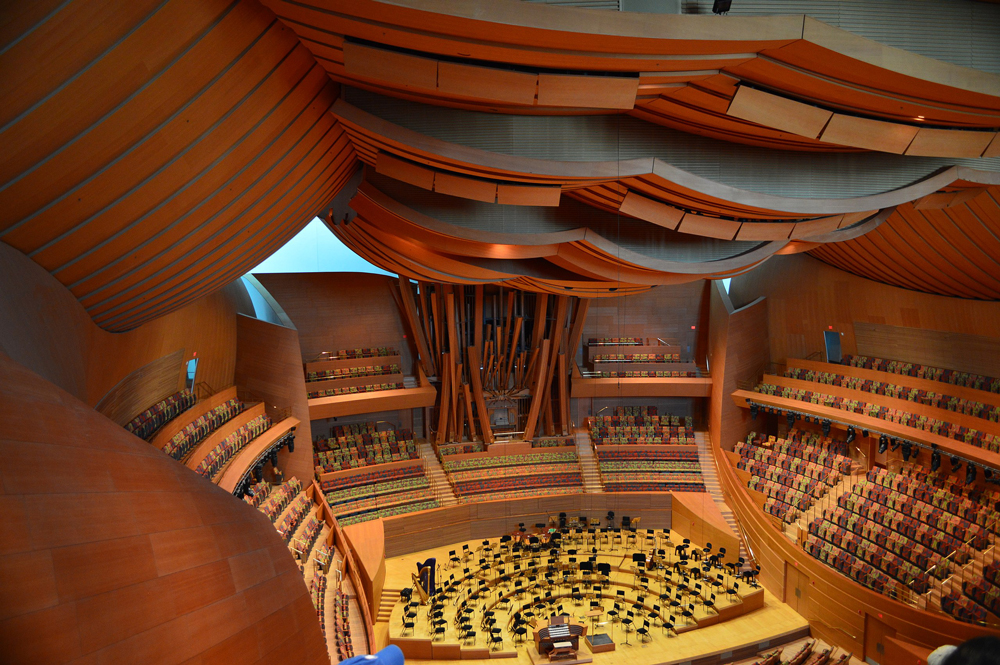
Interior Disney Concert Hall, Los Angeles Image Daniel Hartwig CC BY 2.0


In 1961, he made an adventurous move to Paris to work with André Remondet. His French education and Canadian background served him well, but after a year, he returned to Los Angeles and established his own practice.

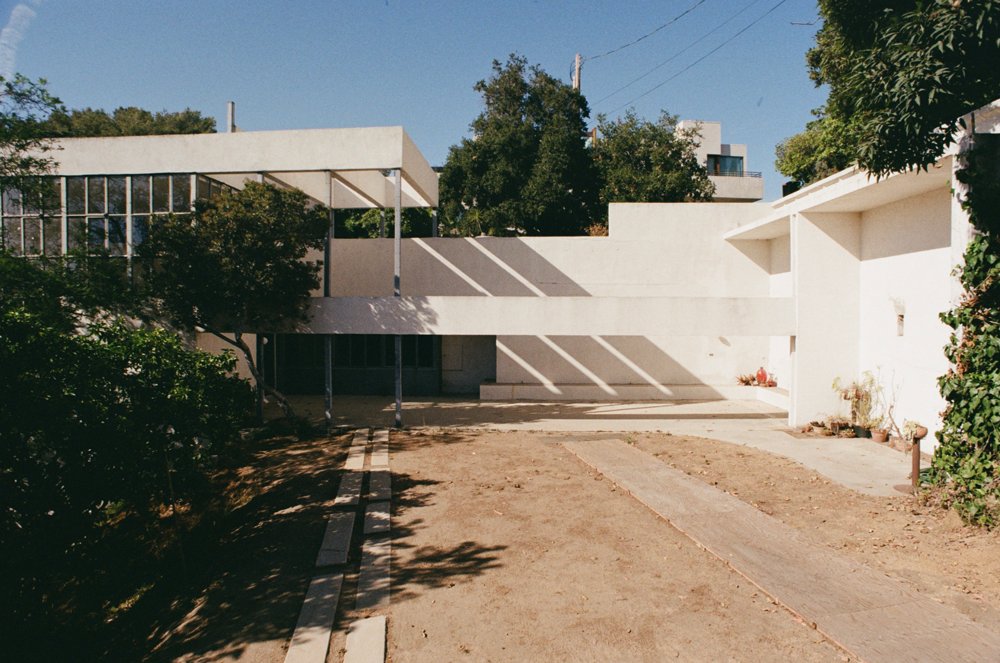
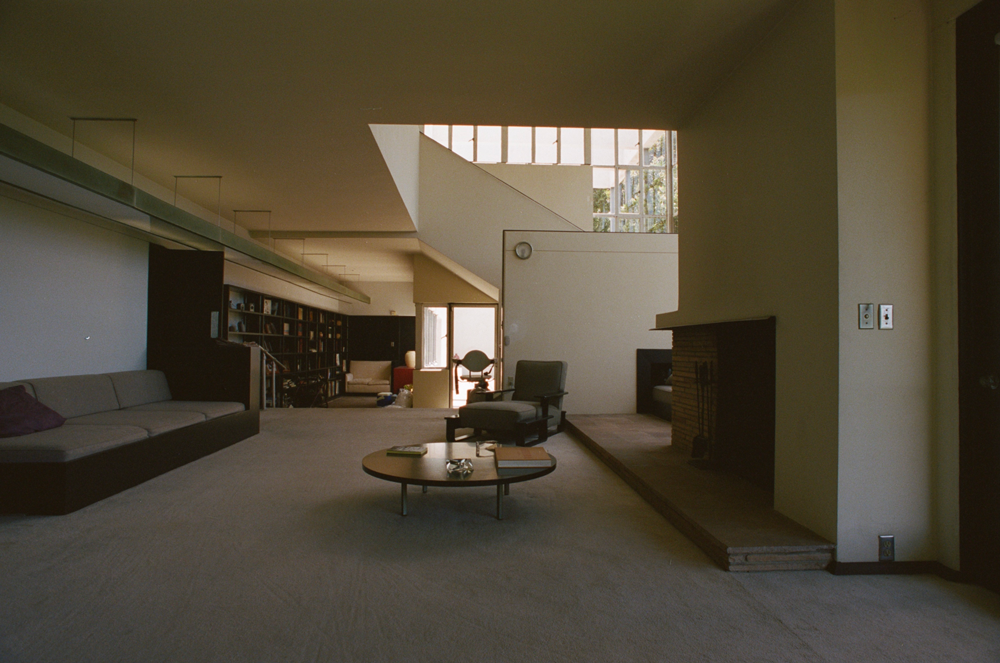
A turning point came in 1978 with the radical remodelling of his Santa Monica home. Its bold, deconstructed form—still endlessly discussed—foreshadowed themes that would define his later work. “I was emotionally trapped because it was this icon,” he reflected years later.

By the 1980s, Gehry had entered full stride. He won the Pritzker Prize in 1989, and his first European commission, the Vitra International Furniture Manufacturing Facility and Design Museum, opened the same year. But it was the 1997 Guggenheim Museum Bilbao that propelled him to global fame. Philip Johnson called it “the greatest building of our time,” and the “Bilbao effect” became shorthand for architecture’s power to transform a city.

Major commissions followed worldwide: the Walt Disney Concert Hall in Los Angeles, the Fondation Louis Vuitton in Paris, Prague’s Dancing House, Seattle’s Museum of Pop Culture, and the Cinémathèque Française in Paris, among many others.

Late in life, he continued to work with undiminished imagination. His projects in Los Angeles, Arles, Philadelphia, Washington and Hollywood demonstrated his continued relevance. At the same time, the ambitious Extreme Model Railroad and Contemporary Architecture Museum in North Adams, Massachusetts, captured his love of play and architectural history.

Gehry’s work resisted easy categorisation, sometimes labelled “the Los Angeles School,” but more often described as unmistakably, undeniably “Gehry.”

He is survived by his family, an extraordinary global legacy, and a body of work that forever altered the possibilities of architecture.

Frank Gehry (28th February 1929 – 5th December 2025)

Preserving Ukraine’s Modernist Legacy

Preserving Ukraine’s Modernist Legacy

Photographer and researcher Dymtro Soloviov documents the nation’s Soviet-era architecture, making the case for its protection amid war, redevelopment, and neglect


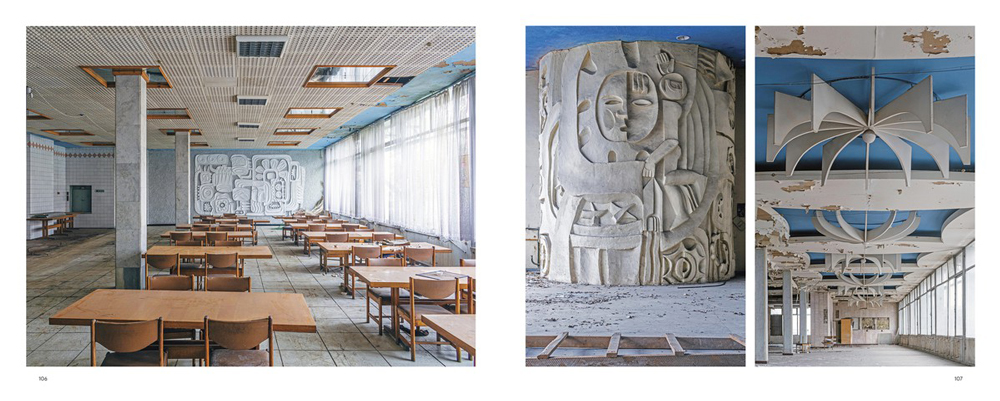
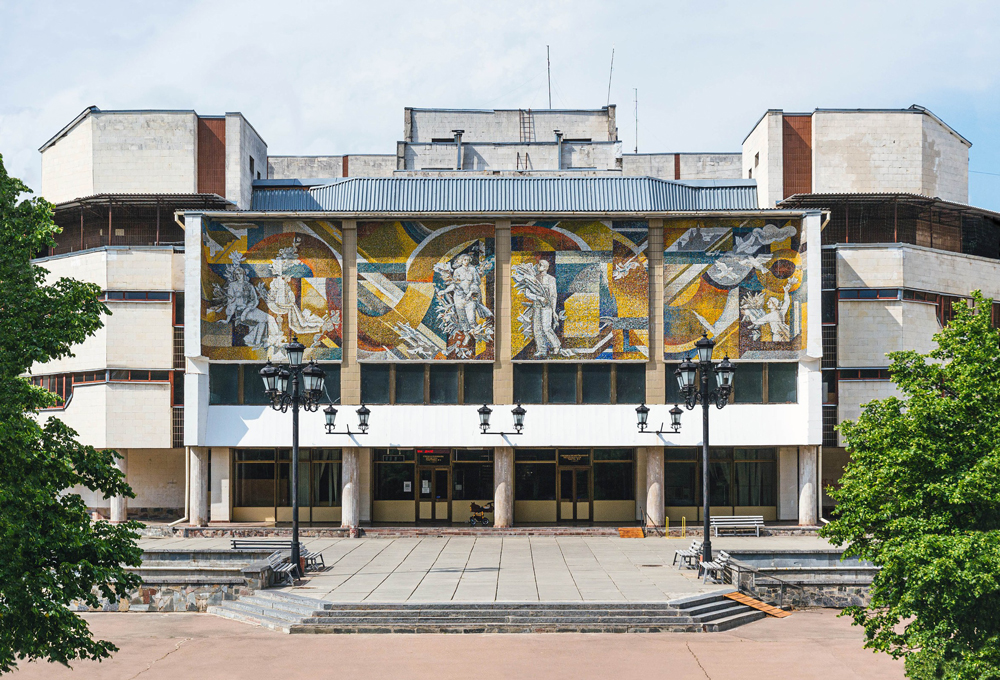
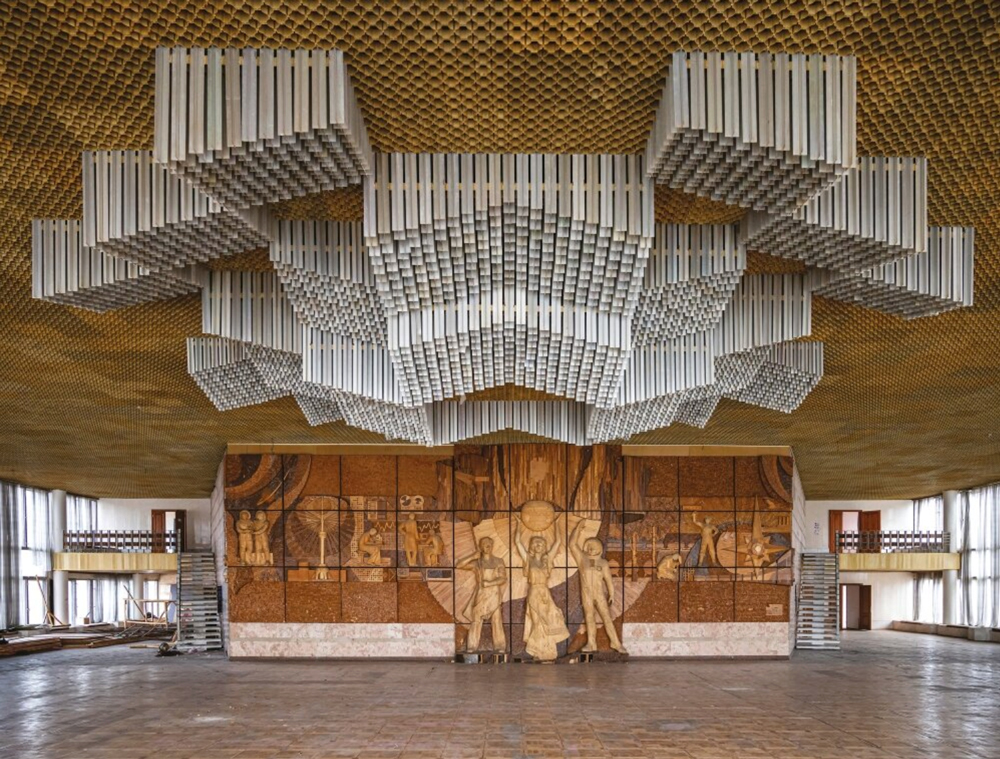
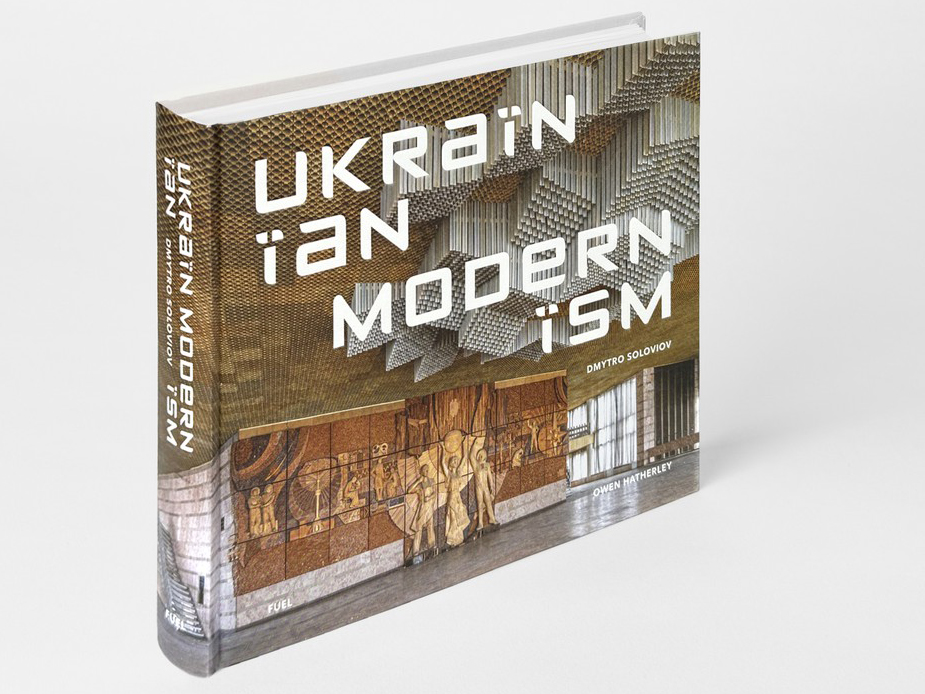
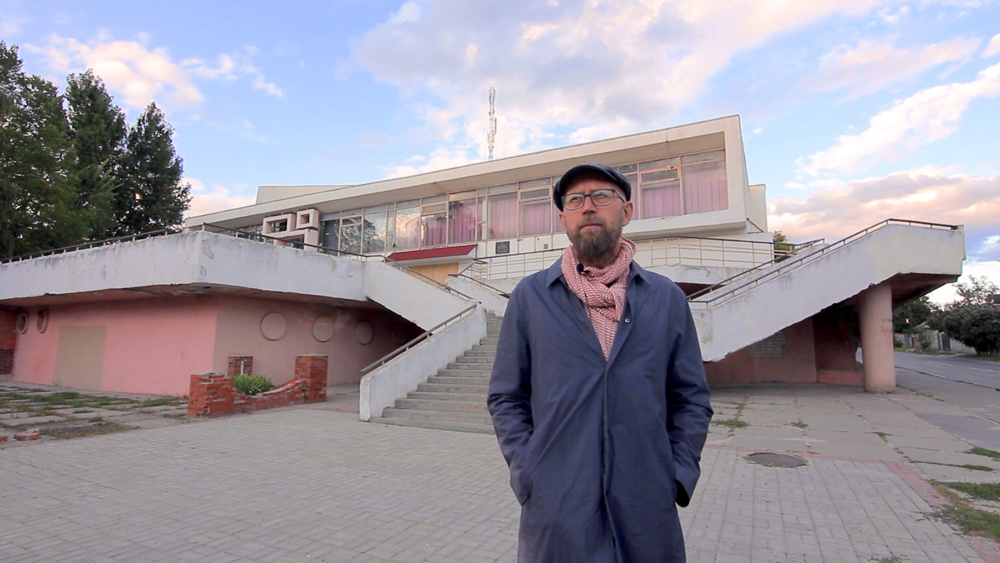
Kyiv photographer and architectural researcher Dmytro Soloviov has made it his mission to record Ukraine’s modernist and Soviet-era landmarks. Familiar to many of us, through his Instagram platform, he presents images and stories both online and in person that bring these buildings to a wider audience. His bookUkrainian Modernism: Modernist Architecture of Ukraine, showcases more than 120 sites, ranging from monumental mosaics and vibrant stained glass to overlooked and forgotten buildings. Alongside documenting them, Soloviov advocates for their preservation, highlighting the threats posed by war, redevelopment, and long-term neglect and stressing the importance of safeguarding the architectural heritage as a vital record of Ukraine’s cultural and historical identity.

To learn more about his work and the challenges of preserving Ukraine’s modernist architecture, we asked Dmytro Soloviov a few questions about his projects, inspirations, and vision for the future.


Q: What first inspired you to begin photographing Ukrainian modernist architecture, and how did that eventually become this book? Was there a particular building or moment that sparked the idea?

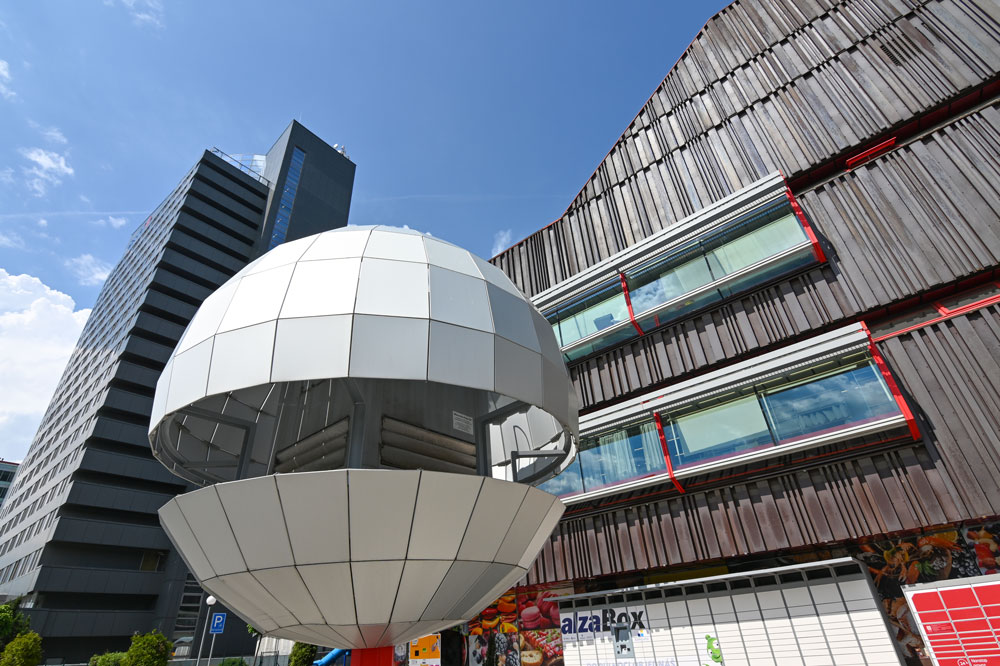
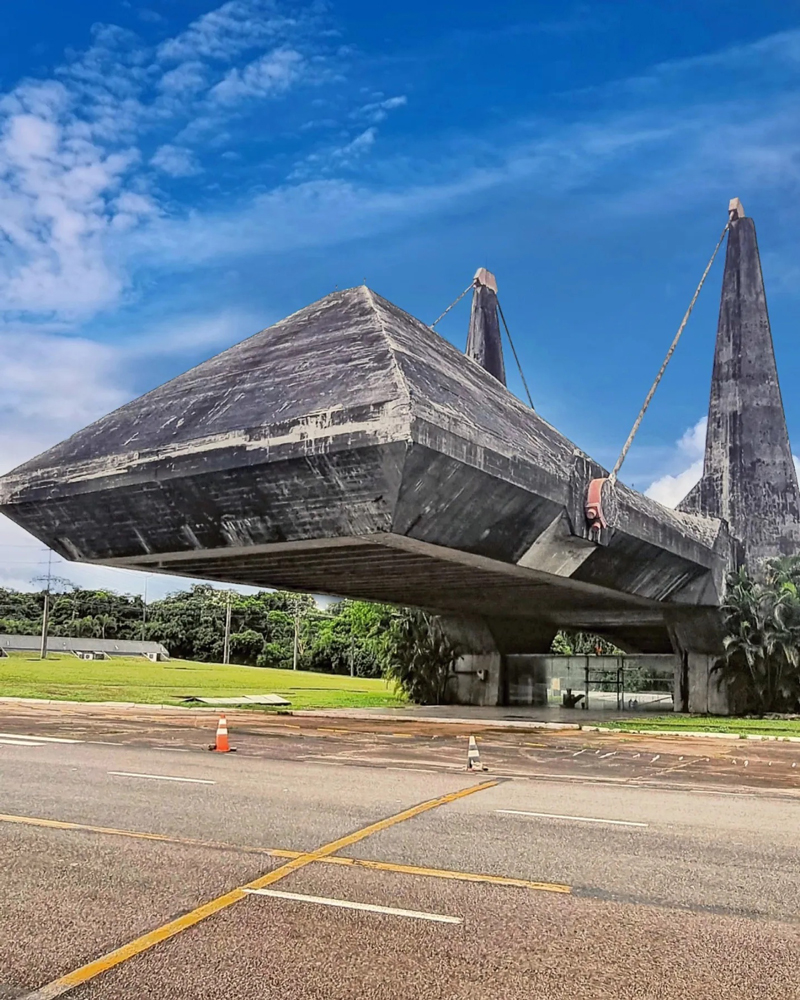
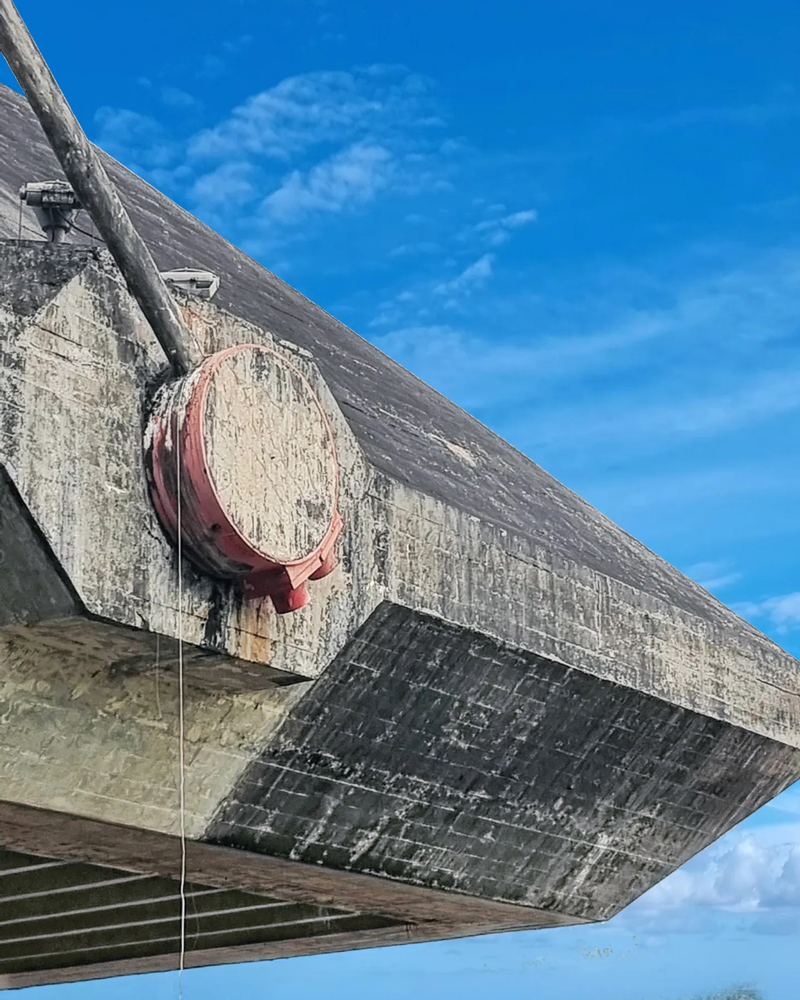
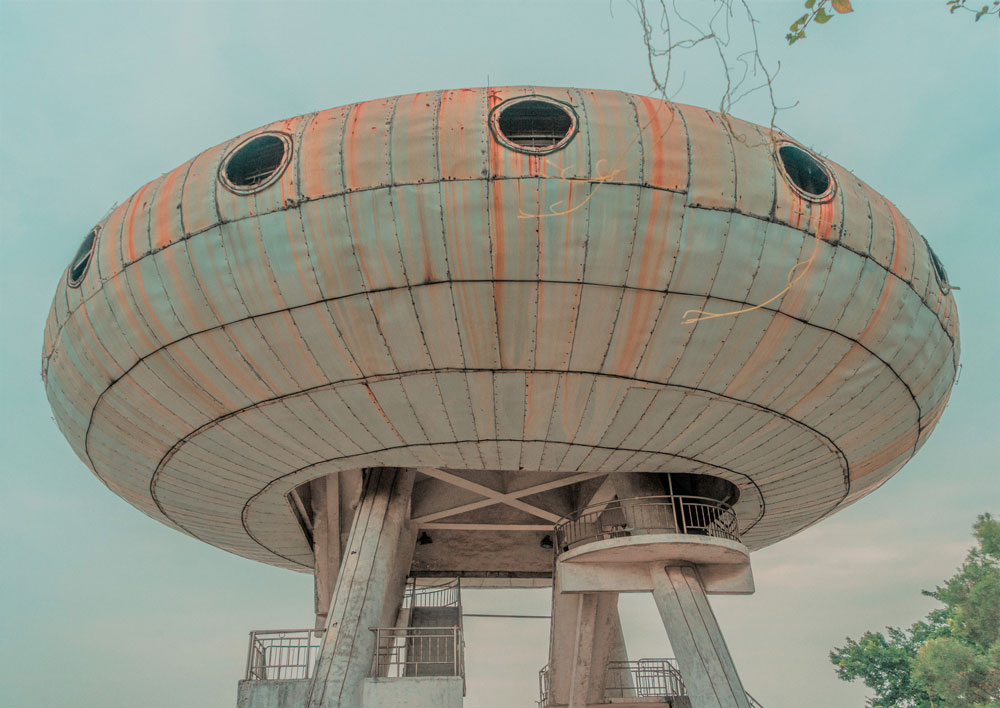
I’ve been interested in both photography and architecture since 2014, when I visited Warsaw and was impressed by the magnetic Palace of Culture and Science. I started travelling across Europe to familiarise myself with different architectural styles. I switched my focus to Ukraine in 2018, after I moved to Kyiv following several years of living in Minsk. I was shocked by how quickly mosaics were disappearing and iconic modernist buildings were being repurposed, reconstructed, or demolished. That sense of urgency drove me to focus on modernism, documenting these structures before they vanished entirely. At the same time, I realised that modernism is my favourite style – bold, optimistic, and innovative, with deeply humanistic aspirations.  There was one particular building and moment that sparked the idea of starting a project dedicated to Ukrainian modernist architecture. I’ve learned that the developers plan to turn the famous Flying Saucer building into a shopping mall. I saw the building back in 2014 in a book by Frederic Chaubin, and to me it was a symbol of Ukrainian architecture. I couldn’t believe how this is allowed to happen. From that shock and the strong desire to save both the Saucer and prevent the complete erasure of modernist heritage, the Ukrainian Modernism project was born. What started as a creative practice centred on exploring the architectural beauty of Ukraine’s modernist structures through an Instagram page gradually evolved to include advocacy, research, guided tours, and eventually practical preservation efforts. This book is the latest manifestation of that work: a visual and narrative archive of Ukraine’s modernist architecture.


Q: How did you go about selecting the buildings featured in the book? Were you guided more by architectural significance, visual appeal, or access?

I wanted to showcase our modernist heritage in all its diversity. So, I was guided primarily by functional and geographical variety, as well as visual appeal. The book features not only grand theatres, libraries, and extravagant hotels, but also small administrative buildings in tiny mountain towns, police stations, bus repair stations, and playgrounds. I believe this diversity offers a richer understanding of both the era and the country.

Q: Were there buildings you wanted to include but couldn’t due to condition, access, or safety?  Are there any that still feel like ‘unfinished business’ for you?

Obviously, I couldn’t visit Luhansk, Donetsk, or Crimea, regions with many modernist treasures, because they’re currently occupied by Russia. I’m glad I made it to Mariupol in 2018, so at least part of Donetsk Oblast is represented. As for safety, it wasn’t a major concern for me. I visited Kharkiv and Sumy in the fall of 2024,  even while they were under sustained, devastating air raid attacks. Access, however, was often an issue. Since February 2022, people have understandably become more cautious, to put it mildly., I had to shift from casually dropping into places to arranging visits through lengthy correspondence. However, those efforts paid off, not only in terms of access, but also in the form of thoughtful and warm conversations with the heads of public institutions, such as the Sumy Library or the Palace of Children and Youth in Uzhhorod.

Q: When you photograph these structures, are you aiming to document them faithfully, interpret them emotionally or both? Has your approach changed over time as your relationship with the subject deepened?

When I started in 2018, my goal was to portray modernist architecture in a positive light – often quite literally. I was always chasing sunny weather, naively hoping to shift public perception that saw these structures as grey, heavy, and depressing. At the same time, I wanted to stand apart from the many popular Instagram accounts that leaned into the bleak aesthetic of brutalism and Eastern Europe, characterised by overcast skies, post-rock soundtracks, and decay. That aesthetic has its power—and its truth—but to me, modernism carried a different emotional charge: one of hope and energy. I wanted my work to reflect that. Over time, as I developed a deeper understanding of both architecture and light, my approach evolved. Now, my aim is simply to do these structures justice, to present the best version of them. I tend to favour clean, smooth shots that highlight form and clarity. It’s funny because Stephen and Damon at FUEL actually prefer a more unkempt, raw look. As for emotional interpretation, it’s fluid. It depends on the building, the surroundings, the weather, and my own mood. However, I always strive to find dynamic or dramatic angles that highlight each building’s unique character.

Q: How do you see the relationship between interwar Ukrainian modernism and later Soviet-era modernist styles? Are there any aesthetic or ideological continuities or tensions that stand out to you?

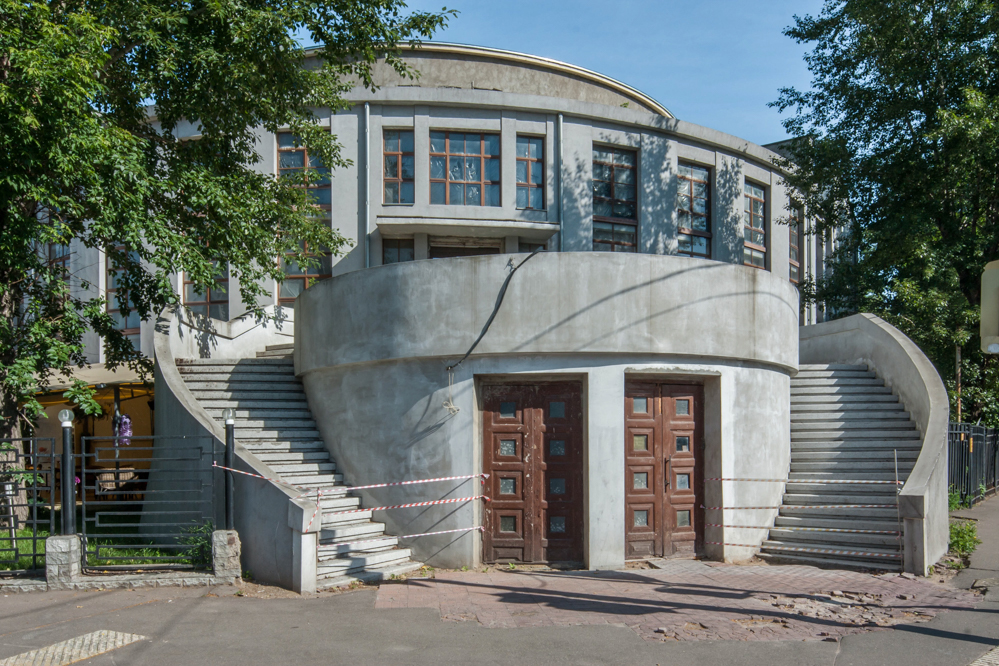
I do see some traces of continuity between interwar Ukrainian modernism and later Soviet-era styles, but the relationship is complex.  After Stalin consolidated power, constructivism and avant-garde were officially banned and never fully rehabilitated, even after his death. Architecture did get fortunate in escaping the rigid Stalinist Empire style under Khrushchev’s leadership, which allowed for more modernist expressions. This is a rich topic that definitely deserves closer scrutiny and deeper research. One clear stylistic continuity I highlight in the book is the Kyiv Academic Theatre for Young Spectators. Originally built in 1932 in the Constructivist style, it underwent heavy reconstruction between 1987 and 1993 in a Neo-Constructivist style, a somewhat on-the-nose example of architectural dialogue across eras.

Q: What role did political ideology play in shaping the forms or symbolism of these buildings? Do you think Ukrainian architects were able to embed national or local identities into these centralised styles?

Political shifts were always reflected in architectural form. The evolution of Soviet modernism in Ukraine broadly tracked ideological changes: light, functional buildings during the Khrushchev Thaw; heavier, monumental forms under Brezhnev; and early postmodern gestures in the Gorbachev era. These shifts paralleled global architectural trends, albeit delayed by the long interruption of Stalinist neoclassicism. Soviet modernism after 1955 wasn’t a centrally imposed style like Stalinism; yet, architecture was more regulated than in capitalist states, primarily due to the planning system. Architects operated in frameworks created by state planning bodies, standardised building typologies, and design institutes.  As the Party itself encouraged the embedding of national or local motifs, Ukrainian architects often introduced regional distinctiveness through materials, ornamentation, and stylisation within these frameworks. Soviet Ukrainian architectural periodicals were filled with endless debates about what constitutes “national form” and how or whether it should manifest in modern architecture. These discussions show that identity remained a live and unresolved question.

Q: To what extent do you see this architecture as a reflection of Ukrainian identity, especially during periods of constrained autonomy? Is modernist architecture now part of how Ukraine tells its own story?

Modernism was a global, cosmopolitan movement, and Ukraine played a significant role in that conversation. Yet here modernism took on a distinct local character. Most notably through monumental art, as artists often tapped into traditional Ukrainian crafts and folk motifs, subtly evoking local identity into modernist forms. This legacy wasn’t created solely by famous architects and artists, but by a collective effort, one that included Ukrainian planners, builders, engineers and craftsmen. It emerged during a highly complex and controversial era, but one that prioritised purposeful creation for the public good over private profit. That ethos is something that holds deep meaning for me, and it has shaped much of the built environment we now look back on. So yes, I believe modernist architecture is and should be part of how Ukraine tells its own story. It’s an integral chapter of our cultural identity, reflecting both our connection to global ideas and our ability to adapt them with local meaning.

Q: Did you notice strong regional differences in how modernism was expressed across Ukraine? Were there areas that especially surprised you in terms of their architectural richness?

Many architects in Ivano-Frankivsk, Lviv and Zakarpattia regions had a strong affinity for local vernacular traditions and often incorporated them into their designs. The interior of the Ivano-Frankivsk Music and Drama Theatre, residential buildings in Nadvirna, or the folk-inspired roof of the Zakarpattia Theatre in Uzhhorod are just a few examples that made it into the book.

Q: Many of these buildings are in various states of neglect. How do you see the future? Are there any restoration efforts that give you hope?

I see them all being demolished and replaced by yet another mall or residential high-rise. Even the iconic, legally protected Flying Saucer building can’t seem to escape developers’ greed. There’s little hope, since both state and local governments are dominated by businessmen and developers, so unchecked corruption feels like the natural order of things here. And the war has only deepened their sense of impunity. There are no official restoration efforts that I’m aware of. On the contrary, every week, another mosaic gets carelessly destroyed during some clumsy thermo-insulation job at a school or kindergarten. On the bright side, there are grassroots initiatives, individuals documenting and raising awareness and the quiet persistence of those who care. It doesn’t give me hope, that’s long gone, but it gives me a reason to keep going. But on an institutional or strategic level, there’s no reason to be optimistic.


Q: What kind of response has the book received inside Ukraine? Has it helped spark new conversations around preservation or awareness?

Circulation inside Ukraine has been very limited so far; the first copies are only just starting to arrive. But abroad, the response has been overwhelmingly positive, from what I’ve seen.

Q: How has this long-term photographic project shaped the way you think about Ukraine’s 20th-century history? Do you think architecture reveals something that written records sometimes can’t?


The project has deepened my emotional connection to Ukraine’s 20th-century history. I studied it closely, from Soviet-era periodicals to contemporary research papers and personal conversations with architects and artists who lived through that time. It provided me with a more nuanced and critically informed perspective, something sorely lacking in today’s discourse.

Architecture reveals far more than written records. After all, it is the sum of human activity in any given period. You can feel the emancipated boldness of the 1920s in constructivism, the oppressiveness of High Stalinism in the imposing neoclassical colossi, the hopeful optimism of the Kruschev Thaw in the light, functionalist buildings of the 1960s, the re-Stalinisation shift in the hulking brutalism of the Brezhnev era, and the playful, rebellious tones of the late Soviet postmodernism during perestroika. The buildings express ideals, beliefs, and contradictions of their time more vividly than words ever could.

Q: Your favourite Ukrainian dish?

Ukrainian cuisine is my favourite of all, on par only with Middle Eastern. I enjoy simple savoury food, so a perfect lunch for me is borsch and mashed potatoes with a cutlet.


Buy Ukrainian Modernism: Modernist Architecture of Ukraine by Dymtro Soloviov from Greyscape.com

All images © of Dmytro Soloviov/ Fuel

Brutalist Belgrade

Brutalist Belgrade

by

Matthijs Kok

Belgrade, a city full of experiments and a dream destination for

Brutalist architecture fans

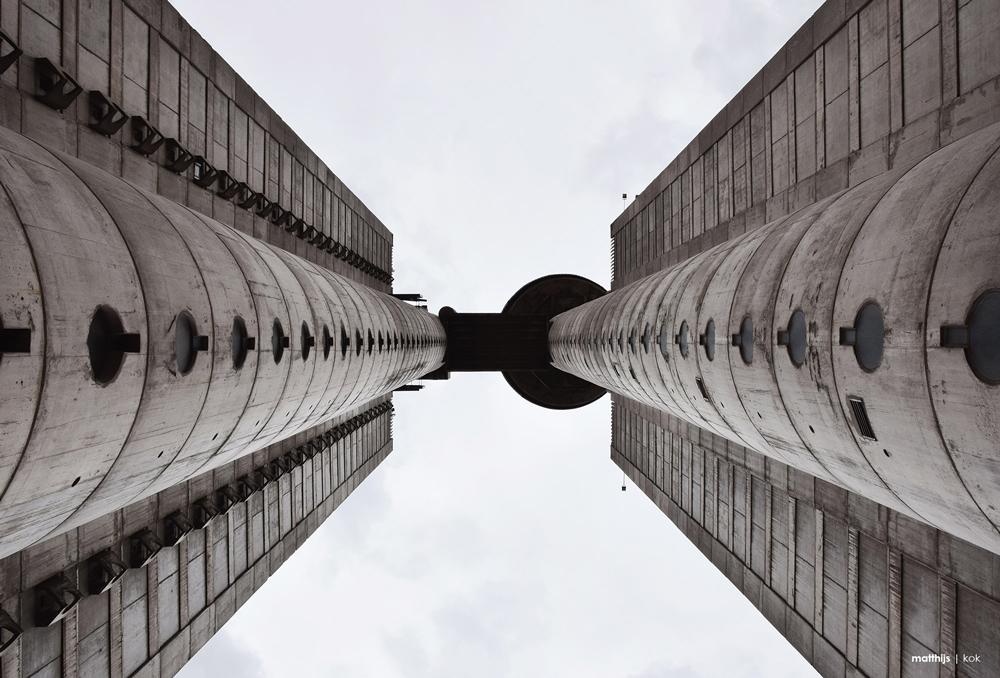
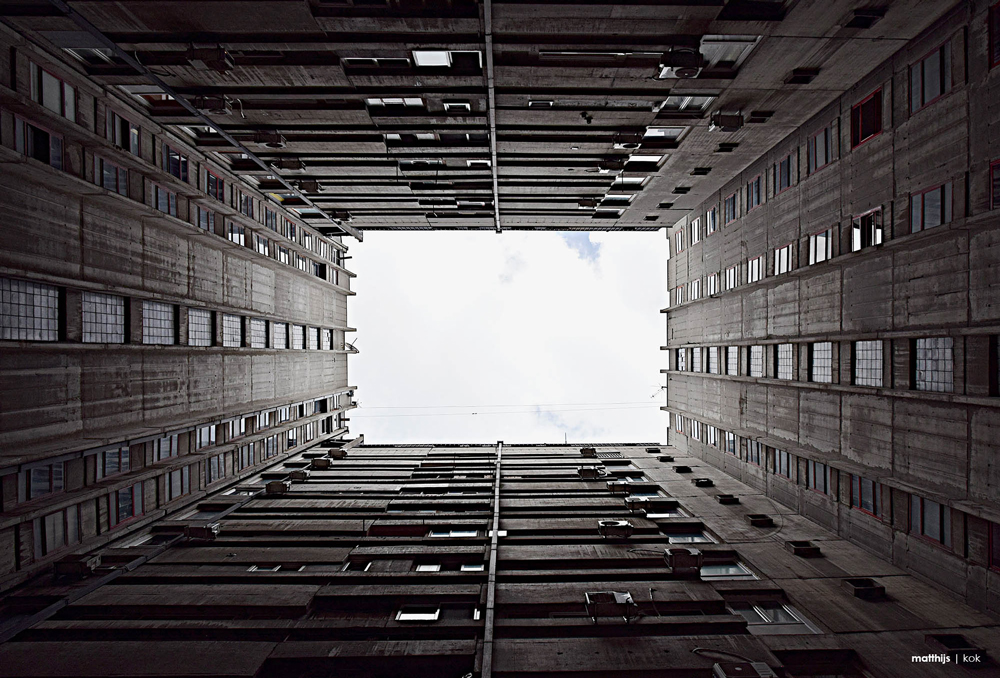
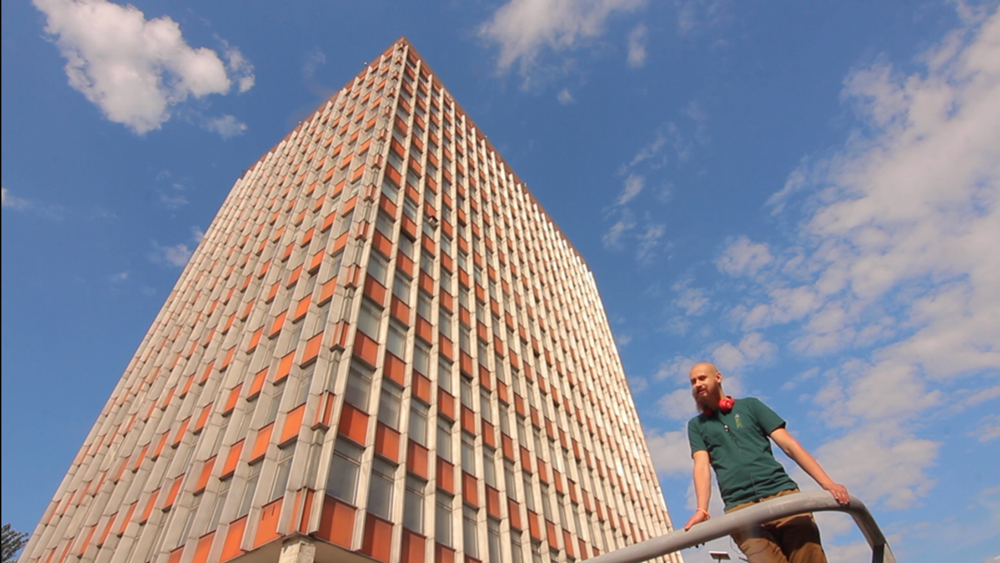
genex tower view from below Belgrade

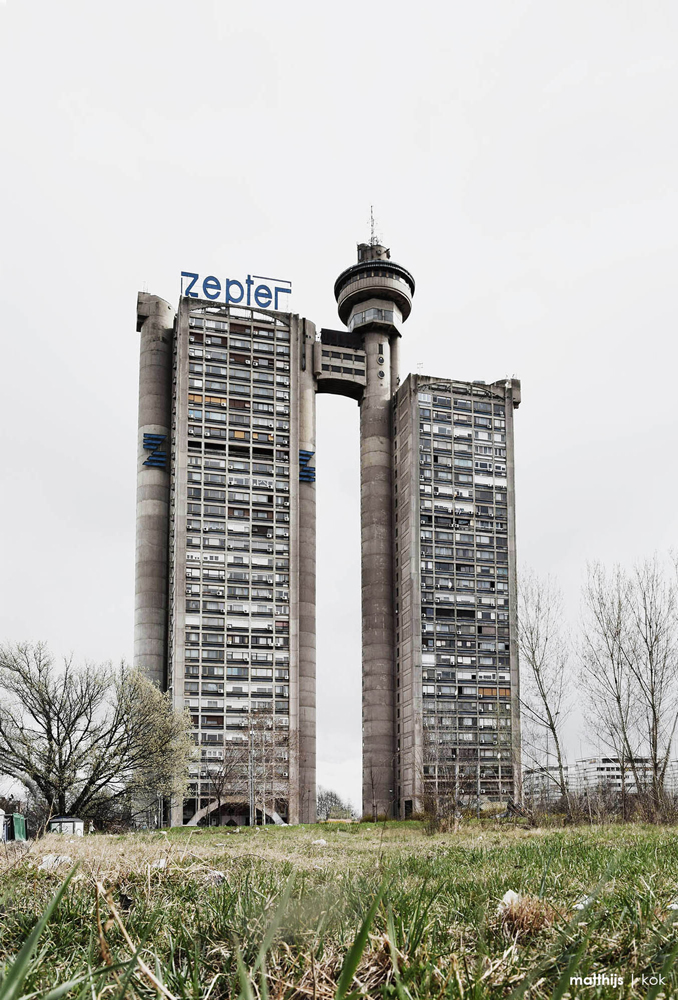
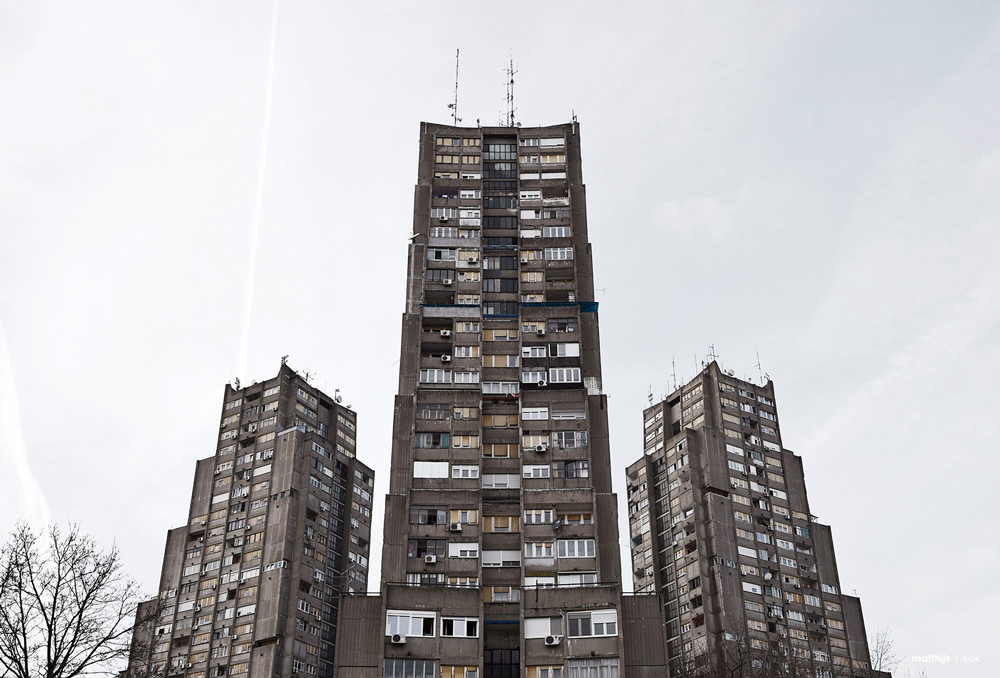
Genex Tower, Western City Gate

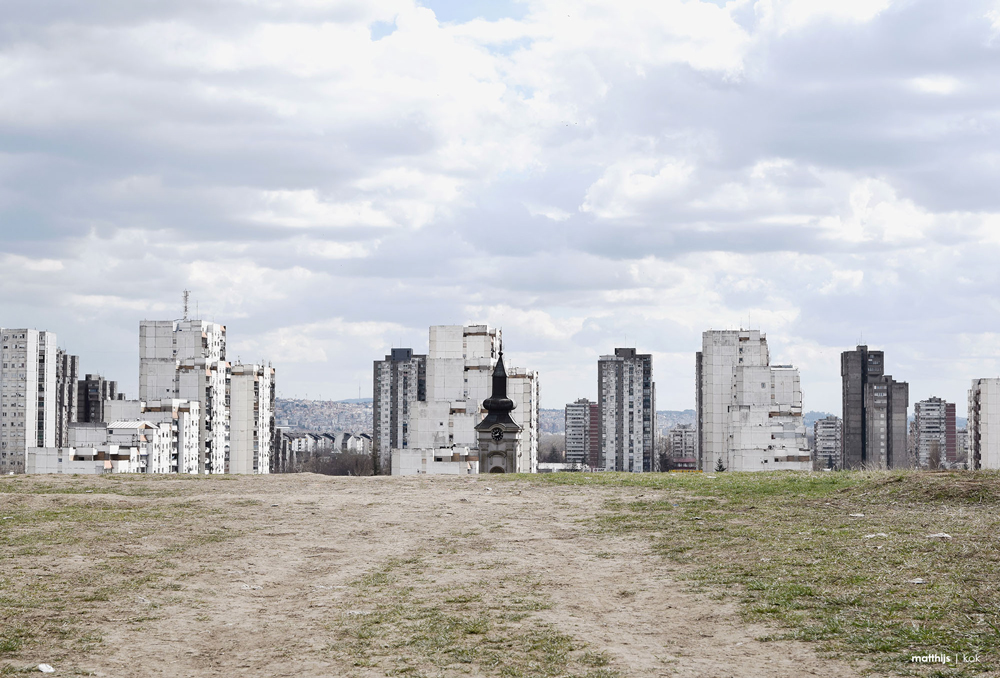
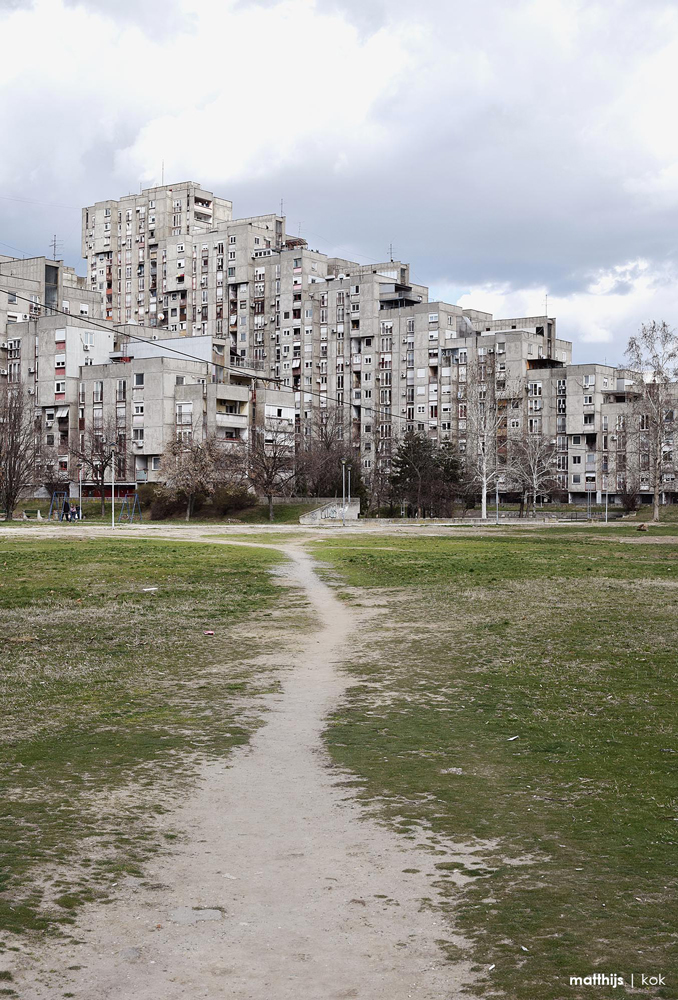
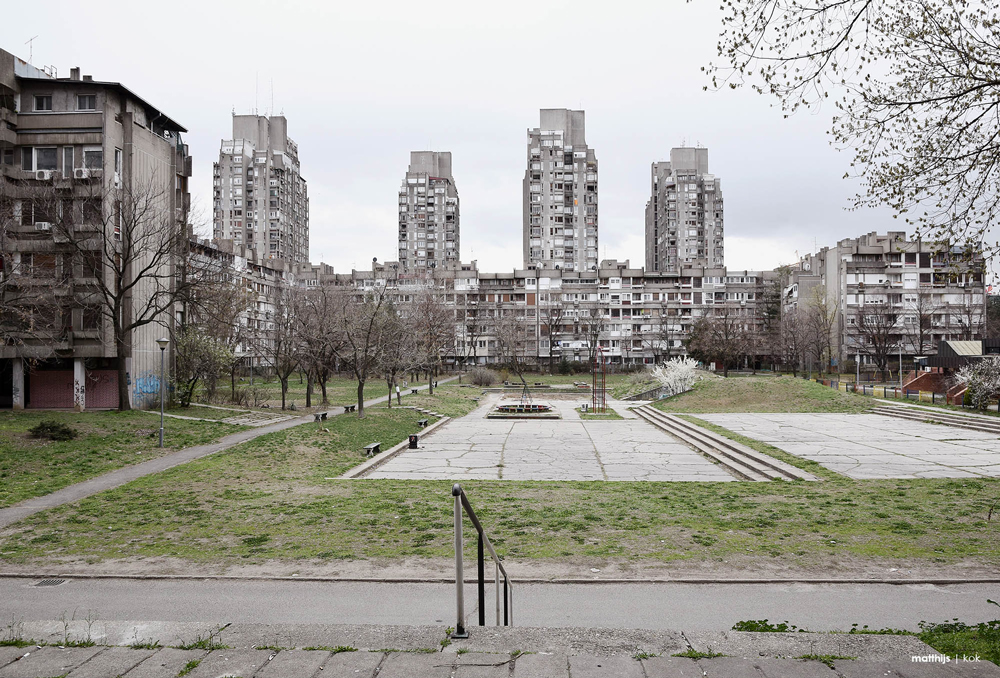
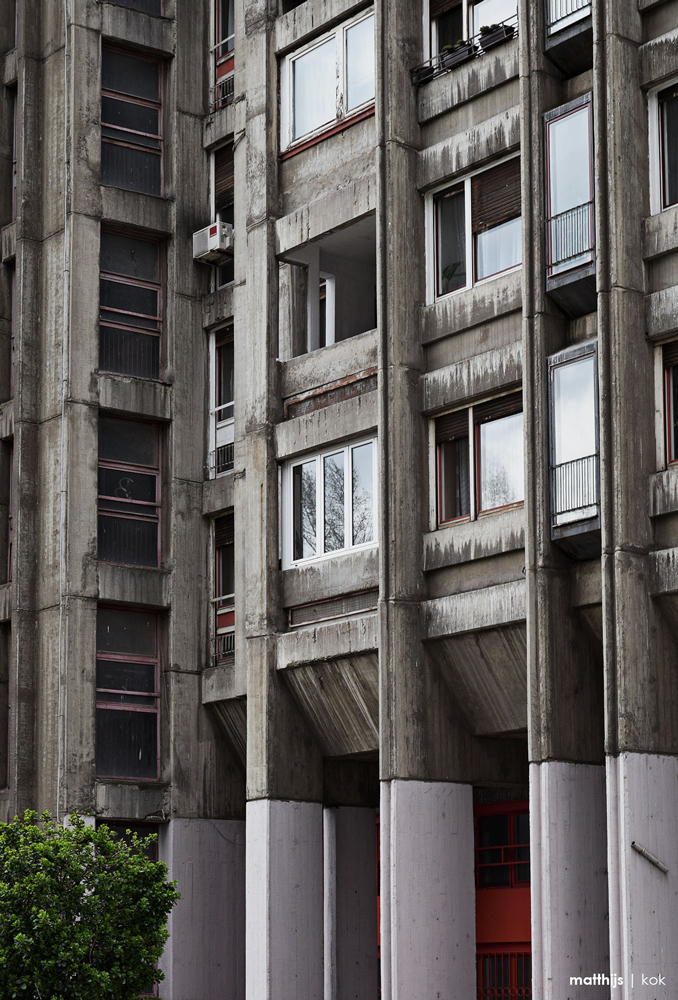
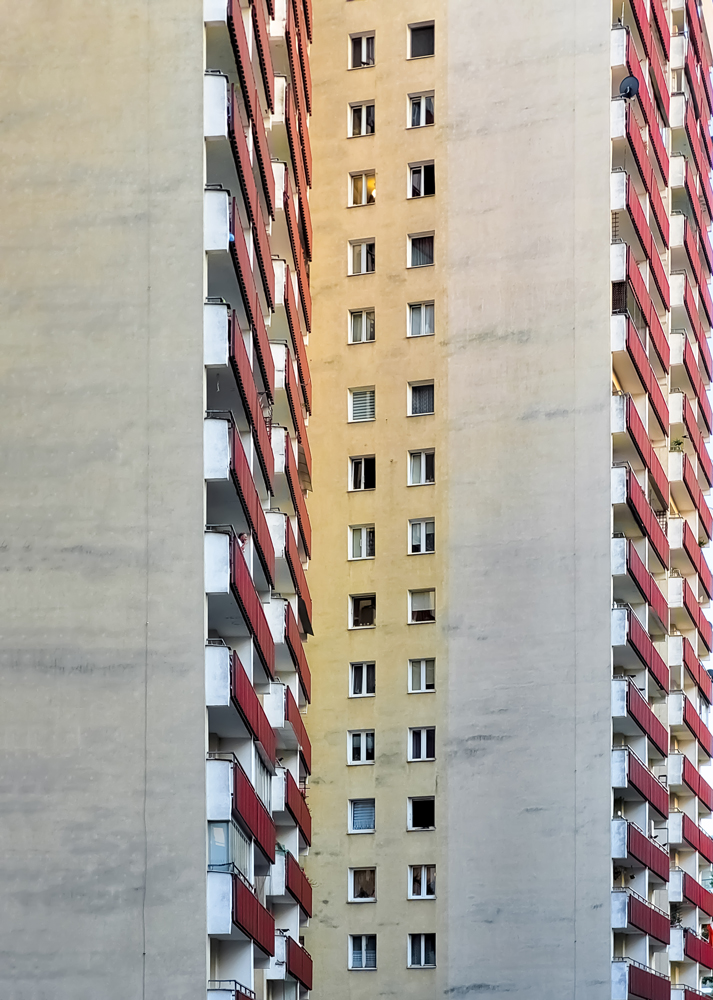
New Belgrade or Novi Beograd is a municipality of Belgrade. Constructed after WW2 in the capital city of the newly created Federal Socialist Republic of Yugoslavia. The communist era architects and town planners built New Belgrade brutal, exacting, and autocratically monumental. The enormous scale of “Blokovi or “the Blocks”, the fitting name given to the urban neighbourhoods of New Belgrade, is difficult to exaggerate. Now it is like an open-air museum, a showcase of mass-produced large scale socialist architecture and urban planning.


Genex Tower Belgrade


brutalist architecture Belgrade

Genex Tower


Immediately following the Second World War, Josip Broz Tito firmly controlled socialist Yugoslavia. Belgrade was named as the capital, a huge construction project was put in place. The deserted area adjacent to Belgrade’s Old Town transformed into a new city, making Belgrade the massive European capital that would be representative of the socialist state of Yugoslavia. Building began in 1948.  Four years later, Novi Beograd was officially designated as a municipality.


Novobeogradski from a distance


brutalist socialist architecture pathway to estate


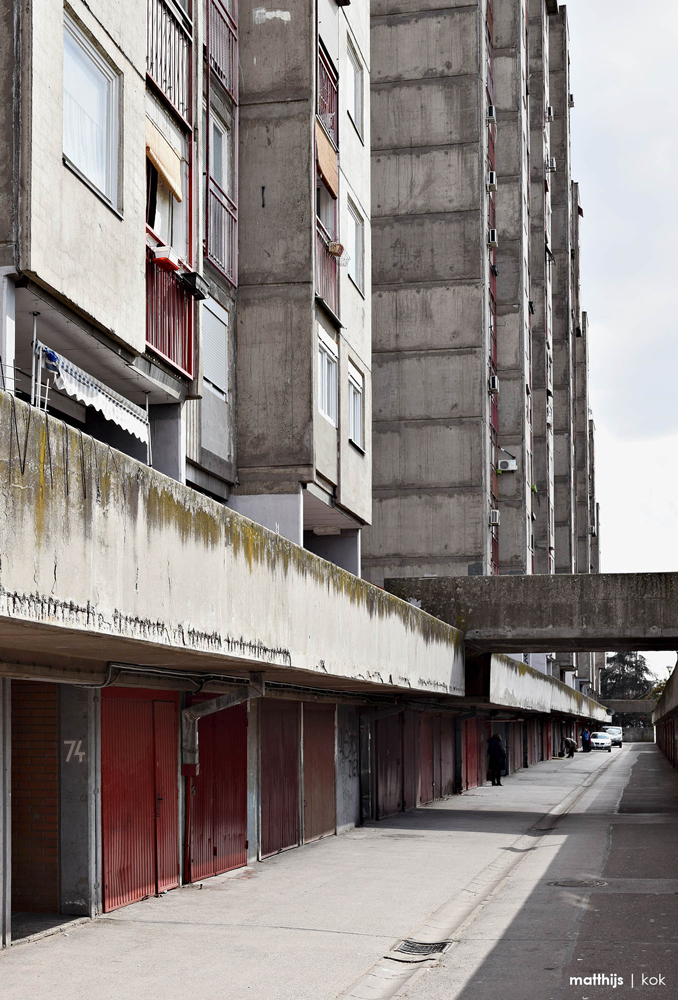
brutalist detail blok 62 belgrade

Blok 62


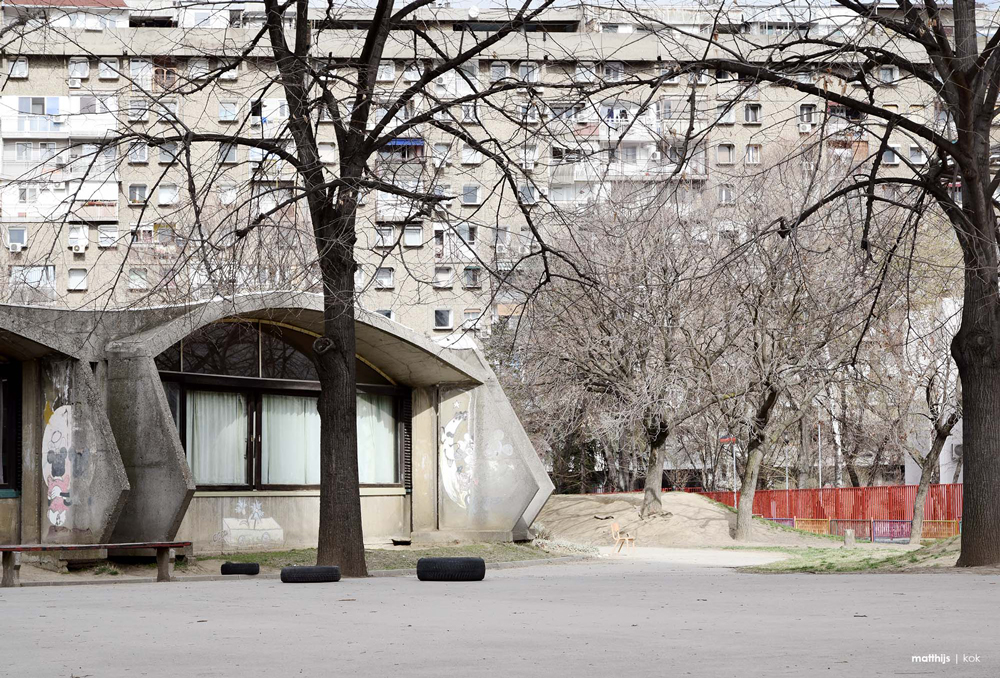
Compared to the West, this planned city had a greater focus on shared spaces and shared labour, with the intention of promoting a more communal way of life. Split into blocks, these communist neighbourhoods were typically crammed full of kindergarten,  designed to maximize the efficiency of childcare while both parents went out to work. The blokovi are designed according to varying concepts and types, producing different forms of urban space from block to block, and ultimately resulting in a kind of catalogue of the virtues and vices of the modernist city. New Belgrade remains perhaps the best example of a fully functioning would-be socialist utopia today.


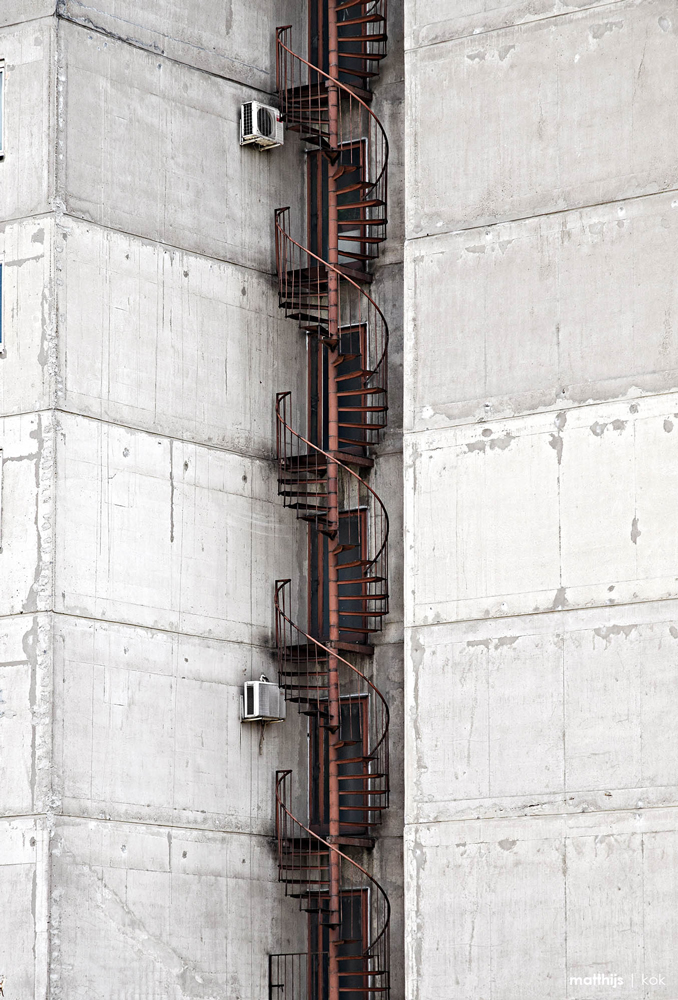
concrete spiral staircase


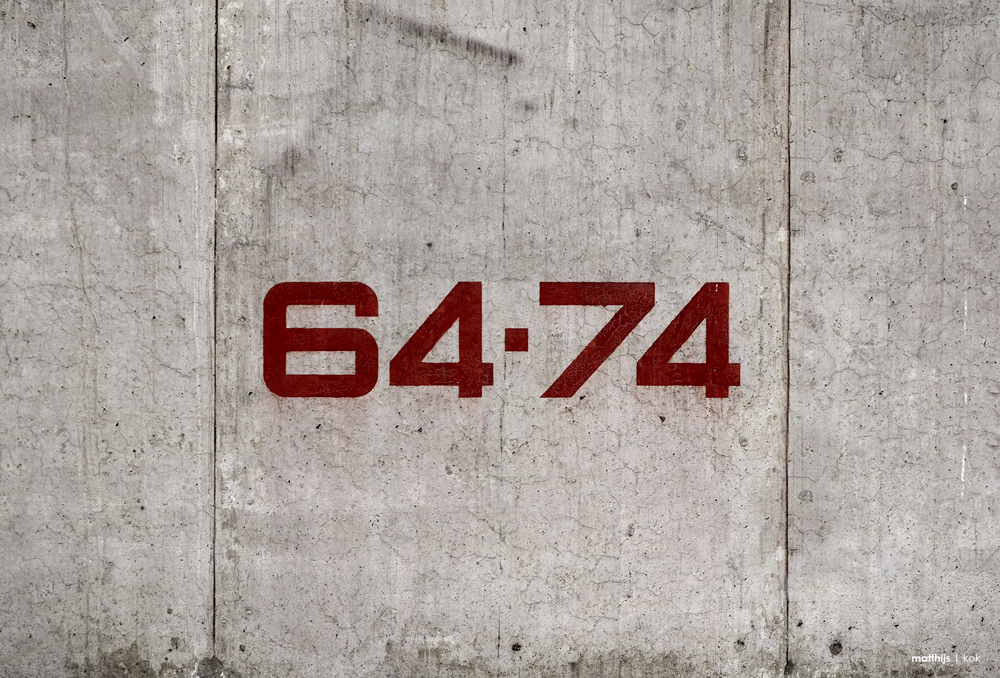
building numbering belgrade social housing

Belgrade Typography


It’s remarkable that the neighbourhoods around these communist buildings in New Belgrade have such a peaceful atmosphere, although they are full of life in comparison with the busy centre of Belgrade’s Old Town.  Despite its crumbling buildings and empty fountains, children are playing, mothers with pushchairs walk by, and old men play chess in courtyards.


brutalist courtyard belgrade block 23


belgrade blok 23 estate brutalist design belgrade serbia

Blok 23

What to see

Hotel Jugoslavija, the Palace of Serbia and the Sava Centre are important examples of mid-twentieth-century Yugoslavian architecture in New Belgrade. Don’t miss the Western City Gate. Known locally as the Genex Building, it rises above the New Belgrade skyline. This tower is one of the most recognizable structures in the city and one of the most impressive examples of Brutalist architecture in the world.


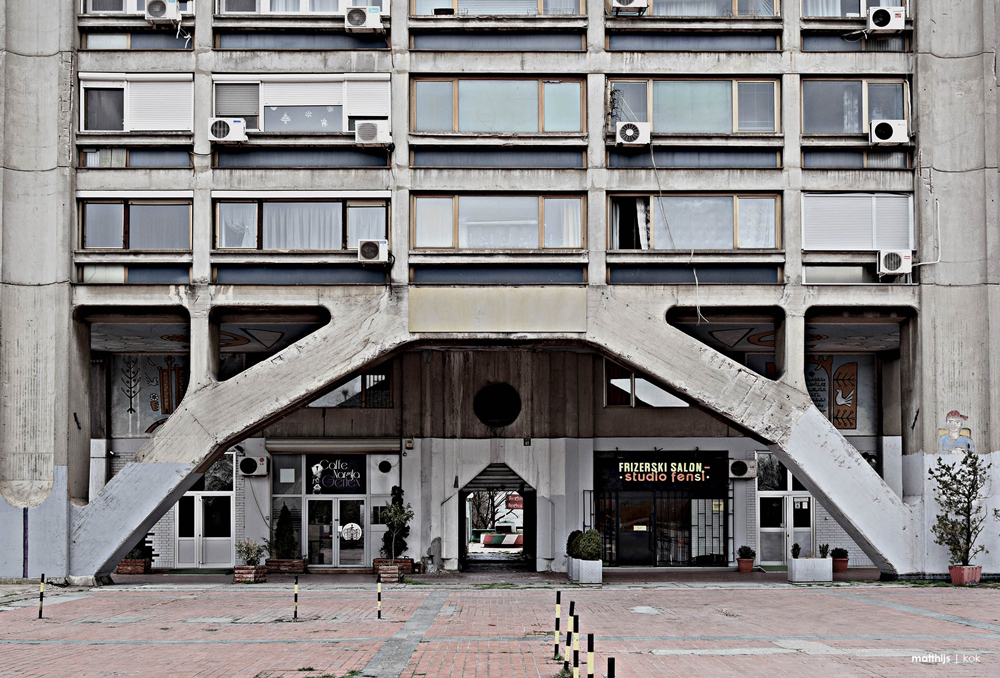
brutalist design on ground floor of Genex Tower neo belgrade

Ground floor Genex Tower


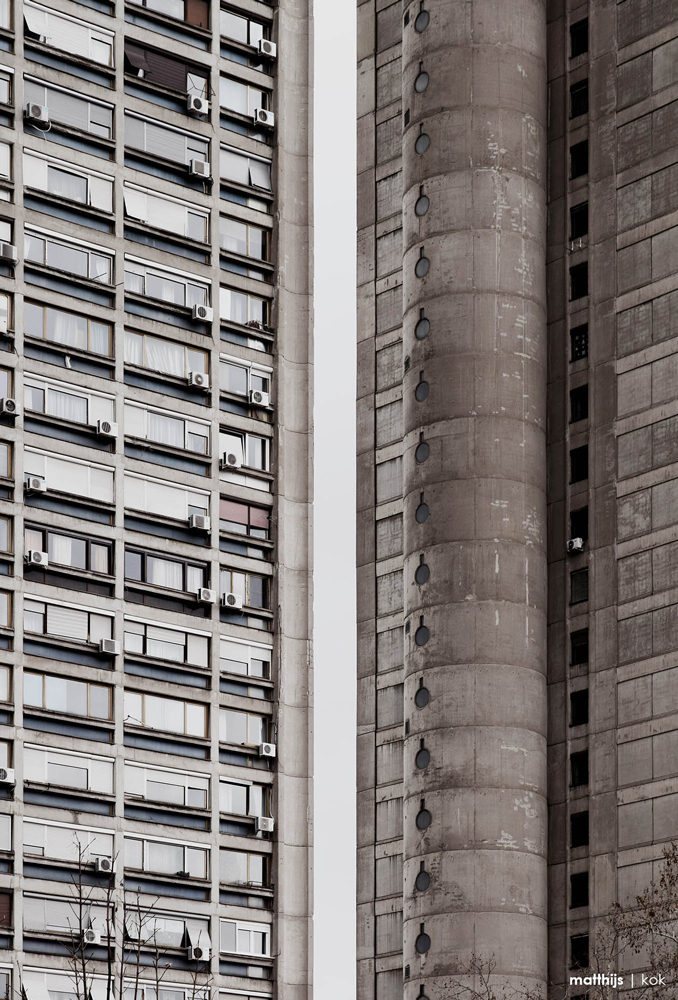
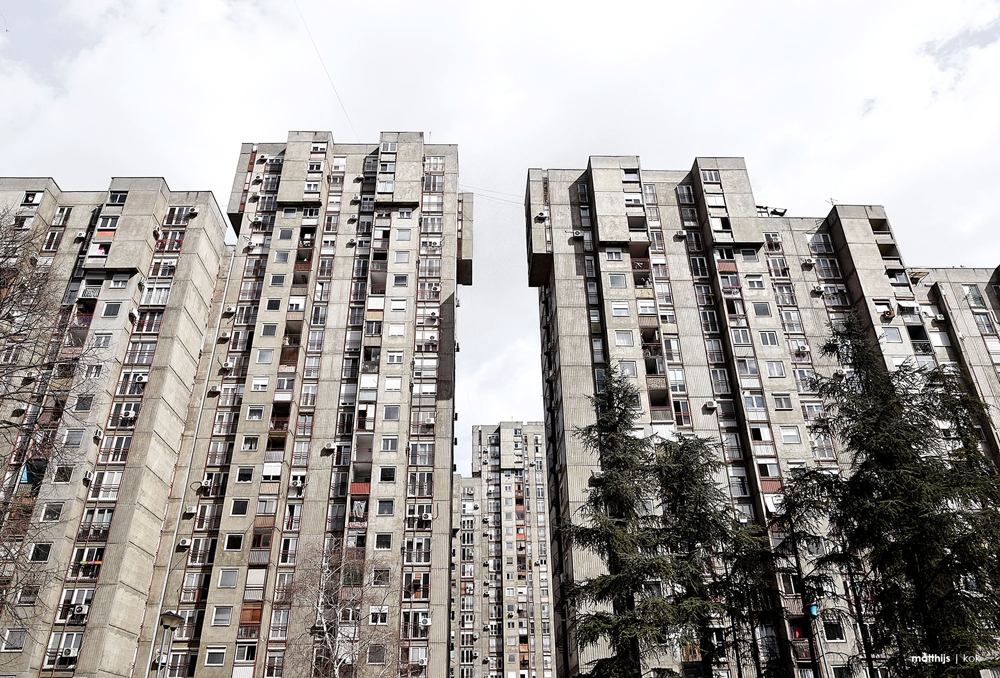
It is, however, the blocks, filled with socialist residential housing designed in its Brutalist-style that give the entire area of New Belgrade its science-fiction feel. Each block features its own kind of angular, rough, Brutalist architecture. Standing in between the step-like triangular residential buildings of blocks 61, 62 and 63 makes you feel very small.


Novobeogradski social housing


brutalist architecture concrete detail

Blok 23


It’s worth gazing up towards the buildings while standing in between the parallel rows. Wandering through block 23, one of the only blocks still fully authentic to its original plan gives the best impression of the idealized image of urban strategy according to functionalist principles. Large public spaces, a community centre, primary school, kindergarten and a sports space, walled in by mega blocks and overlooked by four dominant 17-floor high-rise residential towers. There is no better way to take in the brutalist sights than by bike.


brutalist architecture Novobeogradski kindergarten

Day Care in New Belgrade

Brutalist Gems

Brutalist gems can be found in many parts of the city and on the other side of the River Sava. One Brutalist building not to miss is Riska Sekerinski’s 1963 Karaburma Housing Tower. Locals nickname it the Toblerone Building, thanks to its sharp triangular features. The Eastern City Gate building arrived in the 1970s on a hillside on the outskirts of town, it is known locally as the Rudo Building. It has three towers constructed on a circular base giving the optical illusion that two towers are in the foreground and one tucked behind.

brutalist architecture belgrade


brutalist architecture Toblerone Building upper floors

Toblerone Building – Karaburma Residential Housing


An End To The Socialist Dream

New Belgrade alone is enormous, and there is more than enough to see to fill a full day. It is easy to explore. Regardless of its concrete poetry, there is a sad irony to these monumental buildings. The socialist dream of large-scale socialist architecture and urban planning was all about building strong, authentic communities. However, after the breakup of Yugoslavia and the end of its socialist dream, the buildings that had brought these communities together are themselves falling apart. There is very little funding given for their maintenance. Many facades are in extremely poor condition. For example, from 2013 onwards, concrete chunks up to 60 kg (130 lb) began to fall off the Rudo Buildings. Just as Brutalist Belgrade is surfing a wave of positive international attention, its concrete creations are crumbling.


Rudo buildings Eastern City Gate


Eastern City Gates brutalist tower

Rudo Buildings Eastern City Gates


About Matthijs Kok

Matthijs is an industrial designer and photographer based in Amsterdam. He is passionate about travelling and has visited over 40 countries. He is always looking for inspiration for his work, mainly in art and architecture, in the last few years he has become more and more fascinated by the sculptural aspect of Brutalism. He describes it as monolithic and bold, an imposing expression of material and form. In his quest to discover Modernist and Brutalist architecture, he has travelled to Russia, Belarus, Ukraine, Poland, Slovenia, Slovakia, Bulgaria and Serbia. Matthijs plans to visit the rest of the Balkans and the former Soviet Union in search of more Brutalism.

All images are the Copyright of Matthijs Kok ©

Find Matthijs on Instagram at www.instagram.com/matthijskok.nl

Check out Matthijs’ website www.matthijskok.nl

coca cola sign on top of social housing belgrade

Greyscape Asks Matthijs:

Your favourite book?

This Brutal World, Soviet Bus Stops & CCCP: Cosmic Communist Constructions Photographed, are all great sources of well known and less known awe-inspiring Brutalist structures from across the former Eastern Bloc and the former Soviet Union.

Favourite documentary

BBC’s “Bunkers, Brutalism and Bloodymindedness: Concrete Poetry with Jonathan Meades.” A great introduction to the Brutalist movement, its background and ethos. Here are the links: Part one  and Part two 

Dish you tried we should all know about?

Pljeskavica, a Balkan variation of a grilled burger and flatbread filled with cevapi and ajvar. They can be found on every street corner and are must-tries when visiting Serbia.

top floors of Genex Tower Belgrade


Cap Moderne – Eileen Gray’s Masterpiece Villa E-1027

The near-forgotten architect who aroused Le Corbusier’s envy

Cap Moderne

Eileen Gray’s Masterpiece Villa E-1027

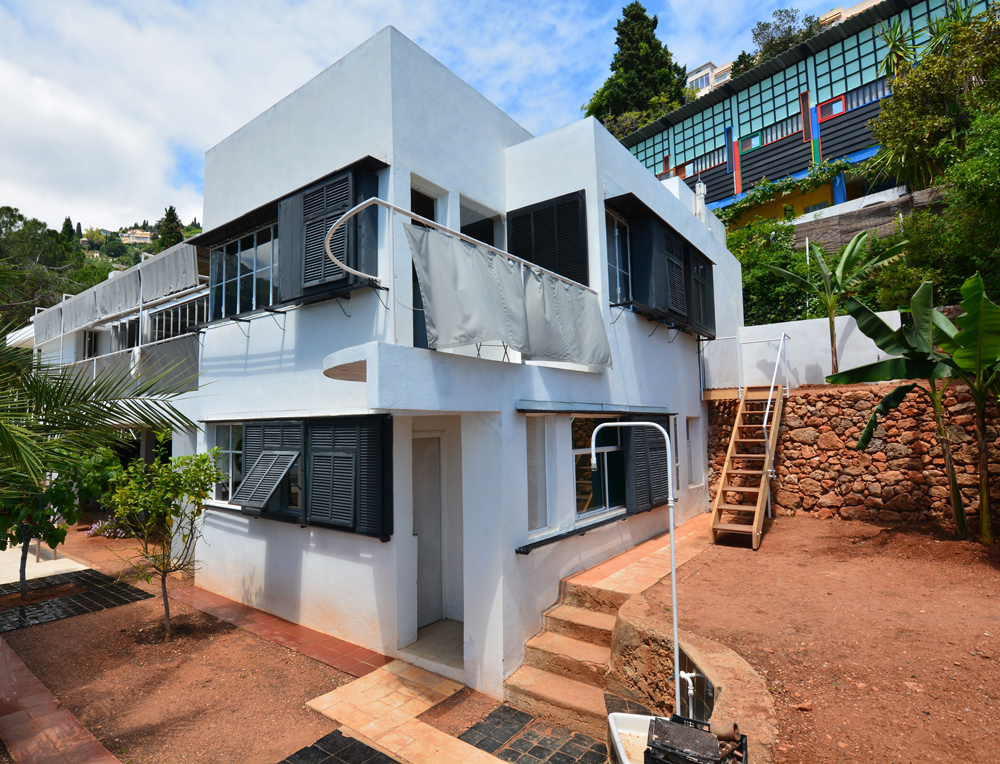
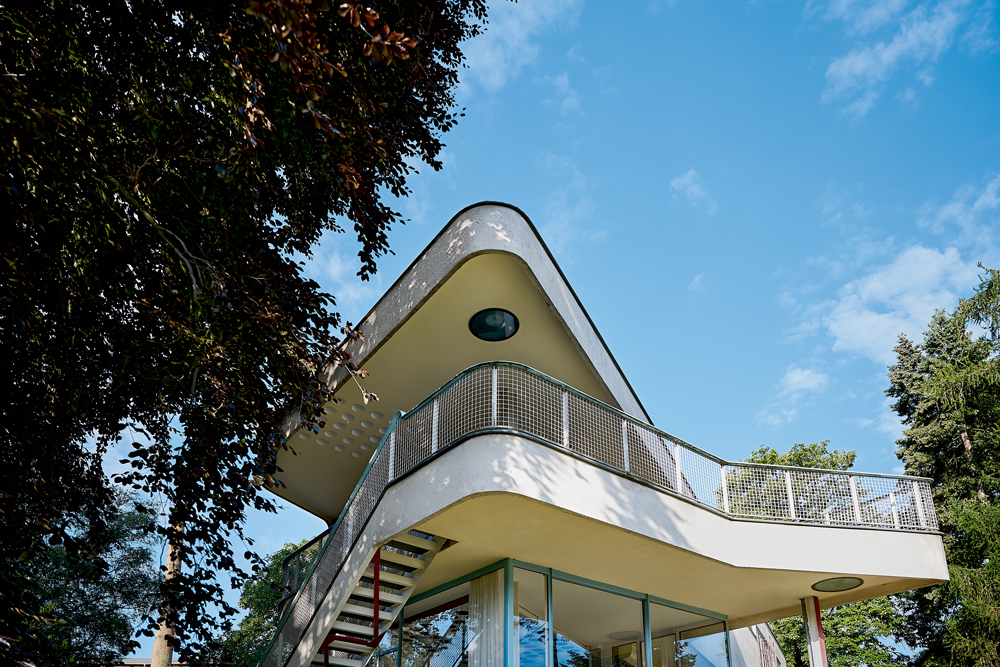
Eileen Gray's Roquebrune villa E-1027 

Certain places are rich in layers of history. Villa E-1027, the masterpiece designed by Eileen Gray, a genius who was for decades almost forgotten,  bathes in, is drenched by, the brilliant sun of the South of France and the air is steeped in the chunky scents of the pine and rosemary of the overgrown path leading down to its Cap Moderne site. It’s impossible not to be sucked into that story which includes a naked Corbusier defacing Gray’s masterwork, his drowning and the murder of the villa’s owner. And try as one might to focus on Gray’s work, there is also a curiosity to see Corbusier’s arrogant murals.


Using Le Corbusier's Five Points of Architecture, E-1027


The beautiful Villa E-1027, the sea-facing elevation


The story of E-1027 should be about the brilliant, modest and enigmatic Irish architect and furniture designer Eileen Gray, a pioneer of modernism. Self-taught, her genius created this treasure. But it’s pretty much impossible to tell that story without it being overshadowed by Le Corbusier and not just his genius but a jealousy he seems to have brooded on for years. Like his modular, the ideally proportioned man painted by Corbusier at one end of Les Unités Camping, the terrace of holiday cabins he built on the site, Le Corbusier bestrides Cap Moderne and the story.

E-1027 is one of four important structures on the site known as Cap Moderne.  The others are Le Cabanon, Corbusier’s log cabin retreat, as well as his study cabin, les Unités Camping and Thomas Rebutato’s restaurant and bar, L’Étoile de Mer.  These buildings, in concrete and wood, capture are the essence of Modernist architecture and design.

Too easily overlooked

Gray designed E-1027 for her lover Jean Badovici.  The drama of their romance and the involvement of Corbusier, who died swimming from the beach just below the house, long after Gray had left E-1027 and gifted it to Badovici, has obscured the genius of Gray as a designer and artist.  Even without that saga, Gray as a woman and, moreover a woman without a male mentor and champion, has been all too easy to overlook or for history to focus on her bohemian private life rather than acknowledge and praise her brilliance and originality as an artist, designer and architect.

Those murals

Perhaps what gnawed at Corbu was that Gray had so exquisitely designed around his Five Points of Architecture.  E-1027 was finished in 1929, at the very time Corbusier was building his archetypal Villa Savoye perfectly expressing these five principles. Years later, in the summer of 1937, at the invitation of Badovici but most definitely not at the invitation of Gray, who knew nothing of this, and naked while he worked, Corbusier painted erotic murals on the interior walls of E-1027.  The murals had no place in the design, and one even contained what appeared to be a swastika. Gray by then was finished with Badovici.  They were done. She built another home nearby, although she remained on good terms with her former lover.


Le Corbusier painted murals in Eileen Gray's Modernist masterpiece villa E-1027


Corbusier was, we know, a man of contradictions. He has invited criticism of his behaviour and his politics. But he also acted with great and persistent kindness to people less important than he. A perfect example being his mural work on the little restaurant and bar of the retired plumber and friend of Corbusier, Thomas Rebutato. Named L’Etoile de Mer, it is also on the Cap Moderne site. In exchange for a small strip of land on which to build Le Cabanon, a log cabin retreat, Corbusier built Les Unités Camping for Rebutato so that he might make some income renting out these small but exquisitely designed holiday cabins.


Corbusier's Modular bestrides the Cap Moderne site above Eileen Gray's villa E-1027


At the local station, known as the Gare de Cabbé, on the Avenue Le Corbusier (there he is again), the Cap Moderne Association has turned a railway shed into a visitor centre. This is the home to an exhibition illustrating Gray’s life and work, with photographs, examples of her furniture, and films.  A walk along an easy path through the lush and fragrant Mediterranean vegetation for about 300 metres leads to Cap Moderne.  You descend from above the villa, its rectangular shape and terrace framed by the bay and the unrealistically blue sea, promontories to left and right, as the mountains reach into the water, cupping the villa.

First female graduate of Slade School of Art

Gray was among the first women to graduate from the Slade School of Art. She learned lacquer work and taught herself carpet design and weaving. Decorative design arts were considered the right thing for women to do. But Gray wasn’t stopped by convention; she taught herself how to fly but more importantly, at the urging of Badovici, and like Corbusier, she taught herself architecture.

A master of design arts

Her mastery of lacquer work enabled Gray to create innovative, versatile furniture:


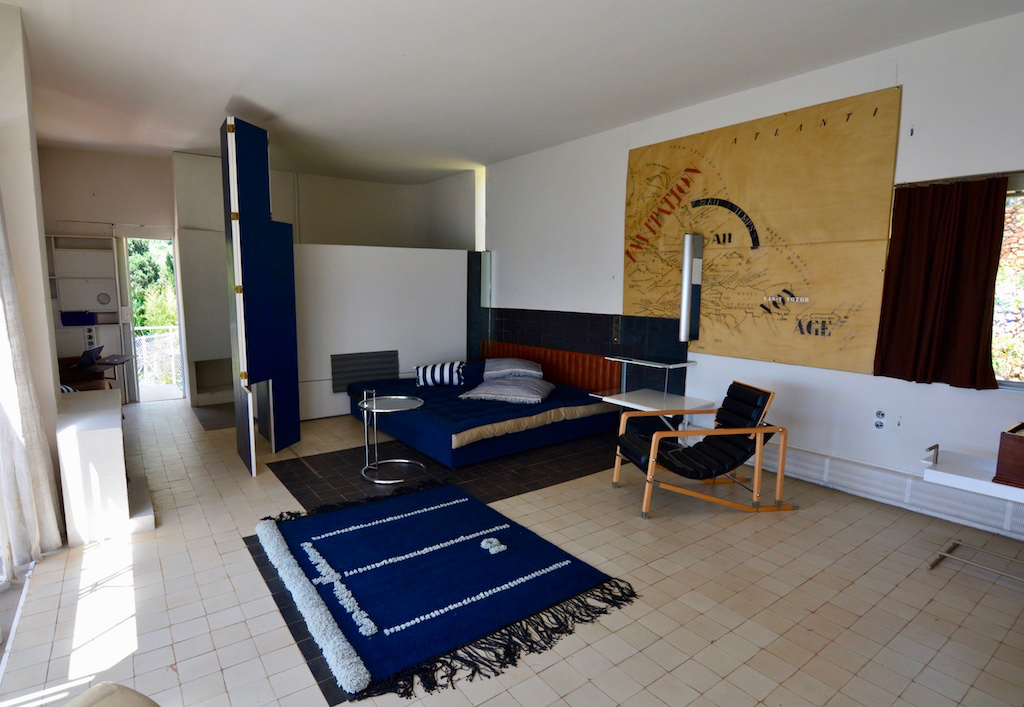
The iconic E-1027 adjustable table, made from chromed tubular steel and glass, remains in production. It was initially designed for the bedroom for breakfast in bed.

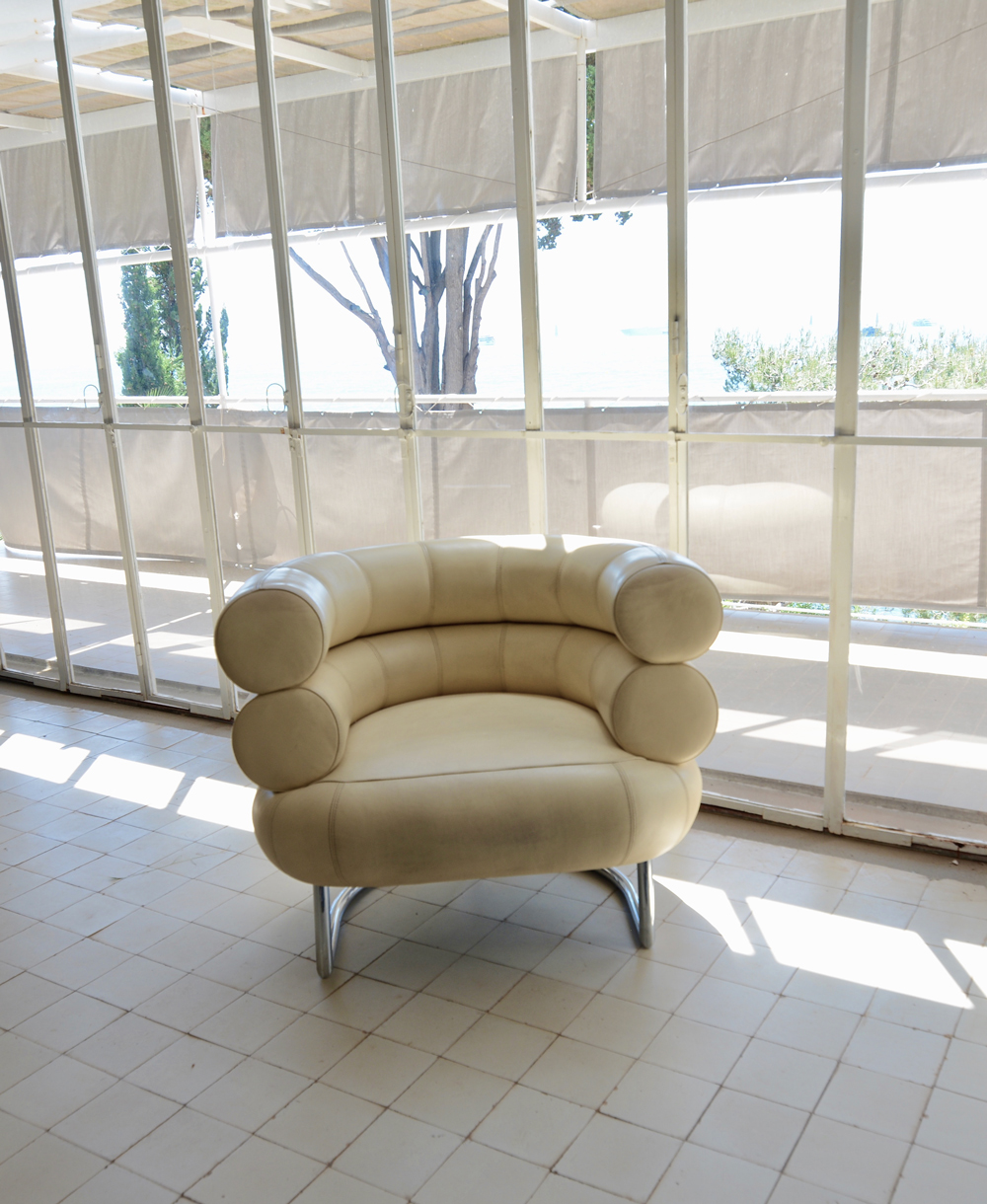
The 1926 Bibendum chair was named after the brand mascot of the Michelin tyre company, the ‘Michelin Man,’ whose official name was Bibendum. Its beautiful form balances modern function and art deco design.

The Transat (a shortening of transatlantic), a wooden-framed chair with leather or fabric seat, inspired by deck chairs on an ocean-going liner, criss-crossing luxury and functionality


Eileen Gray's Modernist furniture and furnishings from her Modernist masterpiece villa E-1027


“E” for Eileen, 10 for the letter “J”, 2 for “B”, and 7 for “G”.

The villa, completed in 1929, is designed and positioned to get the best from its location. A southward-facing main living area and bedrooms facing east to enjoy the morning sun, while as much as possible, the western face was without windows to shade in the heat of the day. It took Gray three years to complete the build, all the while living in a tiny flat. It’s well-known that the name, E-1027 is vanity, a play on the names of Eileen Gray and Jean Badovici; “E” for Eileen, 10 for the letter “J”, 2 for “B”, and 7 for “G”.

Corbusier’s Five Points of Architecture

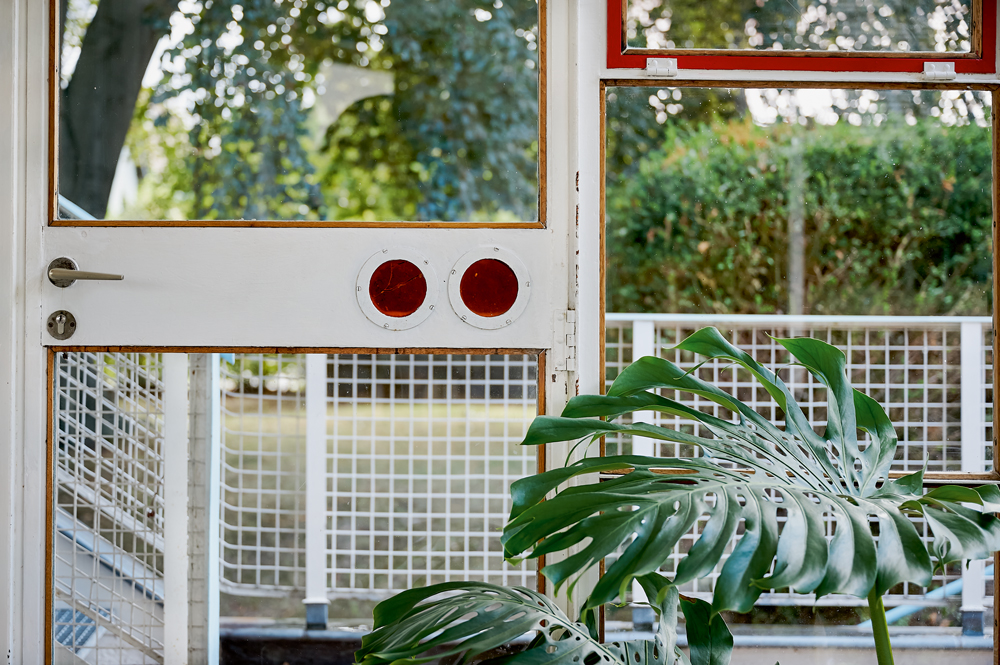
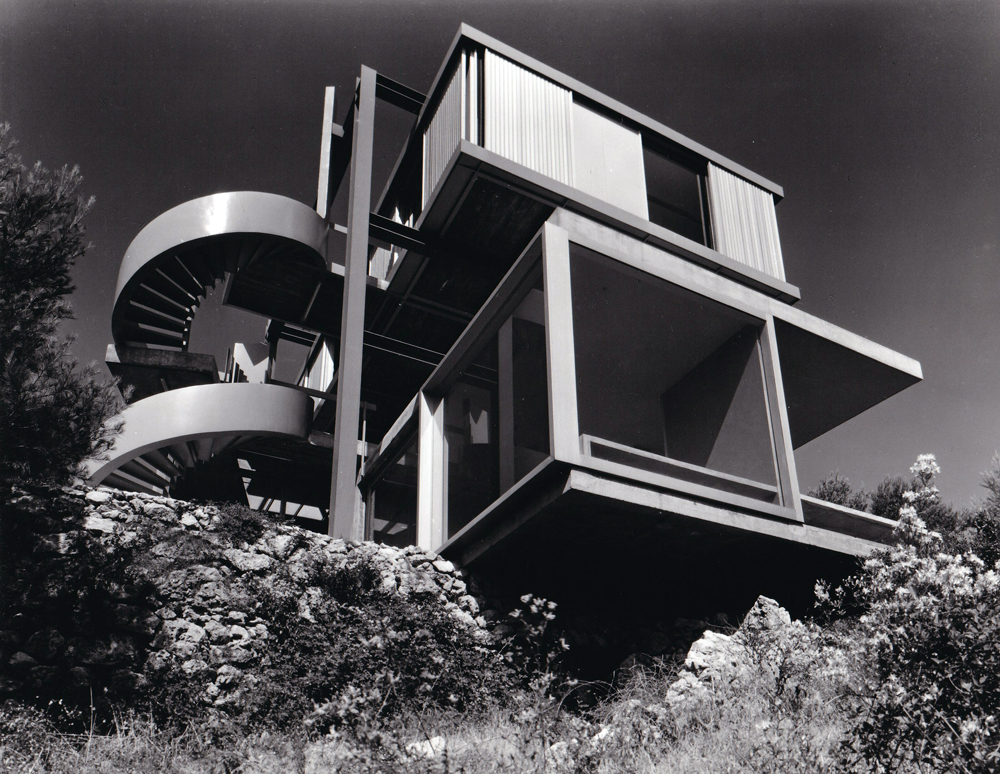
E-1027 follows each of Corbusier’s Five Points of Architecture, simply and elegantly; pilotis, horizontal windows, an open plan, a free facade and a roof that can be used as a garden. With sailcloth awnings echoing the yachts of the rich that then and now dot the bay, louvred shutters that can cleverly slide on rails to shade the interior while the principal room opens onto the balcony, like a deck, with floor to ceiling accordion-like windows. The main floor stands on pilotis. The lower floor that extends only beneath the main bedroom, opens onto the tiled terrace between those slender same pilotis supporting the main floor. From that lower floor, a spiral stair leads to the flat roof, like the topmost deck of a yacht.  In contrast to the size and opulence of so many villas on that coastline, E-1027 is small. A complex series of spaces, allowing the occupants privacy.


Eileen Gray's furniture design inn her Modernist villa E-1027


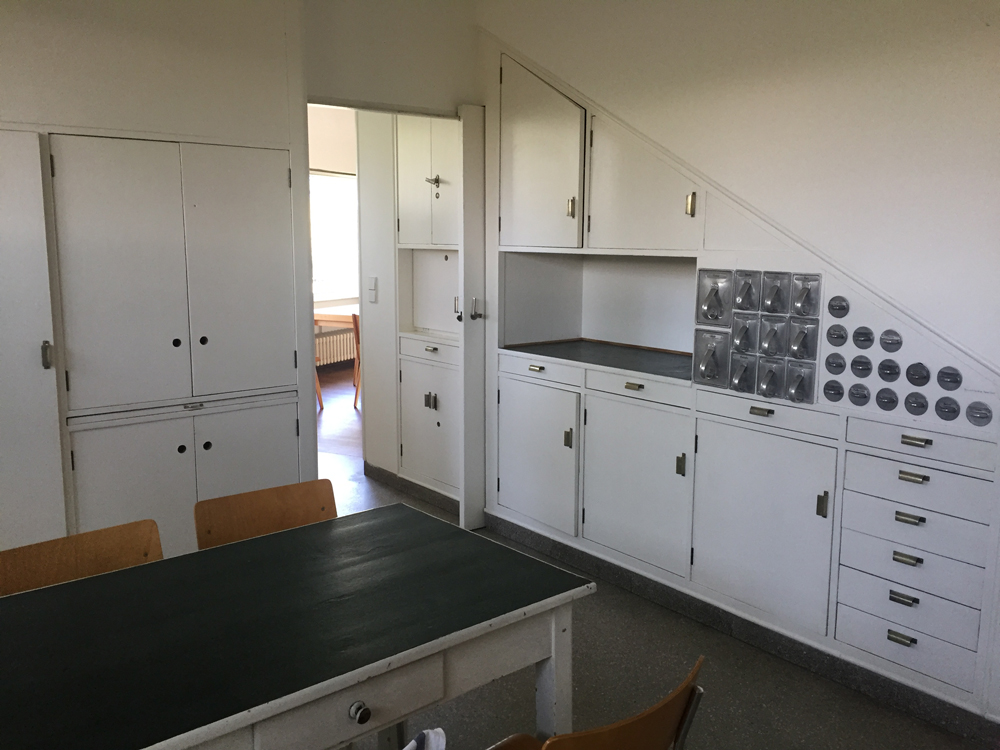
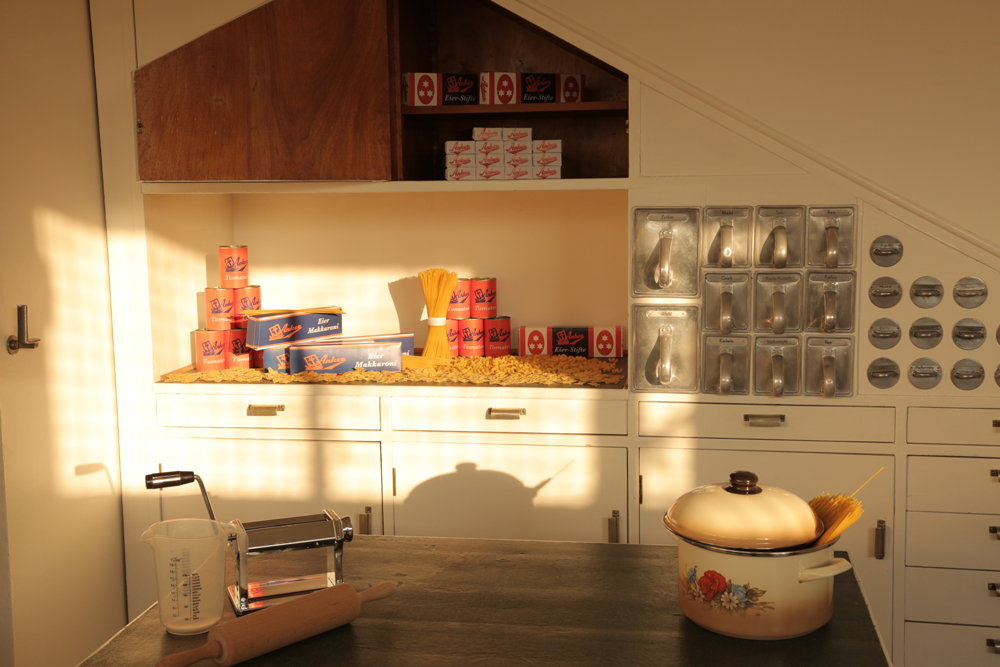
The furnishings were conceived by Gray in exacting detail.  Labels mark the purpose of every cupboard and drawer.  Thanks to the work of Zeev Aram, which began in the early 1970s, many of Gray’s furniture and carpet designs are again in production. That this was a home designed for a particular couple is plain.  Right down to rail at the entrance, created to catch the coat that Badovici would habitually fling off as he entered the villa.

The drama associated with the villa didn’t end when Gray gave it over to Badovici.  It had a couple of owners after him, one of whom was murdered there. By the 1990s, E-1027 was in increasing disrepair and occupied by squatters, not the first time. Italian and then German soldiers had used and abused the property during World War II.  The disrepair was extensive.

Saved

The Cap Moderne Association, led by Michael Likierman in agreement with the Conservatoire du Littoral, has saved the villa. The town of Roquebrune-Cap-Martin has lent its support, and restoration is now completed. The structure has been saved. With painstaking attention to detail, each room is restored with exact reproductions of the furnishings and fittings.

Learn More

Centre des Monuments Nationaux


Eileen Gray's villa E-1027 at Cap Moderne, Roquebrune, France


Eileen Gray 1878-1979

Updated March 2025

Ernö Goldfinger’s Forgotten Nursery: A Modernist Vision for Childhood

Ernö Goldfinger’s Forgotten Nursery:

A Modernist Vision for Childhood


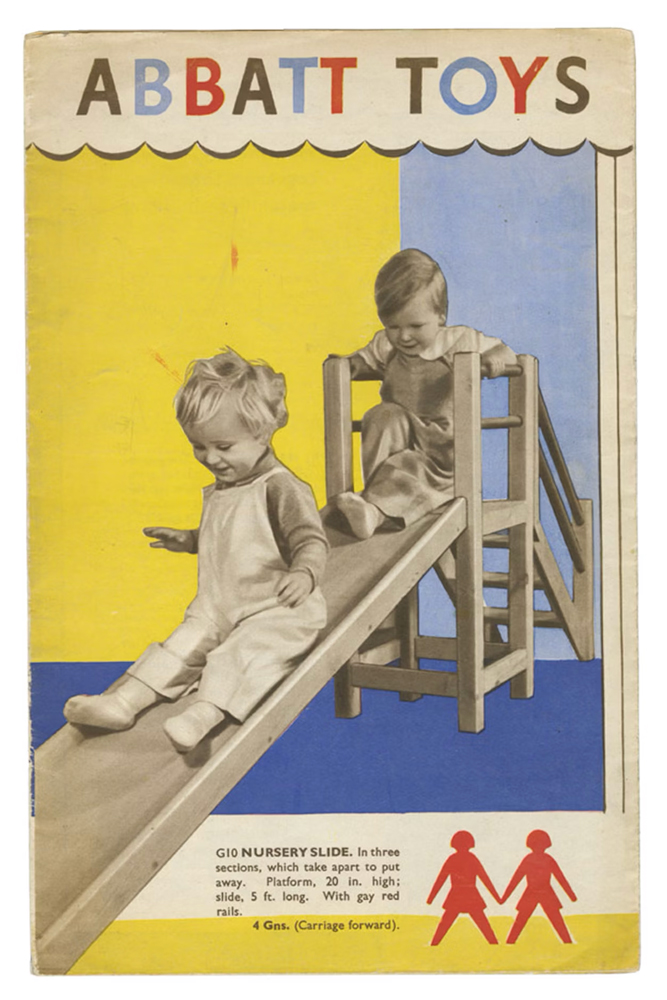
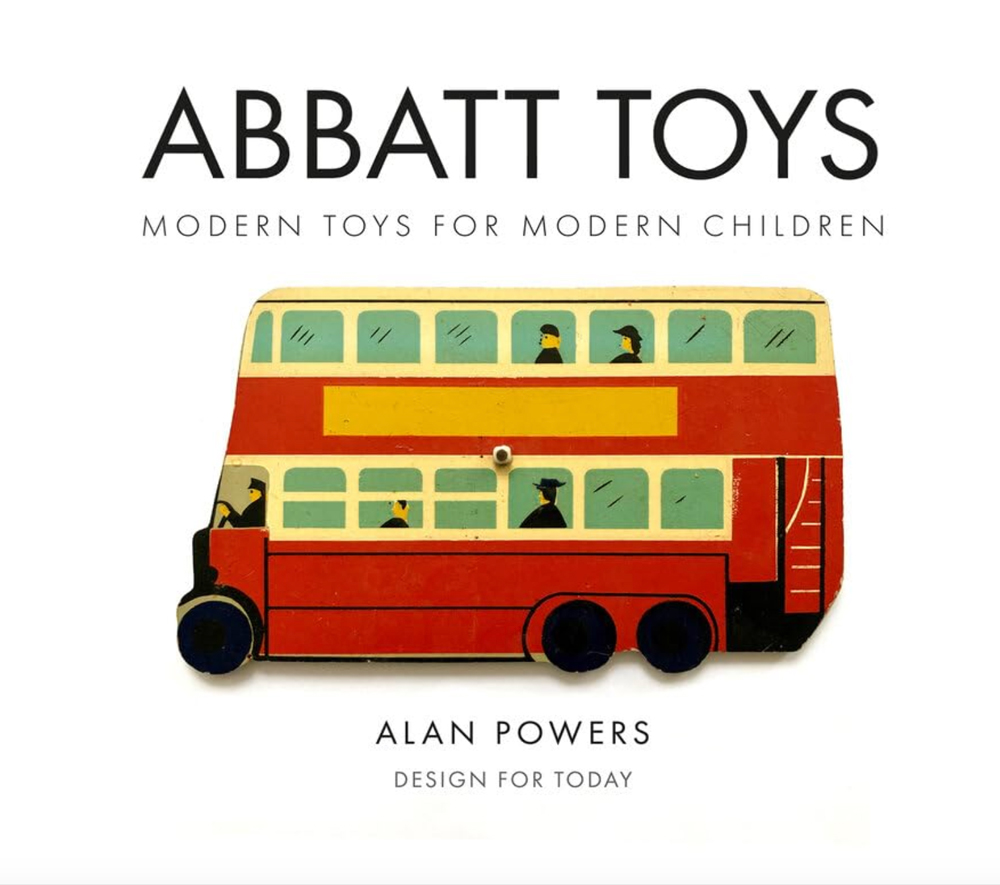
Abbatt Building Frame Catalogue: Abbatt Toys: Modern Toys for Modern Children, by Alan Powers available from Greyscape.com

Ernö Goldfinger, the Hungarian-born architect known for his uncompromising Brutalist structures, was also a visionary in designing spaces for children. In the late 1930s, when British nurseries were still shaped by Victorian sensibilities, Goldfinger, alongside Mary Medd (née Crowley), introduced a radical new approach to early years education. His nursery design, which was created for the Contemporary Industrial Design Exhibition in collaboration with educational toy pioneers Paul and Marjorie Abbatt, was an exemplar of modernist thinking applied to childhood development.


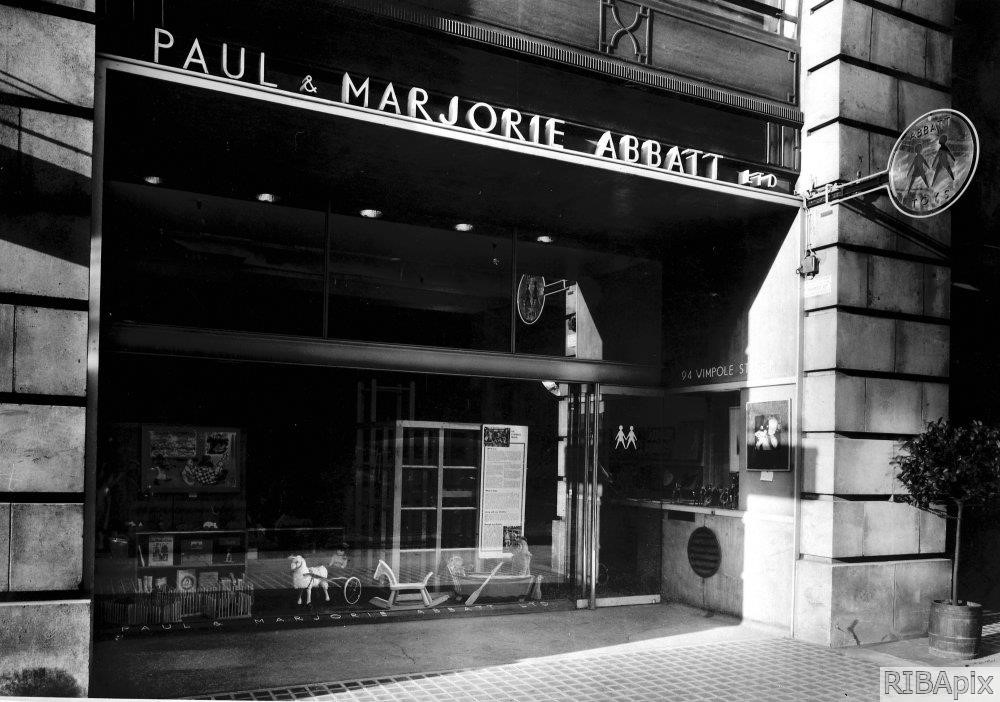
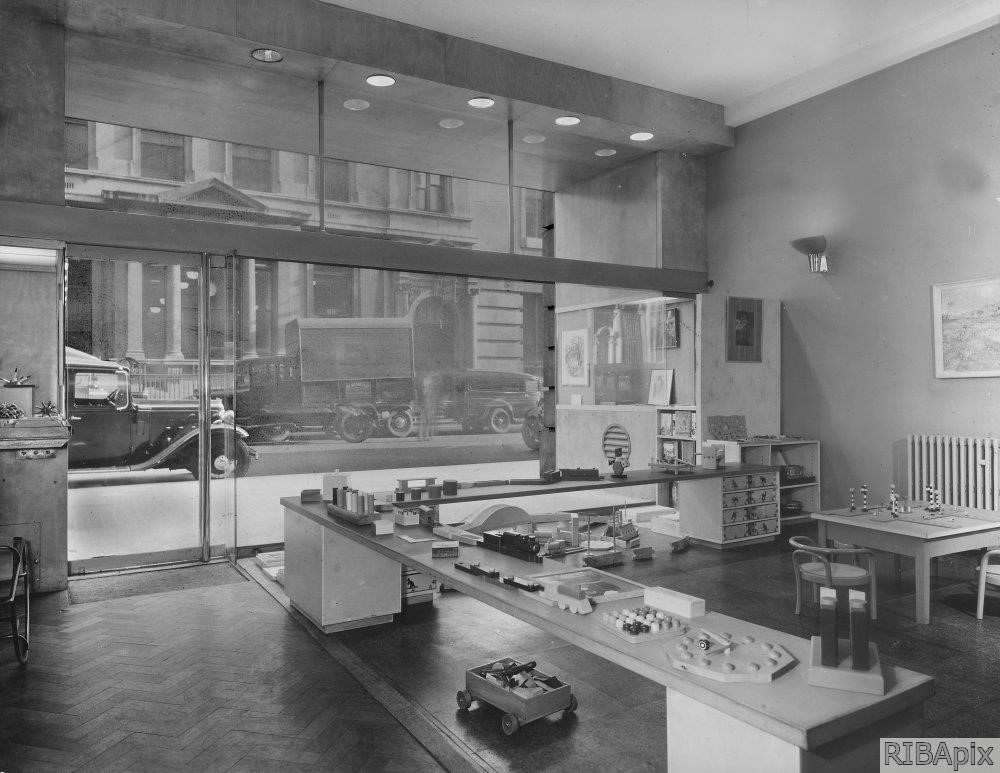
1936 Toy shop for Paul and Marjorie Abbatt Limited, 94 Wimpole Street, London. RIBA Collections

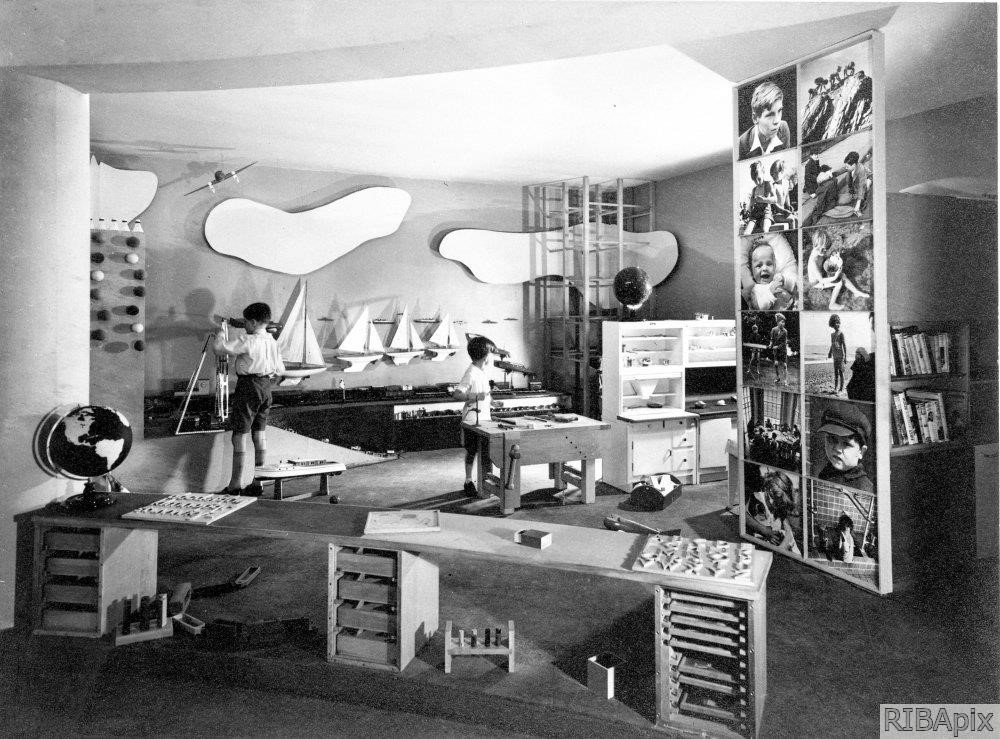
Goldfinger’s design, known as the ‘Expanding Nursery School,’ was revolutionary. At its core was flexibility: the space could adapt to different activities, allowing children to move seamlessly between play, rest and learning. Rejecting traditional nurseries’ heavy, dark furniture, Goldfinger’s scheme embraced clean lines, modular furnishings, and an emphasis on natural light. The design was published in The Architect’s Journal, showcasing a nursery that was not just a place to leave children but an environment actively shaping their cognitive and social development, a space designed for learning.

active learning, creativity, and play-based education

The nursery was based on a unit system, borrowed from continental modernists like Le Corbusier but adapted to a child’s scale. Here, functionality met modernism. Low, accessible shelves encouraged independence, while lightweight tables and chairs could be rearranged to suit different activities. Every element had a purpose: storage was built into walls to maximise floor space, and materials were chosen for durability and hygiene. The emphasis on function, movement, and interaction reflected the core principles of modernist design – form following function, but in a way that placed children’s needs at the forefront.


Toy shop for Paul and Marjorie Abbatt Limited, 94 Wimpole Street, London. Architectural Press Archive / RIBA Collections


Ernö was both a client and friend of the Abbatts. He shared their fascination with toys as educational tools. Paul trained as a teacher, and Majorie studied psychoanalysis at University College London. Alan Powers, author of Abbatt Toys for Modern Children, which is well worth reading, wrote that they visited some of Austria’s ‘lively and advanced’ schools during their extended two-year honeymoon in Europe. They were in the heartland of new childhood and special education thinking, where Milan Morgenstern and Helena Löw-Beer were doing groundbreaking work. This research informed the creation of Abbatt Toys in 1932, which featured building blocks and a climbing frame which became a standard in school playgrounds, winning the 1969 Observer newspaper design award. Goldfinger designed their child-friendly shop, an unknown concept until then, at 94 Wimpole Street and their Tavistock Square apartment. Their groundbreaking reimagining of a doll’s house allowed a child to play with it, Dol-Toi supplied modern doll’s house furniture.


British Pavilion, Exposition Internationale des Arts et Techniques dans la Vie Moderne, Paris 1937: the children’s section with furniture and toys by Abbatts RIBA Collections


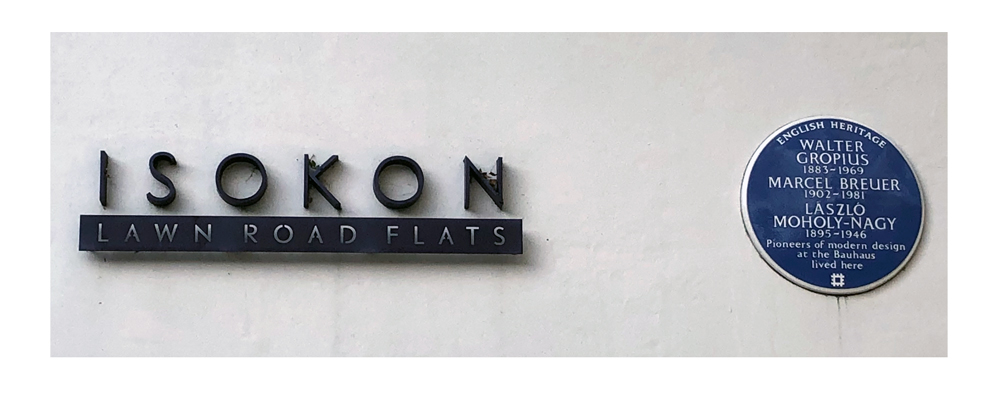
In a further intertwining of the modernist movement in Britain, they chose Bauhaus-trained Edith Tudor-Hart, an Isokon resident, trained Montessori kindergarten teacher and a recruiter of the Cambridge spy ring, to photograph their 1934 catalogue.

The Goldfinger-Abbatt climbing frame, known as the Building Frame, was designed in the 1950s as a modular play structure. It aimed to promote active, creative, and independent play and reflected progressive educational principles to create well-designed, developmentally beneficial toys and play equipment for children. The frame’s simple, modernist wooden design allows it to be climbed, rearranged, and adapted to different play environments.

Despite its significance, Goldfinger’s nursery is often overlooked in discussions about modernist design. His later works, notably Balfron and Trellick Towers, defined his legacy. Yet his approach to children’s spaces was just as radical, applying the same rigorous logic and human-centred thinking that would later shape Britain’s postwar housing.

Today, as architects and designers rethink educational environments, Goldfinger’s nursery stands as an early and vital example of modernism’s potential to transform how children engage with the world around them.

Abbatt Toys : Modern Toys for Modern Children by Alan Powers

New Brutalists’ “Japanese” Pavilions

New Brutalists’ “Japanese” Pavilions

The “reverence for the natural world” – the Japanese architectural influence on New Brutalism and its realisation.


Lacket

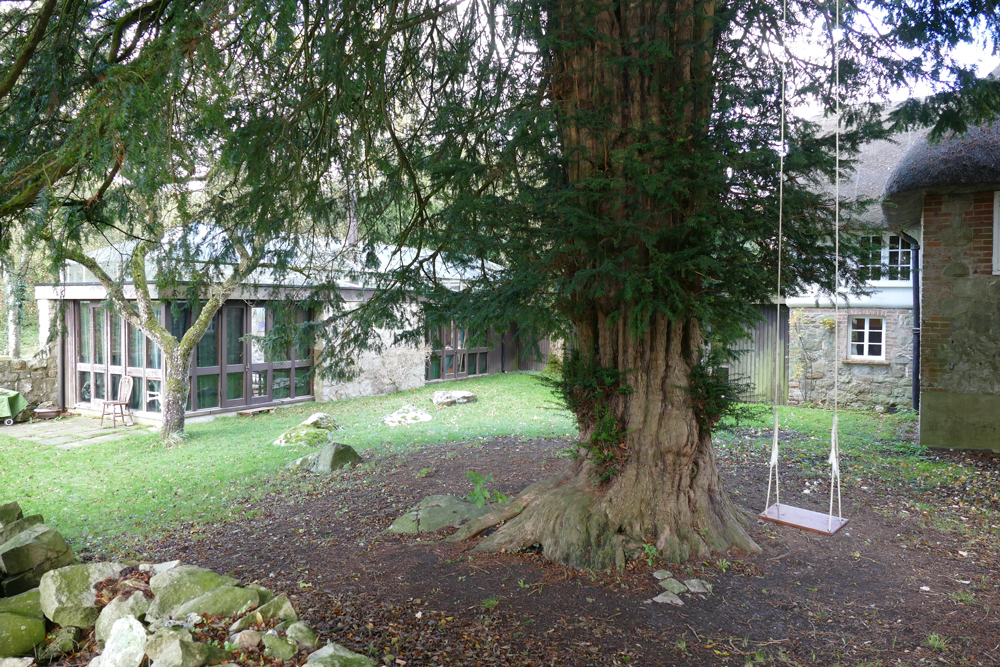
View of Crosby’s extension of The Lacket showing the living room (left) and bedrooms (right)


In Autumn 2020 Juliana Kei, Lecturer in Architecture at the University of Liverpool, was able to visit two overlooked house extensions that reflect the tenets of New Brutalism – one in Bayswater by Alison and Peter Smithson and the other The Lacket by Theo Crosby. What captured Juliana’s attention was that underpinning the two designs were their idea of New Brutalism.

In Reyner Banham’s 1966 book New Brutalism: Ethic or Aesthetic, Juliana explains, he made reference to a one-page article published in the January 1955 issue of the Architectural Design, as the “manifesto” of New Brutalism. The article in question was written by Alison and Peter Smithson, and Theo Crosby, who was at the time the technical editor of the AD and a close friend of the Smithsons. In current studies of post-war British architecture, Crosby has been recognised as an effective behind-the-scene promoter for the Smithsons’ and the Independent Group’s (IG) works. In addition to using the AD as a conduit to disseminate the ideas of the IG milieu, Crosby is also credited as the organiser of the 1956 This is Tomorrow exhibition held at the Whitechapel Gallery in London. This article retrieves the 1955 New Brutalism “manifesto.” Juliana continues, I will also use two house extensions designed by Crosby and the Smithsons, for the same client, to examine their propositions in the manifesto.

In the AD manifesto, Crosby and the Smithsons dedicated the introduction, and five out of the seven paragraphs on the importance of Japanese architectural influence on the Modern Movement and New Brutalism.

They declared,

‘Our belief that the New Brutalism is the only possible development for this moment from the Modern Movement…because fundamentally both movements have used their yardstick Japanese architecture – its underlying idea, principles, and spirit.’

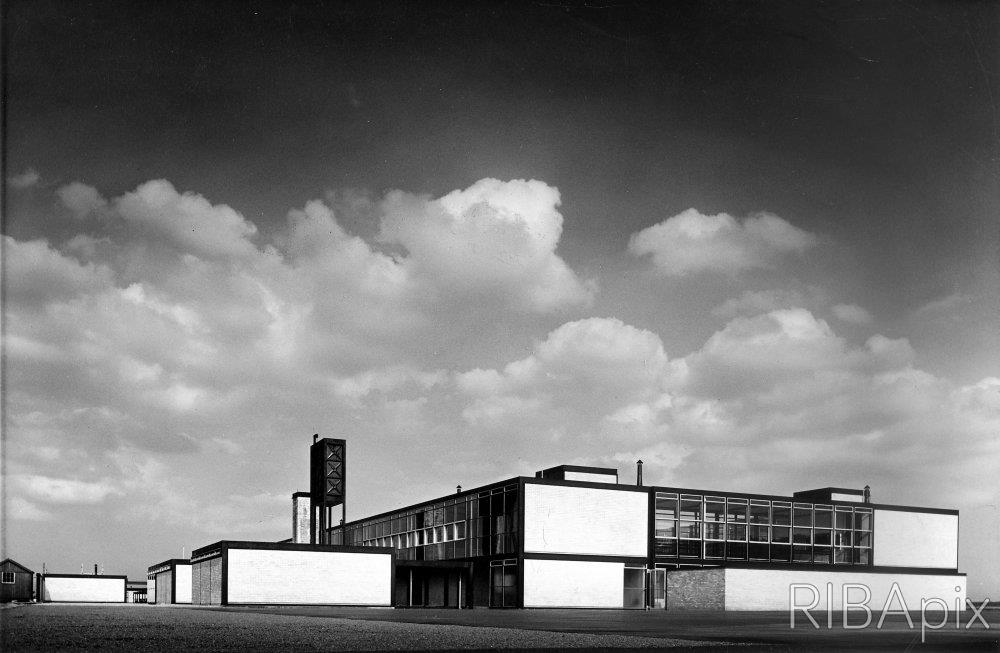
They went on to explain that, through Japanese architecture, New Brutalism found a “reverence for materials” and a close affinity with “peasant dwelling forms”, which resulted in an “architecture as the direct result of a way of life.” They even suggested that the Smithsons’ Hunstanton School “owes as much to the existence of Japanese Architecture as to Mies.


Hunstanton Secondary School, Alison and Peter Smithson RIBA Collections


The manifesto is puzzling. Neither the Smithsons or Crosby had been to Japan at the time of the article’s publication, and their knowledge about Japan mostly came from films and books written by Bruno Taut in the 1930s. However, a different vision of New Brutalist architecture emerges when Japanese architecture is used as a lens to review Crosby and the Smithsons’ works.

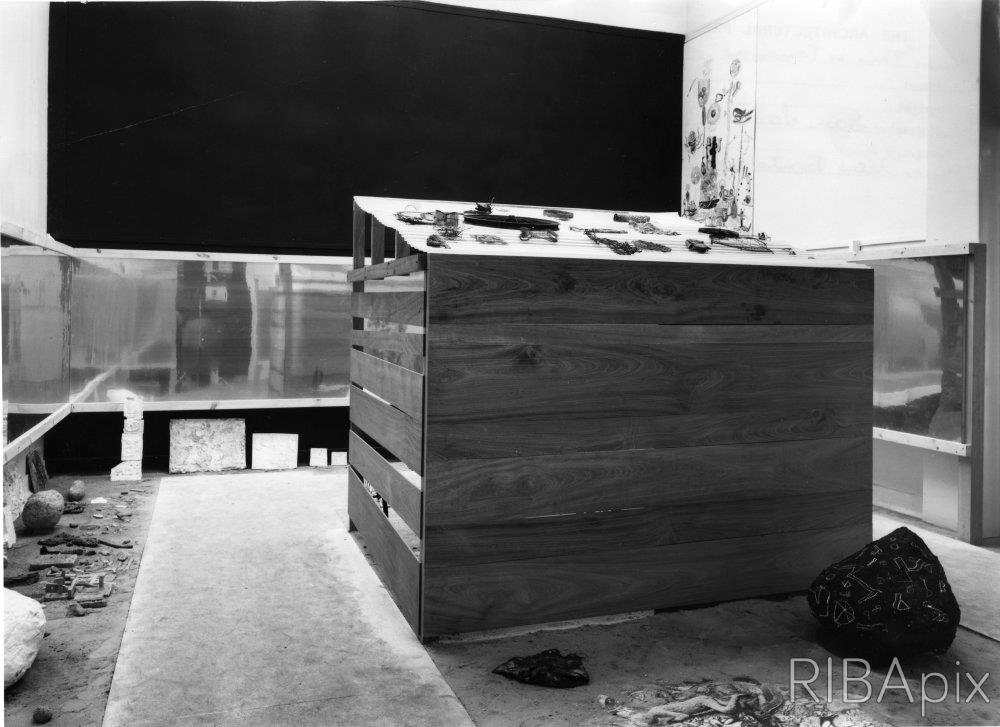
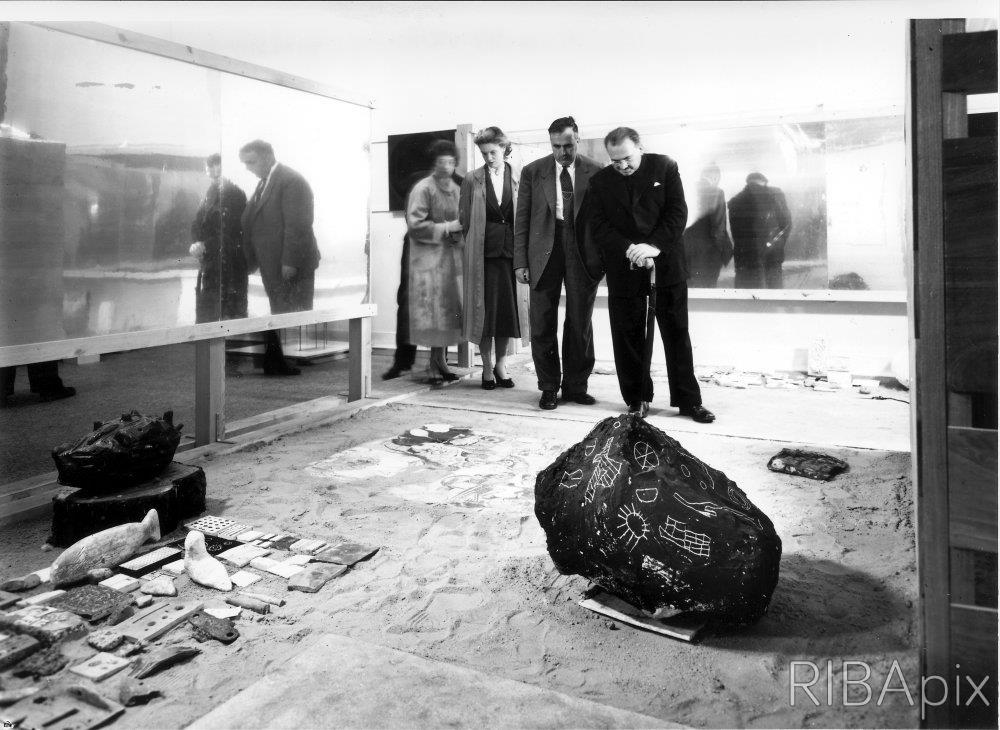
In This is Tomorrow, for example, Group 1 (Crosby, Edward Wright, Germano Facetti, and William Turnbull) and Group 6 (the Smithsons, Eduardo Paolozzi, and Nigel Henderson) installation both emphasised the changeable and replaceable quality of artworks in a mass-produced structure.


shed This is tomorrow Whitechapel

Group 6 Architectural Press Archive / RIBA Collections

Whitechapel gallery Smithsons 1956

This Is Our Tomorrow Group 6 John Maltby / RIBA Collections


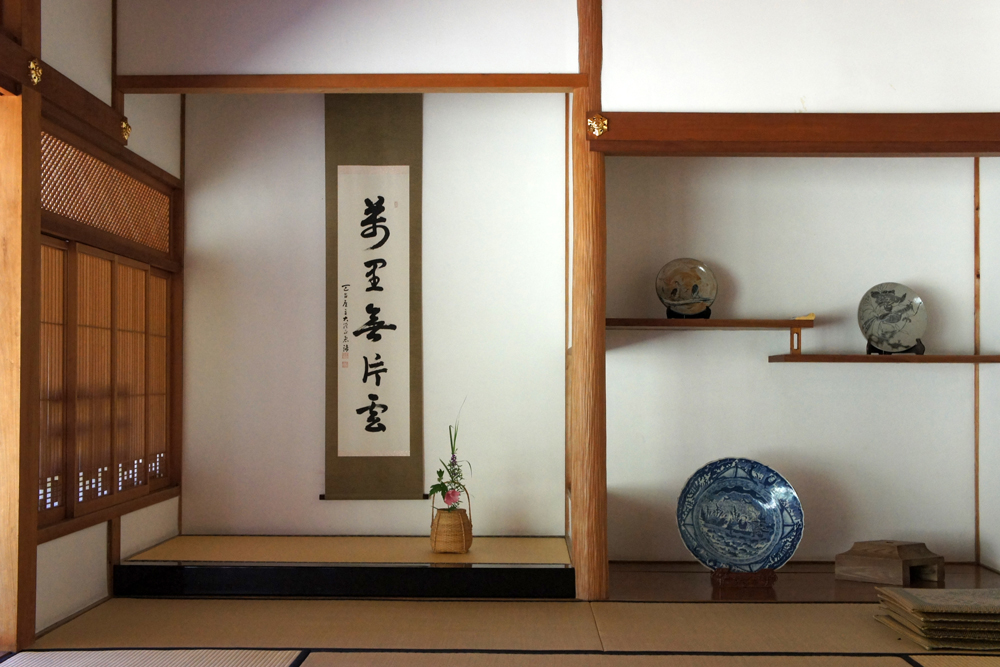
This relationship between arts and architecture responded directly to the concept of Tokonoma – an alcove in traditional Japanese houses designated for an object that corresponds to the season– that was celebrated by Taut. Both installations manifested a different approach towards the integration of arts and architecture from the other groups: the integration was through a clear delineation of and dedication to artworks, rather than blurring the boundary between arts and architecture.


Tokonoma with seasonal items

Tokonoma, Tottori Prefecture CC BY 2.5


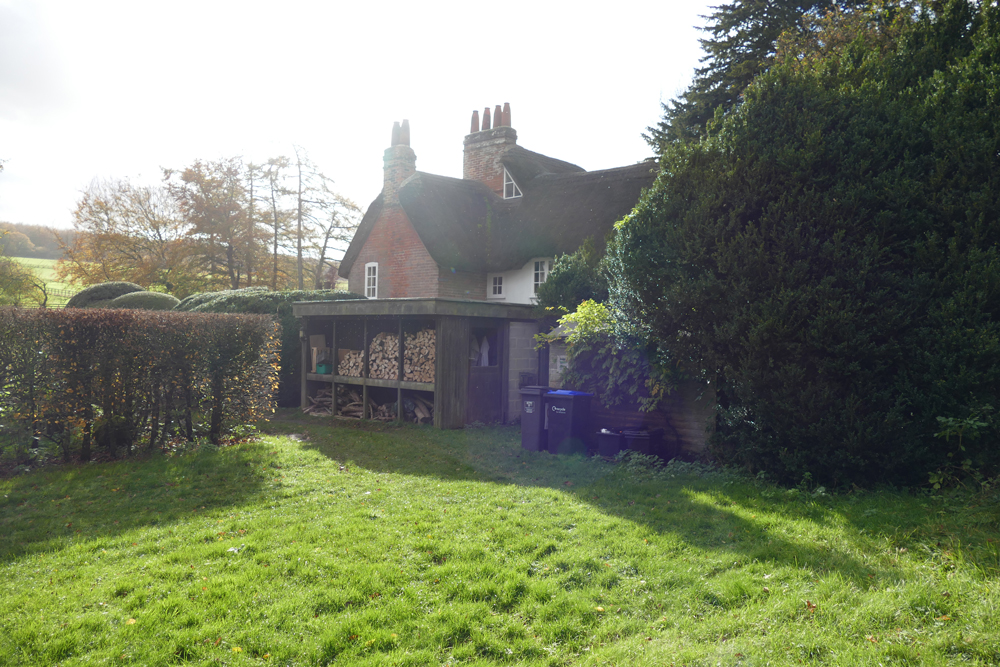
Two years after the exhibition, Crosby and the Smithsons were offered another opportunity to realize their thinking on New Brutalism. The premise was similar to This is Tomorrow they devised their respective “pavilions” under a similar design brief. In 1958, Wayland Young (Lord Kennet), then a junior minister of Housing and Local Government, commissioned the Smithsons to design an extension for his Victorian-era house on Bayswater Road, London. He also asked Crosby to build an addition to the Kennet family’s 18th-century cottage, called The Lacket, in Wiltshire. The function of the extensions are similar, too: both include a living room and two bedrooms. The Smithsons extension also has a bathroom, while Crosby added a storage room for the cottage.


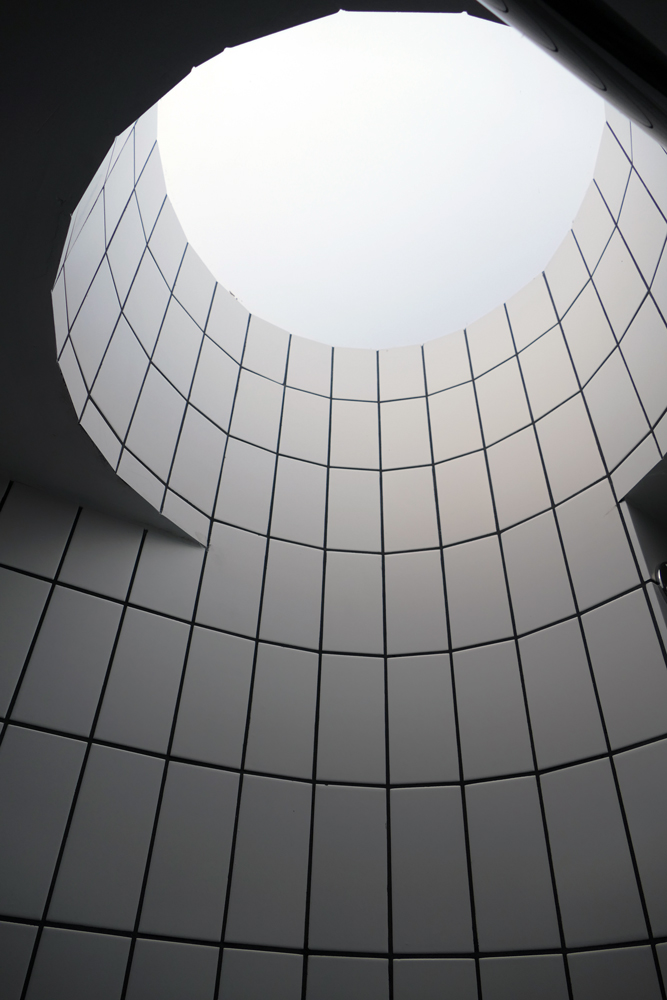
skylight in extension
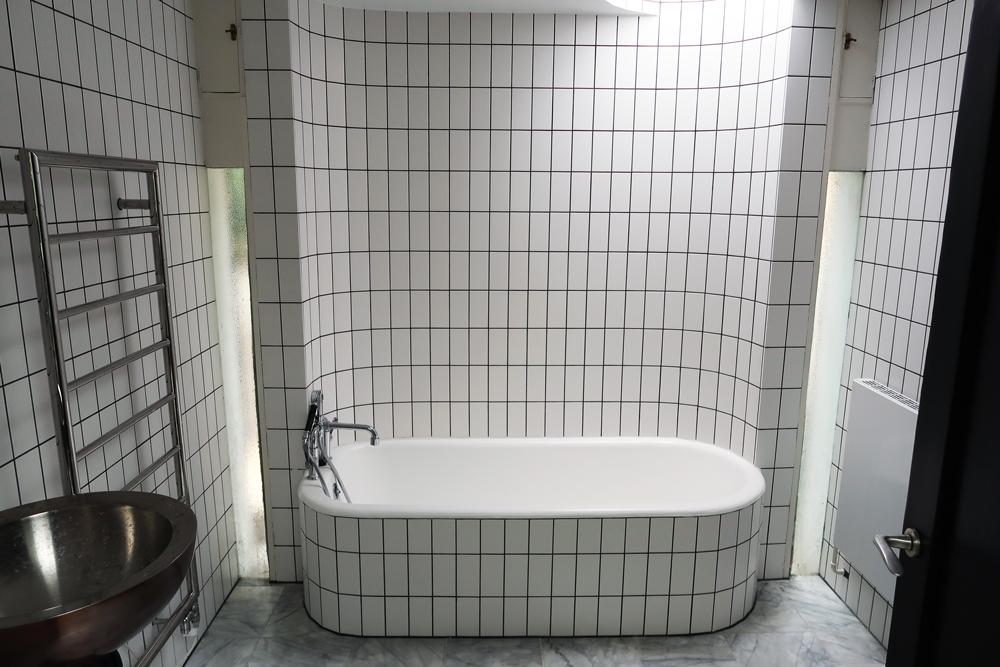
bathroom with white tiles and black grout

The bathroom and bathroom skylight of 100 Bayswater Road extension.


At first glance, the house extensions do not look that similar. Crosby’s Lacket addition is a Z-shaped volume with three components, whilst the Smithsons’ extension in Bayswater appears as one entity. The Bayswater extension is rendered white with an exposed concrete roof. The Lacket addition is partly cladded with cedar panelling and partly constructed with local stone. [Crosby’s extension to the Lacket perhaps shares more material similarities with the Smithsons’ own summer home near Fonthill, Wiltshire.] However, a closer examination of the two houses reveals approaches that resonate with the 1955 New Brutalism manifesto and This is Tomorrow. Notably, both extensions used industrial prefabricated glass roofs which were unusual for houses, in particular in the notorious British weather. In the Smithson extension, the rooms are placed in parallel to the old garden wall of the house.


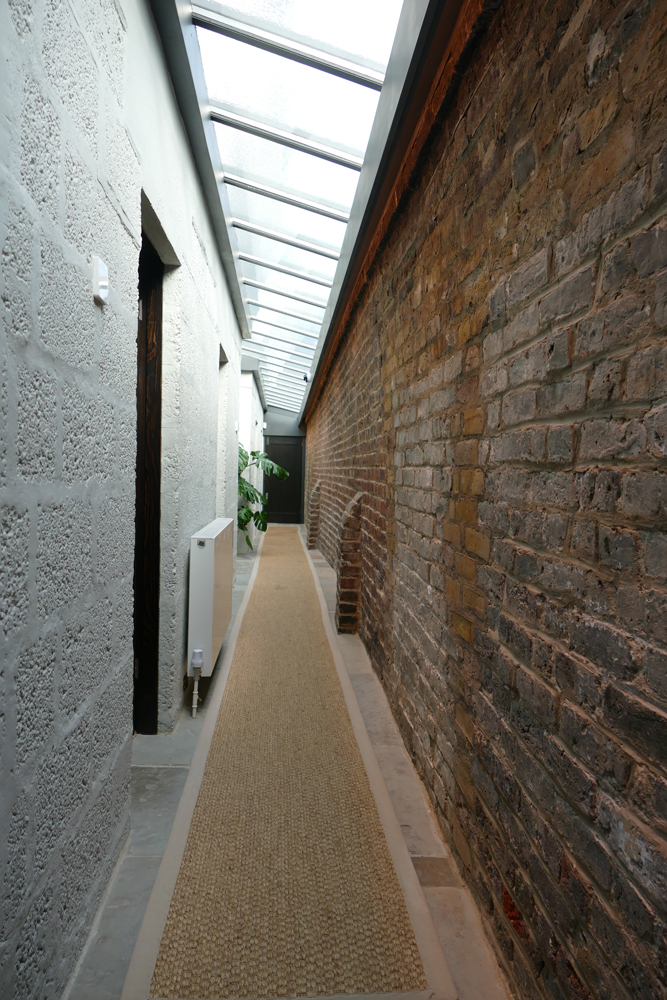
smithsons extension

Corridor of the Smithson’s extension.


A corridor, which connects the extension and the old house, is created between the rooms and the wall. An existing sycamore tree was maintained and used to define the location and size of the rooms. For the roof of the corridor, the Smithsons chose industrialized sheet glass which was trimmed to accommodate the tree trunk. On the one hand, the extension reflected the “as-found” ideal of New Brutalism: the design was determined by the existing brick walls, trees, and garden, and completed with everyday mass-produced materials. On the other hand, the result was a space that was not completely sealed. A similar condition can be said about Crosby’s design at The Lacket. The living room space was constructed with Sarsen, a particular English stone that was salvaged from an old building on the property. The structure is topped with an industrial lantern roof. Again, the living room at the Lacket can also be described as a semi-outdoor environment. Both designs reflect the “reverence for the natural world” that was articulated in the New Brutalism manifesto but are also not entirely inhabitable on cold winter days.


Lacket by the Smithsons
Theo Crosby's home Lacket

Two images of The Lacket after its recent renovation including  the storage in Crosby’s extension


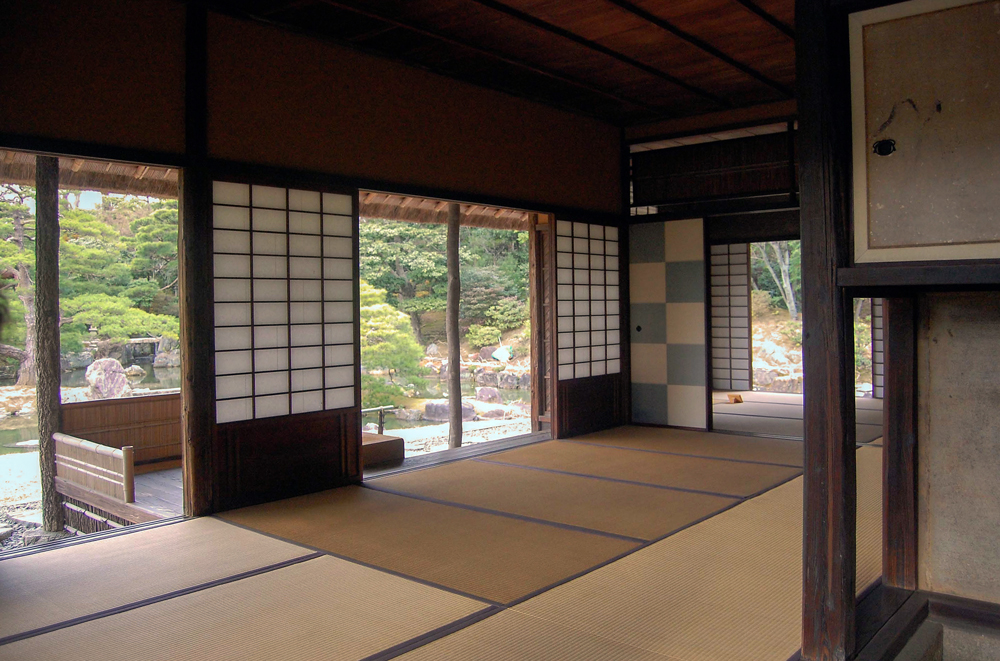
Also worth noting is that both extensions can be described as a pavilion and a route – another important design tenet of the Smithsons. This reconceptualization of a house as elementary modules (the rooms) connects by a route (the corridor) again reflects the influence of traditional Japanese house design. In particular, in the Katsura Palace in Kyoto – a building that was celebrated by Taut and other early Modernist masters – one can find a similar approach of using semi external corridors to connect modular rooms.


interior view tea pavilion towards garden

Shokin Tei, the Tea Pavilion of Katsura Imperial Villa Image: R Azevado Franca


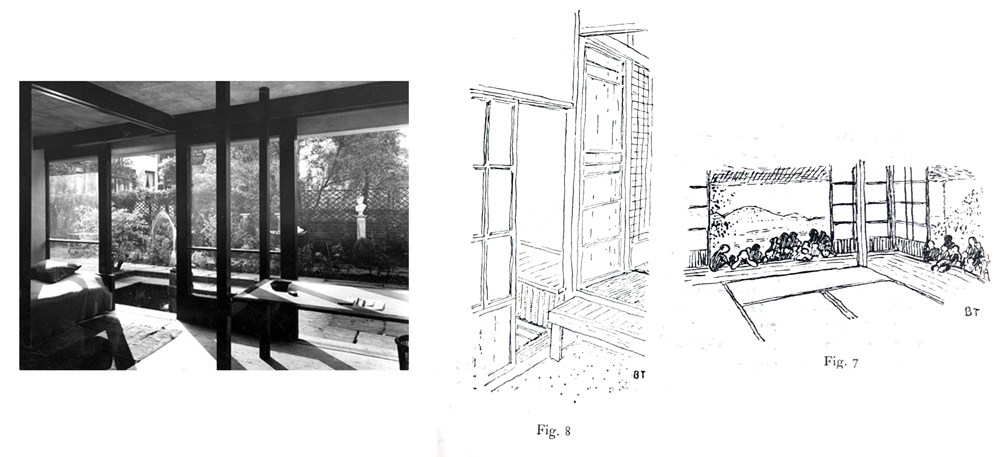
As in the Katsura, this arrangement was devised to mediate the stylistic and material differences between an elder part of the building and new extensions. In the Smithsons’ Bayswater extension, the reference to Japanese architecture is also made explicit by using movable panels to sub-divide the rooms. There was also free-standing timber poles – another motif found in Taut’s study of Japanese houses – that was used to support a writing desk.


Interior of the 100 Bayswater Road extension designed by the Smithsons alongside an illustration from Bruno Taut’s House and People of Japan.


Through Japan, respect to history and historical fabric was mooted in Crosby and the Smithsons’ articulation of New Brutalism and their extension designs. Yet it can also be seen as a tension that pulled their relationship apart, not long after the completion of the two pavilions in 1960. (Although they maintained contact and collaborated occasionally) After encountering Jane Jacobs’ The Death and Life of Great American Cities, Crosby turned into an advent advocate for preservation. Crosby, later as a founding partner of the multidisciplinary design firm Pentagram, dedicated most of his energy to interior, renovation and refurbishment projects. The only major building that he completed in central London was the Shakespeare’s Globe, an “authentic” reconstruction of the 16th-century theatre. His design at The Lacket, therefore, can be regarded as one of Crosby’s last built works for New Brutalism, and also a link between his post-war neo-avant-gardism and preservationist tendencies.

About Juliana Kei

Juliana is a Lecturer at the Liverpool School of Architecture. She is currently completing a monograph on Theo Crosby with Stephen Parnell and Alan Power to be published by Lund Humphries. As part of the Hong Kong Design History Network, she is a curator of the Hong Kong Pavilion in the London Design Biennale, June 2021.

Juliana also wants to express her gratitude to Matt Woollven from Giles Quarme Architects and Thoby Young, the current Lord Kennet for their generous input in this research.

Follow Juliana

Twitter @yatshunkei 

Instagram @julikei

The history of 100 Bayswater Road

The house dates from 1820 and became the home of the author JM Barrie in 1900 and it was here that he wrote Peter Pan which was published in 1905.

Babyn Yar Synagogue, the architectural response to the Holocaust

Babyn Yar Synagogue

‘The architectural response to the Holocaust’, architect Manuel Herz observes, ‘has been concrete and stone, as if the architecture has to be as heavy as the crime’.


architect Manuel Herz

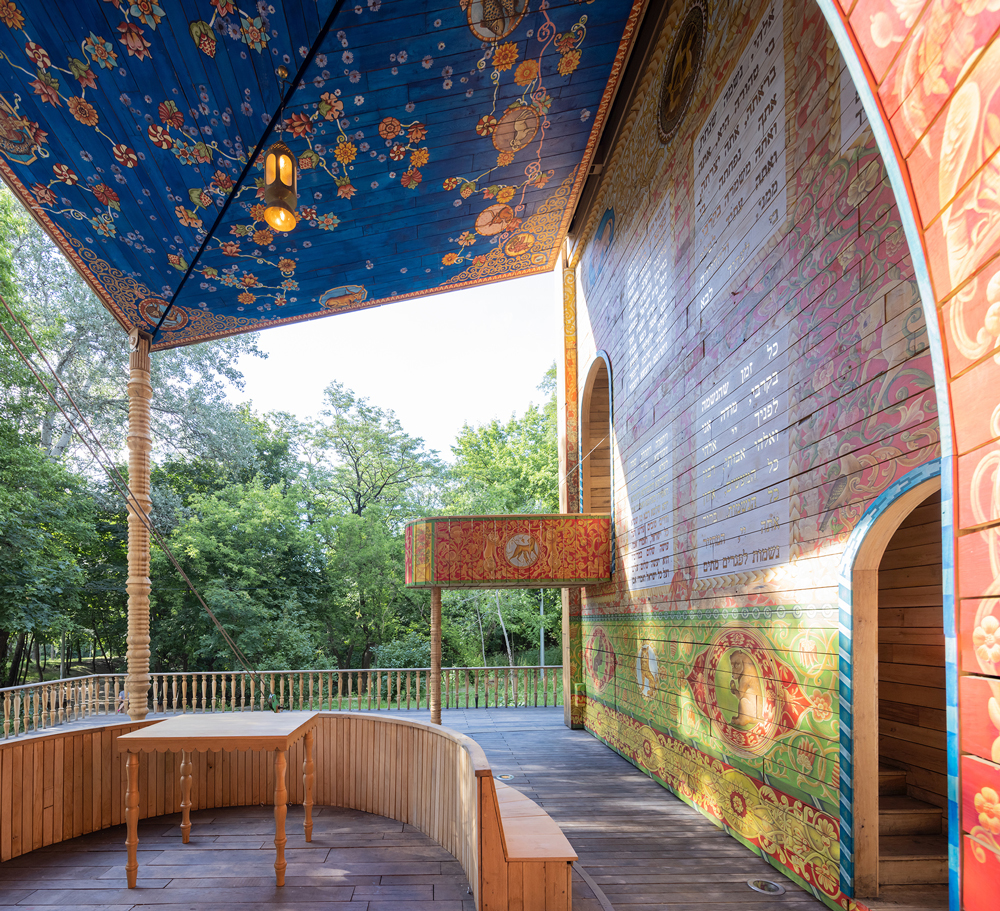
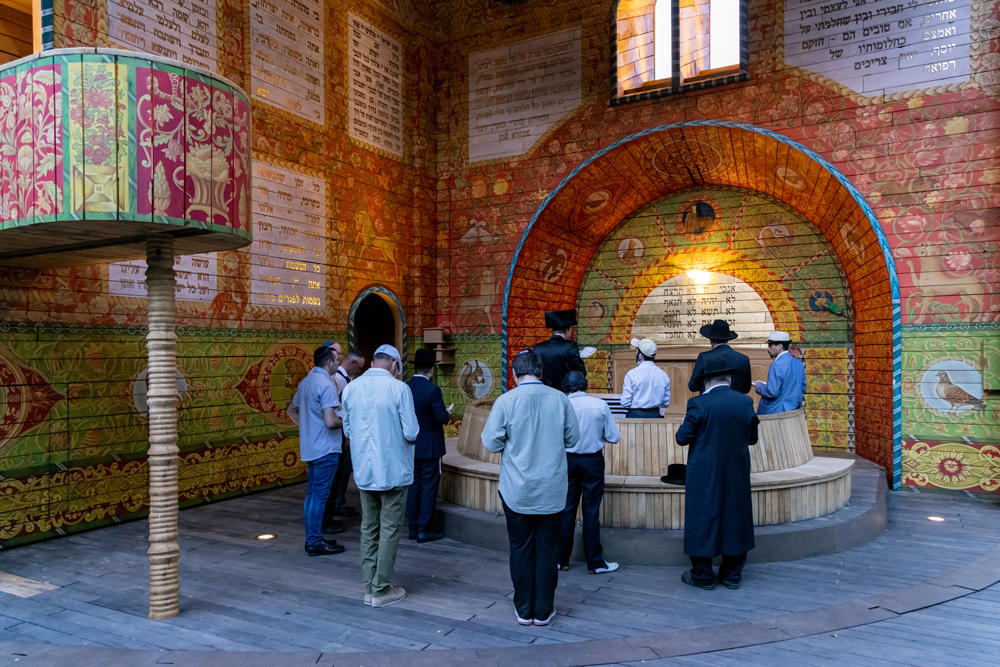
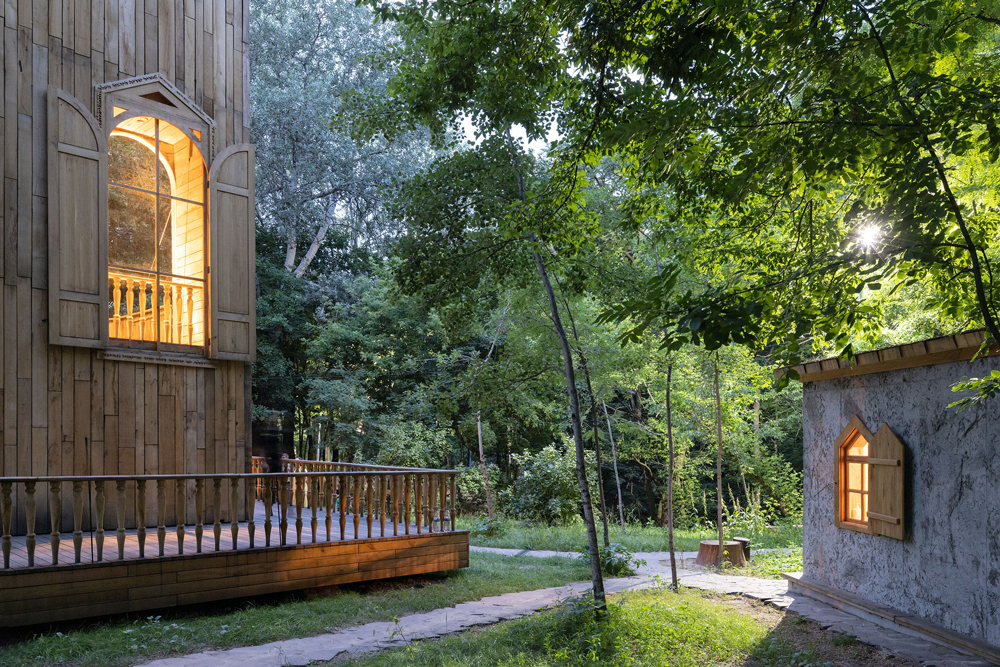
View from the “bimah” (praying platform) towards the women’s gallery and the ceiling. Image Iwan Baan


Greyscape spoke to Manuel on 2 March 2022, the day after a missile hit the Babyn Yar site.

In designing the first element in a series of planned architectural responses to the 1941 atrocity in the Babyn Yar ravine, Manuel chose a very different course. .He chose wood, a gloriously decorated building constructed out of old oak sourced from across Ukraine, purposely chosen to reinforce the importance of the and memory.  The design team explain that the synagogue

‘unfolds into three dimensions. From a flat object of a book, when we open it, new worlds unfold, that we could not imagine before. In a sense, the pop-up book can act as a metaphor for the Synagogue’.


But before we look further at this unique building, we must describe the horror it memorialises.

In September 1941 the Nazi occupiers of Ukraine and their collaborators forced 34,000 naked men, women and children to a ravine just outside Kyiv, where they were shot.  The bodies, the dead and the injured, fell into the pit to be covered by more and more bodies.  This was a two-day affair, one of the massacres comprising the “Holocaust by Bullets” preceding the attempted industrial destruction of Europe’s Jews by gas.


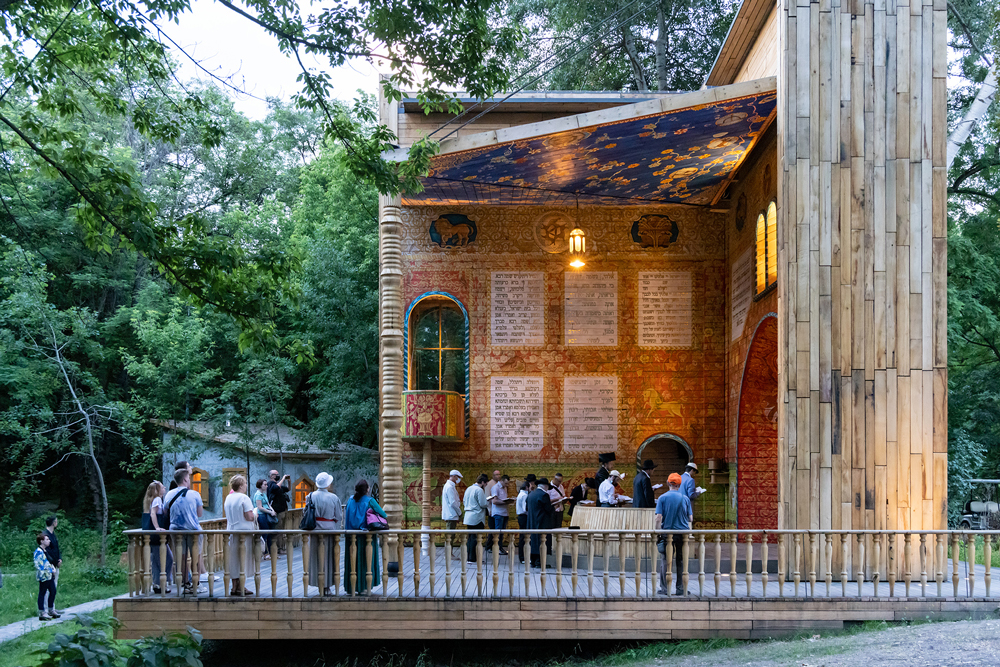
Religious service in the open synagogue Image Iwan Baan©


Manuel’s building is a synagogue, a synagogue along the lines of hundreds, thousands of other peaceful places of worship constructed out of wood that dotted the Pale of Settlement, that area of the Russian Empire where Jews were permitted to settle for a little more than 100 years. Jews had lived in central and Eastern Europe for 1000 years and while regularly the objects of murderous persecution and constant discrimination, poverty and exclusion, they lavished what decorative resources they had on a distinctive style of wooden synagogue.  Often small and intimate.


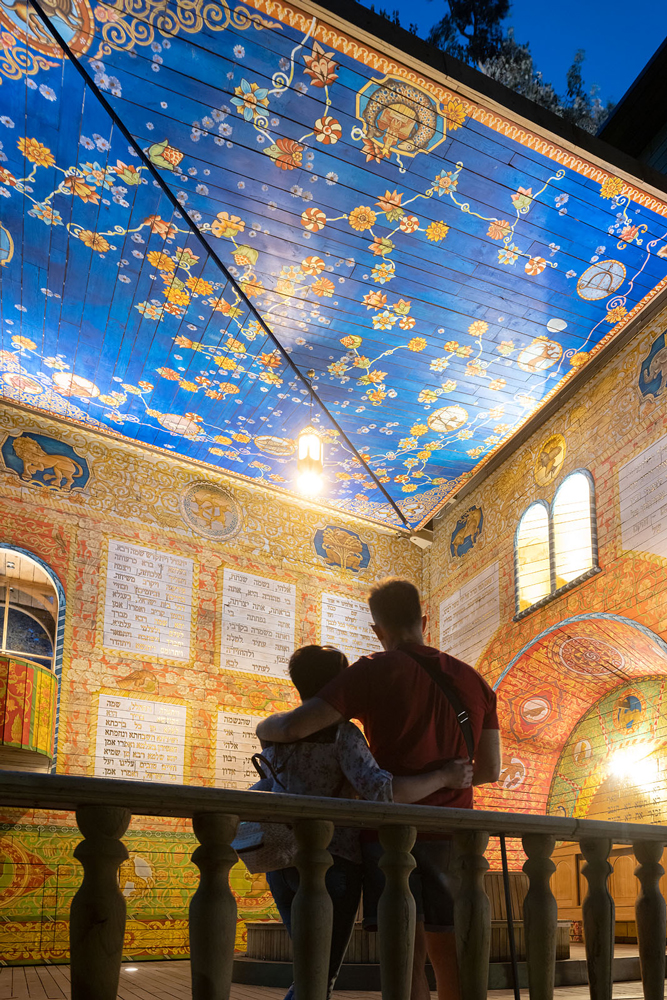
Looking into the ceiling showing the star constellation of the night of the Babyn Yar massacre. Image Iwan Baan ©


Robert Jan van Pelt, professor of architecture at the University of Waterloo, Canada, and an expert on the Holocaust, chairs the architectural board group of the Babyn Yar memorial. He recommended that the first element in that project should be a synagogue.  Another 11 buildings are to follow, including a church and a mosque, a research centre and museums. Manuel and his firm were commissioned to design the synagogue.

Why a synagogue? Because, Manuel says, ‘You start not with death but with life’


architect Manuel Herz

Observing a service in the synagogue with a view onto the moveable wall Image Iwan Baan ©


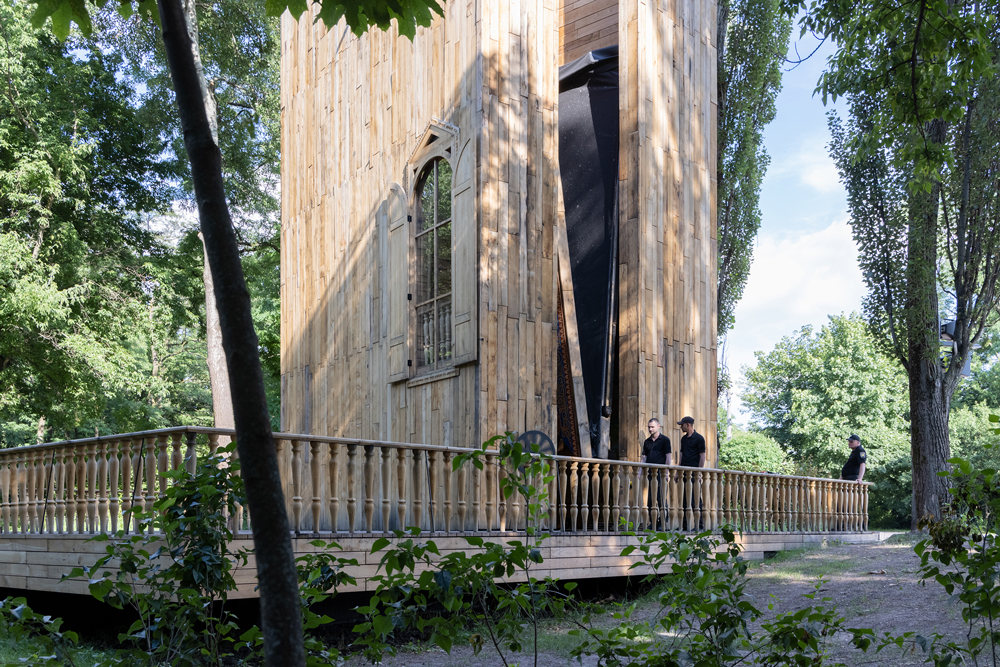
It takes a number of people to open up the synagogue, like a book. A synagogue, Manuel tells us, isn’t a consecrated place but is anywhere where 10 men gather to pray.  The important prayers are always communal.  And the first thing one does in a synagogue is to open a prayer book, with a liturgy of prayers and songs dating back thousands of years. We’re each left to reflect on this modest memorial.  It is an affirmation of life and, actually has a slight whimsical tone. That, too, is deliberate.  One of Manuel’s influences is ‘Victims’, John Hejduk’s proposal for a memorial park on the site of the Gestapo headquarters in Berlin to be composed of a series of small interventions over two 30 year periods. The victors over Naziism don’t need to out-muscle the fascists, concrete and stone aren’t always needed to point out the weight of the crime.


Opening process of the synagogue Image Iwan Baan ©


There is a gentleness in the plan to add a series of small architectural elements over the next 10 or more years, a clear attempt not to intrude into a site whose topography was deliberately abused by the Nazis and then by the communist authorities.  The murder of the Jews was complemented by the murder of thousands of Roma, Ukrainians, Soviet prisoners and the disabled. The Nazis in a futile effort to hide their crimes at one point disinterred thousands of bodies and burnt the remains.  When the communists took over Ukraine the ravine was filled in and in an effort to show there was nothing to see or commemorate, housing was built, a brick factory erected that extracted clay, leading to a flood when its dam burst, and a sports centre and a television tower were constructed. The communist authorities suppressed that the site was the place where Jews were murdered. Jews who tried to pray at Babyn Yar would be arrested.


Babyn Yar Memorial Image Iwan Baan ©

Soviet policy dictated that there should be no reference to the victims being Jewish, which meant no religious symbols were allowed at the site of Europe’s largest mass grave (other than the death camps).   It took 35 years for the authorities to relax the ban and eventually, in 1976 a small memorial was erected. In finally trying to recognise and respond to the atrocity the new memorial is intended to have a light touch, not to dig deep foundations in ground roiled by blood and further disturb that tortured topography.


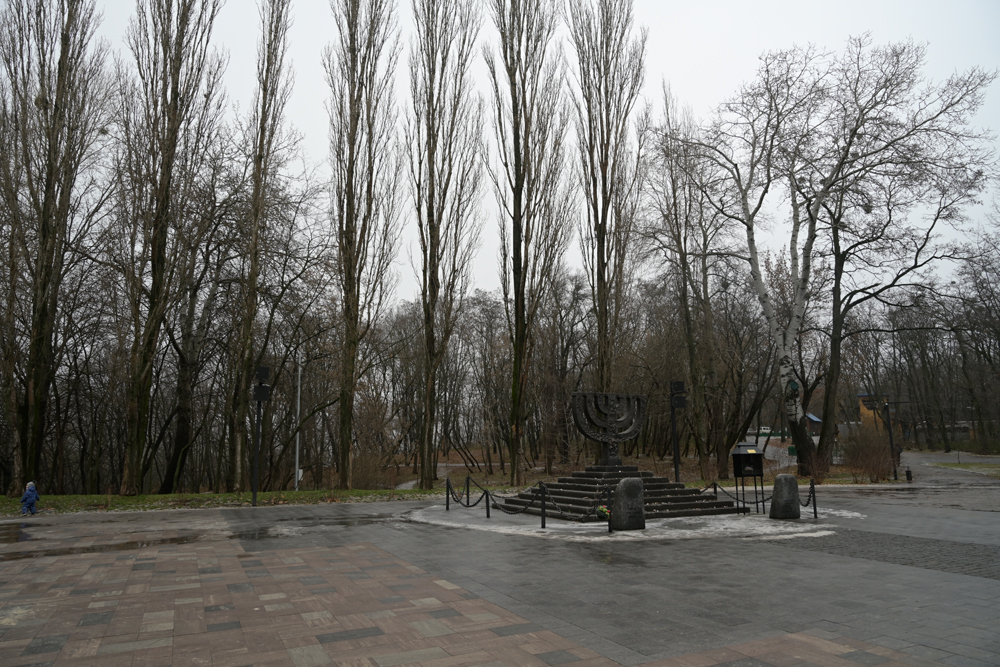
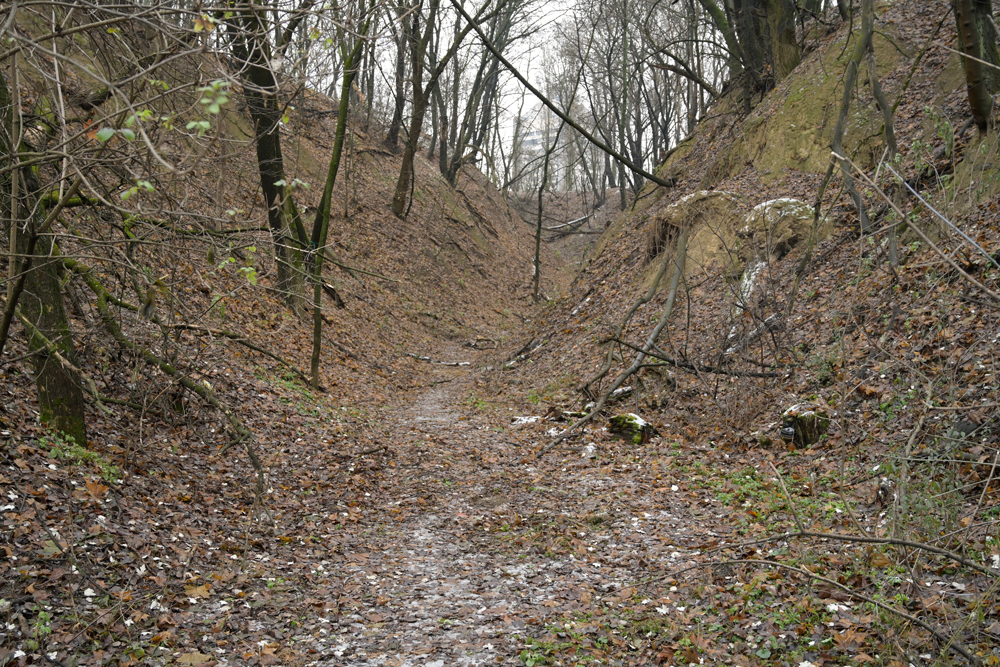
The ravine Image Iwan Baan ©


But on March 1st 2022 Kyiv TV Tower was struck by a missile attack during the Russian invasion of Ukraine. A huge explosion killed, the Ukrainian authorities say, five people.  The TV tower, part of that deliberate soviet-era effort to erase the history of Babyn Yar is less than 200 metres from the new synagogue. According to a BBC report, staff who were able to access the area have confirmed that while the synagogue was not damaged another building caught fire, and there is damage across the 140-acre site such as burnt and uprooted trees.  Again the peace the site of the Babyn Yar ravine deserves has been violently disturbed.

On August 28th 2022 on the 81st anniversary of the massacre, President Zelensky visited the Babyn Yar Holocaust Memorial laying flowers in memory of the victims and placed one of a series of commemorative lamps at the site.

The message of the synagogue to choose life is more urgent now than ever in a war that pits people who share languages, whose history and cultures are so deeply entwined.


architect Manuel Herz

Babyn Yar Synagogue Image Iwan Baan ©


About Manuel Herz

‘Based in Basel, Switzerland, Manuel Herz Architects is an architectural practice that is embedded in research, and is operating on a very wide range of typologies, locations and scales, from the architectural to the urban and territorial. Its completed projects include the Synagogue of Mainz, an apartment building „Ballet Mécanique“ in Zurich with moving facades, and a social housing project with a kindergarten in Lyon. Presently under development are a hospital in Tambacounda in eastern Senegal, a large-scale residential complex comprising over 200 apartments in Cologne, a masterplan and Synagogue for the Babyn Yar memorial area in Kyiv, Ukraine, as well as other projects across Europe and the African continent. Beyond the architectural scale, Manuel Herz has been active in furniture and exhibition design, as well as in urban master planning and urban research. His projects have won numerous international design awards, have been exhibited in museums worldwide, and acquired into the collection of the Museum of Modern Art (MoMA), amongst others. His office currently employs twelve people.

Manuel Herz‘s research focuses on the architecture and urbanism of migration. His book „From Camp to City: Refugee Camps of the Western Sahara“ documents how refugee camps can be places of social emancipation. At the Architecture Biennial in Venice in 2016, Manuel Herz curated and designed the National Pavilion of Western Sahara. His award-winning book „African Modernism – Architecture of Independence“ presents the architecture of countries such as Ghana, Senegal, Ivory Coast, Kenya and Zambia at the time of their independence in the 1960s and 1970s. The parallel exhibition shown at the Vitra Design Museum is currently touring cities in Europe, the US, and Africa. He has also co-authored the book „Nairobi – Migration Shaping the City“ and the MetroBasel Comic, an urban study of the tri-national region of Basel.’

All photos © Iwan Baan


The Values of The Brutalist


The Values of The Brutalist

Concrete giants: European Legacy in a New Land


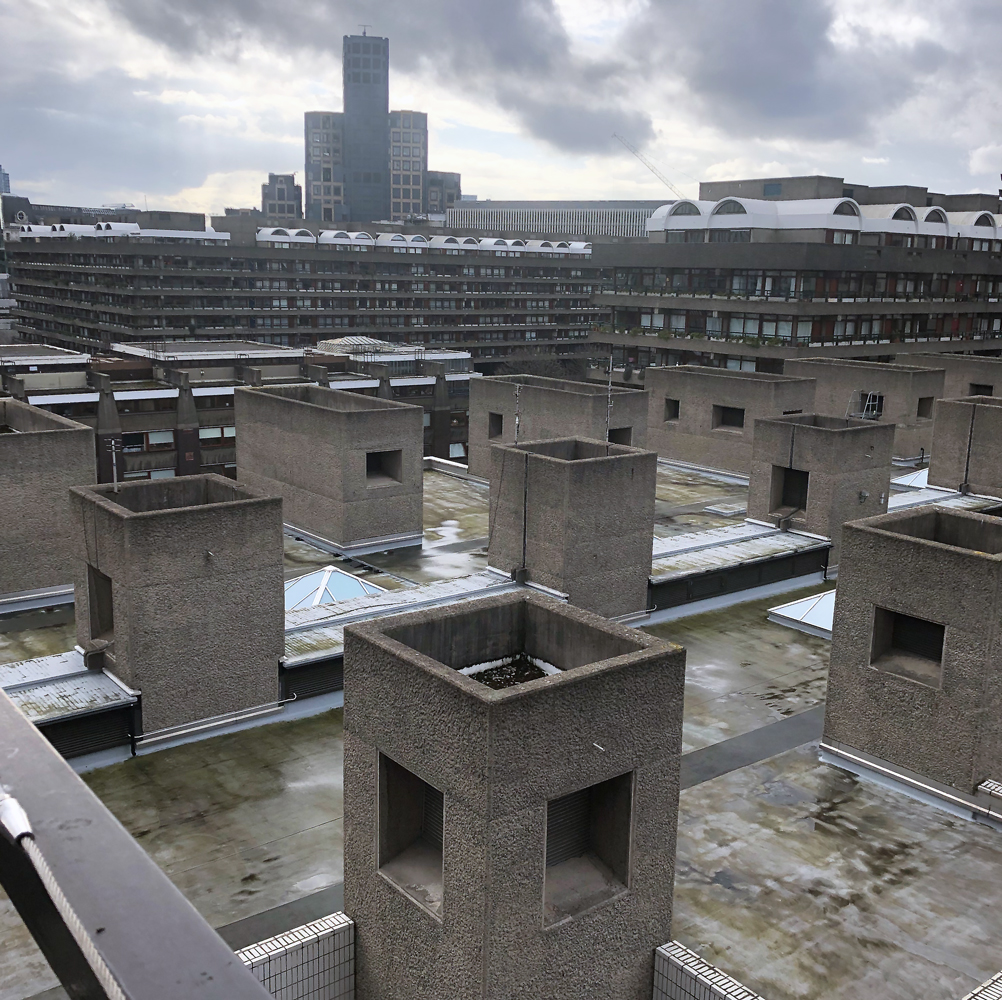
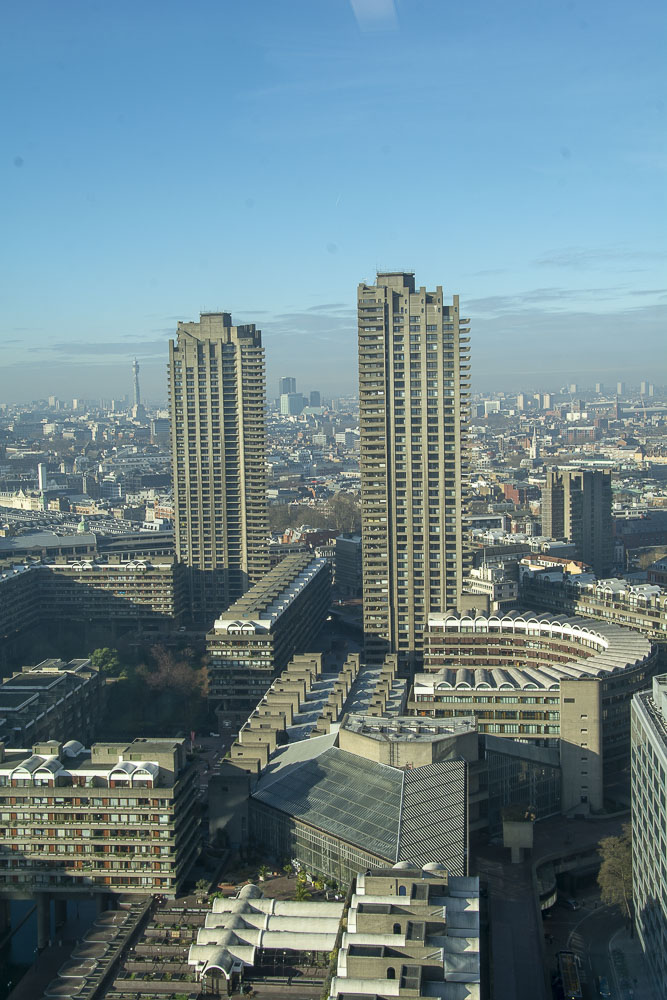
Barbican Rooftops Image Greyscape ©

Brutalism, Modernist Architects, and the Jewish Influence on Modernist Design

The movie The Brutalist has triggered fresh interest in the origins and development of modernist architecture. The film is wrapped in the bold, austere aesthetic of Brutalism. Played by Adrian Brody, the principal protagonist is a gifted modernist architect, a Jew, a survivor of the Holocaust and an immigrant, a stranger in a strange land. Architects of Jewish heritage made significant contributions to modernist design and we ask the question, why?

The term “Brutalism” itself is derived from the French word “béton brut,” which translates to “raw concrete.” It was popularized by the British architectural critic Reyner Banham in reference to the work of Le Corbusier and his use of stark, unadorned concrete surfaces.

A Movement Born of Upheaval

Modernism, and its offspring Brutalism, emerged in the early 20th century, an era marked by dramatic societal, political, and technological transformations. For Jewish architects and designers, the movement represented an opportunity to break from tradition and an establishment that didn’t want Jews joining the profession. Modernism rejected the historicist and ornamental styles of the 19th century, favouring rationality, abstraction, and functionalism. To those who had survived the Great War there was a desire to embrace the new, to use materials and technology in a new aesthetic and one, significantly, that could improve the living conditions of not just the rich but the working classes, too.

Jewish thinkers and architects gravitated toward this philosophy for various reasons. Many saw modernism as a way to challenge entrenched norms and redefine their place in societies where they often faced marginalization. The egalitarian ethos of modernism resonated with Jewish values that emphasized intellectual exploration and social justice. Visionaries such as Marcel Breuer, Erich Mendelsohn, and Richard Neutra were instrumental in shaping modernism, drawing from these principles while pushing the boundaries of architecture and design. The modernists published hundreds of manifestos and papers, envisioning their design ethos as but one part of a road to social improvement and for some socialism. Immediately in the wake of the October Revolution in Russia there was a great flowering of radical new design. Russia was the crucible that produced its own modernism in Constructivism until the iron grip of Stalin’s tyranny crushed the movement and purged the artists and designers who had with such heartfelt devotion fallen for Bolshevism.


barbican estate from a distance

Image Howard Morris


The Role of the Diaspora

The rise of fascism in the 1930s forced many Jewish architects to flee, leading to a diaspora that would spread modernist ideals globally. With anti-Semitic regimes targeting Jewish professionals and artists, Germany, Austria, Hungary and Poland became inhospitable for Jewish architects while doors to Jewish immigration were closed in many more countries. First, they were expelled from their professions losing their livelihoods, their work condemned as degenerate and later, unless they could get away, they would lose their lives.

This exodus, while tragic, allowed modernism to take root far beyond its European origins. In the United States, Jewish émigrés like Marcel Breuer and Ludwig Mies van der Rohe (a modernist leader who collaborated with Jewish colleagues at the Bauhaus) played central roles in integrating modernist design into the American architectural landscape. The Bauhaus, with its experimental approach to unifying art, design, and technology, became a foundation for the work of many Jewish architects and designers as they adapted its principles to new cultural and economic contexts.

Marcel Breuer is renowned for translating the minimalism and functionalism of Bauhaus design into striking architectural projects and furniture pieces. His Wassily Chair, constructed of tubular steel and leather, epitomized modernist ideals of efficiency and elegance. In the post-war era, his work evolved further, influencing Brutalist architecture, with buildings such as the UNESCO headquarters in Paris and New York’s Whitney Museum reflecting the movement’s emphasis on monumentality and raw materiality.


St Martins Place, Harry Seidler, Sydney Image Mike Oliver

Brutalism and Resilience

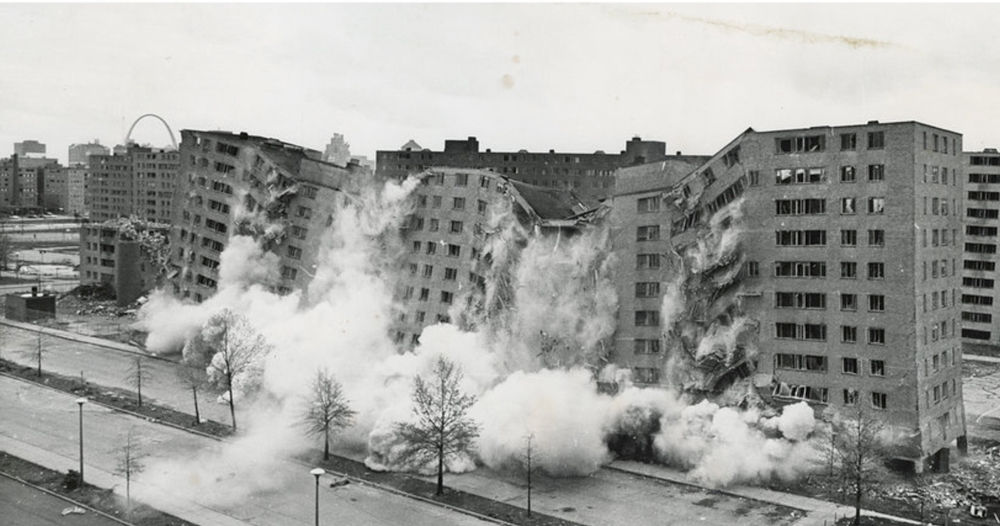
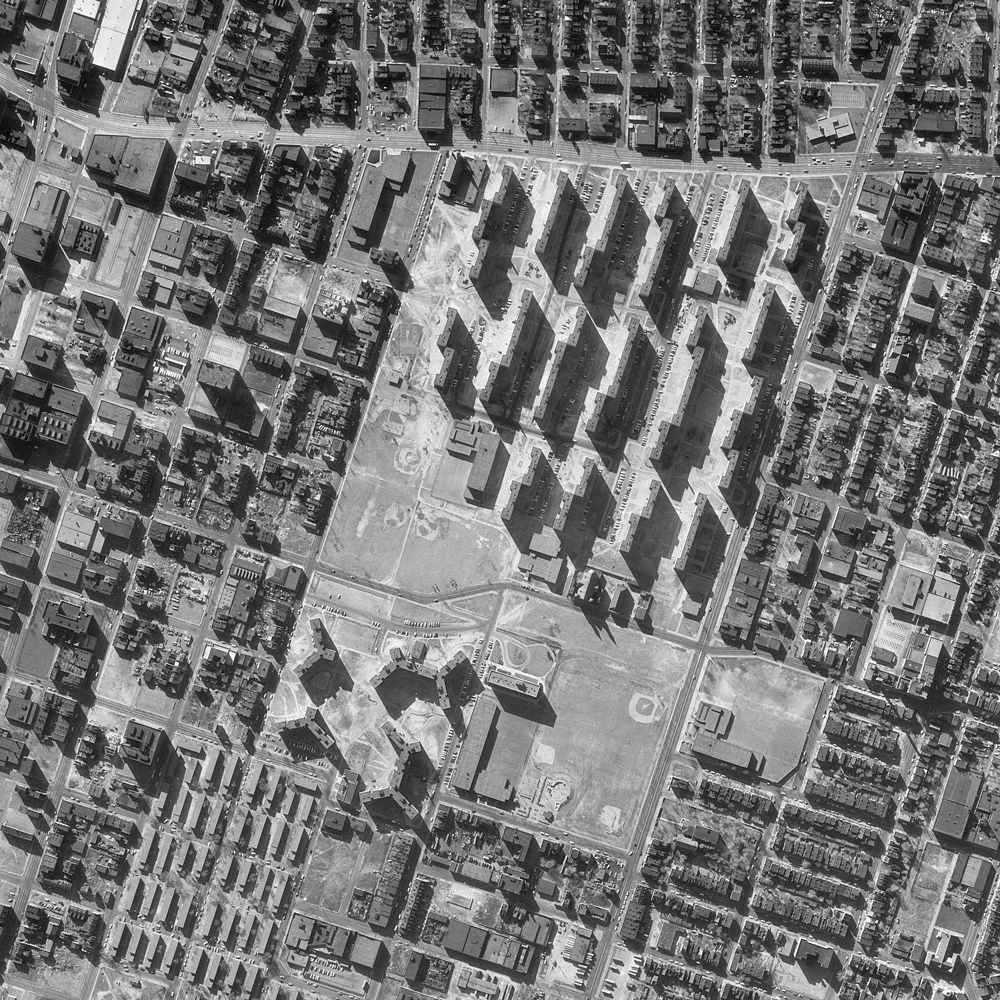
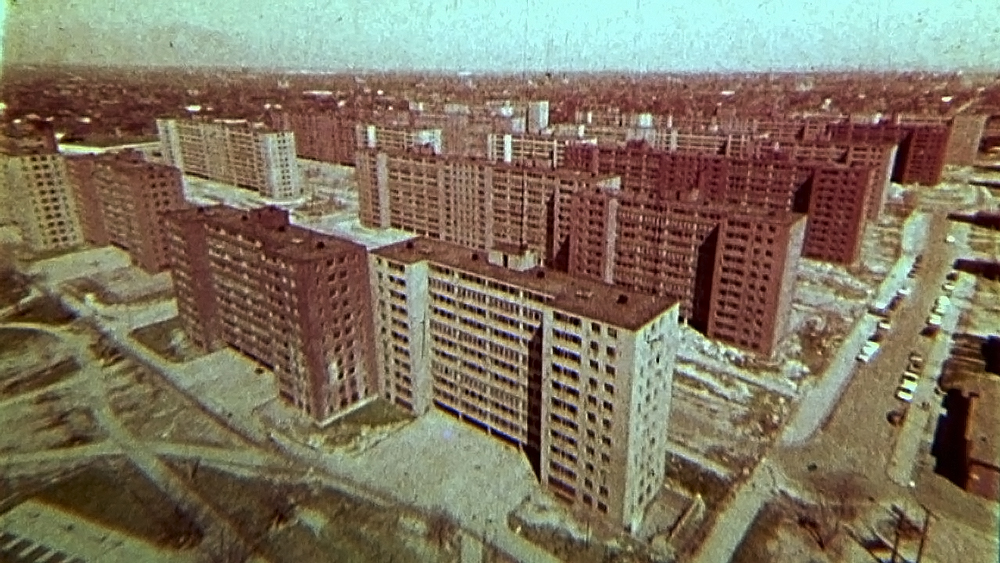
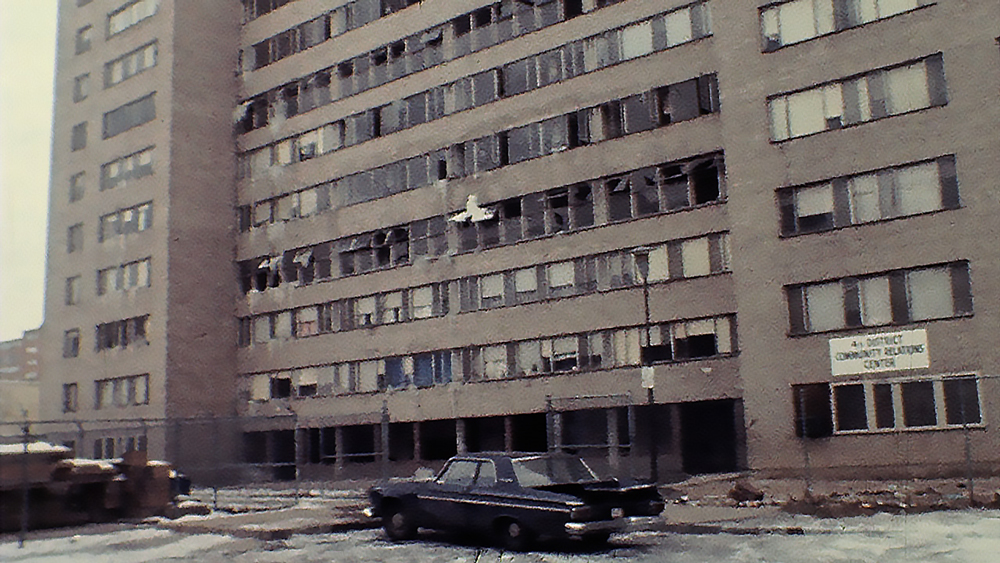
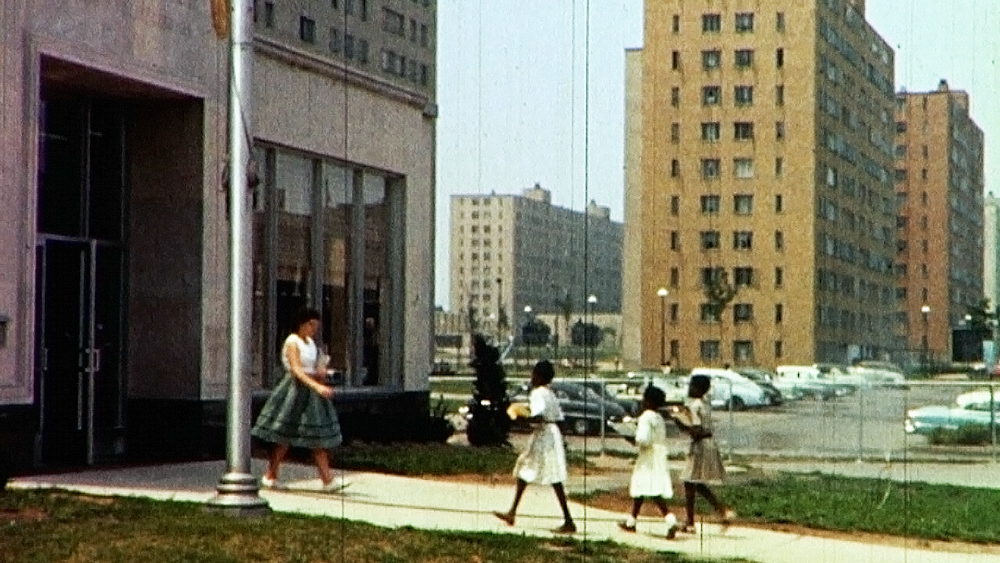
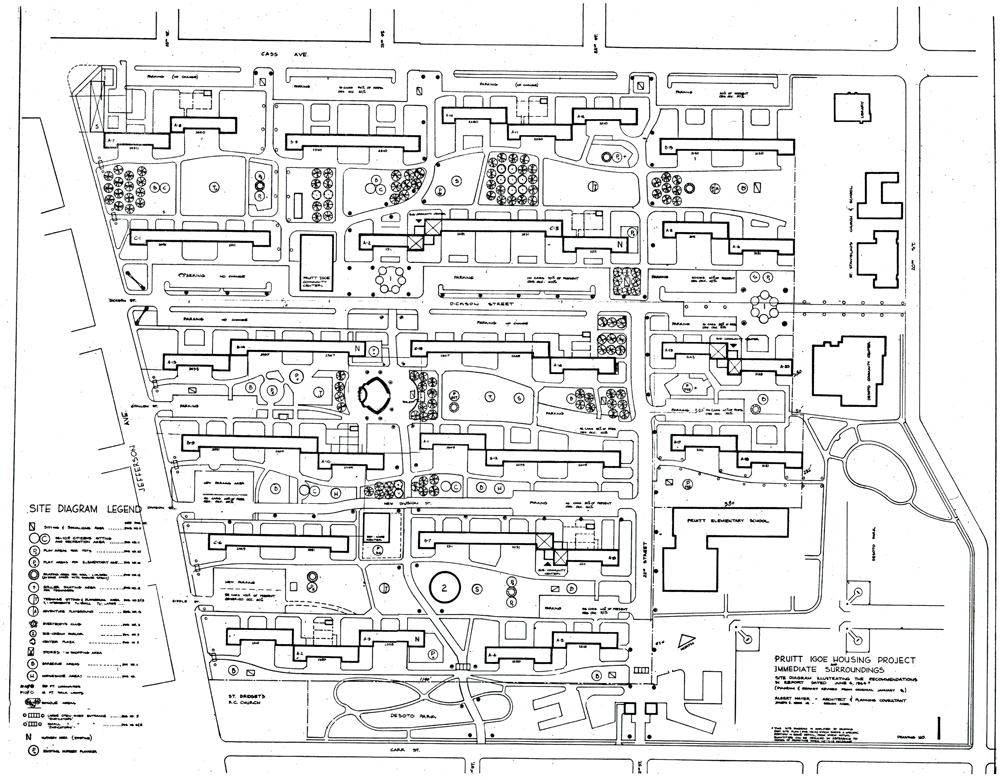
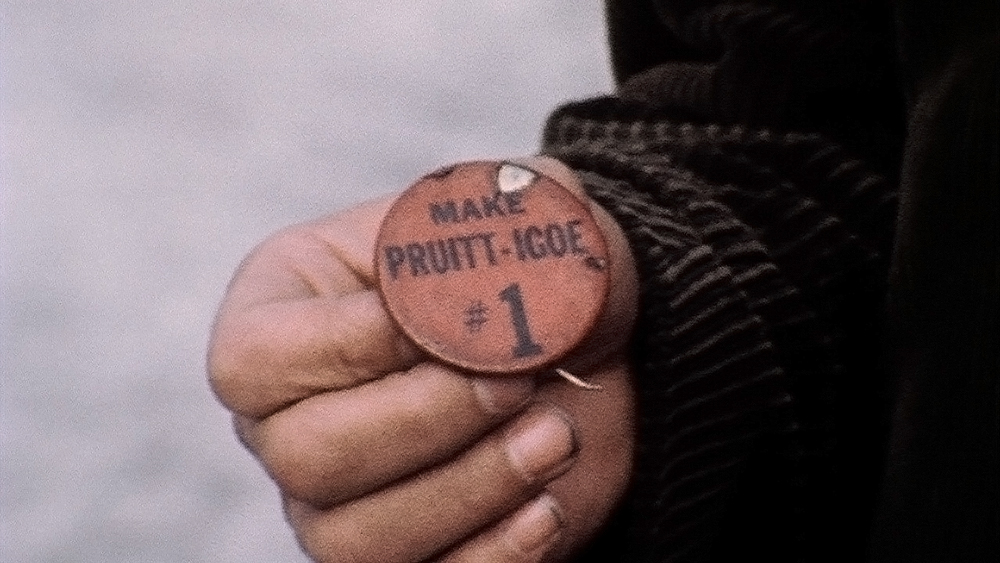
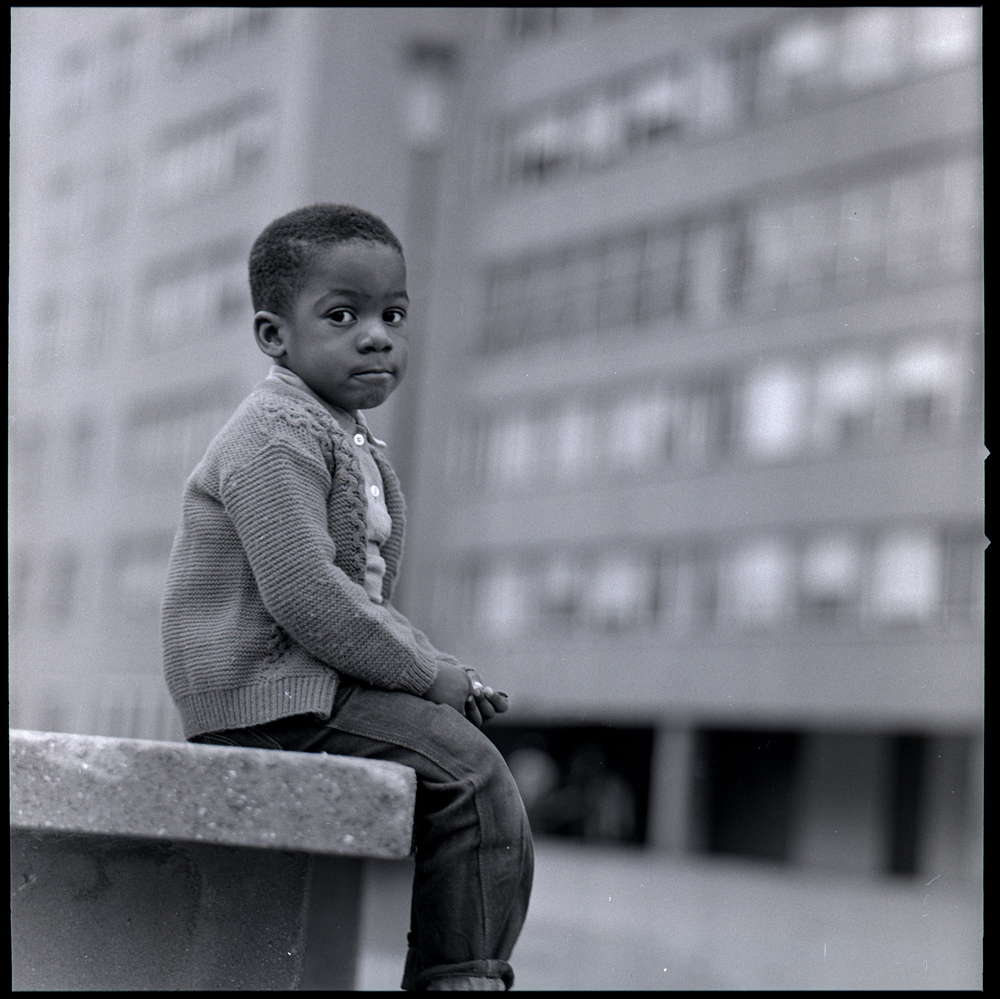
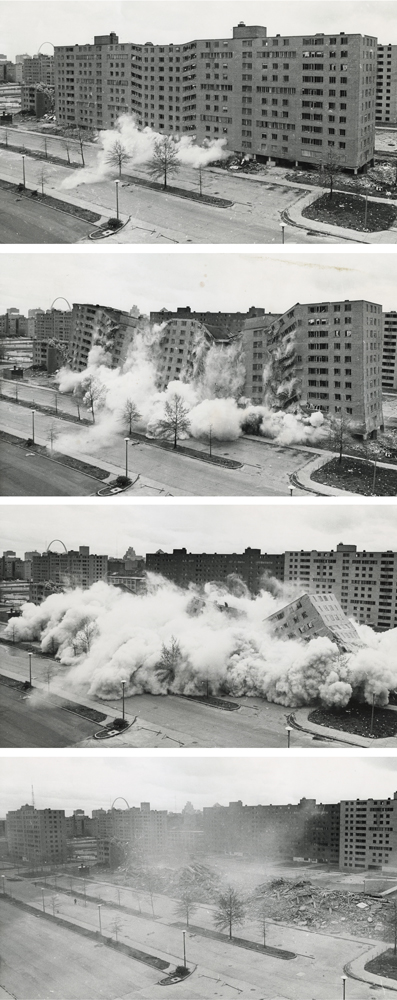
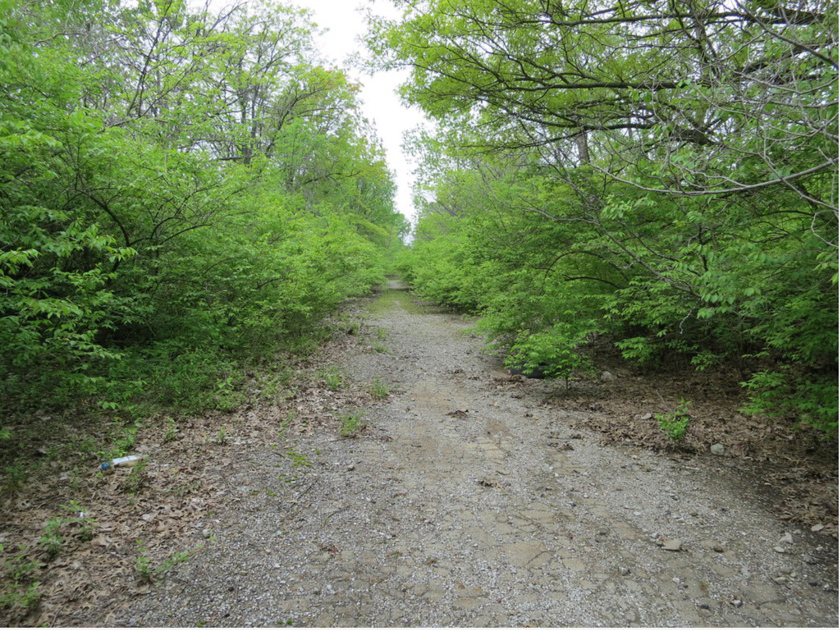
Brutalism, emerging in the post-World War II period, became a material response to the challenges of rebuilding societies and addressing urban housing shortages. Its defining characteristics—monumental concrete structures, bold geometric forms, and a focus on functionality—aligned with the modernist ethos but carried an additional layer of meaning for Jewish architects who had experienced displacement, war, and cultural upheaval. There was a need to create decent homes for working people who had lived in squalor and deprivation and to do so quickly. But there was a naivety and sometimes a meanness in the commissioning authorities that great concrete residential estates would not need maintenance. So whilew the Barbican has flourished, Aylesbury Estate and Pruett-Igoe were neglected.

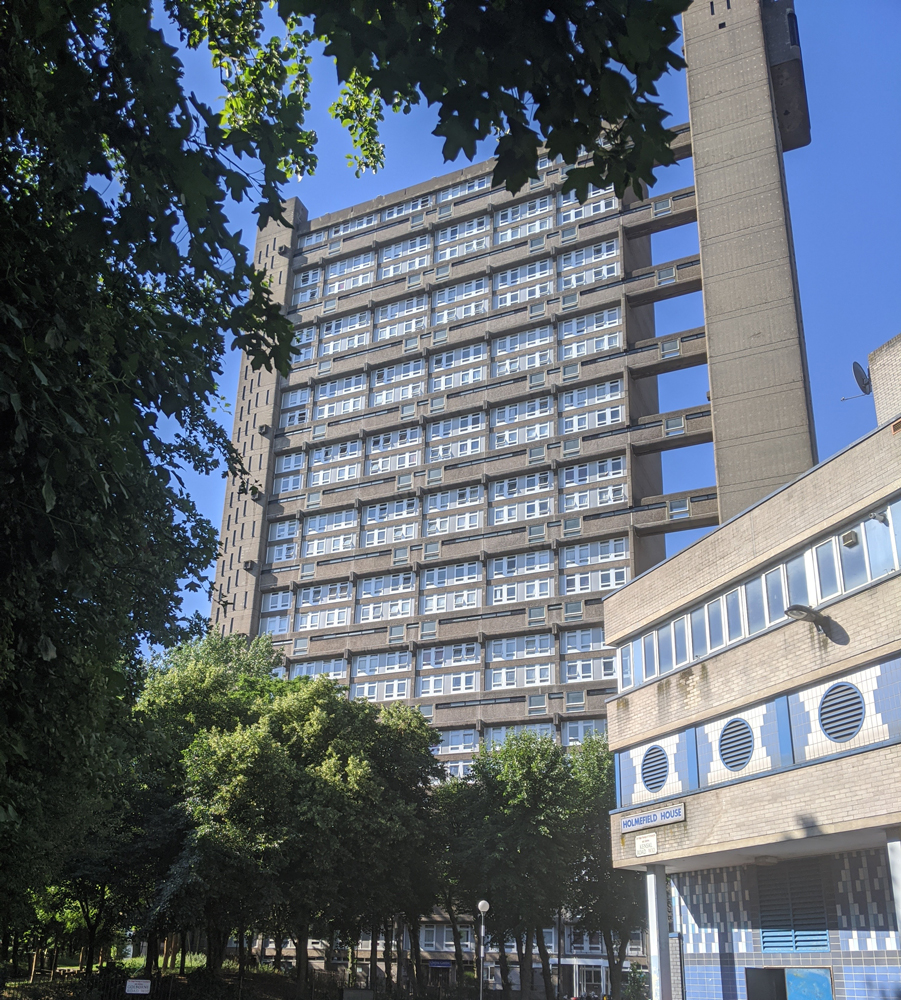
For architects like Ernő Goldfinger, Moshe Safdie, and Marcel Breuer, Brutalism was not only an aesthetic but also a moral project. Goldfinger’s Trellick Tower in London, for example, exemplified the Brutalist commitment to creating accessible housing while incorporating communal spaces that encouraged interaction among residents. Though controversial at the time, Trellick Tower is now celebrated for its visionary design and enduring presence in London’s urban fabric.

Moshe Safdie’s Habitat 67, created for the 1967 World Expo in Montreal, takes Brutalism in a different direction. By combining prefabricated concrete modules into a highly adaptable housing complex, Safdie addressed issues of density and quality of life, providing a visionary alternative to conventional apartment blocks. For Safdie, as for many Jewish modernists, architecture was a way to envision a better, more equitable society—one shaped by principles of social cohesion and resilience.


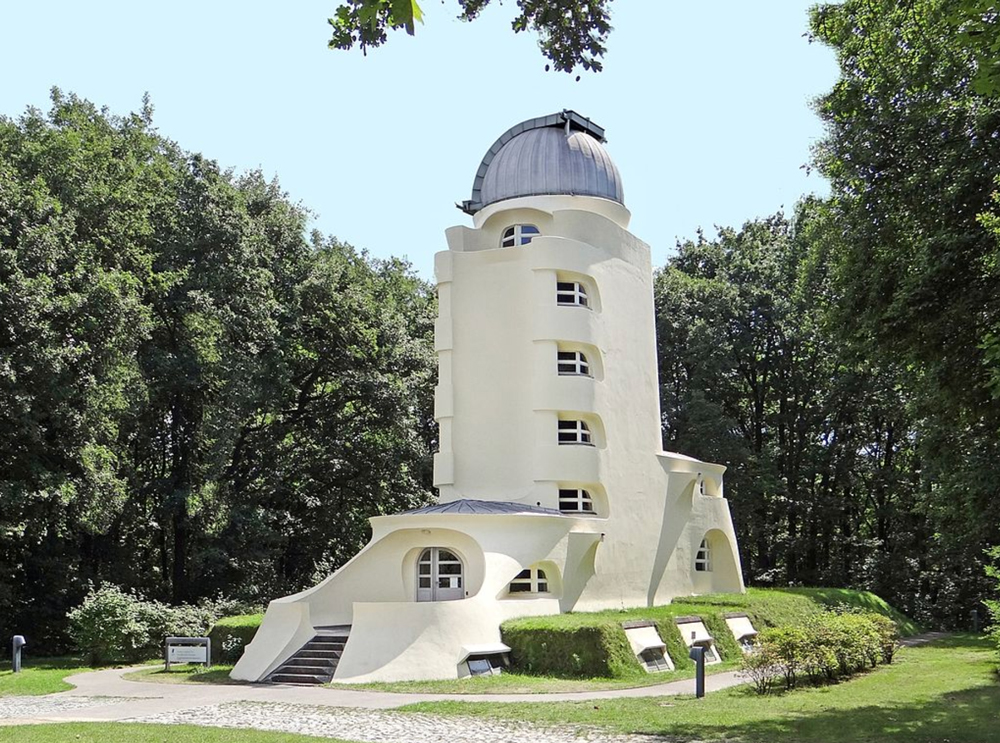
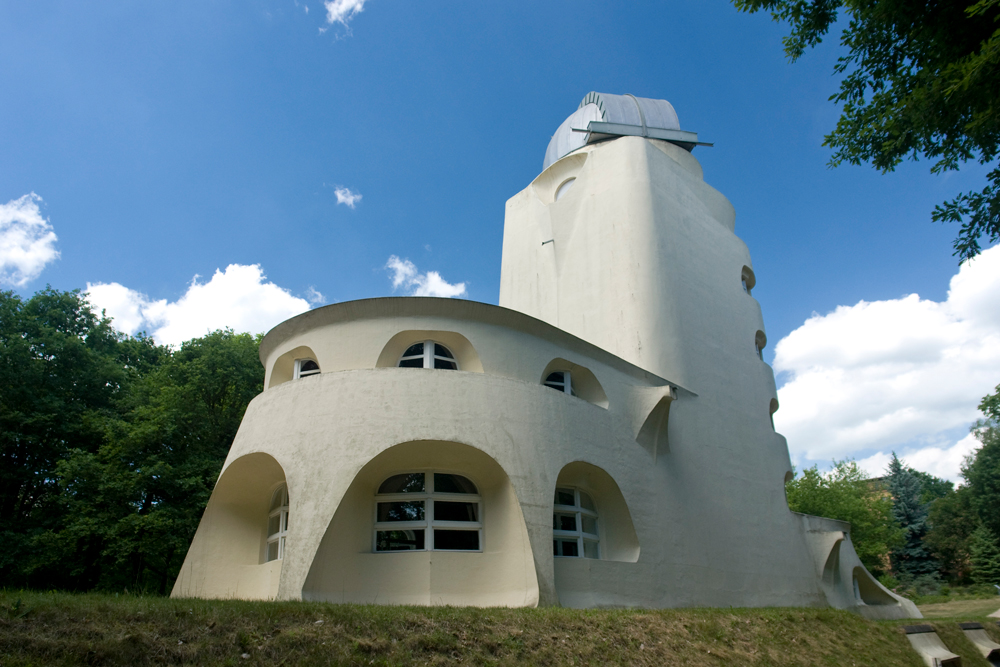
Einstein Tower Potsdam photo Jean Pierre Dalbéra CC BY SA 2.0

The Appeal of Modernism to Jewish Architects

The prominence of Jewish architects in modernism is no accident. Here are some reasons why modernism was especially appealing to Jewish designers during the 20th century:
1. A Break from Tradition: Modernism’s rejection of ornamentation and historical styles offered Jewish architects a way to challenge societal norms and transcend their marginalised status. For many, embracing modernist design was a means of affirming a progressive identity unshackled from centuries of anti-Semitic stereotypes.
2. Urbanisation and Education: Jewish communities in Europe and the United States were highly urbanised by the early 20th century, often emphasizing education as a pathway to opportunity. This emphasis allowed Jewish architects and designers to access the avant-garde intellectual circles where modernism thrived.
3. Exile and Adaptation: Forced migration during the rise of fascism pushed Jewish architects to adapt their ideas to new cultural contexts. This process of reinvention not only spread modernist principles but also infused the movement with fresh perspectives.
4. Shared Values: The modernist emphasis on equality, functionality, and rationality resonated with Jewish intellectual and ethical traditions, which often emphasised community, social justice, and innovation.

A Lasting Legacy

The contributions of Jewish architects to modernism and Brutalism are not merely historical footnotes but enduring legacies that continue to shape the built environment. The sleek lines of mid-century modern furniture, the bold concrete forms of Brutalist housing estates, and the utopian ideals embedded in urban planning are all testaments to the influence of Jewish modernists who sought to transform society through design.

Their work also serves as a poignant reminder of the resilience and creativity of the Jewish diaspora. Despite facing persecution and displacement, Jewish architects and designers used the tools of modernism to create spaces that were both functional and visionary. Whether it was Marcel Breuer reimagining domestic architecture, Ernő Goldfinger building monumental housing projects, or Moshe Safdie proposing radical solutions for urban living, these architects left an indelible mark on the world.


Trellick Tower Image Louise Loughlin


Reflecting on Brutalism

The Brutalist brings these stories to life, offering a powerful homage to the architects who shaped modernism and Brutalism. By weaving together historical narrative and architectural exploration, the film highlights the ways in which Jewish values and experiences informed the movement’s ideals.

Modernist and Brutalist architects grappled with questions that still drive design: How can design address social inequities? What role does architecture play in shaping identity and community? Through their visionary projects, these architects challenged conventional thinking and dared to imagine a better future. The Brutalist makes us think, again, about these questions.

So, what does it all mean?

In the aftermath of the horrors of the Great War, that was supposed to be the very last war, a shattered generation saw in design a means of healing the world. But it was also a time when the world was being reshaped by prejudice and race hatred, and technological change. That there was a disproportionate representation of Jewish architects in modernism is because of the intersection of cultural values, historical circumstances, and, of course, individual genius. Jewish modernists brought a unique perspective to the field, yearning to be free of historical sterotypes and the persecution that went with them, blending innovation with a deep commitment to social and cultural renewal.

The legacy of these architects is not only found in the buildings they created but also in the enduring principles they championed—principles that continue to inspire architects and designers today. By celebrating this legacy, The Brutalist reminds us of the transformative power of architecture and its ability to reflect the complexity of human experience. With every raw concrete form and streamlined design, we see the indelible impact the modernists who turned adversity into art, building a future shaped by resilience, innovation, and hope.

Why were Zoos attracted to Modernist design?

Concrete Menageries:

Why were Zoos drawn to Modernist design?


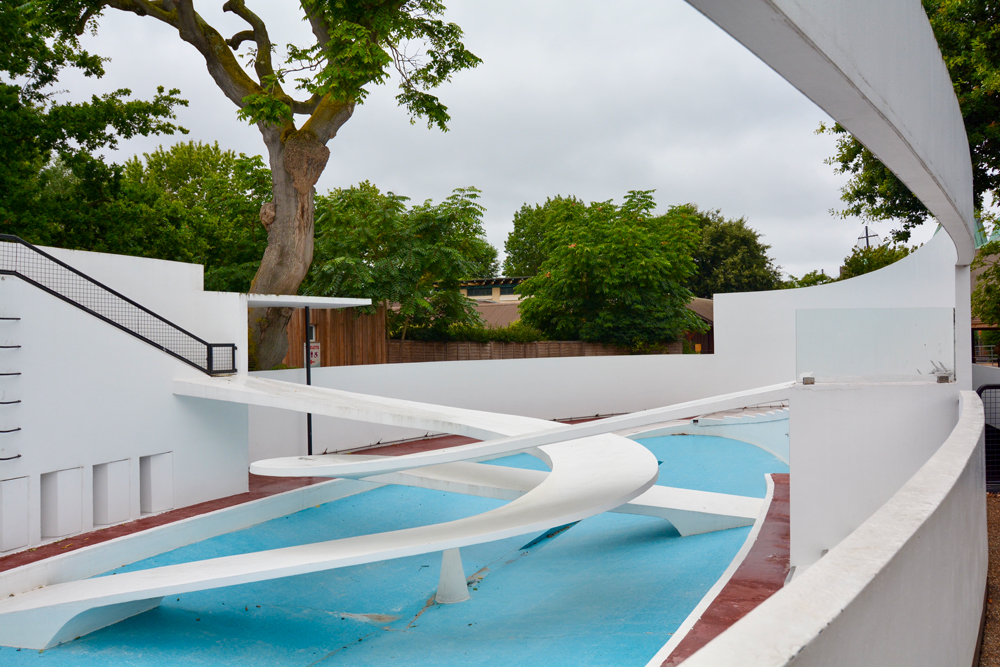
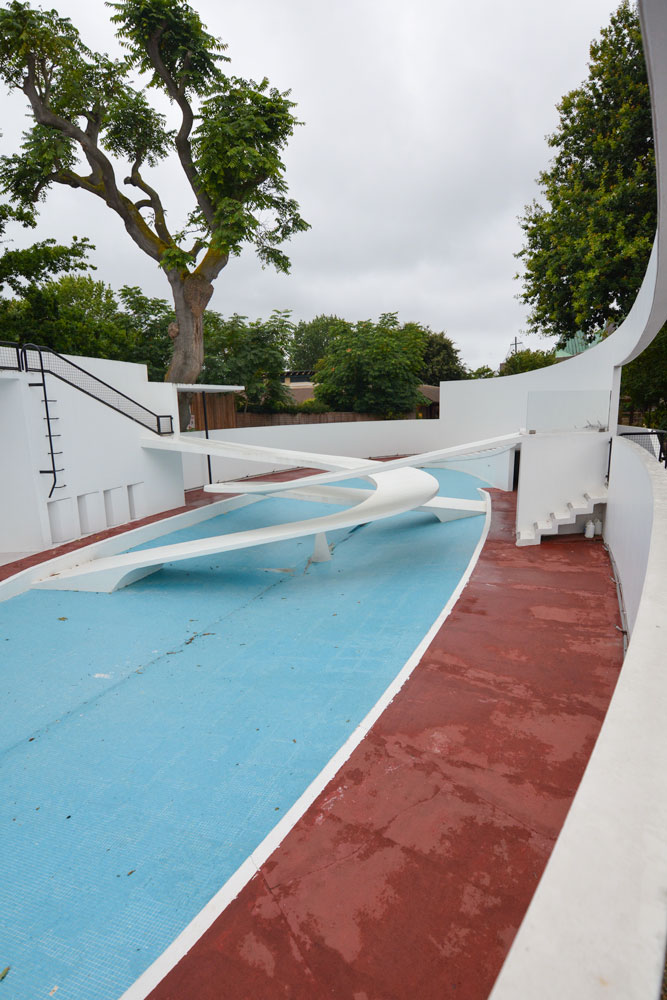
Penguin Pool, London Zoo, architect Berthed Lubetkin Image H Morris


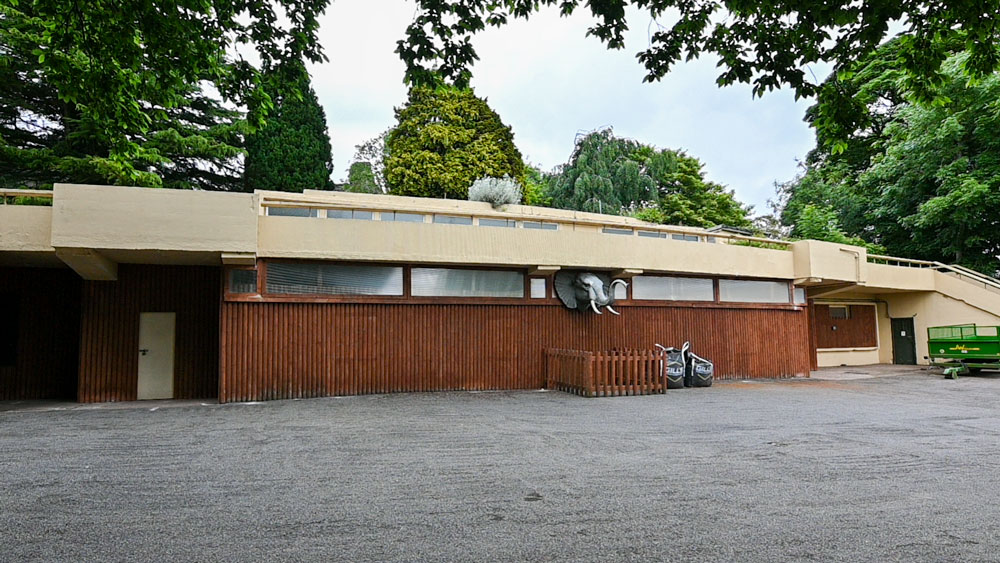
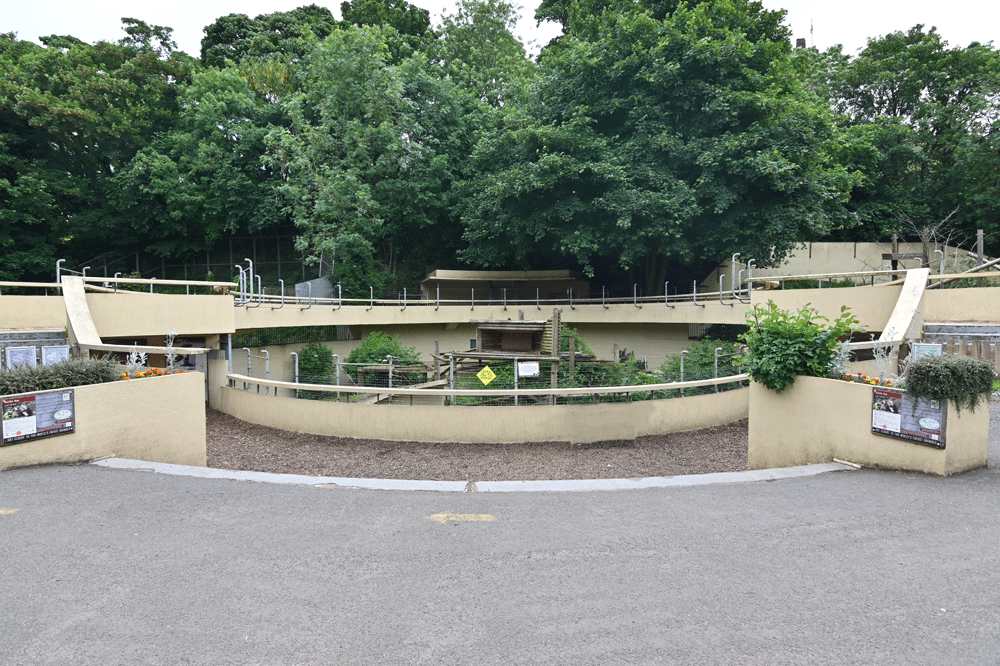
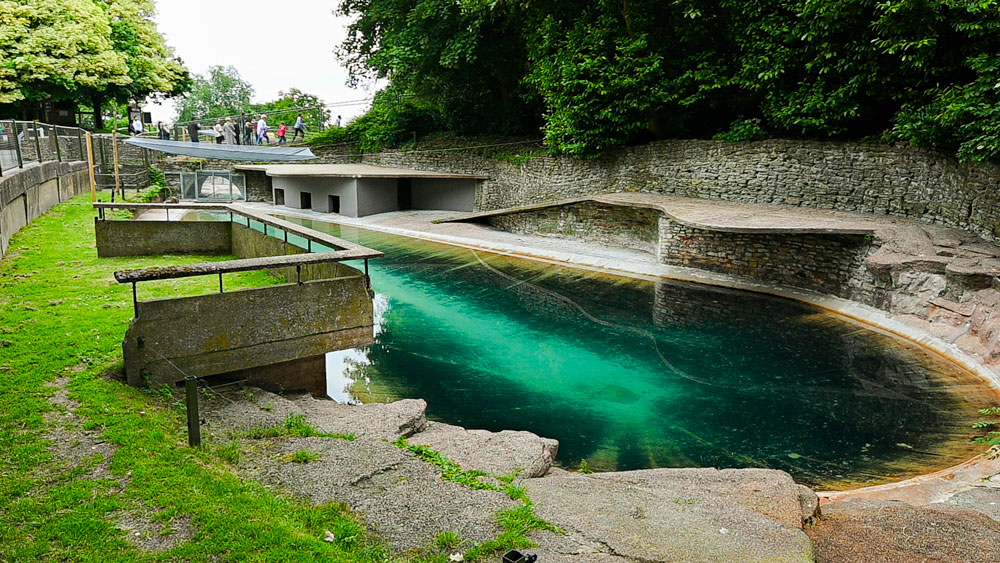
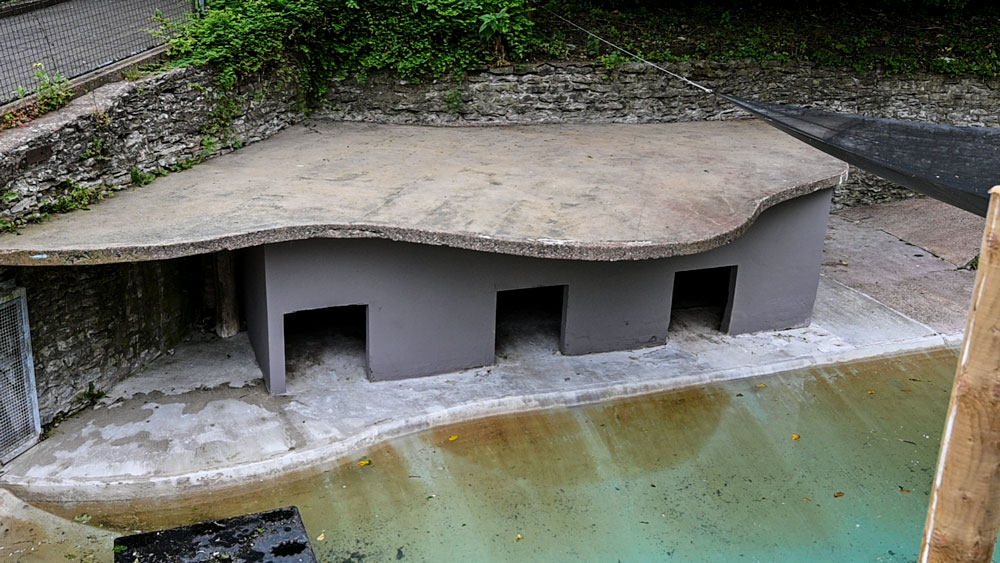
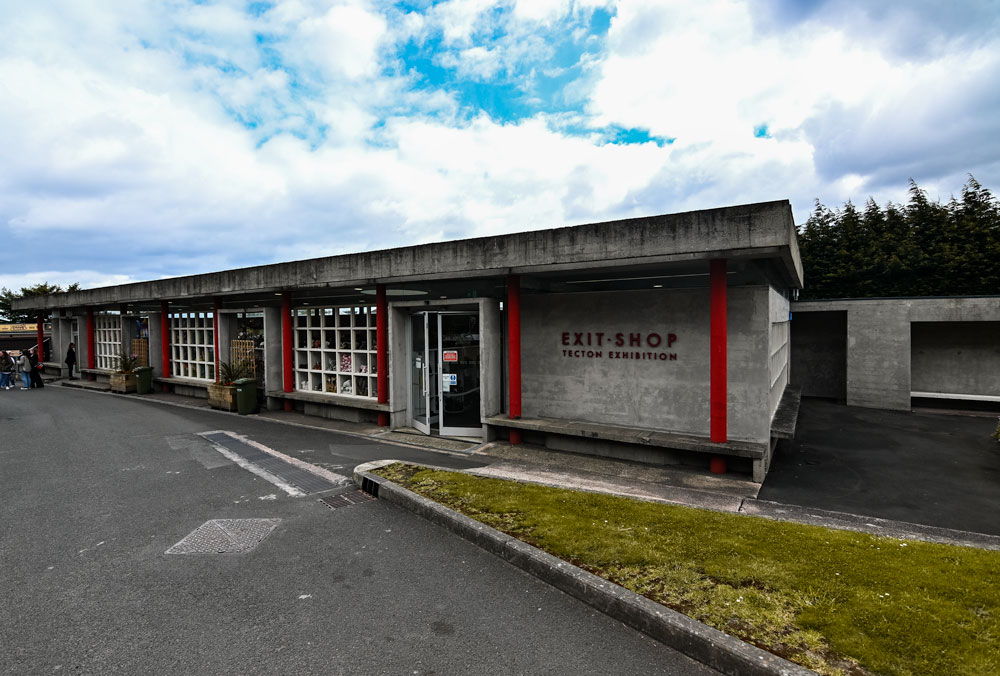
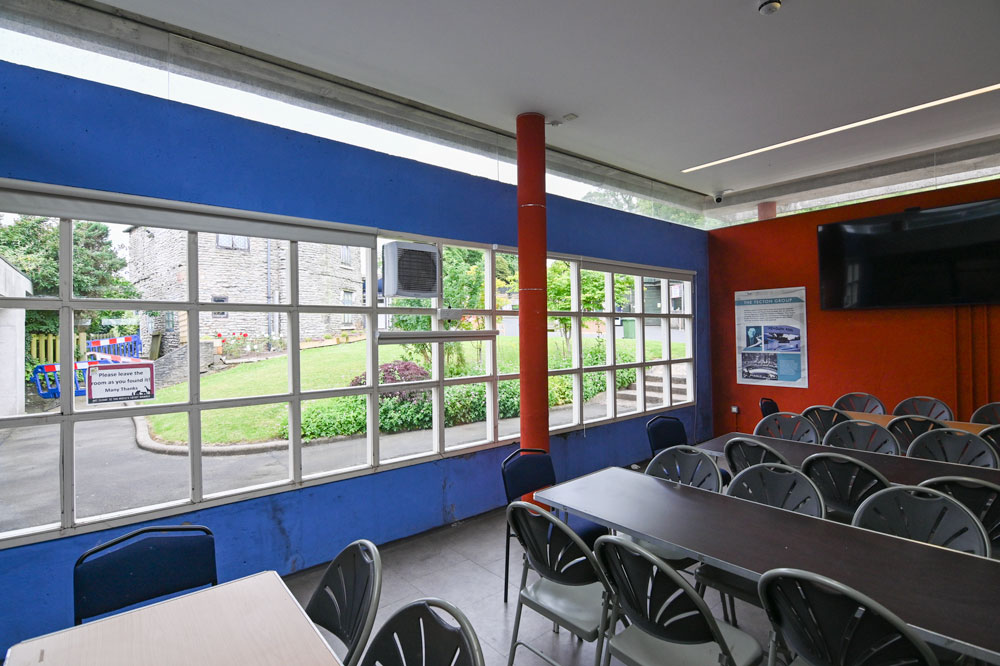
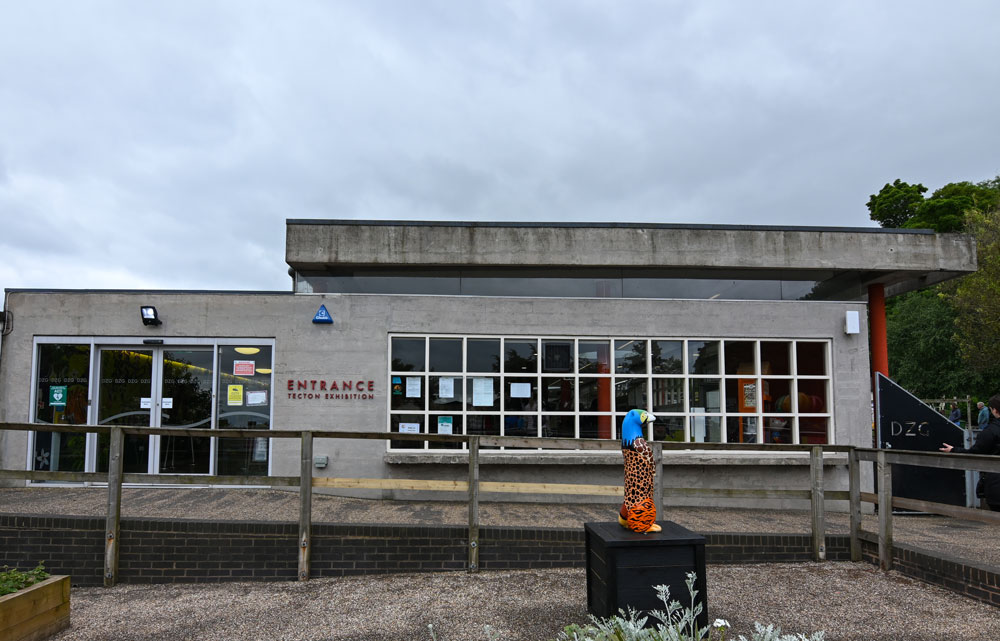
We’ve featured the modernist architecture of two zoos in Britain, Regent’s Park and Dudley. In the 1930s, they were proud to commission the Tecton Group, the architectural practice of the emigre Berthold Lubetkin, to design structures that continue to impress today.  This was at a time when the country at large was equivocal about modernist buildings. So, why were zoos attracted to modernist design?

As the zoos fumbled towards a raison d’être for their existence, modernism and modernist architects were on a mission of social and societal improvement

In the first half of the twentieth century, zoos saw themselves as institutions of cultural and civic pride and promoters of modern ideals, human progress and a greater understanding of the mysteries of biology and human control over nature.  They were centres of research and discovery and while providing entertainment, they were, they believed, educating the public.  While conservation and the breeding of species is now central to the mission of zoos, the early beginnings of this work in the first half of the twentieth century meant that zoos began to see themselves as the protectors of species. We also know that a fascination with eugenics took root among some in the field of biology and this undoubtedly played into another important element of the whole zoo concept, colonialism and supremacy.


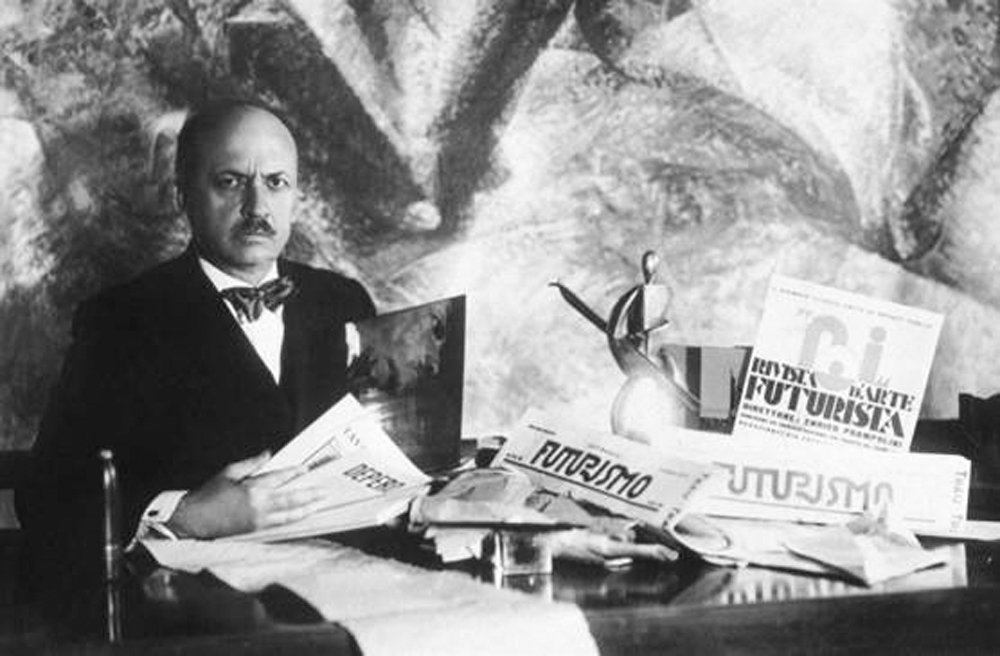
Filippo Tommaso Marinetti’s Manifesto of Futurism


As the zoos fumbled towards a raison d’être for their existence, modernism and modernist architects were on a mission of social and societal improvement. They published manifestos setting out their philosophy that went far beyond their buildings’ design and engineering issues.  For example, Marinetti’s Futurist Manifesto (1909),  Tatlin and Rodchenko’s Founding Manifesto of Constructivism (1921), The Bauhaus Manifesto (1919), the various declarations of CIAM between 1928 and 1959 and, of course, at least three works by Le Corbusier.  There were many others, some 200 it’s been estimated.

Modernism and zoos both saw themselves doing the work of improving humanity and so it was a natural step for zoos to embrace modernist architecture.


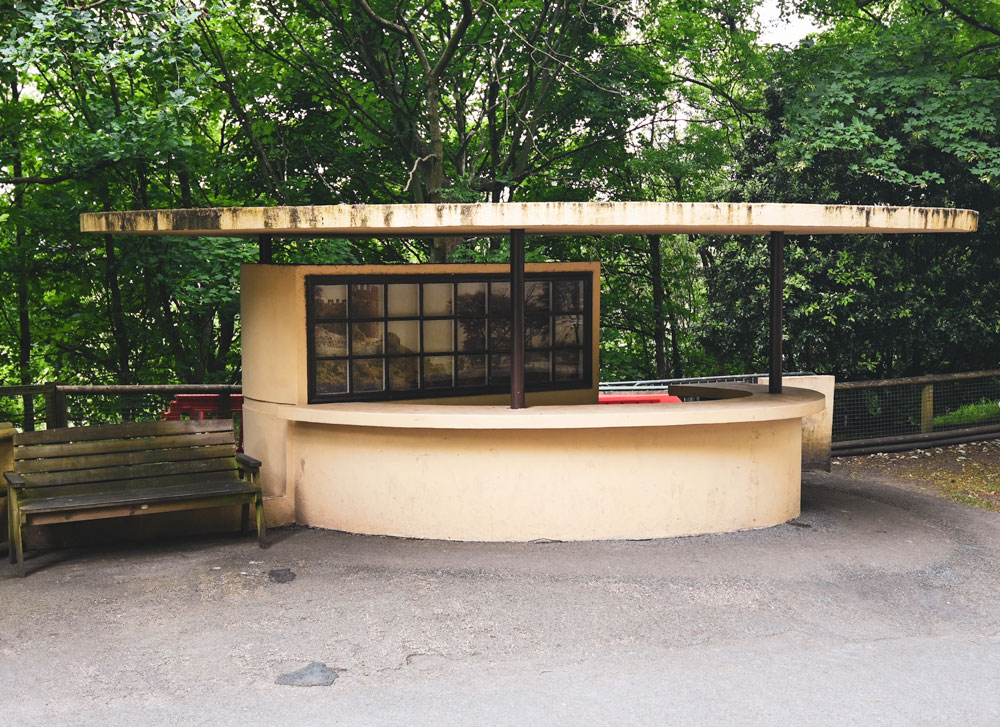
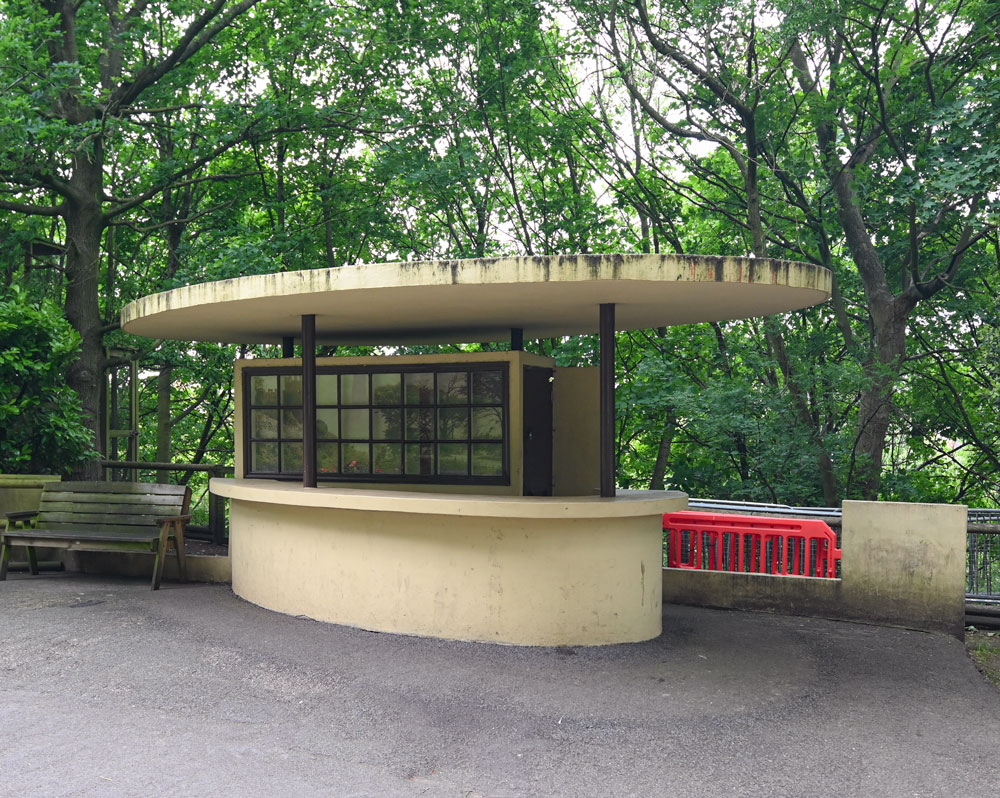
Kiosk, Dudley Zoo, Tecton Berthold Lubetkin Image Howard Morris


Early architectural examples from this period tended to incorporate clean lines, functional forms, and sometimes raw materials like concrete. Here are some notable zoos and buildings from that period that reflect modernist and even proto-brutalist architectural tendencies:

1. Zoo Basel (Zoologischer Garten Basel) – Basel, Switzerland

• Architectural Highlights: Zoo Basel has some early modernist elements. The Penguin Pool (1939), designed by architect Heini Dalcher, has a modernist style with clean, functional lines.
• Notable Features: The Penguin Pool’s use of concrete and simple, geometric shapes reflects early modernist influences. While not fully brutalist, the stark materials and minimalist design were innovative for a zoo structure of that era.

2. Paris Zoo (Parc Zoologique de Paris) – Paris, France


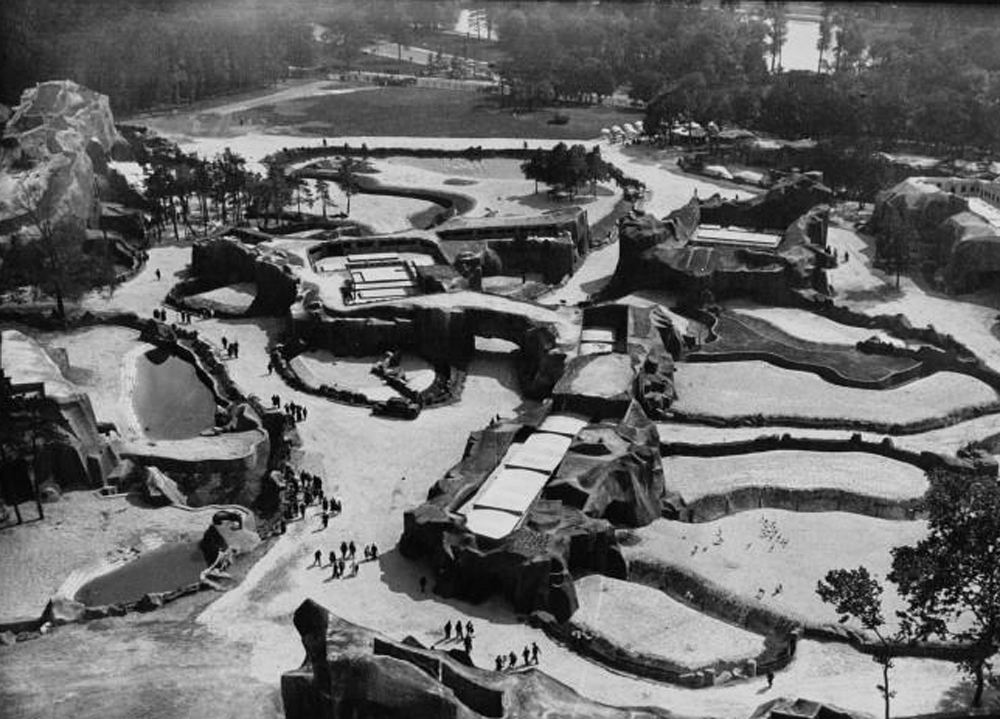
Zoo de Vincennes, Paris 1934


• Architectural Highlights: Opened in 1934, the Paris Zoo was designed by architect Charles Letrosne and landscape designer René Berger, with a distinctly modernist approach.
• Notable Features: The zoo’s main feature is the “Grand Rocher” (Big Rock), an artificial concrete mountain that dominates the zoo’s skyline. This large, sculptural element has a distinctly modernist feel with hints of what would later be seen as brutalism in its raw, imposing concrete.

3. Antwerp Zoo (Zoo Antwerpen) – Antwerp, Belgium


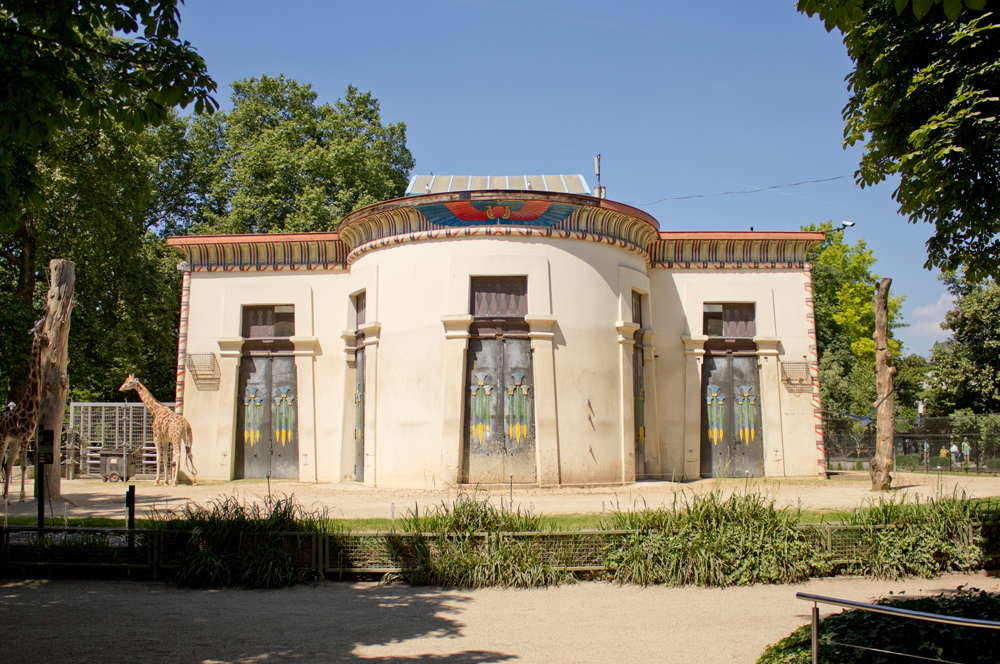
Egyptian Temple, Antwerp Zoo Image Johan Bakker CC BY SA 4.0


• Architectural Highlights: Although Antwerp Zoo dates back to the 19th century, the zoo incorporated modernist ideas in some of its newer 20th-century structures, including renovations and expansions from the 1930s.
• Notable Features: The Egyptian Temple, originally designed in the 19th century but expanded in the 1930s, received modernist touches during the early 20th century as the zoo adapted to newer styles and building techniques.

4. Zoo Zurich (Zoologischer Garten Zürich) – Zurich, Switzerland


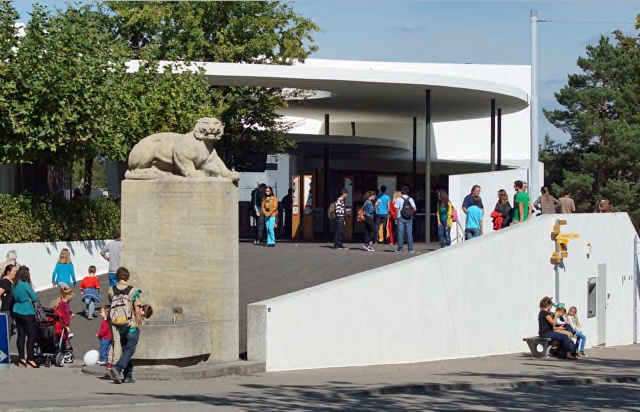
Zurich Zoo with Sumatra Tiger Sculpture by Rudolf Wening Image AlbinfoCC BYSA3.0


• Architectural Highlights: Though most of Zoo Zurich’s modernist architecture emerged later, some earlier pavilions and enclosures were built in a functional, minimalistic style influenced by modernist principles.
• Notable Features: Early structures here emphasized simplicity and integration with natural surroundings, with an increasing focus on functional and aesthetic considerations typical of modernism in zoo design.

5. Tierpark Hagenbeck (Hagenbeck Zoo) – Hamburg, Germany

• Architectural Highlights: Hagenbeck Zoo, while originally founded in the 19th century, introduced innovative “barless” enclosures in the early 20th century that aligned with modernist ideas of open, functional design.

• Notable Features: Although not brutalist or high modernist in the traditional sense, Hagenbeck’s use of open-air, naturalistic enclosures broke from older cage-like styles and influenced modernist zoo design. This approach emphasized functionality and animal well-being over purely ornamental structures, an idea central to modernism.

See for yourself!

London Zoo

Hagenbeck Zoo 

Zurich Zoo 

Antwerp Zoo 

Basel Zoo 


Three Titans of Viennese Modernism


Three Titans of Viennese Modernism

Josef Frank, Josef Hoffman and Adolf Loos


Adolf Loos, Image © Villa Winternitz,


At the turn of the 20th Century, the Hapsburg family’s Austro-Hungarian Empire ruled nearly 700,000 square kilometres from the Tyrol to Italy, from Ukraine to Transylvania, 52 million people.  It may have seemed invincible and unchangeable, but deep currents of change were running through philosophy, literature, the visual arts, and the sciences and, of course, politics, increasingly straining the status quo of absolute monarchy.

The nationalist aspirations of many of the Empire’s dozen plus subject peoples, slow economic improvement and the wretchedness for many of industrialisation formed a rich mulch for the growth of revolutionary and social democratic politics. Out of this increasingly febrile atmosphere of new ideas, Viennese modernism, the Wiener Moderne, emerged as a distinct counterpoint and avant-garde response to the sclerotic official culture of the Empire. An artistic subset of the broader cultural movement was the Viennese Secession. Figures who emerged from the Vienna Secessionist movement continue to hold significance today.

Adolf Loos

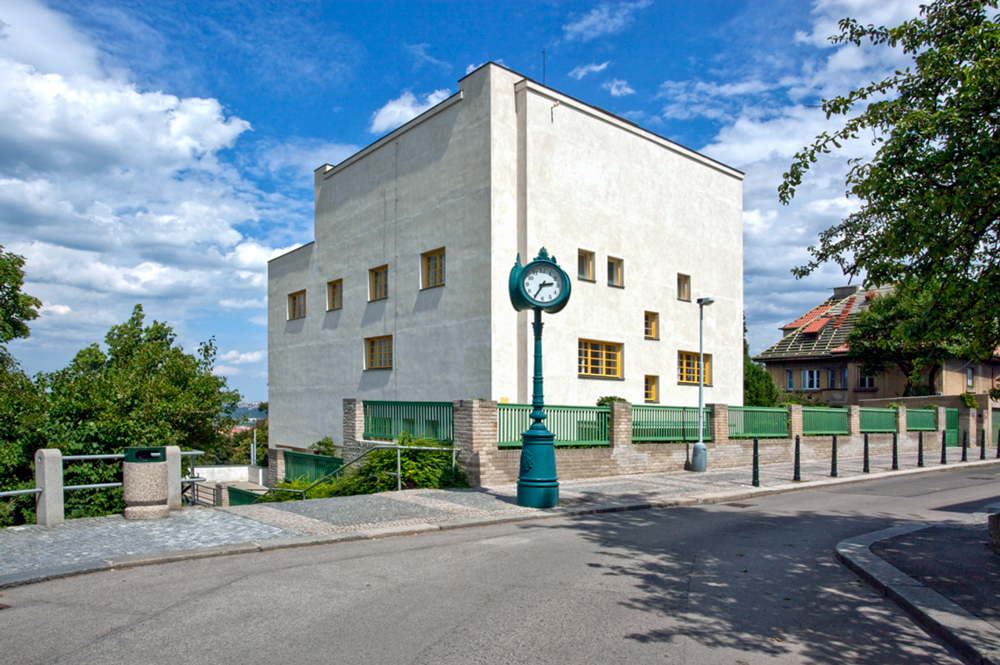
Adolf Loos was a pivotal figure regardless that he was only briefly involved in the movement and subsequently very publicly turned his back on the Secessionists. Born in Brno, his adopted home was Vienna. The three years he spent in America shaped his views and led the way for his embrace of modernist architecture in Europe. Loos rejected the typically Viennese overly decorative style to embrace the philosophy of Louis H. Sullivan, the American architect who coined the phrase ‘form follows function’. Loos’s rejection of the pervasive Viennese architectural style culminated in his essay ‘Ornament and Crime’.  His role in bringing modernism to Europe cannot be underestimated, and two of his houses, Looshaus in Vienna and Villa Müller in Prague, are perfect illustrations of his minimalist approach and remain iconic examples of modernist architecture.


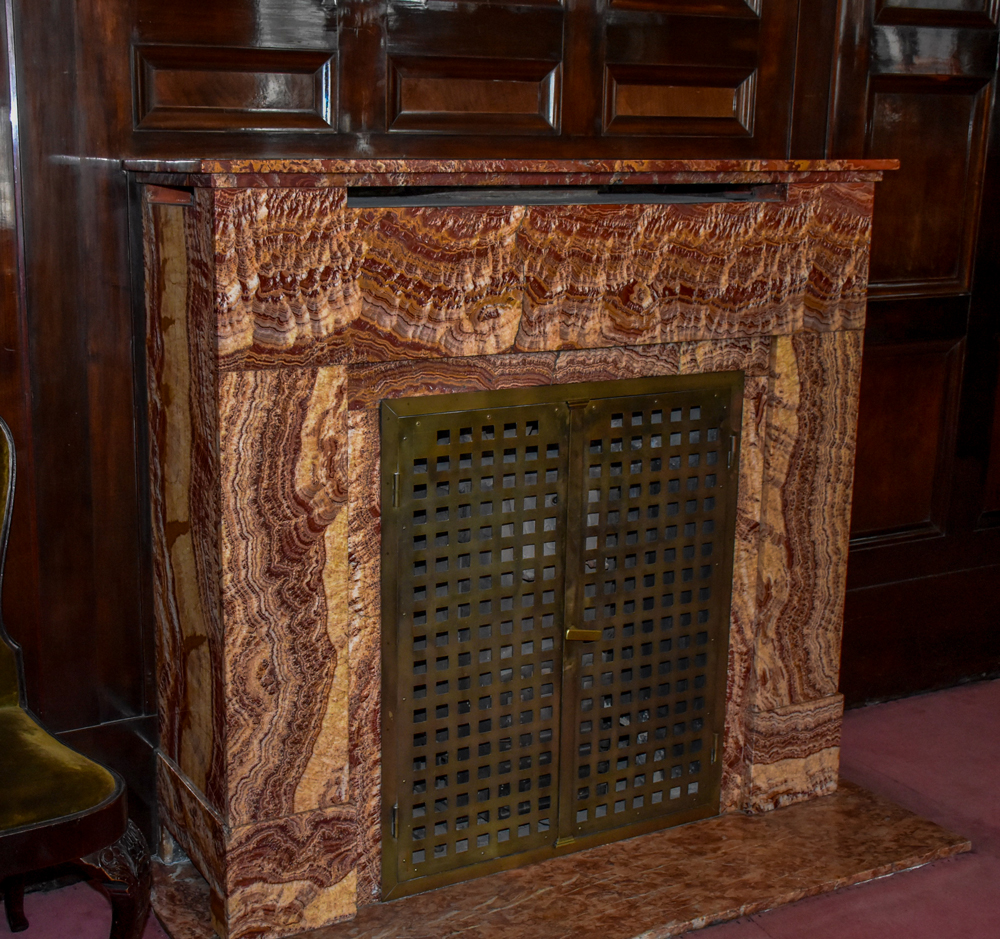
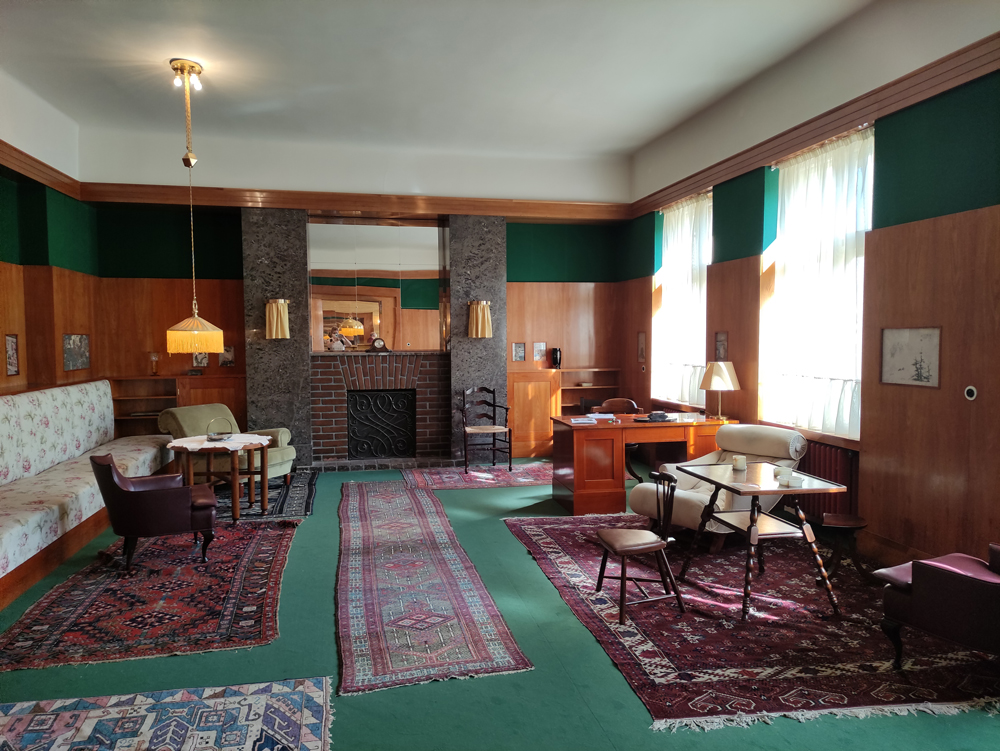
Adolf Loos fireplace in the dining room of Wienbibliothek Musiksammlung Image Mihaela Nancu CC BY SA 4.0

Plezeň, Czech Republic, apartment for the Vogl family designed by Adolf Loos CC BY SA 4.0

We’re going to look at two other titans who share a first name, Josef Hoffmann and Josef Frank. They were extraordinarily gifted modernists; both were controversial within their own lifetimes, but Hoffmann didn’t do enough to distance himself from the darkness that swallowed up art and design, politics and peace after the 1938 Anschluss. In fact he sought to ingratiate himself with the Nazis.


Villa Muller Prague, Adolf Loos, CC BY SA 3.0


Josef Frank

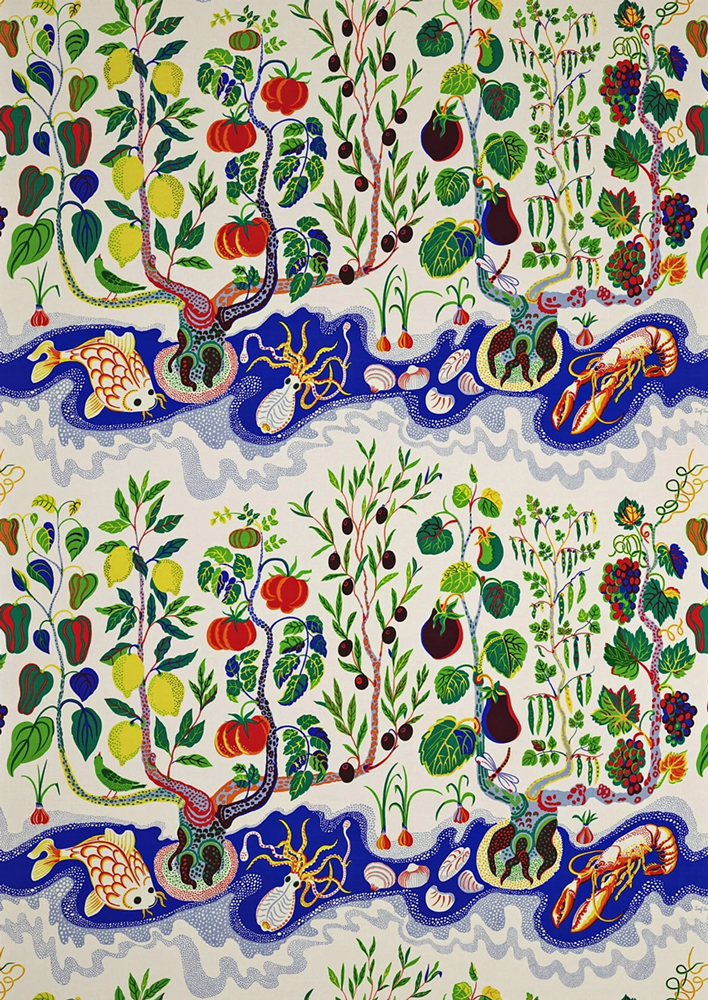
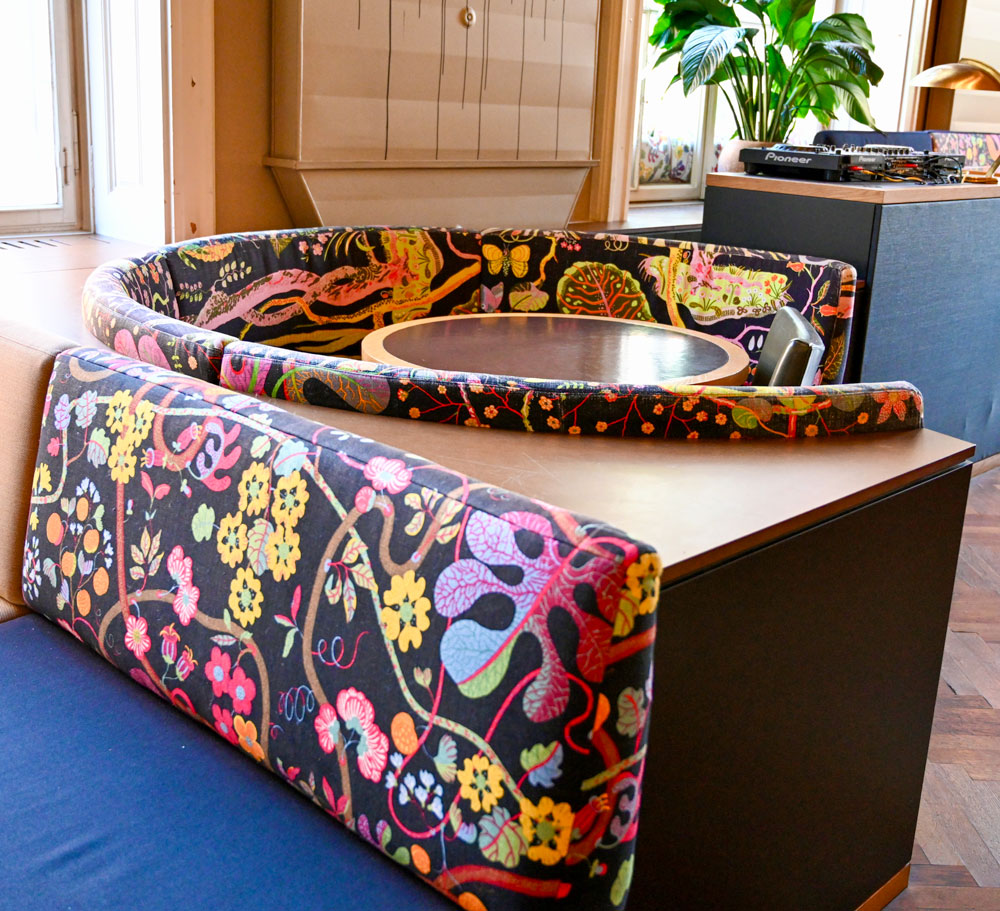
Today, Josef Frank is most associated with his iconic nature-inspired fabrics and wallpapers, but this narrow focus overlooks his immense contributions as an architect and intellectual.

Born in 1885 in the spa town of Baden bei Wien to a Hungarian-Jewish family, Frank was a student of Carl König and studied architecture at the Technische Hochschule and TU Wien between 1903 and 1908. Early in his career, he was drawn to progressive circles where design and intellectual discussion were deeply intertwined. In 1913, he began collaborating with Oskar Wlach and Oskar Strnad, leading to the establishment of the Wiener Schule der Architektur.

After World War I, Frank became a leading figure for the Austrian Association for Settlement and Small Gardening (Verband für Siedlungs und Kleingartenwesen), where he experimented with both architecture and furniture design. From 1919 to 1925, he served as Professor of Building Design at the Vienna School of Arts and Crafts (Kunstgewerbeschule). Simultaneously, he was similarly influential in the Neuer Wiener Wohnen, a group of designers and architects pioneering a new approach to furniture and interior design.

“The house is not a machine to live in. It is rather a shell that should include everything human.”

In 1925, Frank co-founded the furnishing company Haus und Garten with Oskar Wlach and Walther Sobotka. This venture connected him with international designers, including the highly respected Estrid Ericson, owner of Svenskt Tenn, a renowned Scandinavian interior design company. Frank, whose wife Anna Sebenius was Swedish, had already developed an affinity for Sweden, spending several summers in the ‘Swedish Riviera’ town of Falsterbo. This connection led him to receive commissions to design five villas in the area between 1924 and 1936.


Italian Dinner Fabric, Josef Frank Credit: Svenskt Tenn


Josef Frank fabric currently at the MAK Wien


As Frank’s international career flourished, he became a well-known character in the Wiener Moderne movement. Oskar Wlach and Josef Frank were the only Austrian architects invited to participate in the 1927 Stuttgart Werkbund Estate, Josef Frank later became the artistic director of the Vienna Werkbund Estate. During this period, he also developed his Raumplan theories.

Among Frank’s significant commissions with Wlach was Haus Beer, a modernist villa completed in 1930 for Dr. Julius Beer in Vienna’s Hietzing district. The Franks and the Beers were close friends, and Dr. Beer wanted a house designed for entertaining and hosting cultural soirées. Today the house is the subject of a major renovation.

In 1928, Frank was invited to Switzerland as a founding member of the International Congresses of Modern Architecture (CIAM). Although now recognized as a Modernist architect, Frank was sometimes critical of  the increasing prescription of  what was and wasn’t Modernist design, famously stating,

“Modernism is that which gives us complete freedom.”

It’s hard to know if in 1932 Frank was preparing his exit plan but anti-Semitism, always endemic in the Empire, was only growing. The Anschluss would not be for another six years, but in 1932, he signed a formal agreement with Estrid Ericson of Svenskt Tenn. Together, they became a powerhouse. Frank’s textile designs jumped off the page, his lifelong interest in botany brought together in a riot of colours, and his furniture was both modern and highly desirable—to this day! Josef Frank’s brand of modernism was underpinned by his desire to shake off dyed-in-the-wool rigid traditions and give breathing space for personal expression.

“Every human needs a certain freedom of movement within his environment. Too much order creates discomfort.”

With Hitler’s rise to power in Germany, Frank recognized the growing danger and permanently relocated to Sweden in 1934, accepting Ericson’s invitation to work there—a move that will have saved his life. He never returned to work in Austria.

Frank’s work with Svenskt Tenn began with representing the company at an exhibition at Liljevalchs Konsthall, where he introduced the “Liljevalchs Sofa,” a design that defied contemporary Scandinavian conventions. The sofa was a tremendous success, marking the start of a fruitful collaboration between Frank and Ericson. They exhibited together at the 1937 World Exposition in Paris and the 1939 World’s Fair in New York, where their work was closely associated with “Swedish Modernism.” Frank became a Swedish citizen in 1939 by then, he had already established himself as an important figure in the Swedish Modernist movement.

It’s a common question considering the extent to which Modernism emerged and developed in Germany and Central Europe, what would have happened if the Nazis hadn’t taken power and aged war and committed mass murde? With their love of monumental classicism, their irrational loathing of modernism, which they considered immoral and tainted with Jewish and Bolshevik influences, and their brutal suppression of modernist architects and artists, Modernism was stopped in its tracks in Germany and every country they occupied. Institutions were shut down, educators removed from posts, and Jewish architects (a significant number of whom amongst the modernists were Jewish) had their professional licenses to practice removed and if they weren’t able to escape and many were not, they and their families were murdered. For non-Jewish architects, allowed to stay, it became clear immediately that they would must abandon modernism. But modernism did not disappear; quite the contrary, exiled architects took their ideas abroad, where they flourished.

During World War II, deeply concerned about the conflict’s trajectory, Frank moved to New York. Before leaving, he gave Estrid Ericson a parting gift of 50 prints, which the company’s website describes as a significant contribution to design, even surpassing the work of his role model, William Morris.

Josef Frank died in 1967, leaving behind a rich and enduring legacy in architecture and design.


Winarskyhof Wien 20, Josef Hoffmann, Josef Frank, Peter Behrens, Oskar Wlach and Oskar Strnad named for Social Democratic Workers Party politician, Leopold Winarsky

Josef Hoffmann

The Moravian-born Austrian architect and designer, the son of a middle-class textile manufacturer, became a leading light in the Vienna Secession and Wiener Werkstätte. He is known for using traditional craftsmanship with a strong modernist aesthetic, frequently using geometric forms. In essence he could turn his hand to everything from furniture to art to everyday household objects.

Hoffmann had tried to make a Faustian Pact but it seems that the Devil wasn’t that interested.

In 1892, he became a student of Architecture at the Academy of Fine Arts, working on the Ringstaße project to create the Ring Road in Vienna under Baron Carl Freiherr von Hasenauer. In his third year, he became a student of Otto Wagner,  which was pivotal to Hoffmann’s development. Wagner’s ideas entirely chimed with Hoffmann’s views.

only that which is practical can be beautiful

Wagner 1896 Modern Architecture

Hoffmann was a founding member of the Vienna Secession (1897), and his contribution there, along with his work with the Wiener Werkstätte (1903), perfectly illustrates their impact. His co-founders at the Wiener Werkstätte were Koloman Moser and the Austrian Jewish industrialist Fritz Waerndorfer (who left the project in 1913 when he was declared bankrupt). More than a  cooperative of artists, designers and craftsmen, it was an art movement underpinning modernism’s development. Its creators were given artistic freedom, and their work straddled many disciplines, from architecture to furniture design, textiles, ceramics and jewellery. The Wiener Werkstätte used traditional crafts but wasn’t opposed to employing modern manufacturing methods, whichever best fitted the purpose but it didn’t favour mass production. Philosophically members saw it all as part of their gesamtkunstwerk, the creation of a ‘total work of art’

“…We want to encourage close contact between the public, the designers, and the craftspeople and produce good-quality, simple household utensils. We begin with the purpose, serviceability is or first requirement. Our strength should lie in good conditions and good treatment of materials. Where possible, we will aim to decorate but without compulsion and not at any price ….”

 (from the work programme of the Wiener Werkstätte, 1905 via MAK)


Josef Hoffmann Wiener Werkstate: Embossed leather Leather book cover for Walter von der Vogelweide poems Munich 1920 MAK Wien.


Josef Hoffmann became a Professor at the School of Arts and Crafts in 1900. He was organised, prolific, and had a clear vision, much of which he realised, a point to return to later.

The Wiener Werkstätte’s grandest commission was the Palais Stoclet in Brussels (1911), a private home for banker and art collector Adolphe Stoclet.  Koloman Moser and Gustav Klimt played significant roles in this project. Klimt designed seven-metre-long friezes – they saw the project as the perfect vehicle to create gesamtkunstwerk. Stoclet was so enamoured of the creation that he asked to be buried with a ‘black and white handkerchief by Hoffmann.’


Josef Hoffman, hand cut crystal and sheet steel chandelier 1914


Another early Wiener Werkstätte architectural commission was the Sanatorium Purkersdorf on the outskirts of Vienna (1905); it was for this health spa that Hoffmann designed his ‘sitzmaschine’ – literally a machine for sitting. And let’s not forget the iconic Kubus chair (1905) still in production today, Villa Ast, Cafe Fledermaus and the Austrian Pavilion at the 1934 Venice Biennale.


Sanatorium Purkersdorf Image Roman Klementschitz CC BY SA 3.0

Purkersdorf Sanitorium Entrance Hall Image Thomas Ledl CC BY SA 3.0


While it would be nice to ponder the legacy of Hoffmann’s enormous contribution to modernism, it isn’t possible to ignore his choices after 1938 when he was already 68 and might have avoided the obloquy he has attracted by simply retiring. He didn’t retire, instead recognising that he was the beneficiary of the collapse of most Viennese modernist architects’ practices and their persecution—let’s not forget he knew many of them well, had been taught alongside and worked with them. Also, remember that many of his contemporaries who didn’t need to flee because they weren’t Jews nonetheless left Austria. Josef Hoffmann stayed. But Hoffmann was a Modernist, synonymous with the movement, and that was a problem because to the Nazis and their lickspittles Modernism was degenerate, and he wasn’t able to just drop the design movement that had made his career.  Hoffmann was at least well-connected with people in Vienna’s administration, which enabled him to pick up municipal contracts. An early one was the commission to design the Haus der Wehrmacht, turning the historic German Embassy into an officers’ club for the Wehrmacht, the German armed forces.  Hoffmann embraced the project, creating all the furniture and even specially customised swastikas.

MAK (the Museum of Applied Arts in Vienna) comments,

‘Josef Hoffmann used and cultivated his connections in a time of social upheaval. He neither took up the cudgels for old friends nor questioned the new regime. He rather tried to entirely adapt to it to be able to continue working as an artist, however, the National Socialists never really trusted Hoffmann and the relationship remained ambivalent’.

The enormously powerful and influential Albert Speer ,Hitler’s favourite architect and hisMinister of Armaments and War Production, was also an obstacle to Hoffman’s ambitions as he was said to dislike the ‘Viennese style’.

Awkward is the word that springs to mind – here was Hoffmann, trying to ingratiate himself with the Nazi authorities,for example, his vase with the coat of arms of the State of Saxony and swastika currently part of the collection of the Wien Museum, relishing every commission he got but never fully embraced by the Nazis.

After the war, Hoffmann returned to practice, he received some awards for his lifetime achievement but he never regained his pre-war eminence. Meanwhile, fellow Viennese modernists who survived the war such as Josef Frank, went from strength to strength. Hoffmann had tried to make a Faustian Pact but it seems that the Devil wasn’t that interested.


The Concrete Menagerie: Tecton at Dudley Zoo

The Concrete Menagerie: Tecton at Dudley Zoo


Kiosk

These days many of us feel ambivalent about zoos,  Imprisoned animals for public entertainment seem so wrong. Yet we also know that zoos are essential for conservation and preserving biodiversity. Without the work of zoos, rare species would be under even greater pressure of extinction. A hundred years ago, zoos were very much at the centre of our intellectual infrastructure.  Sir Julian Huxley, a great scientist, became the secretary of the London Zoological Society and its Regent’s Park Zoo the year after Berthold Lubetkin’s groundbreaking Penguin House was built.  Sir Julian was a lauded scientist and a eugenicist. He moved in a circle that included leading modernists (as well as other eugenicists, and we know what we think about eugenics), who would meet at the Isobar in the Lawn Road Flats, the wonderful Isokon designed by Wells-Coates.  Modernism was but one expression of the questing minds that were unlocking the science of genes and inheritance.

Dudley Zoological Gardens, just outside Birmingham, is not just a home to over 1,300 animals, including endangered species like Sumatran tigers, Bornean orangutans, Tibetan red pandas, and Humboldt penguins. It’s also a gallery of pioneering Modernist architecture, thanks to Berthold Lubetkin’s Tecton Group.

 The Tecton Group


The Penguin Pool, Regent’s Park Zoo

The Tecton Group was led by the emigre Berthold Lubetkin.  Lubetkin’s birth and family history remain something of a mystery, a mystery fed by Lubetkin himself.  He is variously a Russian, a Pole or, and current scholarship points towards him being, Georgian. Whether he was the illegitimate son of a White Russian admiral or not, he was a brilliant architect responsible for Highpoint, Finsbury Health Centre, the Spa Green Estate, Bevin Court and that Penguin Pool and the Gorilla House at the Regent’s Park Zoo, his first work after he formed Tecton.

The Gorilla House, Regent’s Park Zoo

Tecton brought a radical vision to Dudley Zoo. The zoo wanted a progressive design reflecting the modern ethos of the work done there.  Tecton’s use of concrete would create durable animal enclosures and buildings and attract public interest. The organisation’s leadership saw the zoo as a microcosm of society, and architecture could enhance both animal welfare and visitor experience. The mission was clear: create structures that protect animals while providing visitors with clear, safe views. Between 1936 and 1937, the Tecton Group erected twelve Lubetkin-designed concrete structures at Dudley Zoo. These buildings represent the largest surviving collection of Tecton works globally and are among the UK’s most important Modernist buildings.


Originally the Moat Cafe, now the Discovery Centre

In 2013, a Heritage Lottery-funded project restored four of the Tecton structures: The Station Cafe, Entrance, Bear Ravine, and adjacent Kiosk. The project team sought to repair the dilapidated structures and restore their original design intent. The restoration works were completed in 2014/2015.

The Entrance

When the new zoo buildings were constructed, there was only one viable location for the entrance building due to the limited street frontage available on the grounds. Positioned on a narrow strip of land at the base of the hill crowned by the castle, the building’s depth was constrained. To accommodate the anticipated large crowds, the design incorporated eight turnstiles, dictating a broad street frontage.


The entrance gates


The sloping terrain made a single slab roof, used for larger zoo structures, impractical. Instead, dynamic, interlocking S-shaped roof canopies were devised. These canopies not only allowed the roof to cascade downwards, following the contours of the buildings beneath, but also established an iconic aesthetic for the zoo’s public face.

Practical needs, such as providing shelter for queuing visitors and preserving the building’s appearance, were meticulously considered. This led to the creation of deep overhangs in the roof canopies, featuring slots set just back from the front edge. These slots serve a dual purpose: they lighten the visual impact of the roof and prevent staining of the visible front edge from rainwater runoff. The central three kiosks were adorned with the now-iconic 200 lettering, a feature that remains to this day.


The Dudley Zoo entrance gates photographed from inside the zoo.

Elephant House


The Elephant House

The Elephant House merged functionality with aesthetic appeal. Its clean lines and innovative use of concrete highlight Tecton’s vision. The structure’s spacious, open areas ensured the comfort and well-being of the elephants, while offering visitors an engaging and unobstructed view. This building exemplifies the Tecton philosophy of harmonizing architecture with nature.  The elephants’ house is no longer used for elephants.

 Aviary


With its graceful curves and open framework, the Aviary allowed birds to soar freely while providing visitors with unobstructed views. Tecton Group sought to create enclosures mimicking natural habitats. The aviary’s open, airy design supported the birds’ physical health and well-being, fostering a deeper connection between humans and animals. The aviary or Tropical Bird House is no longer used for keeping birds.

The Tropical Birdhouse

 Bear Ravine


The Bear Ravine

The Bear Ravine harmonises Tecton’s design with the natural landscape, creating a seamless transition between animal enclosures and visitor spaces. The structure’s design uses the site’s natural topography, incorporating rock formations and vegetation to create a habitat that is both functional and aesthetically pleasing. This integration of natural and built environments is a hallmark of the Tecton Group’s approach.


Bear Ravine

 Queen Mary Sea Lions


The Sealion Pool

The sea lions’ habitat exemplifies Tecton’s commitment to both form and function. The curved concrete walls are like ocean waves.  This design provides a visually striking environment for visitors and a dynamic, stimulating habitat for the sea lions. The enclosure’s layout allows ample swimming space, promoting the sea lions’ health and natural behaviors, while the use of concrete ensures durability and ease of maintenance.

The Sealion Pool

 Conservation Efforts

Over time, some Tecton structures fell into disuse, becoming monuments rather than functional spaces. However, recent efforts have revitalized these architectural gems albeit as the zoo has developed not all are used for their original purposes. With support from the Heritage Lottery Fund, four structures have undergone repairs, using traditional concrete and localized carbon fibre reinforcement to strengthen cantilevered viewing platforms. This approach maintains the historical and architectural significance of the structures while ensuring their integrity and longevity.
The conservation work at Dudley Zoo is a testament to preserving the Tecton Group’s legacy. These efforts honour the innovative spirit of Modernism by restoring and maintaining these buildings for future generations to appreciate.

The Safari Gift Shop, originally the Safari Cafe

Looking Ahead

Dudley is determined to preserve its Tecton heritage, but as with Regent’s Park Zoo, advances in understanding the needs of animals make a number of the buildings inappropriate for their original purposes.  The financial pressures on zoos are tremendous and conservation of buildings as well as animals are intense.

The Safari Gift Shop, originally the Safari Cafe

Tecton’s work at Dudley Zoo is a remarkable blend of architectural innovation and functional design. The structures they created were not just enclosures for animals but carefully thought-out spaces intended to enhance the experience for both animals and visitors. The commitment to Modernist principles is evident in every aspect of the design, from the use of concrete to the incorporation of natural elements.

The Safari Gift Shop, originally the Safari Cafe

While science and cost may have dated some of Tecton’s zoo buildings, they’re nonetheless a testament to a design ethos that remains relevant.  The values animating Lubetkin’s work, a focus on social felicity and improvement are shown not just by these zoo designs but in buildings like Spa Green, Bevin Court and the Finsbury health Centre.

Howard Morris
Greyscape
Visit

Aylesbury Estate In Three Pieces

Aylesbury Estate In Three Pieces

‘They call this a community
I like to think of it as home’

PET SHOP BOYS

“Single”, Bilingual


Aylesbury Estate, image Howard Morris


First Piece – The Prime Minister

‘No no-hope areas’, declared Tony Blair the new British Prime Minister in a speech at South London’s Aylesbury Estate after his sweeping election victory in 1997.  His first speech away from Parliament was delivered in the modernist housing estate supposedly symbolic of Britain’s inequality, a blighted landscape of a no-hope existence. Aylesbury Estate became a cliché of British post-war social housing. Larger than the Barbican and providing homes for more than 7000 people, Aylesbury was built in the ‘70s. It was thought a failure; flawed designs, poorly constructed using poorly understood techniques and dehumanising to the socially and economically disadvantaged residents schlepped in by the statist-inclined Southwark council.  Tony Blair’s New Labour wanted to condemn and replace rotting and neglected council estates and do something immensely better for the people made to live in these modern rookeries. But what eluded the well-intentioned PM was that Aylesbury was where people, good people, definitely loaded with problems of wealth and health and resources, were nonetheless making decent lives for themselves and for their families. But no one was listening to them.

In Aylesbury, we hear echoes of Pruit-Igoe, the mighty St Louis housing project that finished up being dynamited, its destruction bruited by the famous architectural critic Charles Jencks, as marking the end of modernism.  The same wrong lessons were drawn from Aylesbury, proof that modernism doesn’t work, that ‘some’ people can’t live in a socially acceptable way and will ruin whatever homes are provided for them, that public housing is simply an incubator for anti-social and criminal behaviour. The voices calling out underfunding in construction and maintenance struggled to be heard above the biases of discrimination on the grounds of race and class.


Aylesbury Estate by Howard Morris


Prime Minister Blair went on:

‘Behind the statistics lie households where three generations have never had a job. There are estates where the biggest employer is the drugs industry, where all that is left of the high hopes of the post-war planners is derelict concrete. Behind the statistics are people who have lost hope, trapped in fatalism.’

If Aylesbury was in difficulty before Blair’s speech, it was in deep, deep trouble afterwards. ‘Community’ is hard to measure.  The degree of empathy people feel for and identification with, one another doesn’t admit of hard metrics like numbers of people, rent rolls, the tally of broken windows and vandalism. So how do we know there was and is a community on the Aylesbury Estate? The marginalised may not have had the political voice they need or the influence wealth confers but they can make art.  That’s where Harriet Mena-Hill enters the story. First, let’s describe what has happened to Aylesbury.


Highwalks, Aylesbury Estate


Aylesbury fell into the coils of a cycle of decline. As it became increasingly dilapidated and families moved out, Southwark Council filled the estate with short-term tenants, people with overwhelming problems of immigration status and mental health. Through no fault of their own, they weren’t invested and weren’t able to commit to the estate, and the decline continued with growing anti-social behaviour and crime. The estate initially brought huge improvements to the lives of the original tenants – they talked repeatedly about the light, the space, the views and the connection with their neighbours. But with the loss of the caretakers and subsequent tendering of the cleaning contracts and the introduction of temporary housing licences, the physical decline accelerated. The estate was used as a backdrop to film dramas set in a cacotopian world of abandonment and atomised society.


Over £350m would be needed to regenerate Aylesbury, money Southwark didn’t have and so it decided, in 2005, to demolish and build anew putting the estate in the hands of a housing association.

The project isn’t finished and will take years.  It’s dogged by controversy, occupation by squatters and the powerful case that some of the buildings could be more easily and economically be refurbished than demolished.

Second Piece – the Artist

And so to Harriet Mena Hill, an artist trained at the famous Camberwell School of Arts and Crafts and, as Harriet observes, a school located close to Aylesbury Estate but at the same time a world away. She knows Aylesbury, her her home is close, her studio, too and in 2018 Harriet started art workshops with young people from the Aylesbury Estate.


Taplow Nocturne displayed on the Aylesbury Estate June 2021


Harriet’s work on Aylesbury began with large felts, what she calls Soft Concrete. In a painstaking process of mixing soft corredale and merino wool fibres using carders, broad wooden paddles covered in a fine, viciously sharp steel comb, and then pushing the mixed colour through the felt with steel needles, Harriet has created startling panoramas of the Aylesbury Estate in the twilight of its life. In soft felt, concrete is rendered.


Aylesbury Felting by Harriet Mena Hill


Harriet didn’t stop working with people, especially young people, from the Estate.  There have been holiday projects for young people and through lockdown online art clubs.  Aylesbury might have been written off as a failed estate, but Harriet saw a rounded and warm community, admittedly with problems but nonetheless a community. As much as she taught people how to express themselves in art, she learned from them.  And then one day, while walking past the Chiltern block during its demolition, Harriet had the idea of painting directly onto concrete fragments of Aylesbury Estate.

Technically, concrete is a poor surface to receive paint, and Harriet had to figure out how to prepare the surface.  In her Aylesbury Fragments work what we see is re-purposed concrete waste from Aylesbury used to capture in meticulous detail the lives of a community that wasn’t supposed to exist.


Pigeon Netting, Wendover by Harriet Mean Hill


In an interview, Harriet explained why concrete?

‘As I travelled to work I became aware that the only activity continuing unabated was the demolition. Demolition is a violent, ruthless process.It affected me physically. In the midst of such uncertainty the destruction seemed to amplify the failure of the utopian ideals that guided the building of the estate. I reacted instinctively and started to retrieve pieces of shattered concrete that had escaped beyond the perimeter barriers.I didn’t have a conscious plan. The first fragment was a drawing of the skeletonised Chiltern as it had looked gutted awaiting demolition. I think ‘The Aylesbury Fragments’ began as an unconscious act of restoration in uncertain times, and speaks of something beyond the buildings themselves.’


Lights Out On, Aylesbury Estate by Harriet Mena Hill


Third Piece – The Architect

There is just one other piece of the story of Aylesbury. In her article, The Lost Architect of London’s Aylesbury Estate, Sarah Osei focuses on the enigmatic architect of Aylesbury Estate, Hans Peter “Felix” Trenton, who disappears from the public eye and the architectural record after the estate’s building.  Many of the estate’s problems in design and construction are laid at the door of Trenton, much of that unfairly. he never publicly reacted to the opprobrium heaped on him. He was, in fact, an architect dedicated to helping those in society who most needed help. We now know that Aylesbury, ambitious in scale, was dogged by the familiar failings of local governments, insufficient money for maintenance and repair, and to solve the inevitable problems of new forms of construction.

Trenton was no stranger to marginalisation, to discrimination.  He was born Hans Tischler in 1926, in Wroclaw, now in Poland but then a German city named Breslau.  His father, the gifted artist Heinrich Tischler was arrested following the Kristallnacht pogrom when the Nazis attacked Jews and torched synagogues and Jewish properties across Germany while the police and fire service looked on or helped. Tischler was jammed into Buchenwald, the now notorious concentration camp, along with other artists, workers, pedlars, tailors, lawyers and doctors, all enemies of Germany because they were Jews. His health was broken by the brutal conditions, and he died soon after his release, aged 46. Heinrich’s wife, Else, with their two boys, Hans and his brother Franz, managed to escape to England.

In her article ‘Cursed art – post scriptum‘ Katarzyna Andersz writes in the magazine Chidusz further to the exhibition of Heinrich’s works in the City Museum of Wroclaw in the Royal Palace. ‘Cursed Art’ is devoted to Jewish artists active in the interwar period. ‘The central artist of the exhibition was the painter, drawing artist and architect Heinrich Tischler – a student of the architect Hans Poelzig and the painter Otto Müeller. Few of these artists’ work have survived, at least in the public domain (as we know anything of value was looted or expropriated by the Nazis and so may still be in private hands or hidden in a vault somewhere) but his family did manage to save Heinrich Tischler’s works.

Andersz writes; ‘Heinrich Tischler had two sons – Franz and Hans. Their names are straight from the Brothers Grimm’s fairy tale, the boys are pretty and very talented – as it turns out, they inherited their artistic talent from their father. In their last photo together, from October 1938, the three of them look happy. We don’t know when exactly it was made. Maybe there’s still over a month, maybe two weeks left until Kristallnacht, or maybe there’s no point in enumerating it, because anyway, they will soon lose their father…’


Heinrich Tischler and his two sons


Hans anglicised his name; German names weren’t a smart idea as Britain went to war with Germany. Both boys grew up to be architects. Franz worked on the Festival of Britain while Hans Peter ‘Felix” Trenton became the Borough Architect of Southwark. Borough architects were hugely influential in the programmes of social housing construction from 1945 until 1981 that created hundreds of housing estates across Greater London (including some featured of the 275 featured in London Estates by Thaddeus Zupančič). Aylesbury was one of those needed projects.  It sought to achieve so much and, in reality, was no failure. The blame must have been a heavy burden for a man, himself a refugee, who had lost so much, who worked so hard to improve lives for others.

In 1977 Hans began his own architectural practice but died ten years later at the age of just 61.

And that, in short, is the story of Aylesbury.  There are no villains, but there are heroes, people who strove to make things better, who made a community and still do so, and who honour that community in art.


The Fading Reminders of Soviet Modernism in Central Asia

THE FADING REMINDERS OF SOVIET MODERNISM IN CENTRAL ASIA

Landing in Dushanbe, Tajikistan in the middle of the night, exhausted by the long trip from Switzerland, Nathan Lopez challenges us to follow in his footsteps


soviet era residential building with painted patterned facade

Tashkent


‘Curious about discovering a region I didn’t know much about aside from vague knowledge of the Silk Road. A matter of hours later I visited the ‘city centre’, renovated and still undergoing construction. I purposely did not organise too much in advance to get that real sense of travelling spontaneously’.

‘As I was walked away from the centre of town, I took in my surroundings, an abandoned cable car, distinctively shaped windows, balconies and facades.


appartments Khorog Tajikistan central asia
Windows and balcones Khorog Tajikistan

Khorog Tajikistan


A graphic designer by training, the modernist buildings decorated with geometric patterns jumped out. A wonderful assault on the eyes. Spotting them became like a game for me and I spent most of the time just exploring, discovering new buildings and patterns throughout the city landscape.

‘A wonderful assault on the eyes’

I tried to imagine what these buildings might have looked like originally. Most dated back to the ’60s, ’70s and ’80s. In order to construct them, entire neighbourhoods were probably erased. There isn’t much evidence of older forms of architecture.

In terms of colour, the Pamir mountains (especially the Wakhan corridor) will give you a mix of yellow sand, red mountains, green fields and white snowy peaks… a delight!


side view of hotel uzbekistan

Hotel Uzbekistan

dushanbe architeture

Dushanbe


A hundred years ago, Dushanbe was simply a small market. The name means “Monday” in Tajik, which is the day the market used to take place. The evidence of Soviet influence definitely gets stronger as one leaves the centre of town.  Discovering the suburbs feels like time-travelling. It is quite clear that Dushanbe is being reimagined. Many of the buildings I’ve seen might soon disappear, forever’.


window detail dushanbe
central asian architecture Dushanbe

Dushanbe


My round trip continued on to Khorog and the Wakhan Corridor, then back to Dushanbe, onwards to Khujand and finally finishing up three weeks later in Tashkent, the capital of Uzbekistan. My mode of transport? I restricted myself to shared car rides, frequently finding myself, accompanied by families, with my bags and their watermelons resting precariously on our knees’. There are still plenty of Soviet trucks in evidence as well as colourful cars.


coloured facade Vahdat

Vahdat Tajikistan


You have to be ready for the poor quality of roads once you get outside central areas. Sometimes totally unpaved, which made journeys slow and shaky. The upside? Time, time to meet people, time to hear their stories.  In the most remote places, people would be very nostalgic about the Soviet Union. For some, the perception when the state collapsed, was that what disappeared with it was support for people living in isolated places and extreme climatic conditions. Khorog, for example, has an airport has not been operational since the end of the Soviet Union.


turquoise central asian mosaic

Khujand Tajikistan

facade of residential block Chkalovsk

Chkalovsk Tajikistan


Across the regions, the Modernist apartment blocks simply looked like canvases, the streets overflowing with works of art. Each covered with curves, triangles, ellipses and geometrical motifs. You have to use your imagination as too many of the buildings are hard to see properly, covered with electric wires, parabolic antennas and there’s always a carpet hanging over a balcony here and there… this combination is charming.

‘At night, the cities are twinkling with the glow from coloured lights decorating newer buildings’

Tashkent is a particularly interesting place to visit as most of the city was destroyed by a massive earthquake in the ‘60s. It’s the country’s capital city and was entirely rebuilt capturing the essence of Soviet modernism. Its monuments, hotels and museums are particularly impressive and most of the apartment blocks have geometrical concrete motifs on their facades and stunning colourful mosaics on the side.


Tashkent architecture building taken from corner
concrete bus stop Dushanbe

Dushanbe Bus stop


Intriguingly, the concrete patterns have evolved over the decades. Each occupant modifying and leaving their mark on geometric facadesSeems like it’s not so easy to deal with non-squares! People are so creative when it comes to covering an elliptical window, closing a balcony or turning a circle into a square…


The beautiful ’S’ shaped windows in Khorog, Tajikistan, are particularly memorable. However, almost none are actually still intact. It was interesting to see how the modification of the windows has evolved over the years, slowly bringing square shapes to the initial curves. I spotted the same evolution in Dushanbe, large numbers of buildings with diamond-shaped windows, again, too few remained untouched.


Tashkent soviet era block

Tashkent


Today most of these buildings are in bad shape and many of the facades are slowly decaying. It gives them a curious charm with a tinge of regret. How much longer they will be evident is anyone’s guess.  They are being erased from the city landscape and many of Tashkent’s geometrical mosaics are now hidden behind giant advertising hoardings.

The architectural history is composed of layers, decorative, Soviet and beyond

Returning to Switzerland I realize these photos represent a testimony to Central Asia’s Soviet heritage, and a chance to record them with my own lens before they disappear forever.


dome of Tashkent building

Tashkent

Travel hacks from Nathan:

Getting to the Pamir mountains can take longer than you expect. The roads are long and not in good shape or are being repaired causing delays.

If you are planning a city to city trip, such as Dushanbe – Khujand, Tashkent, the roads are in better shape and the landscape beautiful. To cover more ground it works to mix in air travel. There is a direct flight from Dushanbe to Tashkent.


building facade window detail central asia

Dushanbe


Pack wisely. Summers can be extremely hot (It was around 40 degrees when I was in Dushanbe and Tashkent).

Always carry enough water with you

Protect your camera

Make sure your camera is well isolated from shocks, the roads can be extremely uneven, and travel can at times be very shaky.

Keep your camera equipment with you at all times. Always refuse to put you bag in the trunk or on the roof of the car. I found out the hard way as my camera actually broke because of that… Luckily, I managed to get it repaired once I got back into the city.


interior view Tashkent Metro
underground system Tashkent

Tashkent Metro


If you are not travelling solo, I’d recommend renting your own car. Bearing in mind the condition of the roads, I met quite a lot of groups, couples and even solo travellers exploring on their own. Not the best option if you are on a budget but it enables you to stop everywhere. There are so many, buildings, monuments or landscapes I noticed from the window without any possibility to stop. It can be really frustrating!

The border crossing between Tajikistan and Uzbekistan is changeable (so check travel advisories) – sometimes a visa is required and a precise itinerary with hotel reservation confirmations other times it’s a simple 10-minute drive through the checkpoints


hotel in central asia golden facade

Hotel Uzbekistan Tashkent


In Tajikistan, an e-visa can be obtained online within two days It is a one-entry visa so if you cross the border, you will just have to order another one if you are coming back to Tajikistan (at time of writing)

‘There’s a lot of fried mutton’

Foodwise, you won’t have that many options and it’s a lot about fried mutton (most of the time in soups or with rice) all over Central Asia. Vegetarians might have a hard time there;) There are salads but make sure its components have been peeled and only drink water from closed bottles. In Tashkent, the situation is completely different, and you can find food from all over the world.

There are very few cars in such remote places and it is more common to see people travelling and/or carrying stuff on a donkey.


white detailed building tashkent

Tashkent Facade


There is no Wi-Fi, connection or regular public transportation in remote areas outside of cities. Think of it as an ideal destination to combine with a digital detox:)

In the hottest hours of the day, it is worth spending an hour or two in Tashkent’s metro. The colourful stations are simply amazing!


from the road bus stop central asia decorated
central asian bus stop

Dushanbe


At sunset, go to Amir Temur Square in Tashkent to watch the white facade of Hotel Uzbekistan turn to orange. It is wonderful.

Check out the modernist apartment blocks in Dushanbe painted in pastel green, blue or pink. Round the day off by walking from the ‘blue towers’ on Abuali Ibn Sino Avenue to Dushanbe’s Circus, it’s the perfect way to appreciate the architecture, colour and detailed mosaics in an authentic setting.

About Nathan:

“Originally from Switzerland, I live and work in Lausanne in Digital Education for a Swiss University where I develop animations and produce educational videos. A graphic designer by training, I graduated from the Lausanne University of Art and Design in 2014. In 2013, I had the opportunity to go for an exchange semester in Tel Aviv, where I actually started to practise photography on a regular basis and became more interested and familiar with the medium.

My fascination with architectural photography began in 2017, I’d spent time in Iran, Armenia, Georgia and Azerbaijan I particularly love to find forms of beauty in raw concrete, abandoned places or buildings that might mistakenly be written off as  “ugly”. I discovered socialist and modernist architecture and now try actively seek these designs.

Typically I research ahead of taking a photo not simply to locate it also to understand its orientation to figure out what time of the day I’ll get the best light. It involves lots of checking out longitude and latitude on google map! I try hard not to plan too much to leave room for spontaneity.

As well as Central Asia, favourite destinations include Armenia, Poland, Iran, Lebanon, Montenegro and Bosnia. I actually consider Sarajevo top of the list!


colourful dome central asian architecture

Tashkent

All images are Copyright of Nathan Lopez ©

Find Nathan on Instagram at www.instagram.com/__nathanlopez/


Vladimir 518: Rethinking Architectural Narratives in Czech Architecture 1958 -1989 Czech Centre London

Vladimir 518: Rethinking Architectural Narratives in Czech Architecture 1958 -1989


Alena Šrámková , Jan Šrámek, Jan Bočan, Zdeněk Rothbauer, Josef Danda, Julie Trnková, new check-in hall of the Main Railway Station in Prague, 1971-1979. Archive of Vítkovice a.s.


Meet visual artist and musician Vladimir 518, who lectures on Czechoslovak architecture between 1958 and 1989. The Greyscape crowd has a highly developed appreciation of post-war, former Eastern Bloc architecture. However, it seems we are a niche group. Vladimir wants to ‘reset’ the general public’s perception.


Karel Filsak, View of Karel Filsak and Josef Klimes’ sculpture called Equilibrium on the Barrandov Bridge


The overwhelming body of so-called communist architecture has little in common with this ideology in terms of its formal aspects, yet a layer of negative emotions and misunderstanding still clings to it. Unfortunately, in the long term it has been impossible to find a healthy relationship with this now historical architecture, which is why one important building after another is disappearing from the streets of our cities. If we as a society fail to preserve at least what is left of the quality buildings from the beginning of the second half of the 20th century, we will erase a piece of our own history and cultural memory once and for all.

Vladimir 518


Jaroslav Mayer, interior of the Palace of Culture in Prague with a view of the sculpture of the Sun by Vladimír Procházka, archive of Vitkovice Ironworks


Since the collapse of the communist regime, there has been what feels like an unstoppable desire to tear down anything that has a whiff, architecturally, of communism. It is often negatively labelled architecturally of low value, ‘deemed highly ideological, and seen needing repair’.

Vladimir 518 published Architecture 58-89 as a ‘call to re-evaluate and preserve’. Having made the trip to Hotel Thermal in Karlovy Vary, we have to agree. Vladimir pinpoints two moments – Expo 58 in Brussels (the first post-war World Fair, which ended up centre stage for a Cold War ideological contest between the Soviet Union and the US – with one accusing the other of stealing a replica Sputnik) and the 1989 Velvet Revolution.


Hotel Thermal, Karlovy Vary. Image Howard Morris

‘His aim is to foster a deeper understanding and appreciation in order to reset the perspective of the general public and preserve those landmarks for future generations’


The Jested Tower and Hotel ŠJů, Wikimedia Commons

The Jested Tower and Hotel ŠJů, Wikimedia Commons


About Vladimir Broz aka Vladimir 518

The founder of the BiggBoss label and publishing house. His publication, Kmeny (Tribes) was also produced as a documentary series for Czech Television (2015). In 2022, he published Architecture 58-89, a two-volume publication of nearly 1400 pages written by a group of thirty experts, which was followed by a documentary series for Czech Television and a feature-length documentary film. He started out as a prominent figure on the Prague graffiti scene, later devoting himself mainly to music projects, illustrations, paintings, comics and scenography. He collaborated with the experimental theatre group TOW, and is the founder of the audiovisual project SPAM and the comic newspaper KIX. As a musician, he is well known for his projects with the band PSH and his solo albums.


DBK Shopping Centre architects Vera Machoninova and Vladimir Machonin. Image Howard Morris

‘Opposite Places, Common Traces’ at the Barbican

‘Opposite Places, Common Traces’ at the Barbican


Naked Structures, City Road 2018


Chilean architect and photographer Francisco Ibáñe Hantke takes us on his photographic journeys, some lasting several years. He’s mapping a city’s imperfect beauty, capturing its buildings’ life cycle. His series Non-Structures featured London as ‘a spectacle of constant conflict, negotiation, and flux’. And now, in his newest exhibition opening on 1st June in the Barbican Library, he invites us to ‘reimagine the transformation of two global cities: London and Santiago.’ He has an intimate knowledge of both capital cities, having lived between the two for some time.


Palimpsest Holywell Lane, Shoreditch, 2019


‘I undertake prolonged photographic investigations. Usually, over months or years, I revisit several times the areas that I have photographed, aiming to achieve a series of images that critically reflect on the challenges and conflicts faced by urban transformations’.


Using 36 images, some new and some from his archive, he constantly contrasts and merges, bringing the cities together and reminding us of the links between architecture, infrastructure, art, and design.

‘the show explores the visual and symbolic language of various ephemeral urban elements, from building and demolition sites to mutated, propped up, and obsolete structures’


Unsustainable Structures, Wentworth Street, London 2017


About Francisco Ibáñez Hantke:

Francisco Ibáñez is an architect, urban planner, and photographer based in Santiago and London. He specialises in urban regeneration and divides his time between managing urban regeneration projects as part of multidisciplinary teams and working on audiovisual research projects on cities and architecture transformation.

Unsustainable Structures Piccadilly 2020


Visit the exhibition in the Barbican Library foyer

Level 2, Barbican Centre, London, United Kingdom, EC2Y 8DS

1st June  – 26th of June 2024

Opening event: 1st of June, 11:30 am – 1:00 pm.

Website Francisco Ibanez Hantke: https://www.estudioibanez.com/

London Festival of Architecture event

The Velvet Cell

Greyscape Photo Competition Winner

Greyscape Photo Competition Winner

We’re delighted to announce that Daryl G. Morrissey’s image of Bastion House has won the Greyscape photo competition.


Bastion House. Image Daryl G Morrissey

We loved the photo because it captures Bastion at a less familiar angle, includes its roots in the Museum of London, also under threat, doesn’t shy away from the less attractive elements while fairly representing what’s make many people like the building  Technically and in terms of composition the photo is sophisticated.

Daryl shares,

‘There is something beautiful in brutalist architecture when you can see it in conjunction with older or even newer buildings’

‘…the way light and shadow seem to compete for your attention.’

Bastion House sadly remains at risk; for updates and how you can lend your support to the Barbican Quarter Action group, follow their campaign. 

Daryl will receive two Bastion House Mugs with graphic designs by Adam Nathanial Furman.

Find Daryl on Instagram at @london_the_unfinished_city/

A controversial development plan for the Barbican border – London Wall West

London Wall West, the controversial development plan for the Barbican border, hasn’t gone away;

But neither has Barbican Quarter Action


A lot of voices were heard – but weren’t listened to – NEWS UPDATE.

On 17 April 2024, the City’s Planning Committee voted in favour of the City’s application for planning consent but Michael Gove  issued an Article 31 Holding Directive so that while the Planning Committee could vote in favour of granting the City of London (yes, we know) the Holding Directive froze the process.  However the Secretary of State for Housing and Communities didn’t “call in” the application, there will be no scrutiny.  Instead the Holding Directive was lifted. This is, of course, not the end of the Barbican Quarter Action campaign.


Bastion House, so reminiscent of the revered Seagram Building in New York by Mies van der Rohe, is still set to be demolished along with the white-tiled Museum of London and the rotunda in the junction of London Wall at Aldersgate Street. If the Corporation of London had its way, reflected in votes cast on April 17th 2024, the demolition could begin very soon. However, the Secretary of State, Michael Gove, intervened, issuing an Article 31 order

However, let’s not slip into any moments of complacency. Time doesn’t seem to be on the side of Bastion House and the former Museum of London building. The City of London Corporation, a local government authority tracing its history back more than 950 years, is in charge of the City of London, the ancient Roman city and now one of the world’s leading and most successful and prosperous financial centres. It has plans for a major redevelopment of what it has called London Wall West.  The plans indicate that we could soon find ourselves in the shadow of three overbearing office blocks between five and seventeen storeys with a range of ‘public realm’ improvements.

The C20 Society urged Michael Gove ‘to call-in the application and fully review it at a Public Inquiry’. He didn’t.

Reaction

Barbican Quarter Action issued the following statement in response to the latest developments:

The Secretary of State has lifted the holding direction on London wall west paving the way for the city to issue its planning permission for redevelopment. The decision by Michael Gove, while disappointing for the future of the London wall west site, has ramifications beyond the Square Mile.
Just a few weeks ago the high court ruled that the country’s net-zero strategy is in breach of the law, in a fresh legal blow to the government’s efforts in addressing the climate crisis. The London Wall West scheme is in breach of local, London and national policy. The decision now enables the demolition of two significant post-war heritage assets and damage to many listed assets that will be dwarfed by the bloated and bulbous buildings being proposed.
Developers wanted to retain and retrofit the existing buildings by Powell & Moya but their credible offers were ignored. This was and remains an opportunity for the City of London corporation and the UK government to lead the way and demonstrate a commitment to tackling the climate emergency. Barbican Quarter Action believes that the fight does not stop here. We will use all remaining avenues available to halt this shameless, rapacious scheme. Watch this space!


Retain, Reuse and Retrofit

Objecting to the Corporation’s plans is Barbican Quarter, a group of locals, lovers of the Barbican who aren’t, they say, opposed to redevelopment, just these plans.  The Barbican Quarter’s argument is to retain, reuse and retrofit the site, and they have the backing of the Twentieth Century Society taking up the challenge to save these buildings.

“Once demolished there is no turning back, a unique creation is lost for ever. Whilst some of these buildings (on the C20 Risk List) may need imaginative renewal, all are capable of inspiring and energising new uses. We need to make sure that none of these opportunities are missed. All ten of the 2023 buildings deserve to survive to make our lives richer and more interesting, the positive benefits of keeping them are immeasurable.”

Catherine Croft, director of the 20th Century Society

The City’s plans for 750,000 square feet of new office space release (according to the Barbican Quarter’s studies) a massive 45,000 tonnes of CO2 by the demolition of the existing buildings, and worst of all, this action doesn’t need to be approved for the City to begin to swing its wrecking ball.  The remaining tenants of Bastion had their marching orders at the end of March 2023, and by the Autumn, the Certificate of Immunity expired.  The City, which declared that it couldn’t find the original plans last year, disputes the objectors’ assessment of the carbon price to be paid by demolition and relies on its own Whole Life Carbon Assessment.


What’s hard to understand is the thinking behind the whole project – how could it possibly bring added value to the neighbourhood?  A few years ago a world-class music centre was on the cards for the Museum of London site. The original plan was that the Corporation would invest £288m in the project intended to add substance and kudos to its “Cultural Mile”. Part of that vision involved the Museum of London’s move to the Smithfield market, which is still going ahead. However, the post-pandemic landscape and a worldwide financial dip derailed plans for the new concert and music venue; the Corporation changed direction and decided it needed London Wall West, a massive commercial development. Take a look at the City’s plans to get a flavour of this vision of commercial paradise.


MoL from adjacent to Barber Surgeons Hall, a patch of ground, which, according to some pagans, has never ever been built upon.

Architecture critic Rowan Moore wrote The Museum of London: a fundamental clash as the City of London dreams on’  contrasting the objectors’ view that the cost in terms of lost architecture and release of CO2 should be to ‘retain, reuse and retrofit’ rather than to demolish and build what, in the eyes of the objectors, are office buildings that hark back to the old office culture, a utility that no longer exists.


Bastion House from the Barbican Highwalk

There are always people who object, and it’s not unreasonable to figure that a good number of the people who might be troubled by the Corporation’s plans are the residents of Mountjoy House and Thomas Moore House, the blocks of the Barbican nearest to the site of Bastion House and the Museum of London. That people facing years of noise and disturbance are concerned doesn’t make those concerns illegitimate, and the Corporation certainly hasn’t made that argument. Barbican Quarter has focused its objections on the need for very large office blocks and the carbon cost of demolishing Bastion House and constructing new buildings.


Image JM Petroschka


Image JM Petroschka

It’s an accepted fact that offices are changing and are going to change more 

Everything changed after the pandemic. We know that hybrid working isn’t going away; you don’t need studies to see that – simply walk around the City on a Friday afternoon. It’s an accepted fact that offices are changing and are going to change more.  An office built along pre-pandemic lines may be a costly white elephant. Few people live in the City of London, just over 8000, businesses and workers have to choose to commute to the City. Shouldn’t the Corporation, striving to keep the City relevant, be creating tomorrow’s office?

We must never forget that it was the venerable Corporation of London that was responsible for the building of the Barbican, a bold and modern design that has become a glorious globally-known icon. It’s a spirit and imagination that few institutions could match, and in ensuring that the City of London and the environs of the wonderful Barbican remain a centre where people and businesses want to be, those same animating characteristics are needed as much as ever.

MAKE YOUR VOICE HEARD: https://www.londonstartshere.co.uk/

TWITTER @barbicanquarter

INSTAGRAM @barbicanquarteraction

LINKEDIN here

Walden 7, Visiting A Little Piece of Utopian

Walden 7, Visiting A Little Piece of Utopia

Walden 7 gives an appreciative nod to behavioural psychologist, social philosopher and Sci-Fi novelist B.F Skinner who dreamed of a utopian community in his 1948 book Walden Two

Walden 7 in Barcelona by architect Richard Bofill
We asked Helene Haugaard, whose Instagram site is a must-follow, about her recent visit to Ricardo Bofill’s famed 1975 residential apartment block in Sant Just Desvern close to Barcelona.

What drew you to Walden 7?

My boyfriend and I were planning a trip to Barcelona, and in preparation for any holiday we always do our research on two things: cheap eats and architecture. There are a few trips we’ve made primarily to please my love of brutalism (Emphasis here on my love, as boyfriend Michael is not as big a fan of the raw concrete! But a big shout out to him as he always comes along anyway, to share my enthusiasm:So when I was looking up any interesting post-war buildings in Barcelona, Walden 7 popped up as an option just outside of town. I took to Instagram to see more, and fell in love. It was like something out of a Terry Gilliam film, completely over the top and a great mix of futurism and nostalgia (the orange and turquoise colour palette is very 1970’s, it’s fantastic.

Your photos always capture something extra and your Walden 7 series reflects that, how do you approach taking a photograph? Do you carefully select views or do you take multiple shots and then choose the best?

Firstly, thank you for the compliment. I am very much a shoot-and-point type of person, I take a lot of pictures out of bus windows and the like. If I see something that interests me, I’ll take a picture and hope for the best.
With Walden 7 we visited as part of a guided tour, so we were taken around the building and got to photograph things from just about every angle. I ended up with about 200 shots. In general, I like to line up images that give the viewer an idea of scale and geometry – I am really drawn to structural architecture, that is, how things are built and constructed. So I try to frame a shot that gives the viewer a sense of the building, rather than focusing on, for instance, the people on a street or smaller details, I like things to be very straight, it really irritates me if a window or doorway doesn’t line up with the edge of my photograph. It’s one of the elements I take time over.
Walden 7 Barcelona residential estate by Richard Bofill
View of the Walden 7 Towers by spanish architect Richard Bofill

Your Instagram @helenhaugard has some beautiful and striking photographs, it looks like you favour posting in threes; how do you curate the site? What messages would you like visitors to receive?

Posting in threes can honestly be a bit of a hassle, but I feel obliged to keep to the structure I’ve created now. I like things to be well organized and just so, and I think that bleeds into the way I create my Instagram feed. I always look for a common theme when selecting the three images to post side-by-side; whether it’s tonal similarities, composition or subject matter. I like the flow and cohesion it brings.
I am terrible at posting consistently. Sometimes I don’t post for weeks, and other times (like after the visit to Walden 7) I end up posting about 20 pictures in a day of just one building. The feed is really a scrapbook of memories, but put together in a way that I hope is visually engaging for people who don’t know me or the stories behind the travels
If someone visits my feed and wants to keep scrolling, that is all I can hope for.
Inside Walden 7 by spanish architect Richard Bofill
Richard Bofill's Walden 7 internal tiling

What camera do you use?

I always use my phone to take pictures, right now that is an iPhone 7 Plus. Bearing in mind that a lot of what I photograph is unplanned. I like how handy it is to always have your camera in your pocket. Sometimes I regret not having better quality images, but then I remind myself that the format most of my pictures end up in, on Instagram, means I don’t need to think about pixels or anything fancy. I just photograph what I see and hope others can find the everyday beauty in that.
Utopian inspired Walden 7 by Richard Bofill

One of the main ideas in Walden 2, the book that is the kernel of the concept of Walden 7, is that the environment can influence and change behaviour.  Do you think Walden 7 has a sense of community? Do you think the design affects the behaviour of its residents and visitors?

The architecture of Walden 7 definitely imposes a certain awe – for visitors and residents alike, I am sure.
It is built like a fortress, really, with gangways and internal courtyards. There is absolutely a feeling of being separated from the outside world when you are in Walden 7. Unfortunately, the utopian dream of Walden 7 seems never quite to have come to fruition. The building is in a semi-permanent state of disrepair. This means there is always a bit of scaffolding or work being done. I think in that sense the residents need to come together, as they safety-proof their homes.

Due to the way the building is structured, I imagine it’s hard not to rub elbows with your neighbours. As we were touring Walden 7, there were no activities in any of the communal spaces. Hardly anyone was outside on their terraces, balconies or just heading to the mailboxes on the ground floor. It was almost eerie, this huge place laid bare of people and noise. Most apartments have tiny windows. I couldn’t help imagining these people just holed up in their dark little fantasy homes, waiting for the possibly unwelcome tourists to leave, so they could get back to their everyday lives.

If I am being completely honest, for me, Walden 7 was a fantastic visit and a beauty. But I would never want to live in it. Visiting Walden 7 made me think of a classic architectural ‘would-you-rather.’ Would you rather live in a spectacular building, or live in the dull building with views unto the spectacular building?

I almost always answer that I want to live in dull building. My love of architecture is primarily visual, but I am a pragmatist at heart. I want to live somewhere with plumbing, cladding, windows, fire codes and all the rest up to code. Not in a palace that is beautiful to look at, but crumbling. And that is the impression I got from Walden 7: a marvel in decay.

Wandering off the béton track with Helene, we asked:

Your favourite record?   Any record by Genesis, the Phil Collins years.
A film you have seen more than three times?  Alien
Must see architecture in your home city? My current top 3 in Copenhagen are the Tycho Brahe Planetarium, The Silo and Grundtvigs Church
All images are the copyright of the photographer, visit Helene Haugaard on instagram

Bolwoningen Sphere Houses

Bolwoningen Sphere Houses

Being described as living in your own bubble is actually an accurate expression if it just so happens you are a resident of one of the Bolwoningen Sphere Houses in ‘s-Hertogenbosch in Holland, or Piet Blom’s Kubuswoningen in Rotterdam.

bulb shaped homes in Bolwoningen Holland Architecture
Photos of these globes popped up on Instagram, care of Dutch-Irish, Fabiénne O Sullivan; capturing arguably the strangest housing project in Europe. So we had to ask, what do the Bolwoningen Sphere Houses actually look like?


” Think giant golf balls, they are pretty futuristic but are actually houses that people still live in today”


Giant indeed, 55 square metres of living space within an orb made of fibreglass and toughened cement created by Dries Kreijkamp.  While not Dries’ original choice of materials, this compromise did nod to fire regulations and in the spirit of a golf ball on a tee, they sit on individual concrete cylinders.


dutch bolwoningen bulb homes

Dries Kreijkamp was a man ahead of his time, but also with a foot rooted in the past, a past filled with Sputnik, Echo 1, NASA’s inflatable Mylar balloon and living in the shadow of Expo58’s Atomium, just up the road in Brussels. It’s as if he wanted to anchor to the earth space-age ideas, reminding us that the planet was beautiful. Was his curiosity about the possibility of spherical living nourished by Hollands’ post-war interest in experimental housing projects? Government subsidies allowed a generation of creative architects to think out of the box, or should one say in this instance globe. It was a gift to the man who said

“We all live on a sphere, so why not in a sphere?”


Kreijkamp first thought of the concept in 1970, it took more than two decades for his dream to be realised. His training in art and design allowed him to feed his obsession for drawing spheres, early drawings show his experiments in developing them into a viable living space. For Kreijkamp a globe was


“the most natural shape possible, after all roundness is everywhere. We live in a globe, we are born from a globe”


What makes theses spherical homes all the more curious is the way they popped up like mushrooms in suburbia, and perhaps that old estate agents adage, ‘location location’ does hold true in this instance. Fabiénne, a fan of the Bolwolingen Sphere Houses, alludes to this,

“As an experiment, I think Dries Kreijkamp was a little off the mark. Architecturally I think they are wonderful, they have that SciFi, communist, futuristic brutalism about them which I adore, who doesn’t love concrete? They were built the same year as Piet Blom’s Cube houses in Rotterdam, but they don’t quite fit into a medium-sized suburb. Rotterdam was flattened during the war which gave it an opportunity to reinvent itself, the Blom cube houses fit nicely into the other oddities and extremes of modern architecture of the city. These are a lesser know oddity but a wonderful one.”

open window of a bulb home in Holand
Each home, a Bolwoningen to be precise, which actually translates as bulb house can accommodate up to two people who get on very well – there’s no place to hide in this joint. Over three levels there is a living room, a bedroom underneath and a bathroom, all reached by an internal spiral staircase. Round windows let light flood in.
inside a dutch bol house
Kreijkamp lived the dream in his very own bulb house in Vlijman, however, the attention the designs received came at a painful price, the Bolwoningen’s became more an object of curiosity, if you will, a signpost to future design. Kreijkamp set about preparing to roll out the design in large numbers but the orders just did not come in.  Time ticked by and weathering took its toll when the Bolwoningen project needed repairing the local authority turned down Drieskamps’ offer to build some new ones.

 “The reply was: We already have some, thank you very much. I found this shocking in its ignorance”

But a man with a dream can never be held back, and until the end of his life in 2014 the architect who dreamt out of the box kept on coming up with fresh ideas in experimental living.

As well as being a dab hand with a camera, she’s a cigar specialist, so naturally, we had to ask for the inside groove on her favourites. She shared as only a professional would ‘Cubans: Por Larrañaga, Partagas, El Rey Del Mundo, Cohiba and La Gloria Cubana. Dutch (of course), De Olifant,  Justus Van Maurik, Jacob Van Meer and De Huifkar.

Her list of must-see cities in Holland: As well as ‘s Hertogenbosch she added, Utrecht, Zwolle, Aalten, Leeuwarden, Doesburg and Rotterdam. “All wonderful places”
Fabiénne can be found on Instagram at www.instagram.com/fabiennekip/
Photos of the exterior of the bulb houses by Fabiénne O Sullivan © Photos of interior and blueprint by Super Formosa Photography Jaap Joris Vens  ©


London Estates by Thaddeus Zupančič

London Estates

Modernist Council Housing 1946 – 1981

London Estates by Thaddeus Zupančič

Bracketed by the Blitz and the introduction of Right to Buy, the 35  years from 1946 to 1981 was a period of immense social housing construction by the boroughs comprising London. It stands out in Europe for its ambition and imagination. High rise, low rise, mixed developments, green spaces, indoor plumbing, central heating, new materials and visions of healthy, collaborative communities, these ambitions came together in the massive effort of architects and planners and politicians.The need for housing, for decent homes, was critical. Tens of thousands had been destroyed in the War and much of the remaining stock was sub-par, rookeries of slums long overdue for bulldozing. Somehow, the needed funds were conjured in Britain’s bankrupt post-WWII economy. The building programmes were backed not just by the Labour Party that stormed to electoral victory in 1945 ousting Churchill but also by the Conservatives, too. Many schemes were too hurried, the designs flawed and the new construction techniques employed too little understood. But among them were some gems, successful in making affordable homes.


London Estates by Thaddeus Zupančič

Thaddeus Zupančič spent five years photographing London council estates and two years ago began work on his book London Estates, Modernist Council Housing 1946 – 1981 with Fuel.  It is a passion project by a meticulous author and great photographer. The book is a celebration of 275 estates and the innovative work of the many architects, consulting architects to the boroughs. London Estates includes Denys Lasdun (Keeling House, Trevelyan House); Ernő Goldfinger (Balfron Tower, Trellick Tower); Basil Spence (Stock Orchard Estate, Tustin Estate), and Kate Macintosh (Dawson’s Heights). London Estates gives deserved recognition to the borough architects like Edward Hollamby in Lambeth and F.O. Hayes in Southwark.

In writing the book Thaddeus visited dozens of archives across London to research the history of each development. He speaks with admiration of the diligence and seriousness of borough debates and decision-making, of the sense of mission and purpose that the records of their debates show. At the launch of the book, hosted by Fuel and held at David Rosenberg’s Velorose Studio + Gallery Thaddeus was in conversation with Catherine Croft, Director of the Twentieth Century Society. A packed launch party heard Catherine warmly describe Thaddeus as “Mr Maisonette”. The maisonette, Thaddeus observed,  is rare outside the UK but is to his mind, and he isn’t alone, in recognising it as such, an ingenious concept.  “Terraced housing in the sky”, Thaddeus quoted John Bolton and we know how successful terraced housing has been in creating community.  He instanced the motivating vision of the boroughs with the example of six bedroom flats and the wide variety of accommodation, designed for Londoner’s needs.

Listening to Thaddeus it’s clear that the council house building programmes that produced these 275 estates wasn’t about expediency, wasn’t about quickly dealing with the grave problems of a housing crisis but fundamentally improving the lives of people, providing what we all crave, a home.  That later cost-cutting and the biases of social exclusion have changed attitudes to the way some think about council housing estates mustn’t obscure the vital and visionary work of that massive post-War building.


Author, Thaddeus Zupančič, photographed in the Golden Lane Estate


Of course the Golden Lane Estate for the City of London by Chamberlin, Powell & Bon, a particular favourite of Greyscape, as the direct predecessor of the Barbican, is included.


“Council housing, often hidden in plain sight, is arguably the greatest gift that architects have bequeathed London”


What is it book blurb often says, “lavishly illustrated”? In the case of London Estates, that is not promotional puff.


London Estates by Thaddeus Zupančič


The book is over 300 pages, including a concise and insightful historical introduction, an index of the estates and, of course, hundreds of photographs patiently snapped of all of these estates. Each photo is captioned with the name of the estate, its architect and year of design and construction, the key for taking a deeper delve into the history and, as we know, every one of these estates has its own story. Like Greyscape, you’ll enjoy using London Estates as a jumping-off point to explore your favourite buildings and some that aren’t so favoured.


London Estates by Thaddeus Zupančič


It’s a must-have for all of us interested in modern architecture and post-war social history and a  long overdue work for anyone fascinated by our London heritage and the expression of a desire to meet a social need. It’s taken the diligence of Thadeus, with the support of his publisher, Fuel, to bring this work to completion.

Thaddeus Zupančič is a Slovenian-born writer and translator. He studied comparative literature and sociology of culture at the Ljubljana University’s Faculty of Arts and moved to London in 1991, when he got a job as a radio producer with the BBC World Service.

Brutalism remains his favourite C20 architectural style – his impressions of the National Theatre when he first visited London in 1982 and of the Barbican Estate a year later were profound. It was also a starting point for his Instagram account – @notreallyobsessive –  created in 2015; the second post was of Goldfinger’s Balfron Tower on the Brownfield Estate in Poplar. After a few years, the account started systematically documenting council housing in London from 1946 to 1981 (with a few excursions elsewhere). These posts led to his first exhibitions (at FILET in London and the Museum of Architecture and Design in Ljubljana), lectures (at the Architectural Association and London Metropolitan University) and, ultimately, to the book London Estates, published by FUEL.


London Estates by Thaddeus Zupančič


His favourite small post-war council scheme in London is Neave Brown’s Dunboyne Road Estate, but he still can’t decide about the large ones: “It’s a perennial toss-up between Powell & Moya’s Churchill Gardens, Lubetkin’s Cranbrook Estate, Darbourne & Darke’s Lillington Gardens, Alton West Estate by the LCC Architect’s Department and the Golden Lane Estate by Chamberlin, Powell & Bon.”

London Estates available from Greyscape.com

Kaufmann Desert House

Kaufmann Desert House

an iconic setting for poolside gossip


Kaufmann Desert Home Image Pmeulbroek CC BY SA 4.0

It is impossible to think about Southern Californian desert modernism without conjuring up a vision of the Kaufmann Desert House designed by Richard Neutra in 1946. Europe was in ruins and bankrupt while the USA was at the pivot point from its role as the mass manufacturer of the hardware that had helped smash the Nazis to the great mass producer of consumer goods to power its huge economic boom of the next 20 years. From the moment the Palm Springs ‘winter’ home was completed for department store magnate Edgar J Kaufmann, and photographed by Julius Shulman, it gained international recognition.  Palm Springs had become in the 20s the fashionable retreat for Hollywood celebrities because it was less than two hours from the studios and so satisfied the contractual stipulation for film stars that they could be back for a shoot within 120 minutes.  Neutra’s architecture became the very image of the late 40s, 50s and 60s starry leisure society of Palm Springs, including the Rat Pack (Dean Martin, Sammy Davis Jr and, of course, Frank Sinatra), Marilyn Monroe, Cary Grant, Bob Hope and Kirk Douglas. Palm Springs had even been a refuge for Albert Einstein. Palm Springs still signifies American optimism and aspiration.

The Kaufman Desert House’s design is a free-flowing, open plan, principally one-storey home, with the addition of the gloriette – Neutra’s name for the one-raised area affording the viewer the opportunity to survey the whole scene – house, pool and stark landscape beyond. Using concrete, steel, glass and Utah sandstone with a landscaped surround featuring desert plants and boulders, Neutra brought everything together to create a family home in the harshest of conditions (average summer temperatures 94 degrees) whilst entirely blending in with the desert backdrop of the peaks of Mount Jacinto and Coachella Valley.

It’s curious to think that two men who made such a profound mark on our understanding of desert modernism were Swiss-German-born Albert Frey and Austrian-born Neutra. Both had been schooled in European modernism and had worked on landmark projects with leading figures., They found their way to the West Coast (for Neutra, with some notable pitstops along the way) and shaped America’s understanding of international style. For Albert Frey, Palm Springs was his life’s work. Neutra was constantly being drawn back to Los Angeles. When the two men came together, Palm Springs’ Limelight News wrote a feature article, “Frey Weekend Host”, about the visit from “Mr. & Mrs. Richard J. Neutra of Los Angeles.”   It noted, “Mr. Neutra is the well-known architect so famous for his ultra-modern houses.  He designed the Grace Lewis Miller modernistic house here a few years ago, which since has appeared in many architect magazines as an outstanding example of modern design.”  The house in question was Neutra’s 1937 Mensendieck House. A decade later, he would complete the Kaufman House.

If the pool deck looks familiar, it’s not by chance. Slim Aaron made it an icon of cool in his photo of Lita Baron, Helen Dzo Dzo Kaptur and Nelda Linsk avidly taking part  in some ‘Poolside Gossip’ in 1970. This leads neatly to the story* shared by architectural historian and author of Richard Neutra and the Search for Modern Architecture, Thomas S. Hines, that Neutra built the pool area first. It was not uncommon to find him “critiquing the rest of the construction while splashing and floating in the water.”


“the inherent and inseparable relationship between man and nature”


Biorealism was the expression Neutra coined to convey his belief that underpinning everything was “the inherent and inseparable relationship between man and nature”. The Kaufmann Desert House and his much earlier Lovell Health House were physical embodiments of his philosophical approach. Is it conceivable that he might have had an inkling then about how climate-threatening changes would have such a profound impact on our well-being today? He worked tirelessly to ensure his client’s homes were not just beautiful, but that they worked – today the speak of sustainability – Neutra wouldn’t have recognised the term in 1946 but he knew what he wanted to achieve for the Kaufmanns, and the house stands as a testament to that ideal.


Richard Neutra 1935 CC BY SA 4.0


With a huge vision Edgar J had in his portfolio another modernist masterpiece, Fallingwater in Pennsylvania. Designed by Frank Lloyd Wright for the family a decade earlier as their summer retreat.

Know before you go:

The house is in private ownership and not open to the public

It has been awarded Palm Springs City Council Class 1 Historic Site

Palm Springs Modernist Week information 

Kaufmann Desert House image: Pmeulbroek CC BY SA 4.0

*Ref: Architectural Review

** Desertsun.com


Is Modernism Antiquated?

Is Modernism Antiquated?


National Gallery Sainsbury Wing

2024 arrives and we look forward to the buildings we’ll visit in this new year.  Some at home and others overseas. We’d better prepare, too, for the fight to save buildings of merit from the developers’ wrecking balls. And we know that each building that isn’t saved isn’t replaced with a modernist design. There are lots of modernist buildings, perhaps more than a person can see in their lifetime, but we’re not building new ones. Are we, the lovers of modernism, constructivism and brutalist design, really just antiquated?

Are we stuck in the past really just fans of an architectural cosplay?

There were many new years, many Januarys, that felt different.  For decades modernism was on the march, not just in architecture and design but more widely in art and literature. New architects with their manifestos for societal improvement were getting their designs built, developing new techniques and using novel materials, eschewing fussy ornamentation, bringing the outside in and there were people who wanted these refreshing, new, buildings and had rather means and were willing today for them.

In the eyes of many, modernism had failed

But then Robert Venturi with Denise Scott Brown and Steve Izenour wrote “Learning from Las Vegas”, a book that marked the end of the modernist period.  Charles Jencks in 1977 in “Language of Post-Modern Architecture” had declared modern architecture dead but it was Venturi, Scott Brown and Izensour who interred the movement.  In the eyes of many, modernism had failed.  It was unable to meet, people said, the needs of family and community and society, it ignored individuals and their familial and communities. Too much effort was devoted to the use of cheap materials with a resulting lack of build quality and too many buildings became identified with the statist and totalitarian regimes of the mid-twentieth century.


Vanna Venturi House NW Philadelphia

‘less is a bore’

Venturi didn’t shy away from ornamentation but perhaps more importantly considered that buildings shouldn’t be a break with the past but rather be sympathetic to the location and the buildings and history around them.  There was an emphasis on the people for who the buildings were built. Of the course the criticisms of modernism can be met but ridicule, even if at most sardonic, is deeply wounding.  Venturi, mocking Ludwig Mies van der Rohe’s maxim “Less is more”, said “Less is a bore”.

In the Vanna Venturi House designed for his mother, Venturi created a definitive Postmodern take on the American suburban dream home. The Gordon Wu Hall at Princeton College illustrates Venturi’s principles; it ties together the buildings around it, co-opts design elements to make the building culturally sympathetic in contrast to the exclusivity of the core precepts of modernism. The Ghost Houses on the site of Benjamin Franklin’s long demolished house are made from tubular steel and represent those lost buildings. The structures help the visitor to conjure a vision of the house and print shop, razed to the ground in 1812, but they’re not archaeologically accurate.


Gordon Wu Hall, Princeton CC


Now a little over five years after Robert Venturi died, his legacy, and he did design some wonderful buildings, is itself in jeopardy. The plans to revamp Venturi’s Museum of Contemporary Arts in San Diego went ahead notwithstanding the opposition of many prominent architects. Here, in London, the Sainsbury Wing of the National Gallery designed by Venturi, Denise Scott Brown, Venturi’s design partner and wife, and Jeremy Dixon is in the process of major change ostensibly to future proof it but, truth be told, many have hated it since construction. In 1984 King Charles, then the Prince of Wales, famously described the Sainsbury Wing as a “monstrous carbuncle on the face of a much-loved and elegant friend”.


Franklin Court Ghost Houses, Philadelphia

Mark Alan Hewitt in his article “In London, a Venturi-Scott Brown Masterpiece Is Threatened” says

Though he died in 2018, Venturi continues to be the whipping boy for cultural watchdogs who want Postmodernism relegated to the dustbin of bogus history. As I have written before on Common Edge, there is no excuse for stupid, ill-informed and destructive ideas from our “best and brightest” contemporary architects. The best architects, no matter their style, race, or gender, ought to be working to preserve masterpieces like the Sainsbury Wing from ill-advised administrative ploys to “update” their very durable features and protect them …

‘The Weissenhof Estate turned out to be ruinously expensive to build and way outside the means of ordinary people’


Weissenhof Estate and Museum Image Howard Morris

What comes around goes around. The critics of a style or a design philosophy may tear down its precepts to replace it with what becomes a new orthodoxy that then some make a dogma and they, in turn, find themselves attacked as the establishment. The point is that for those of us moved and inspired by modernism, by those visions of utopianism made substantial in concrete and masonry, must not be deterred.  Of course not everything worked.  The Weissenhof Estate turned out to be ruinously expensive to build and way outside the means of ordinary people for whom it was meant to be a proof of concept.  Unité d’habitation fell short of its goals.


The Melnikov House, Moscow

The Melnikov House, Moscow

The Melnikov House appeared radically modern, but traditional materials and techniques were used to build it because the USSR didn’t possess the materials or the skills to use the new. Many modernist housing estates from Pruitt-Igoe to Aylesbury to Hulme Crescent didn’t succeed because they reached too far and there was never the money needed to maintain ambitious social housing projects. But there are quite stunning modernist designs that worked and survive the test of time.  You will know some. How about Villa Savoye, Corbusier’s Notre Dame du Haut, Adolf Loos’ Villa Winternitz, Chandigarh, the Guggenheim and the Barbican Estate?


Villa Winternitz

So in celebrating the new year and resolving to visit and enjoy modernist buildings we’re not stuck in a historical rut, we’re not nostalgia freaks, we are taking joy in the brilliance of conception and design, the sweep of ambition.  And if there must be campaigns to preserve and restore great buildings, so be it, we can write letters, articles, emails and we can advocate. Modernism, in all its forms, has made solid, concrete, if you will, dreams of great designers.  Happy new year.

Howard Morris

Image credits: Vanna Venturi House NW Philadelphia. CC0 Image Smallbones;  National Gallery Sainsbury Wing Image Ricard George CC;  The Melnikov House ©Greyscape

VSBA Architects & Planners

Venturi, Scott Brown Architectural Archive at University of Pennsylvania 

Kharkiv 2024, What Now?

Kharkiv 2024

What Now?


War-damaged buildings in the historical centre of Kharkiv. Image Pavlo Dorohoi ©

Shot in September 2021, just four months before Russia’s full-scale invasion of Ukraine, What Shall We Do With Buildings, a film by Jonathan Ben-Shaul about the Soviet-era buildings in Kharkiv, is innocent and prescient, tragic and terrible. It explores the then passionate controversy between modern Ukrainians’ ambition to ‘Ukrainise’ Kharkiv and Russian-speakers’ pride in and affection for, buildings that to them symbolised their culture, heritage and historic achievement.  There was already war; remember that Russian-backed insurgents had taken part control of two eastern regions of Ukraine and the Crimea had been annexed by Russia but this was before the futile open Russian attempt to conquer the entire Ukraine in February 2022.


The film weaves together concrete, people and movement


In the film, Soviet-era public buildings are introduced by local voices, Russian speakers, and Ukrainian speakers. This film isn’t polemic, it’s not propaganda, it’s a patient observation, an illustration of the challenges of dissonant heritage; what do cities do with buildings when the political system and dominant culture for which they were constructed is over?  We first wrote about the film in April 2022 and now it’s time to revisit this heartbreaking topic.

Watch the entire film here.


There is a wistfulness about the film, an effort to express the issues other than simply in words and in the eloquence of the buildings themselves.  Mykola Naboka, the film’s producer, an actor trained in movement, mime and physical theatre, who until the invasion was teaching a movement course at Kharkiv’s School of Architecture, allows us, together with Igor Klyuchnik, to experience the power of these concrete edifices in a very physical way, as the film weaves together concrete, people and movement.

Kharkiv, Ukraine’s second city and the first capital of the Soviet Socialist Republic in 1919 (replaced by Kyiv in 1934), has been at the centre point of an epic tug of war.  It was a battlefield in the Great Patriotic War against the Nazis and it was brought under siege again. While Ukrainian resistance and then counter-attacks first held the Russians and then forced them away, it continues to be bombarded and missiles. The state of the buildings featured in the film can’t be known from day to day, but we do know what happened to the people who appear in the film. At the end of the article, we give you the latest we have about the folk involved in the film.  We hope they stay safe.


Bird’s-eye views of the historic centre of Kharkiv before the Russian Invasion

Images Pavlo Dorohoi ©

The city revealed in the film goes to the heart of the dissonance dilemma: how should Soviet-era architecture be considered? If that question was relevant when the film was made, it is even more pressing now. The discussion about the post-war reconstruction of Ukraine is well underway – decommunisation was already enshrined in the law On the Condemnation of the Communist and National Socialist (Nazi) Regimes and the Prohibition of Propaganda of their Symbols. Buildings have potency and all across Europe buildings from communist and fascist regimes still exist, are still used, too expensive to re-purpose, too controversial to demolish but we must not underestimate their symbolic power.


the voices of Kharkiv residents must be central to the reconstruction plan


Kharkiv native Ievgenia Gubkina, architect, architectural historian and author, including Soviet Modernism, Brutalism, Post-Modernism, Buildings and Structures in Ukraine 1955 – 1991, is a leading thinker and commentator on what should be done with Kharkiv when it can be reconstructed.  With an international brouhaha, Sir Norman Foster’s involvement in a series of projects to rebuild Kharkiv was announced in April 2022.  Ievgenia is not alone among Ukrainian architects in being deeply concerned that the project, commissioned by Kharkiv’s mayor,  won’t give the people, Ukrainians, Kharkiv residents, influence in how the city is reconstructed.  It’s their heritage, their aspirations and their national identity, the very causes for which Ukrainians have been fighting and resisting the invasion, that must be paramount, so their voices must be central to the reconstruction plan.


War-damaged buildings in the historic centre of Kharkiv Image Pavlo Dorohoi ©


Ievgenia, in interviews, has movingly expressed the profound emotional attachment she feels for her city and the pain of not just the lives lost or the people maimed by Russian attacks but the destruction of heritage.  Before the war, the tools to protect Ukraine’s precious built heritage were too weak, and Ievgenia fears that preserving and enhancing that which remains won’t be easy in a massive reconstruction insufficiently directed and influenced by the people of Kharkiv. Ievgenia’s new book “Kharkiv” an Architectural guide is due for publication later this year. It’s about the complexity of the relationship between the old and the new in the city, and its precious constructivist heritage made all the more poignant as the city has been on the front line since the Russian invasion, and that built heritage is being destroyed, not by time, not but neglect but by munitions.


War-damaged buildings in the historic centre of Kharkiv Image Pavlo Dorohoi ©


The filmmakers have pledged all proceeds from the film to support humanitarian aid on the ground


Rescue Now is a humanitarian charity that was set up in the wake of Russia’s full-scale invasion by Igor Klyuchnik, who performs in the film. To date, they’ve evacuated 22,000 civilians from combat zones in Kharkiv and eastern Ukraine and continue to deliver thousands of packages of food and medical supplies each month.

The city revealed in the film goes to the heart of the dissonance dilemma: how should Soviet-era architecture be considered? If that question was relevant when the film was made it is even more pressing now. The discussion about the post-war reconstruction of Ukraine is well underway – decommunisation was already enshrined in the law On the Condemnation of the Communist and National Socialist (Nazi) Regimes, and the Prohibition of Propaganda of their Symbols. Buildings have potency and all across Europe buildings from communist and fascist regimes still exist, are still used, too expensive to re-purpose, too controversial to demolish but we must not underestimate their symbolic power.


Derzhprom Building, Freedom Square, Kharkiv What shall we do with these buildings ©

The film-makers

Everyone who you saw in the film is safe. Most have had to flee Kharkiv, some the country.

Mykola Naboka

Mykola is in Lviv, in the west of Ukraine
After the invasion, he helped deliver humanitarian aid to Kharkiv by train.
Now, Mykola participates in theatre productions in Lviv, where performances are held in bomb shelters. He has founded a physical theatre studio to allow young artists to continue their education.

Igor Klyuchnik

Since the invasion, he has set up Rescue Now, a humanitarian charity that was set up in the wake of Russia’s full-scale invasion. To date, they’ve evacuated 22,000 civilians from combat zones in Kharkiv and eastern Ukraine, and continue to deliver thousands of packages of food and medical supplies each month.

Maxim Rozenfeld

Maxim has remained in Kharkiv.
He works with the Kharkiv Regional Film Commission to document the destruction of the city. With a specific focus on the damage to architectural heritage, he makes short films about the history of buildings which have been levelled. In his spare time he paints damaged buildings.

Yuriy Brayko

Yuriy has stayed in Kharkiv.
Yuriy always dreamed of teaching at KPI and now he is lecturing there online. He helps to deliver food supplies on foot and regularly donates his earnings to the army. In his spare time, he drives by the deserted U-2 Lecture Block in KPI.


Lecture Block U-2 Kharkiv Polytechnic Institute (formerly Lenin Polytechnic) 1977, with Yuriy Brayko ©

Vadym Pozdniakov

Vadym is no longer in Kharkiv but, for security reasons, does not want his current location disclosed.
He continues to decommunise Ukraine. According to him, the Russian invasion brought with it a drastic increase in the rate of Soviet monuments torn down.

Masha Shumiatska

Masha is in Lviv.
For a while she worked with large international human rights organisations helping document and investigate war crimes and other human rights abuses in Mariupol. Now she continues to teach English.

Pavlo Dorogoy

Pavlo has remained in Kharkiv.
Now he is documenting the destruction of the city. He captures the impact Russian shells have had on residential areas and the city’s architectural heritage. Pavlo’s photos of Kharkiv have been used by the New York Times and Der Spiegel.

Oleg Drozdov

Oleg is in Lviv.
In the early days of the invasion he helped evacuate pupils and staff members of the Kharkiv School of Architecture to Lviv. There, they work together to transform non-residential space into housing for internally displaced persons. Oleg is actively involved in developing architectural plans to rebuild Ukraine after the war.


Students’ Palace, School of Nutrition, Kharkiv. Oleg Drozdov, Architect and Founder of the Kharkiv School of Architecture ©

Daiana Sheludkevych

Daiana evacuated Kharkiv on the third day of the full-scale Russian invasion. She arrived in Prague a week later. There, she has been working with the Lobkowicz Museum. She volunteers as a translator. She is working hard to look after her mental health.

Jonathan Ben-Shaul and Louis Norris

Jonathan is a movement, theatre and film director from London. Previously, he studied at Cambridge University and L’École Internationale de Théâtre Jacques Lecoq. “What Shall We Do With These Buildings?” was the result of a two-month residency supported by the Kharkiv Literary Museum, during which he also taught at the Kharkiv School of Architecture. Louis is a filmmaker from London. His short films have been shown at festivals worldwide (most recently at the BFI in June, as part of the London Short Film Festival), with one award (Best UK Film, Dirigo Film Festival, Bristol, 2019). Another short was given a feature in Film International last year. He’s worked in cinema programming (for the Garden Cinema, London) in digital art production (ZINC, Marseille), and as a projection designer in theatres in the United Kingdom and Iceland.

Since the invasion, Jonathan and Louis have been in London, organising fundraising screenings of the film in aid of Rescue Now. They have also set up their own production company Moving House Films and continue to make dance documentaries about people’s relationship to their built environment.

Follow the filmmaker’s progress.

Instagram @wswd_buildings

Instagram @gubkinamodernistka

Facebook @WhatShallWeDoWithTheseBuildings


Capturing Modernist India with John Gollings

Capturing Modernist India

 From private tuition with Ansel Adams to photographing 20,000-year-old Aboriginal rock art, John Gollings is challenging us to sit up and look

Charles Correa sports stadium view beneath stand

John Gollings ©

The first time you see the Ahmedabad cricket stadium through John Gollings’ lens you get it – you smell the passion, you get the nature of Indian’s national obsession. This photo is more than a batsman practising – this is a perfectionist. John recognised that because he is also a perfectionist and perhaps equally obsessed.


pitch of Charles Correa cricket stadium

John Gollings ©


outside the stadium looking towards the concrete brutalist design

Ahmedabad cricket stadium, ImageJohn Gollings ©


beneath the stands practicing bowling

Charles Corea’s Cricket Stadium Image John Gollings ©

Trained as an architect, he actually started earning a living in fashion photography but the career quickly morphed ‘gradually getting more buildings to shoot’. Today he works around the world with a lot of focus on the US, China, Singapore and Indonesia.

Do we expect photographers to speak exclusively through their camera? In John’s case, to be frank, we’d miss out on some pretty pithy stuff – his take on how he assesses a subject is a case in point,

“Sydney Opera House is a major building in the public domain that would work well as a ruin,” he says. “But not many other buildings would work well as ruins, which is my criteria for assessing them.”

(to Michael Bleby of AFR.com.Au)
mill owners association building concrete brutalist

John Gollings ©


Red door within the Mill Owners Building

Mill Owners Association Building Image John Gollings ©


View towards red door and concrete pillar

Le Corbusier Mill Owners Association Building Image John Gollings


interior view with wood le corbusier in India

Le Corbusier Mill Owners Association Building Image John Gollings ©


internal concrete staircase

Mill Owners Association Building Image John Gollings ©


view from first floor down towards open red door

Mill Owners Association Building Image John Gollings ©


Greyscape asked John Gollings about his life in photography;

What led you to become an architectural photographer?

Been a keen photographer since the age of nine but wanted to be an architect, which I studied at university. Was offered a job in an advertising studio shooting fashion but as my contemporaries got buildings up I was asked to shoot them.

I read that you were given private tuition by Ansel Adams, what did you learn and what was Adams like?

Yes, correct. He was friendly and informative, a great teacher and shared all his knowledge. But it was his broad connection to the arts communities that inspired me to go beyond commercial work and shoot my own projects.

Do you have a personal favourite architectural style?

It’s not the current curvilinear look or parametric derivation. I was taught that form follows function. I still think that is the best starting point for a good solution. This doesn’t preclude innovative forms.

concrete stairs inside corbusier museum Ahmedabad

Corbusier’s City Museum Image John Gollings©


ground level with people walking under the corbusier city museum Ahmedabad

Beneath Corbusier’s City Museum Image John Gollings ©


black door and doorway in city museum

City Museum Chandigarh Image John Gollings ©


Indian modernism

Would you say that Indian Modernism is particular in of itself?

Tight budgets and simple materials have produced a stripped back version of Modernism which is timeless. Environmentally sensitive, not much glass and good use of brick and concrete.

Did you come across the work of any Indian Modernist architects that deserved more international attention?

Not personally, Snehal Shah comes to mind, a student of Doshi. Shah’s best work is yet to come. Hafeez Contractor has some bigger projects and Bijoy Jain in Mumbai

You mentioned some favourites, Louis Kahn, Corbusier, Charles Correa and Balkrishna Doshi who all built in India. What struck you about their projects – to what degree were Corbu and Kahn’s designs influenced by Indian culture and heritage?

Not much, I think India gave them the creative freedom to be international and modern


facade and brickwork of Louis Khan Plaza

Louis Khan Plaza/Balkrishna Doshi: John Gollings ©


facade Louis Khan Plaza India

Louis Khan Plaza Khan/Balkrishna Doshi John Gollings ©


looking towards the entrance of Louis Khan plaza from inside detailed masonry work

Louis Khan Plaza Image John Gollings ©


How would you recommend photographers approach photographing a building of the magnitude of the National Parliament House?

Apart from having your own compositional aesthetics, you need to follow a system or you get lost. The cinematography idea of a wide shot, medium and close up works well. I’m always looking for the hero shot. Thinking that out in advance gives a starting point.

‘I’m always looking for the hero shot. Thinking that out in advance gives a starting point’

Can you explain about your recent projects?

I have a lot on the go at once, private aerial shots of the Victorian bushfires, and a study of 20,000-year-old Aboriginal rock art in the Grampians. A hospital in Hobart and an electron microscopy building in Wollongong and an entertainment venue in Rooty Hill.


brick and concrete facade of corbu designed city museum

Corbusier’s City Museum Chandigarh John Gollings ©


corbusier facade in india

City Museum Chandigarh Corbusier Image John Gollings ©


Ahmedabad city museum courtyard

Corbusier’s City Museum Image John Gollings ©


Ahmedabad interior view of exhibition area with stairs to side

Corbusier’s City Museum Image John Gollings ©


Are you planning for the new decade?

More rock art, I’ve become addicted to the ancient discoveries in the outback, more dead cities around the world and more commercial work which I thrive on. I’ve been slowly doing aerials of outback Australia which I will continue, they’re a challenge to not be too pretty or abstract yet allude to issues of white occupation and destruction and cultural mapping.

The one that got away? A building or place that you didn’t manage to capture and would love to return to? 

Corbusier chapel at Ronchamp and Lloyd Wright’s Fallingwater

Book? 

Perfume, Suskind

Song?

Suzanne by Leonard Cohen

Home city tips on what to see and do?

Melbourne,  Lyon House Museum, Stokehouse Restaurant, Città, the Mornington Peninsula and proximity to Sydney.

All images are the Copyright of John Gollings ©


facade of villa shodhan with tree

Villa Shodhan Corbusier Image John Gollings ©


facade of CEPT showing floor layout

CEPT University Khan/Doshi Image John Gollings ©

Visit John’s website http://www.gollings.com.au/projects

Find John on Instagram www.instagram.com/johngollings/

Read: Beautiful Ugly: The Architectural Photography of John Gollings ISBN-13: 978-0500500316

See John Gollings: The History of the Built World at the Museum of Sydney until 26 April 2020

John in action: Now And When


Sunseekers: The Immigrant Architects That Created Hippie California Lovell Health House

Sunseekers: The Immigrant Architects That Created Hippie California

The Making of Lovell Health House


entrance to lovell house

Image 1) © J. Paul Getty Trust. Getty Research Institute, Los Angeles (2004.R.10)


Turn of the Century Southern California was a place where aspirations and dreams slotted together with the search for a new and healthier way to live, with more space and more sun… to get out of the clutches of TB, which was ravaging overcrowded cities. Being big fans of modernist architecture, we were always going to find our way to Lovell Health House and Lovell Beach House.  Both houses are known to fans of American modernism for their design, but not many know the background story as to why they were built and who precisely Dr Philip Lovell was. When writing about the Hollywood Hills, it’s too easy to fall back on the assumption that anything grand and modernist was designed for a movie director, Queen, or King of the silver screen. But actually, the early modernist buildings in the late 1920s were the domain of the new-age healthy-living crowd.


interior view Lovell House Los Feliz

Job 761: Lovell House (Los Angeles, Calif.), 1950, 1965, 1967 Julius Shulman, photographer © J. Paul Getty Trust. Getty Research Institute, Los Angeles (2004.R.10)


Lovel Health House 2020 Ryan Soniat


Studio heads knew as cinema became a more and more powerful industry that their talent needed to glow, to be beacons of light, health and vitality … regardless of their real choices. Perhaps this could counter any stories that might find their way to Heda Hopper about some very different lifestyle moments and fitness regimes.  For Morris Saperstein or Dr Phillip M. Lovell ND (Doctor of Naturopathy), Los Angeles was the perfect place to develop his ideas as he later self-styled himself. By the time he arrived in 1923,  Los Angeles was already the centre of the universe for fans of ‘sunbaths’ (the dangers of overexposure to the sun were not known then) and advocates of a vegetarian or vegan raw food lifestyle. Lovell was already a strict vegetarian when he arrived. Within a few years, his career had taken off.


lovell house view to pool julius shulman archive

Job 761: Lovell House (Los Angeles, Calif.), 1950, 1965, 1967 Julius Shulman photography archive, 1936-1997. Series II. Architects, 1936-1997© J. Paul Getty Trust. Getty Research Institute, Los Angeles (2004.R.10).

richard Neutra

Lovell Health House Image Ryan Soniat 2020


Writer Lyra Kilston meticulously researched Saperstein for her book Sunseekers: The Cure of California, taking readers on a journey deep into the business of well-being. She explains Saperstein’s ‘weekly newspaper column in the Los Angeles Times had a large audience. He self-published and sold his books and ran a successful medical practice for many years. He was clearly a player, but was there substance to his beliefs? Lyra thinks, ‘Some of them, yes. Others were completely wacky and unfounded’.

The natural (forgive the pun) next step for this, by now well-known broadcaster, was to have houses designed by Neutra and Schindler, who fully understood how to interpret his requirements. What they created were homes that were profoundly different from any of the surrounding properties. Lyra goes as far as to say that they were ‘Shockingly unusual. Spanish revival, Art Deco, and Storybook were more common. In these two architects, steeped in European culture, Dr Lovell had found designers whose deeply held beliefs about modern buildings chimed well with his. Theirs was the feeling of the age. Today, many of those ideas are frankly mainstream.

Corbusier, across the Atlantic was thinking along similar lines;


“The machine that we live in is an old coach full of tuberculosis … where as the modern house is a [health] machine for living”


exercise and modernist design


Neutra, Schindler at home

Richard Neutra and his family with Rudolf Schindler at home + two other images from Sunseekers: The Cure of California @Atelier Éditions

Neutra began by interviewing each member of the household (two parents and three sons, plus their housekeeper and cook) about their daily habits and needs

Lovell was deeply involved in the design of the Lovell Health House. Lyra’s research found that ‘Neutra began by interviewing each member of the household (two parents and three sons, plus their housekeeper and cook) about their daily habits and needs, and sought to build a house that would accommodate them, rather than impose his vision upon them. It seems like there wasn’t too much conflict between the architect and his client: through their attention to contemporary medical and architectural journals, they were both tuned into the latest developments in health design’. The house became a major sensation locally and put Neutra firmly on the map.


Lovell Beach House

Job 4361: Lovell Beach House (Newport Beach, Calif.) Julius Shulman photography archive, 1936-1997. Series II. Architects, 1936-1997 © J. Paul Getty Trust. Getty Research Institute, Los Angeles (2004.R.10)


It was profoundly different to anything seen in California before,  ‘Outdoor sleeping porches provided fresh air all night, large windows let in lots of sunlight, the kitchen was equipped for washing large amounts of produce for a vegetarian diet, and there was exercise equipment built into the backyard’.  Regardless, this was not an extension of his practice, he had both ‘a gym and physical culture centre downtown for his clients’. But the showman in Lovell couldn’t resist inviting his audience to experience the Neutra steel-framed house … well from the road.


“Over several weekends in December 1929, thousands of curious Los Angeles residents traversed the winding, chaparral-fringed roads near Griffin Park to tour an extraordinary new house”


Lyra explains that it’s entirely understandable how it came to be that Los Angelinos and those drawn to its magnetic allure were, are and, undoubtedly, will continue to be, entirely comfortable with the notion of embracing experimental lifestyles. It was not by chance that the raw food fad began there that a young Morris Saperstein was drawn there. The New Age dawned in Los Angeles 100 years ago.

There was a boyA very strange enchanted boyThey say he wandered very far, very farOver land and sea

Nature Boy eben ahbez

How does Nat King Cole’s Nature Boy slot into the story? It’s so extraordinary that you couldn’t make it up; Brooklyn-born musician George McGrew, drawn to the LA lifestyle, arrived in the city in 1941 and played the piano at a raw food restaurant and shop called Eutropheon. The owners, John and Vera Richter, were self-declared Naturmensch who practised Lebensreform  – which followed the German Wandervogel movement. Think very early adopters of the hippy movement, they grew their hair long, were vegan and of course .. wore beads; George entirely embraced the philosophy and became known in the local alternative scene developing around Eutropheon as eden ahbez (no capital letters).  He removed himself to a cave near Palm Springs and wrote what would become the Nat King Cole classic, Nature Boy. So the story goes, eden eventually got a copy of the sheet music, with great persistence and chutzpah, to Nat King Cole’s valet. Cole loved the song, and so did audiences who heard it, not having the faintest idea what it was about. Something coming close to a manhunt ensured to find ahbez who had moved caves. Eventually found apparently under the Hollywood sign, ahbez sold the song to Cole. But that wasn’t the end of it as we are, after all, talking about the Californian music industry very aware of it’s own wellbeing and generally not known then or now for its kindness to individuals. Herman Yablokoff enters the story in 1951 claiming that eden ahbez had plagiarised his yiddish song Hush My Heart. If you listen you can see where he was coming from, Yablokoff received an out of court settlement of what today would be $300,000. Check out the link and if you stick with it about 2m in you will surely have an aha moment, eden wrote other songs for Cole and did carve out a career staying true to his lifestyle choices – though he did go bricks and mortar instead of rock shelter.


nightime view of lovell health house

Julius Shulman photography archive, 1936-1997. Series II. Architects, 1936-1997© J. Paul Getty Trust. Getty Research Institute, Los Angeles (2004.R.10)


Images unless otherwise stated are the copyright of Sunseekers: The cure of California ©Atelier Éditions

Image 1) Job 761: Lovell House (Los Angeles, Calif.) 1950, 1965, 1967
Julius Shulman, photographer© J. Paul Getty Trust. Getty Research Institute, Los Angeles (2004.R.10)


Gingerbread City at the Museum of Architecture

Gingerbread City at the Museum of Architecture

How buildings made of sugar and spice help us understand the challenges ahead

‘Water in Cities’


In the middle of the mayhem of a shopping mall in December is an oasis of sugar-dusted calm. Gingerbread City has taken over a shop in London’s Westfield White Cty and a sister space in the Seaport Building in downtown Manhatten. It’s an annual event; a theme is pre-set, plots are sold, and world-class architects dream and build… in gingerbread. It’s an architectural and creative marvel. This year’s theme is Water in Cities; the plot designers and their baking teams experiment and champion sustainable design ideas.

Melissa Woolford, the founder and director of the project, and site master planner Madeleine Kessler are the driving force behind the Museum of Architecture, a charity ‘dedicated to connecting the public with architecture and design in fun and exciting ways’.


We spoke to Melissa and Madeleine ahead of this year’s opening;

Why Water in Cities?

Melissa: We are looking at how we can have a more sustainable water cycle. Also, how do you build and construct in relation to water, whether that’s in a canal setting or on a floodplain? Architects have been looking at different ways of tackling the issue.

When does planning begin?

Melissa: We start thinking and planning in July – the architects start in October, but obviously, they’re building at the last minute because the gingerbread has to last

Why London and New York? Is there a separate team in New York?

Both cities are dealing with the same issues: urban floodplains. Some of architects are looking at the notion of floating cities and submersive cities. The New York Gingerbread City features the designs of locally-based architects. Otherwise same idea, same concept

How much do you see of the designs ahead of set up?

Madeleine: A few sketches that come through, they don’t ask for permission or anything

Melissa: They just respond to the theme and we trust that

Madeleine: The master planning document does have a certain level of prescription to it. It states the theme around each of the plots, how big the structure can be, so we do have some idea of the scale. But we don’t know the individual detail or how people respond to the theme. This year I think we have both been absolutely blown away.


Is it suitable for children?

Melissa: Its a great way for young kids and families to talk about the importance of architecture and why they should care about the built environment and climate change

What happens to the city when the event closes? Do you get to eat it?

Madeleine: It gets composted; we teach sustainability and practice sustainability

The Peppermint Biodiversity Centre designed by Yuliya Kaizer

We caught up with Yuliya, who approached the brief from the perspective of regeneration programmes in historic urban waterfronts. Yuliya lives in the Portsmouth area and shared that ‘having done a master’s in Architectural Regeneration and Development, the gingerbread design was a no-brainer. Being surrounded by underused historic forts and lighthouses, I wanted to highlight their importance in creating local identity. The old lighthouse she imagined in biscuit and melted mints incorporates a bird watching platforms and underwater viewing areas. And its a real example of how the architects of the ‘city’ are using the opportunity to consider real issues which will impact us all more and more in the coming years.


The Peppermint Biodiversity Centre designed by Yuliya Kaizer


Yuliya Kaizer’s concept sketch

VISIT DETAILS:

Purchase tickets from the official website: www.thegingerbreadcity.com

There’s the option to go to a workshop and build your own gingerbread house – we went last year and cannot recommend it more highly

Location London: Westfield London at White City

Location New York: Seaport in Downtown Manhattan
Dates: 2 December to 7 January
Prices:

Find The Gingerbread City on Instagram @thegingerbreadcity

New Khmer Architecture  The work of Vann Molyvann 

New Khmer Architecture

The work of Vann Molyvann

by Rob t’Hart

The temples in Angkor Wat are visited daily by thousands of tourists to experience the sunrise. However, Cambodia’s history also offers unexpected surprises, such as the short-lived heyday in architecture, the New Khmer Architecture


photo Rob t'Hart

Chaltomuk Conference Centre, Cambodia

Its principal architect was Cambodian-born Vann Molyvann, a man informed by his education at the École Nationale Supérieure des Beau Arts in the late 1940s. On an engineering scholarship, he was inspired by Le Corbusier and came into contact with ‘Le Modulor’, a measurement system that Molyvann later used as the basis for all his designs. After nearly a century of French rule, Cambodia’s independence in 1953 sparked a renaissance in architecture, art and music. This continued until the outbreak of the civil war in 1970 when cultural life was brutally halted.


Silhanoukville


It’s a strange twist of fate that Vann Molyvann’s buildings, which form part of the country’s architectural heritage, the few that survived the excesses of the Khmer Rouge’s bitter ideological war, are now in danger of being demolished in peacetime.  In my view, Molyvann’s works deserve World Heritage status and I am not alone in that view.


Kampot Train Station


Born in 1926 in Ream, one of only four formally trained architects, returned in 1956 to poverty-stricken Cambodia, a country without any urban planning or architectural tradition. The 93-year-old Molyvann noted in an LA Times interview in 2010 with Hannah Sender;

“Architecture was a strange concept in Cambodia. They didn’t know what it was,”

His big break came when Prince Sihanouk asked him to become the Chief Architect of newly independent Cambodia – freed of its connection to France. Van Molyvann designed modernist buildings with his clear and original design signature. He was not the only architect in the region working at this time on a grand scale; others such as fellow Cambodian Lu Ban Hap and the French trio Leroy en Monde and Georges Kondracki, also created beautiful designs.


The Institute of Foreign Language University Phnom Pehn

Vann Molyvann’s  buildings from that time made ingenious use of what is now called ‘Green Technology’

Molyvann reimagined traditional design principles, climate control and symbols from Khmer architecture. His buildings from that time made ingenious use of what is now called ‘Green Technology’, such as natural ventilation, cooling water features, cross ventilation, smart daylighting and drainage systems to withstand the harsh Cambodian climate of extreme wetness with flooding and intense heat. In thirteen years, Molyvann built nearly a hundred buildings and structures in Phnom Penh, Sihanoukville, Battambang, Kampot and other cities.


image Rob t'Hart

Auditorium University of Phnom Pehn


During this period (1953-1970) Prince Sihanouk actively sought international cooperation in his attempt to keep Cambodia neutral in the power struggle unfolding in Southeast Asia. The showpiece for its foreign guests was the Russian Boulevard that connects the old centre of the capital with the airport. Sihanouk’s authoritarian leadership has been criticized, yet no megalomaniac state buildings were erected; the opposite is true. That being said the country’s building programme was ambitious; in a little over 15 years all the structures you would expect to see in a well-developed state were built in abundance, not just in the capital – planned cities and towns sprung up all over Cambodia with admirable consequences. Singaporean Prime Minister Lee Kuan Yew who visited Phnom Penh in 1967 used it as a model for today’s Singapore.


Vann Molyvann

National Sports Complex, Phnom Pehn

Vann Molyvann recalled

“A lot of Khmers who had studied abroad came back and were very keen to explore their culture. There were movements in film, music, dance and art. It was a heady time and one I look back on with huge affection.”*


Phnom Pehn ’60s Architecture


Captured soberingly in the film The Killing Fields, this was not to last. Molyvann fled Cambodia in 1972 after Marshal Lon Nol’s military coup. The mismanagement of the newly proclaimed Republic of Cambodia and the US B52 bombings left the rural population in the arms of anti-American communists. In 1975 the Khmer Rouge (the Communist Party of Kampuchea) overran Phnom Penh, where they were hailed as liberators. The Khmer Rouge hated anything that smelled of so-called Western imperialism; internationalism, family ties, the elite, art, religion and every form of urbanity. They attempted to create with brutal force their vision of an ideal society of traditional farmers. Anyone who did not fit into this picture was killed. Huge numbers of people with vocational training were murdered, from dentists to mechanics, artists to teachers as well as architects. In just four years, two million of the seven million Cambodians died. The population of the capital Phnom Penh was completely evicted between 1975 and 1979 and the city remained depopulated for years. I tried to imagine this during my stay; an eerie ghost town overrun by wild dogs, snakes and tarantulas.


St Michael’s Catholic Church Sihanoukville


It took Molyvann 14 years to return to his homeland in 1993. The Phnom Pehn he saw develop in the intervening years, until his death in 2017, bore little relation to his vision as the former Chief City Planner. The rebuilding programme, a response to the rapid population growth, had begun without any organised plan in mind with the sole aim to replicate the likes of Bangkok or Shanghai; energy-consuming structures and gigantic volumes in no discernable style. And what of Molyvann’s green architecture?  Most Cambodians are unfamiliar with his groundbreaking work and it certainly is not getting enough coverage internationally regardless that Green Architecture is such a hot topic.


University of Phnom Penh

It’s a strange twist of fate that buildings which form part of the country’s architectural heritage,  that survived the excesses of the Khmer Rouge’s bitter ideological war, are now in danger of being destroyed to make way for new developments. 


The Institute of Foreign Language University Phnom Pehn


Today internationally acknowledged as, amongst his greatest designs, the National Theatre and the Council of Ministers building have been demolished. The 40-hectare site of the Olympic Stadium has been sold to a Taiwanese developer who intends to build a megastructure in its place. Cambodia seems to be in the thrall of large private investors. Entire residential areas and even the Angkor Wat temples are now in private ownership. It’s a strange twist of fate that buildings which form part of the country’s architectural heritage,  that survived the excesses of the Khmer Rouge’s bitter ideological war, are now in danger of being destroyed to make way for new developments because the laws around the protection of heritage assets is simply too weak. 


image Rob t'Hart

The Institute of Foreign Language University Phnom Phen

 A ray of light, the Vann Molyvann project

In my view, Molyvann’s works deserve World Heritage status. I am not alone in this thinking; American architect Bill Greaves created the Vann Molyvann project, an international team of architects, architecture students and other researchers working in Cambodia to document the buildings of Vann Molyvann and other modernist architecture.


Take a deeper dive into the topic:

Read New Khmer Architecture 1952 – 1970
View ‘Don’t Think I Have Forgotten’ documentary by John Pirozzi

All images are the Copyright of Rotterdam-based photographer Rob t’Hart © www.instagram.com/robthartfot

This article, first published in DearArchitect in 2014, has been revised and updated in 2022

www.instagram.com/dearchitectnl www.instagram.com/harmtilman/
* Reported David Eimer, South China Morning Post 02-2014

John Walmsley ‘photographing ordinary people and the interesting things they do’

John Walmsley

‘photographing ordinary people and the interesting things they do’

British documentary photographer John Walmsley found his visual voice in the Summer of ’68. In his final year at Guildford School of Art, this was the moment when the urge to reset the dial became overwhelming.


Wester Hailes, Edinburgh 1979

Student protests in Paris threatened the stability of the government and activists in London were revving for a huge anti-Vietnam war protest. For a would-be documentary photographer, this was a rare opportunity. When John heard that Vanessa Redgrave and Tariq Ali were leading a march to the American Embassy, he  ‘borrowed a college camera and hitched to London to photograph what was happening’.

The spreading international protest movement inspired Guildford’s art students to demand systemic change to their school. They wanted their voices heard and a better arts education reflecting modern teaching methods. Today, the notion of student representation is accepted as good practice, but not in ’68. Spurred on by the protests at LSE and Hornsey, a sit-in began with no clear end plan; it was to become the longest-ever sit-in at a UK educational establishment. Laid bare was the sense of alienation between older teachers and students. The sit-in spiralled out of the control of the school. The sacking of 40 teachers who sided with the protest took the tension to a new level.  John Walmsley was perfectly placed within the Guildford student protest to take photos.  John’s photography documents the crisis at the Guildford art school, and he also covered the famous Grosvenor Square anti-Vietnam War protest. Those images are now held by the National Portrait Gallery and other national and international collections.


Vanessa Redgrave & Tariq Ali with the letter to the American Ambassador, anti-Vietnam War demonstration from Trafalgar Sq to Grosvenor Sq, Sunday 17th March 1968. I was told the headband was a Vietnamese sign of mourning for dead children. A print of this photograph is in the Permanent Collection at the National Portrait Gallery, London.


We discussed with John his stellar career and time teaching at the Architectural Association School of Architecture. Let’s begin with that summer in Guildford:

The 1968 protests in Paris began in March and exploded into violence in May, to what degree were the Guildford are students influenced by what was happening there?

I think we must have been influenced to some extent, but Paris was on the streets or violent; ours was never that nor ever intended to be.


Working by candlelight, sit-in, Guildford School of Art 1968


Were your photos published as events unfolded? And how did you get them published?

My photographs carried in local and national papers were as immediate as I could manage.  A full page in New Society by Anne Corbett took about a week to organise.  I had to process the film, make physical prints and get them to the picture desks either in the post or by hitching into London myself and hand-delivering them.

Who were the Guildford forty? Were you considered their chronicler?

The Guildford 40 were the part-time and full-time staff of the art school who were either sacked or didn’t have their contracts renewed because they sided with our sit in.  I was an active student in the protests but not, in all honesty, one of the thinkers or directors, though I did chip in.  I recorded events as they unfolded but not with any long-term plan for the photos.  It was important I did this from start to finish for its own sake.


Sit in Guildford School of Art, It is our right to examine our education photo John Walmsley

‘One of the sacked staff knew John Lennon and asked him to attend the exhibition.  As an ex-art school lad himself, he was happy to’


How did the Guildford Minus Forty Exhibition come about?  The roll call of names involved is a tick-box list of the most important contemporary artists of the period.

The Royal Institute Galleries heard of our plight and offered us their gallery in Piccadilly.  One of the sacked staff knew John Lennon and asked him to attend the exhibition as did Yoko Ono.  As an ex-art school lad himself, Lennon was happy to agree.

Actually, I’d forgotten quite how extensive and eminent that list of supporters was.  When I read it again for our get-back-together 50th anniversary exhibition in 2018, I was really surprised and chuffed.


Bernard Brett, Vice Principal, Sit-in Guildford School of Art, 1968


John and Yoko – any memories? 

… they were high profile and we were respectful, but they seemed approachable and willing to help us.

At what stage did you realise the importance of the photos?

To me, the stories I’d shot have always been important by their very nature, and it’s other people who have later realised that they capture significant moments.  When, in 2018, we curated the exhibition marking the 50th anniversary of the sit-in, people said to me how glad they were that not only had I taken the photos but that I’d looked after them well enough for them to be used in the exhibition.  The same thing happened with my Wester Hailes housing estate work in Edinburgh that I did in 1979.  People who were kids on the estate then said how good it was to be reminded of their youth.  One man said he was so pleased to show the book to his own 15-year-old son so he could see how his dad had been at the same age.

Were you allowed to return to the art school after the protests ended?

I did photograph the odd significant day of protest but by then, I’d run out of money and moved back home with my parents.  The next time I entered that building was for a film years later.  Actually, the Art School archivist got in touch wanting to have a set of the photos, but, as there was no budget at all (how often have I heard that?), it didn’t progress.  Claire Grey, Brian Dunce (one of the sacked staff who still lives locally) and I gave a talk there about the events.  Students were amazed by what had taken place in ‘their’ building.  I’ve since given a couple of talks to the FE Media Studies students in the school, and I pop in when they have an exhibition of their work.

‘I started protesting way back then and have carried right on’

Does protest work? 

Definitely, saying something needs changing/improving is always worth it, at least in my experience.  I started protesting way back then and have carried right on.


Grosvenor Square battle 1968

The one that got away and the one that broke through  

This is a ‘do I turn left or right?‘ question.  Choices one makes that have a lasting effect on your life or someone else.  I once saved a woman’s life and didn’t know it until we met up some 30 years later.  I would love to be able to say I crawled through a minefield and dragged her injured body back to safety, but, no, it all took place in a bedsit in Tooting.  It happened when I returned to the house and, instead of going to my room, something made me go to hers.  Apparently, she was about to throw a rope over the pipe up above her, and my turning up interrupted her.

Buying the Guardian one day changed my life.  It introduced me to the writer Leila Berg, and together we did the Summerhill book with Penguin Education in 1969.  That changed my outlook and continues to do so.  But, I suppose my best-known image must be Vanessa Redgrave and Tariq Ali leading the anti-Vietnam war protest to Grosvenor Square.  That very soon went into the National Portrait Gallery’s Collection.  Several times, I’ve been showing a postcard of it to people and they’ve said, “You took that!  It’s one of my favourites”.


If you could return to your younger self, what would you photograph that you missed the first time round? 

No idea.  I was always busy, and the educational textbook publishers I worked with wanted all sorts of pictures: from a week in a secondary school in Lancashire for an English book to how on earth you get the tread in car tyres for a Physics one.  Always something interesting.

What was your first commercially successful photograph? 

I don’t think any have been successful at making lots of money.  Vanessa and Tariq are the best known but has probably brought in no more than £200 over four decades.  The problem is people want a print or to display it but “… have no budget”.

‘I put black tape over the brand name on my camera bodies to try to stop middle-aged men coming over to tell me why their camera body is better than mine’

Do you have a favourite camera and lens?

No.  I’m not technically gifted.  I use what will do what I need.  When it’s time to buy newer kit, I have to ask other photographers what would fit my needs.  Modern cameras are fantastic and fantastically complicated.  I don’t understand 90% of what they do so apply my KISS approach.  It’s the light and people that matter.  I put black tape over the brand name on my camera bodies to try to stop middle-aged men from coming over to tell me why their camera body is better than mine.

Which photographers inspire you?

Cartier-Bresson, Robert Doisneau and all the ones you’d expect.


Sewing Group, Summerhill School 1968


People or location – what comes first? 

I’ve always been a people photographer, so it’s people, wherever they are and whatever they’re doing.

What do you hope the viewer of your photos experiences?

That’s a deep one.

With the older shots/stories, I hope they remember who they were then and enjoy, if that’s possible, the memories.  I know at least one woman in the Wester Hailes photos who, as a 14-year-old, had spent a morning with me and got through a box of tissues with the memories the book brought back.  We have to be careful because it’s very personal to these people.  When I work on my books, I always try to get back in touch with the people I photographed so people can contribute, correct or refuse.

Also, I prefer to exhibit in the locality where the old photos were taken, maybe in the village hall or library or hospital, rather than in a big gallery.


National Gas Turbine Establishment, Pyestock

To what degree do you think your life experiences have impacted your work and shaped the person you are today? 

Must have.  I’m the youngest of five from the council estate, with all that implies.  I respect people who may not have much but are trying their best.  Conversely, I have no time for the sort of politicians and lawyers who twist things so they can have even more, usually at poor people’s expense.  I had a real go at the politician who used one of my photos without asking or paying and wanted me to know his friend was a barrister, and I should remember this if I were thinking of making a claim.


Sir Denys Lasdun photographed at an Architecture Association Council meeting before his knighthood


Are you a storyteller, an optimist, or something else?

I’ve always suffered from optimism.

Your time at Summerhill School, was this before or after Guildford? 

I heard about Summerhill when I was beginning my final year at Guildford so this was shot when I was a student.

What were your impressions of Summerhill?

I liked it immediately and felt at home there.  Having shot in hundreds of schools, I now think the best approach for a school is to match the child, their family and the school.  If you can do that, there’s a better chance of a good outcome.  Summerhill gets slightly above-average GCSE results.  But it’s not for everyone.  I doubt how kids are taught matters much as long as it suits that kid and their family.  I didn’t send my kids there because I wanted them with me so I could see and help them grow up.  When I was diagnosed as dyslexic a few years ago (good spelling and vocab but slow reading and processing), I read a book written by several well-known people, each of whom has some form of dyslexia.  It seemed they all had had a bad time at school and were each ‘saved’ by having one adult on their side.  It didn’t matter if it was a teacher, parent, relative or neighbour.  There was always an adult to whom they could turn.


Steelworks, Ebbw Vale, Wales, 1971

How did you find yourself at the Ebbw Vale steelworks and Aberfan? 

In 1971, I bought my first car, which, in those days, had a genuine walnut dashboard but no synchromesh gears.  There was much grinding.  A teacher I’d got to know and her husband had a small cottage in Wales they let me use, so I took off on my first trip ‘abroad’.  I photographed the Port Talbot steelworks and Ebbw Vale and then went to Aberfan to photograph the cemetery.  Ebbw Vale steelworks and its surroundings were like nothing I’d ever seen in the home counties.  My own father was from mining country up north and had briefly been down the mines before deciding it wasn’t for him.  Here, you had tough men enduring all sorts of hardships to bring coal to the surface so it could stoke the steelwork’s fires and bring relative prosperity to the area.  You also had tough women who knew that every day could bring tragedy.  It was the bargain the neighbourhood had made; for most people, there was no other choice.  The loss of all those children in Aberfan was an unspeakable disaster that no one could have prepared for.

Architectural Association School of Architecture 1975, architect Walter Segal


The Architectural Association School of Architecture, when were you teaching there?

1974 to 1981

You mentioned when we spoke that if there isn’t a human in the photo, something’s missing – how did that work out at the AA?

It was news to the students that this was an option.  All photos of buildings up to then had been without people, so my suggestion was novel.  Most gave it a go, could see the reasoning and made photos with and without people.  I said that if a building is not for and about people, what is it for?


Getting Your Ducks in a Row

Copyright infringement 

You’ve done a tremendous amount of work on this – what are the five steps you would advise other photographers to take to protect their images?

Make the Copyright, Designs & Patents Act 1988 your bedtime reading.  It is your friend, but, like most friends, you have to understand what it/they can and can’t do for you and how you can help them help you.  I offer a talk, Getting Your Ducks in a Row.  This covers the basic things you should do when you make the works so that, if (I’m tempted to say, when) someone does take advantage of you, you have the records in the right form to make them pay the fees due.  If you wait until you want to claim before putting these measures in place, it’s too late.  Plus, read my Substack articles on copyright protection.

What are you working on at the moment?  Any exhibitions lined up? 

I have four photos in a year-long outdoor exhibition, To the Sea, in St Gilles Croix de Vie on the French Atlantic Coast. Organised by Shutterhub, it runs until October 2024.  In December, I have a photo in Light & Shadow at the Glasgow Gallery of Photography. In January 2024, a photo in a gallery in Rome. In February/March, I’m doing a two-hander with the printmaker Jenny Rickman at the Guildford Institute.

The best way to view and purchase John Walmsley’s images and new book Don’t Tell Me How to Run My Art School:

John Walmsley online: https://linktr.ee/johnwalmsleyphotos

All photos are the Copyright of John Walmsley.


The original Fiat factory in Lingotto, Turin

The original Fiat factory in Lingotto, Turin

Automotive Past Grandeur

The Fiat car company and its founders the Agnelli family are the perfect medium to understand the development of Italian politics, industry and design in the 20th Century. 


Lingotto the fiat factory Italy


Giovanni Agnelli sat in the driving seat, so to speak, in the rapidly developing car industry. He’d been to Ford in Detroit and was very clear about what he wanted to introduce to Italy. He understood the importance of reaching a mass market and the necessity to find a way to ramp up production. He had several interim factories before Lingotto, which would become Europes’ largest car production facility at one point. The huge new factory designed by Giacomo Mattè-Trucco dominated the Lingotto district of Turin. 500m long, five storeys high and with a test track on the roof (immortalized in the film The Italian Job).

Fiat is an acronym for Fabbrica Italiana di Automobili Torino but it’s also a Latin expression, ‘Let it be done.’

The factory was operational from 1923 to 1982 and it’s hard to believe, given the fame of the building, is that there has been no car production on site for more than 30 years. But the Agnellis knew that in its post motor life Lingotto had a real value. Less than 2 years on from the production lines being switched off, new ideas were being considered for the space.


Lingotto the fiat factory Italy


Italian architect Renzo Piano won a 1982 competition to change the exhausted factory into a very different space.

Renzo Piano Building Workshop explains,

‘The building’s exterior remains largely unaltered, but its interior was completely modified in order to accommodate an exhibition centre, a conference centre and auditorium, two hotels, offices and retail space. In 1997, Fiat group’s management headquarters returned to the office block. In 2002, Turin Polytechnic’s automotive engineering department was also installed in the building.’

Today we can get a real sense of the magnificent design of the building from Belgian photographer, Reginald Van de Velde’s photos. He notes that Ligotto is one of the finest ways of experiencing in person ‘automotive past grandeur’ and reminds us that ‘there are only three factories in the world that have a rooftop test track. This is one of them. Bucket list material without doubt’.

More about Reginald Van de Velde

Reginald’s awarding winning photos have been widely exhibited including at the New York Photo Festival, Somerset House in London. He’s been published in National Geographic Magazine, Wired, Esquire and numerous other publications.  Awards include the Grand Prix de la Découverte at the Cannes Lions International Festival and in 2020 the Aerial Photography Award.

See more of Reginald’s photos on his website Suspiciousminds


Lingotto the fiat factory Italy

Images Copyright of  Reginald Van de Velde ©

Lovell Health House

A sneak peek at

Lovell Health House


Used to set the scene in the 1997 film LA Confidential perfectly, Lovell House has an immense wow factor. Built for Dr (of Naturopathy) Philip Lovell by Richard Neutra, it is the living embodiment of Lovell’s mantra about ‘Care of the Body’ and Corbusier’s the house as a machine for living. Naturopathy may long have fallen out of vogue as an alternative medicinal system but Dr Lovell’s house retains its class, style and power.

The house featured in Philip Johnson’s and Henry Russell-Hitchcock’s International Style: Architecture since 1922, the groundbreaking 1932 MoMA New York exhibition.


architect Richard Neutra


Here the house is photographed by LA based Architecture Preservation Designer Ryan Soniat, who specialises in ‘the minutiae of modernist houses’.  Unexpectedly the house came up for sale in 2020 and for a brief period there was the opportunity to see it in its full glory. Ryan grabbed that moment and we are all the beneficiaries.


Rather than a shrine to modernism, a sacred cow with pristine unmarked white walls, it is clearly a real home that real people lived in – actually two generations of the Topper family who bought the house in 1961 for $60,000. Aside from Julius Shulman’s iconic photos of the ‘health house’ who knows when we’ll get another opportunity to peak inside.

The house and the City of Los Angeles and their place in the development of alternative lifestyle and therapies figures in Sunseekers, the cure for California. What is clear is that it is not by chance that Richard Neutra and Rudolf Schindler found more than the bricks and mortar, their spiritual home is in California.


architect Richard Neutra architect Richard Neutra

Dundee Drive, Los Feliz

Los Angeles

Architect Richard Neutra 1927-1929

All images the Copyright of Ryan Soniat ©

Find Ryan on instagram @ryansoniat

Harry Seidler, the Man Who Shaped Modernism

Harry Seidler, the Man Who Shaped Modernism

What was it that set Harry Seidler on course for his stellar career?


St Martins Place, Sydney Image Mike Oliver


Born in 1923, so we’ve reached the centenary of Harry Seidler’s birth, which also happens to be the year Corbusier published Vers une Architecture – Towards a New Architecture, it’s a full blown challenge trying to figure out Harry. The expression, ‘a man of contradictions,’ is apt. We’ll start arguments if we try and list all the giants of Modernism, but alongside Corbusier, Gropius and Mies van de Rohe, must be Seidler. Just look at his output, the quality and originality of his designs and their profound influence on other architects down the years.

The moment he stepped foot in Australia, Seidler made his mark and just kept doing it for decade after decade. Winning the coveted Sir John Sulman Award in Australia in 1951 for Rose Seidler House brought him to national attention. Significantly Seidler said of criticism of one of his buildings:

‘It doesn’t worry me that people have criticised the building’

Were his focus and appetite for creativity derived from coping mechanisms forged by his experience of intense racial hatred and his departure from Vienna to England as a 15-year-old child, his subsequent internment by the British. Was it that trauma that gave Seidler a life-long resilience and a propensity for being unnecessarily blunt?

In 1938, the Anschluss, the merger of Austria into Germany made clear that the status of Jewish Austrians was increasingly precarious. Ubiquitous and growing hatred of Jews, now endorsed by and official government policy, prompted Harry Seidler’s family to get him out of the country to join his brother Marcell in England. Enrolled at the Cambridgeshire Technical School, the plan for a safe haven was derailed in 1939 when war broke out. By now classed an adult and an Enemy Alien, regardless that he was clearly not a threat, Harry together with his brother, were interned first in Liverpool and later on the Isle of Man with all the other German and Austrian nationals, irrespective of whether they were Nazis or the Jewish objects of their race hate. The brothers were then despatched, by boat, with other enemy aliens, to Canada. Once again the marginal hold that these boys had on ordinary life was ripped away.  They were refugees regarded as barely better than enemy combatants. They came from a family of refugees.  Harry and Marcel’s grandfather had been a Romanian timber cutter and made his way to Vienna.  There his son, Harry’s father, for a while made a living selling textiles.  But this was no more than interlude. Today the trauma of Sediler’s experiences is better understood. The diary Harry kept during this difficult period of great uncertainty has contributed to our understanding. A combination of words and images, the diary is kept in the State Library of New South Wales.


Rose Seidler House architect Harry Seidler Image Rory Hyde CC BY SA 2.0

A welcome change in understanding of the plight of this group of refugees came when the British Government adjusted their status to Friendly Alien. This allowed Seidler to study architecture at the University of Manitoba where his brilliance was clear. He won a scholarship to Harvard in 1946 to study under Gropius and Breuer and took summer courses at the Black Mountain School of Art. In this rarified atmosphere, his contemporaries included IM Pei & Paul Rudolph. Harry became Marcel Breuers’ chief assistant in his New York Office from 1946-48.

Travelling via Brazil, where he briefly worked for Niemeyer, Harry emigrated to Australia in 1948 to reunite with his parents who had arrived in ‘46. and at the age of 25 was commissioned by them to build their first home in the Sydney suburb of Wahroonga.

‘the most talked about house in Sydney’


Completed in 1950, Rose Seidler House became the ‘most talked about house in Sydney’, and was an immediate success. This was a game changer for Australian architecture. Harry built two other houses on the same site beside Ku-ring-gai National Park, the Marcus Seidler House (49-51) and the Julian Rose House (1950). Walter Gropius visited the house in 1954 and Eero Saarinen in 1956.


Harry and Penelope Seidler House Kalang Avenue CC BY 3.0 Image Sardaka

the ‘Seidlerisation of Sydney’

Informed by his time at Harvard, the work of Corbusier, Josef Albers, Breuer et al, Harry Seidler introduced his brand of modernism to Australia. But what did he think of Australia? In a 2002 interview speaking (not too fondly) of his adopted home he commented “There’s nobody and nothing here that sends the blood pressure up. It’s a backwater; a provincial dump in terms of the built environment.”  Actually there is ample evidence of Harry’s real love for Australia and fellow Australians, but was this a marker of Harry’s worldview? Was it an acknowledgement that he was not getting the international name recognition that he clearly deserved and that folks like his old boss, Breuer got because he was so far away from the USA and Europe?

Australia House Image Duncan Gibbs

In 1960 Harry worked together with Italian structural engineer Pier Luigi Nervi on the Australia Square project, a retail and office complex in the heart of Sydney’s business district with, according to the Australian Institute of Architects, ‘the tallest lightweight concrete building in the world at the time it was built’*. European modernism often informed Harry’s thinking. His 1966 Arlington Apartments nodded to a design system not seen in Australia, originally created by Le Corbusier for L’Unité d’Habitation in Marseille, translated by Seidler, he made it his own. Major commissions throughout the ’60s and ’70s included the magnificent brutalist Australian Embassy in Paris designed in collaboration with Breuer.


Australian Embassy in Paris, Architects Harry Seidler with Marcel Breuer Image Howard Morris


Australian Embassy in Paris, Architects Harry Seidler with Marcel Breuer Image Howard Morris

‘Good design doesn’t date’

Seidler had a vision and the vision was uncompromising. It’s no surprise and nor is it inappropriate that he called himself the ‘torchbearer of Modernist architecture’.  Here was an architect receiving both plaudits and opposition, who left his mark on the Sydney cityscape and never ever backed off of saying what he thought. He was never afraid to challenge at the highest level.

Harry wasn’t comfortable with his background. This prodigious talent, living physically and culturally far from where he was raised in the societal margins of pre-War Vienna, devised for himself a fairytale backstory.  He was of noble descent, claimed Seidler. When in 2001 his biographer uncovered that Harry was the grandson of  Carpathian timber cutter, he tried to get the reference removed from the book. Many Modernist talents had to flee the Nazis.  Goldfinger was at ease with his origins but Seidler wasn’t.  Erich Mendlesohn was OK with his history but Berthold Lubetkin, the great Modernist architect who settled in the UK, described himself as the illegitimate son of White Russian admiral when in fact he was from a Polish Jewish family murdered in the Holocaust. If one’s origins are humble, if they marked one for persecution and, let’s face it, death, why not become someone else. Of course what we have to wonder is if Seidler and Lubetkin hadn’t had the experiences they did, would they have been just as creative?

In his obituary, the art critic Robert Hughes complained about the ‘Seidlerisation of Sydney’,  Harry would surely take that as a compliment.

Australia House Interior Image Duncan Gibbs

Harry Seidler 1923-2006: Founder Member Australian Architecture Association

Ray and Charles Eames A Partnership Of Equals

Ray and Charles Eames: A Partnership Of Equals

Recent history has shown that too frequently the equally important female partners in design teams are airbrushed out of the story. (See: Lily Reich to Ludwig Mies Van Der Rohe, or Lucia to Lászlo Moholy-Nagy). However, one couple that’s unparalleled impact on design is in no small part due to their partnership of equals was Ray and Charles Eames.


interior of Eames House Califonia

© Eames Office LLC (eamesoffice.com), photograph by Antonia Mulas.

On June the 20th the Eames Foundation will be celebrating the 70th anniversary of the Eames House and the 79th wedding anniversary of this powerhouse pair.

Their groundbreaking work introduced plywood furniture to America and created along the way, the iconic LCW chair, named by Time magazine, ‘the chair of the century’. It is every designer’s dream to create something that becomes a modern classic just like the Eames moulded chair. Notably one of the first chair designs that was light, movable and easy to mass-produce due its moulding technique, it still feels as fresh and relevant today it did in the 1950s. What the Eames dreamed over became an accessible reality to a post-war generation of homemakers.


View from the embankment behind the house
View of Eames House from the western end, inside the line of trees

Eames House, front elevation facing east Image Howard Morris ©

Charles Eames was born in St Louis, Missouri in 1907. It was a divided city, forward-thinking as host to the World Fair and the Summer Olympics three years before his birth, but yet rigidly archaic about racial delineations for far longer; a 2014 survey showed the shadow of Jim Crow segregation still dominates parts of the city’s urban planning. Since the Civil War its racially discriminatory laws had remained in place and in 1916, when Charles was nine years old ‘residential segregation ordinance’ was put in place, which controlled who lived in particular neighbourhoods.


The Eames House is divided intotwo wings, separate blocks, linked by a terrace with planters

From the central terrace area the western wing of the Eames House Image Howard Morris ©

A scholarship student at the city’s Washington University, Eames left before his third year because of a much-repeated idea that advocating for Frank Lloyd Wright could send you packing. He initially joined the firm of architects Trueblood and Graf, by 1930 he was married with a child, Lucia.


The Eames House is revealed as one walks up the inclined drive

A first sight of the Eames House Image Howard Morris ©

Setting up his own practice, one collaboration changes the course of his life. Together with Robert Walsh, a partner in his practice, and architect Eliel Saarinen, they design the Meyer House. This led in 1938 to Eliel offering him an opportunity to leave St Louis to accept a fellowship at Cranbrook Academy of Art.

The school was recognized as the ‘incubator of Mid-Century Modernism’ and was founded as an ‘experimental artists’ colony.’ Eliel Saarinen, its first President designed the campus and first curriculum. This was where Eames and Eliel’s son Eero met and marked the beginning of their long friendship.


Shot of the two blocks of the Eames House

Eames House, front elevation Image Howard Morris ©

The root Ray Eames (née Kaiser) took to get to Cranbrook was quite different. In 1933, aged 21, she moved to New York to study under the highly respected artist and teacher Hans Hofmann. Here she met artist Lee Krassner (the subject of a highly acclaimed 2019 Barbican exhibition), later wife of Jackson Pollack. Together they were members of the AAA group, American Abstract Artists – Ray had been a founder member alongside Josef Albers, Willem de Kooning and other stellar artists.

Ray briefly returned home to California in 1939 and then onward to Michigan to study at Cranbrook. By now Charles was Head of the Design Department.

The couple first worked together on the MoMA Organic Furniture Competition along with Eero Saarinen. Charles fresh from a divorce, married Ray in 1940. A year later America was at war.


Trees have grown up in front of the Eames House
Obscured by trees that have grown up since it was built, the front of the Eames House

Front elevation of the Eames House Image Howard Morris ©


The Eames are famous for experimenting with plywood, fusing together layers of Douglas Fir veneer, which was then moulded to allow it to curve as well as sculptural 3-D shapes. Whilst using the plywood for the war effort could not have been on their mind originally, what was clear was that it had another life and limb saving purpose. The US Navy commissioned the Eames. It’s hard to imagine that the duo could have foreseen that their designs would be suitable for military production. The flexible mouldable wood was to be used to create leg and arm splints, stretchers and ‘experimental glider shells’, to support and transport injured soldiers and sailors.

They operated out of a space in Venice, California. This was very different from the Cranbrook incubator, accepting the commission was stressful as there were delays between payment by the Navy regardless that they were paying out for materials and labour. The only possible solution was to sell their services to a local business, Evans Products. Ray and Charles and their team (with Gregory Ain as Chief Engineer) became the Molded Plywood Products Division of Evans Products Company.

What this did mean was that when the war ended, they had a real sense of scaling up and could fully turn their attention to creating furniture. A baby-boomer American audience was hungry for a new mode of post-war living. Their combined design skills and vision came together with Ray also creating advertising campaigns which today is seen as quintessential American advertising.

They handed over production to Herman Miller company who holds the US licenses to this day. In Europe, Vitra are the license holders.


series of moulded eames chairs on one frame

Eames moulded plastic chairs Image Rama CC BY SA 2.0.fr

white chair with orange fabric trim

Eames moulded plastic chairs Image Rama CC BY SA 2.0.fr

white eames elephant

Eames Elephant CC BY SA 4.0 Image SInekka Halme


Prolific is the word that springs to mind, the Eames designed everything including toys, such as the 1945  Eames elephant. It remains in production today produced by Vitra in moulded plastic or wood for Vitra.


View of the western end of the Eames House
A tantalising glimpse of the interior of the Eames House

Large window to the Eames House Image Howard Morris ©

The Eames lived design and they were a natural choice for Arts and Architecture magazine’s Case Study project. Their house in Pacific Palisades is ‘Case Study House No. 8’. The project intended to introduce Americans to attainable homes using accessible materials. The magazine’s editor, John Entenza was a close friend of Ray and Charles during and after the process and Charles was a board member of the magazine.


Approaching from the drive, the eastern end of the Eames House
Close up view of the windows

Windows of the Eames House Image Howard Morris ©

The original design for the Eames Case Study House had the project name, The Bridge House – designed by Ray, Charles and Eero Saarinen. However whilst they were waiting for building materials to arrive they frequently used the meadow which ran down from the front of the proposed house, with a perfect view of the ocean, as a social space. It is ‘nestled in a magical setting overlooking the Pacific ocean and sided by an expansive meadow surrounded by trees.’ From that came the seeds of an idea for the house we know today, a new design The Eames House which is actually two separate buildings. A post-war shortage of materials meant that the home which actually only took three months to erect was not completed until 1949.

‘The Eames House is not just a perfect way to experience Charles and Ray’s mindset, it is also held up as an important Mid-Century American Modernist home’.

couch and interior

© Eames Office LLC (eamesoffice.com), photograph by Antonia Mulas.

Today the Case House No 8 is home to the Eames Office and Foundation and is;

‘a living laboratory of the Eameses’ ideas and creativity, illuminating their approaches to life and work in a multi-layered, visceral manner.

Design classics from Eames:

The 1956 Eames Lounge Chair and the 1950 DWS Chair and the 1956 Eames Lounge Chair

Eames Lounge (670) and Ottoman (671)

70th Anniversary events: A virtual celebration going live on June 20th 2020 

Visit the house, by appointment: Eames Foundation
203 Chautauqua Boulevard
Pacific Palisades, CA  90272

Eames Lounge Chair

Eames Lounge Chair Image Blunt CC BY SA 2.0

Richard Davis’ Backstage Pass to Madchester’s Cultural Explosion 

Richard Davis’ Backstage Pass to Madchester’s Cultural Explosion 


Bez Happy Mondays


Richard Davis is among the most gifted British photographers of the last 40 years. His work captures the zeitgeist of 90s post-industrial, Thatcherite urban Midlands and Manchester, architecturally, musically and culturally; the Hulme Estate in Manchester, where Richard lived, at the start of his career, the emergent Manchester Madchester music scene, the breakthrough of the North-West’s alternative comedy and football in the last days before its transformation from working-class pastime to the wealth of the Premier League – and all the time buildings, buildings and buildings. We planned to interview Richard but instead, we enjoyed the most stimulating conversation for over 90 minutes with an artist who is a great artist because he has his eyes open, because he really sees and his photographs enable us to follow his gaze.


Hulme Crescent 1991

Richard moved from his home city of Birmingham to study photography in Manchester. Hulme Crescents was already failing a matter of a few years after being built in the early 70s. Design errors, poor promotion, a failure to consider the needs of the people slated to live there and a lack of funding to maintain and solve problems pushed the development into a familiar bitter spiral of neglect and disinterest. By the time Richard, a pretty much penniless student, settled into a squat in Hulme Crescents in 1988, its massive brutalist buildings were only half-inhabited.

Hulme Crescents was already failing a matter of a few years after being built in the early 70s

While he studied photography at Manchester Polytechnic, the city was in the throes of massive change from its great industrial and manufacturing past. From that turmoil sprang Madchester, a music scene steeped in indie-dance with a psychedelic direction from the 60s.


Nirvana, Manchester Polytechnic 1989

Stone Roses, Wolverhampton 1990


Original, challenging and more complex than Punk, a million miles from glam rock or the New Romantics, distinctly of the North and pioneered by bands including the Charlatans, Happy Mondays, The Stone Roses and, of course, the Smiths. Richard was there, photographing this creative overload as it spilled onto the streets.  And at the same time Manchester birthed a revolutionary new comedy culture that blew away the tired and casually racist humour of the Northern club circuit.  In London the Comedy Store and in Manchester the Comic Strip. Richard was there at the earliest moments of this new movement and his photographs caught its stars as they began their journeys.


Clint Boon, Inspiral Carpets 1990

Embedded in these overlapping, expanding universes of a distinctly Manchester culture was Richard, unobtrusively snapping.

Buildings are central to Richard’s work.  He describes it like this:

‘I’ve done photography for 40 years now. And when I started back in 1983, I probably wasn’t interested in architecture but taking up photography made me start looking at my surroundings, looking at the world, looking at the patterns, looking at textures, looking at lines… I think that’s one of the beautiful things about photography, it makes you look at the world in a different way.  And that’s what’s interesting for me, as soon as I picked up photography, and started rolling with it, I suddenly became aware of architecture and buildings and the history of buildings and everyday surroundings.’


Self-Portrait Hulme Crescent 1990

In these early days, in the massive, gloomy, chthonic Hulme Crescents, Richard learned to be unobtrusive.  It wasn’t a good place to stroll around with a camera, so he’d go out early on a Sunday morning when few would be about;

‘… that tended to make the photos even more empty of people. I was doing black and white in those days. And because you had that really grey look and the concrete and the paving slabs which were completely chaotic. It made it really quite an odd environment.’


Mancunian Way 2023

Manchester, architecturally, has changed.  Forty years ago it struck Richard as predominantly brick-built, red brick, but now it’s post-modern, growing up rather than out, ever more shiny glass towers;

‘What’s great is photographing the old and the new together before all the old is gone. It’s created such a strange looking city, you’ve got parts of old buildings, but then behind them all these glass, modern buildings. The city is changing its identity.’


Hulme Crescents 1991

We asked what went wrong with the Hulme Crescents. It was Europe’s largest public housing development, with over 3200 homes to house 13,000 people, finally demolished between 1993 and 1995, the policy decision having been made to clear the decks and start all over again.  Hulme Crescents was meant to be a step forward, high-intensity housing but not in tower blocks, which were becoming so unloved around the country.


Hulme Crescents 1989

Richard’s view is that communities were broken up and moved from what certainly may have been grimy, cramped terraced housing, to the new homes where they were cut off from one another. The concrete walkways obscured views while the whole development was cut off from the city by a major road.  Residents were barred from keeping pets and then a child had a fatal fall from the top of a poorly designed city-in-the-sky walkway;

The failure of Hulme Crescents is contrasted with the success of the Barbican

‘That’s when all the problems in Hulme started. I think that was only two or three years into it being occupied and they moved the families out again. It’s when Hulme became this strange place, half empty and half squatted, mainly for young people, no families no children.’

The failure of Hulme Crescents is contrasted with the success of the Barbican. It took a long time for it to be generally recognised but in the Barbican there’s a community in the heart of the city, not isolated by uncrossable roads, in a brilliantly designed estate, well-maintained and loved by its inhabitants.


Barbican Estate, Beech Street

Barbican Centre

What was it, we asked Richard, about Manchester 40 years ago that cooked up such a febrile creative mix?

‘I think if you’re in an environment which is quite creative, or it’s full of people, enthusiastic people, not necessarily skilled but enthusiastic, motivated people doing creative things, that does rub off on you. And I think for me, definitely when I was in Hulme it coincided with a huge rise in Manchester in the late 80s. It wasn’t just the music scene but the comedy scene. Caroline Ahearne, Steve Coogan, John Thompson, Henry Normal, Dave Gorman, Jon Ronson, they all were friends. They all came along at the same time and they all encouraged one another. I started an arts collective in Lancaster about 15 years ago. And the idea was to try and recreate the scene and what I remembered of Manchester in the late 80s. I couldn’t do it. There was a different attitude. And no matter how hard I tried to put people together to collaborate, to soak up influences, see what worked, try to push the boat out, try something new, it wouldn’t happen. I think in Manchester in those days, we had a sense of freedom. There were no restrictions. And you kind of, like, think outward and you think big and you think I want to do something I’m gonna do it. Not, ‘we can’t do that.”


Lemm Sissay, Hulme Crescents 1990

Richard’s art, his exquisite ability to seize the moment of people in a particular place, for example and famously, Nirvana when they first came to the UK, is perfectly suited to the drama and documentary truth of football. Not the drama on the pitch or the oh-so-glamorous badge-kissing players but the fans, the supporters.  His football photographs document the last days of the game being the exclusive preserve of the working class before TV money, oligarchs, private equity and sovereign wealth funds elevated the Premier League and made its riches the goal of pretty much every club.


Maine Road Manchester 1991

Everton Fans, Goodison Park, Liverpool 1991

Looking back at the notes of our conversation with Richard, we find that he asked us as many questions as we asked him.  Bit embarrassing, yes, but what it shows is an artist who’s always enquiring, always interested. Busy, well-known people don’t have the time (or inclination) to chat but in Richard, there is the ultimate observer, modest and unobtrusive but part of the story.


Midland Hotel, Morecambe 2021


All images are the Copyright of Richard Davis

A wide selection of Richard Davis’ photobooks for Cafe Royal Publishing are available from Greyscape

Hackney’s German Hospital

Hackney’s German Hospital

The 1936 Modernist wing of the German Hospital in Hackney

 A story of the best and the worst of the 20th Century

This is a picture of the rooftop terrace for convalescent patients to enjoy fresh air and sunlight. Like the rest of the new 1936 wing of the German Hospital, this terrace embodied the most advanced concepts in hospital environments. Hackney, in east London, had a German Hospital since 1845, serving the tens of thousands of people of German heritage who lived in London and Great Britain, as well as, increasingly, the wider community. Before today’s sophisticated diagnostic tests a patient’s answers to a doctor’s questions were of great importance in disclosing what was wrong. So staff and patients who shared a common, first language was hugely useful quite apart from making patients feeling culturally comfortable.  But four years later, in 1940, Britain at war with Nazi Germany had interned the entire German medical staff as enemy aliens on the Isle of Man.

lobby of modernist bruno court formally the german hospital in hackney

Dr Otto Bernhard Bode was the head of the hospital in the 1930s. He was a member of the Nazi party.  The hospital’s staff had close ties to the Hamburger Lutherische church whose pastor was a most enthusiastic Nazi.  The story is that during the blackout introduced after the outbreak of war in September 1939, lights were deliberately shown from the hospital as a signal to the Luftwaffe. The hospital’s staff were all replaced and the hospital, now German only in name, continued in operation throughout the hostilities.

Notwithstanding widespread anti-German feeling in the local and wider population during the First World War, the hospital had continued to operate and wounded and ill German prisoners of war were cared for in the hospital.


modernism in hackney staircase detail in the former German Hospital

The new wing was designed by the Scottish practice of Burnet, Tait and Lorne whose work was breathing in the new ideas of Modernism after the retirement of Sir John Burnet.  The firm had designed the distinctly modernist looking Royal Masonic Hospital in Ravenscourt Park, London, and was heavily influenced in the design of the new wing of the German Hospital by Alvar Aalto’s tuberculosis sanatorium in Paimio, Finland. In these works we see the emergence of Corbusier’s ideas, ribbon windows and terraces for example.

We’re heavily indebted to Mike Mueller who lives in the building, now called Bruno Court, who was kind enough to show us round and enable us to photograph this hugely pleasing building.  The ground-breaking airy and fresh design for patient care and cure serves also to make the flats,  high ceilinged and with plentiful light streaming through the large windows, spacious and luxurious.  The building is an L-shaped steel frame structure finished in yellow sand-lime brick. Mike points out how the curves, of the sun balconies, the roof terrace, even the gorgeous stair rails, contrast with and soften the “rectangular linearity of the …building.”

The new wing had nurses’ accommodation, a third-floor maternity ward with delivery room in the cantilevered extension at the north end of the building.  While the maternity ward, hanging off the building, is striking, its design was driven by the fact that it proved the only way to squeeze the facility onto the small and narrow site, the only land remaining to the German Hospital.

The fourth floor was the children’s ward, with a sun balcony onto which the

beds could be wheeled running the whole length of the western side.

The southern end of the building has cantilevered bed balconies.

Great care was taken to make the new wing as light and airy as possible;

its corridors were lined with primrose-coloured Janus tiles imported from Germany.


roof terrace of listed Bruno Court former German Hospital in London Borough of Hackney

In 1948, following its creation, the German Hospital became a General Hospital in the new National Health Service with 217 beds.  In 1974 it became a psychiatric and psychogeriatric hospital.  But by 1987 its days as a hospital were over and after a period partially empty the hospital was closed and its services transferred to the new Homerton Hospital. The building was left until 1996 becoming increasingly derelict except for being given a Grade II* listing, which saved its exterior.

Bruno Court formally German Hospital in Hackney view from roof top


Modernist block in hackney bruno court formally the German Hospital

In 1996 developers converted the building into Bruno Court with 19 apartments.  Mike, our guide, bought his flat in 2013.  He fell in love with the apartment and the building, telling us how the building is a community and that residents seldom leave.  People are surprised to come across Bruno Court, a building that remains striking because of its bold and deceptively simple design, its freshness and clarity. It overlooks on one side, the original hospital buildings and on the eastern side sits Fassett Square, a pleasant garden square of terraced houses which has particular notoriety as it was used for the original design of Albert Square in the BBC’s soap opera East Enders.

Mike says that if he could go back in time he’d like to see the Modernist wing of the German Hospital in the years when, having served its purpose as a hospital, it was in decay.  A building needs to be used, ideally to be lived in, by people who get joy from the brilliance of its design.  Bruno Court really is such a building.

Our thanks to Mike Mueller.


Lea Lund and Erik K, ‘a story about love, a photographer finding her muse and a subject claiming his identity’

Lea Lund and Erik K

‘a story about love, a photographer finding her muse and a subject claiming his identity’
 

Barbican, London


Savour the first time you encounter Lea Lund’s photos of her husband Erik K. It could be in Arles or Photo London, or in their home city of Lausanne or even Berlin. They are self-proclaimed ‘photographic nomads’. You’re being encouraged to step inside their world. It’s a place where Lea photographs Erik in his highly original clothing (which he designs and makes) against an, often brutalist, invariably modernist backdrop. The fusion of fashion and the built environment multiplies the striking effect of both.  It’s hard to decide: Are these fashion shoots or architectural photography? Perhaps one of the clues lies with Lea, who comes from a family of architects so there is a feeling of her acknowledging and paying respect to her roots. There is a strong sense that their creations have a political dimension.  Erik’s challenging journey from what was then Zaire and is now the Democratic Republic of Congo is one of the driving forces of their collaboration.

Greyscape had the opportunity to interview them recently

Erik, the photographs all feature you. Are you the subject, the object, are you the art? Or is it the combination of you and the location?

Erik: I think that it’s all in one. I can be the subject, the object, the dream, the art…
 

Barbican

How do you choose the locations? 

Lea: There are no rules. Sometimes we make a trip only because we want to discover a place, it was the case for our trip to England, but often the choice of place is linked to an exhibition that we make, and we take the opportunity to make a photographic trip in the city or region where it takes place. Like when we met you in London, we were there because we were exhibiting at Photo London. We are also quite often invited by collectors.

Erik : It’s a mix of accidental moments ‘le hasard’ (chance) and the plan or the idea we have.


In shooting the photographs, Lea, do you and Erik decide together or is it one of the other whose decision makes the final cut?

Lea: We make all the decisions together, except for the choice of photographs. I do it, otherwise, it would be unbearable…

Erik : We do everything together. But Lea is the photographer.

Are you married and what came first the collaboration or the romance ?

Lea & Erik: We’ve been married since September 2015. Collaboration and romance are born at the same time; the two are inseparable. Our photographic work is a kind of diary.

Are there consistent themes or messages in your work?  What do you want the viewers to take from the photograph?

Lea: We don’t have a particular message; we have two main axes: travel photographs and studio photographs. We try to make each photograph a special experience, a world in itself. Whether each image has something special, it may be simply visual, friends also sometimes a touch of humour, political or social message, it depends on the context.

Erik : Oh yes, there are a lot of messages. Each viewer has to catch his message.
 

‘Erik is not the subject but the witness, the immutable landmark’

When we met, you spoke about the profound impact of displacement; how has this impacted on your images?

Lea: Our life is entirely linked to nomadism because we live in three different places, have family in a fourth and travel more for our exhibitions and our photographs. Our photographs affected our lives rather than the other way around because we were always looking for new sets for our images. Erik is not the subject but the witness, the immutable landmark, the common thread of our work.

Erik : It’s a chance to move, much like we do. Because we do not have time to become annoyed. We are always searching new ideas and destinations.
Barbican London

Erik, you have spoken about the changes wrought by the Dictator Joseph Désiré Motutu and his demands about his citizens should wear. Can you explain more about that and how that affects your style and philosophy? Did your striking sartorial style, pre-date your art or have you been developing it for your work?

Erik : I started buying clothes when I was 12. I have always loved ties, and I couldn’t understand why it was prohibited to wear them. This situation forced me to find ways to remain elegant without using a tie. My father was a doctor and he was always elegant. For sure, he influenced me. I learnt very early that there is always a solution when there is a problem. When I met Lea, I was already a kind of dandy. I prefer « elegant man » to « dandy ».

Does political activism cross over into your artistic endeavours?

Lea: If there are political messages in our photographs, they are suggested. Understand who can or read between the lines

Erik : I don’t think so. But for sure, our artistic endeavours are political. Especially now that Africa is waking up.
 

‘reality or virtuality’

How would you describe your style of dress?

Erik : Freedom, well-being, artistic performance.

Would you be comfortable described as digital nomads? Is home still Switzerland and France? And, are you still travelling extensively?

Lea: Not really… Photographic nomads would suit us better. The film-digital debate is of little interest; nowadays, it is rather the question of reality or virtuality that arises with force. Maybe true nomads or non-virtual nomads

Erik : I am an eternal nomad. And I love this uncomfortable situation. I don’t feel or live ‘digital’, I feel and live a real life exactly the way it was before the digital age. We still live between Switzerland and France and travel as usual.
 

Barbican

Lea you’ve mentioned that many members of your family are architects; how has this impacted on your work?

My father, mother, brother and uncle are architects. Since my childhood, I have been encouraged to observe buildings, especially with my father. For me, buildings are like huge sculptures in which, or around which, I can move. I move my field of vision to make a photograph. We had that wonderful experience during our walk with you in the Barbican!
 

Barbican

‘creativity, creativity …’

What are your plans for the future?

Lea: Nothing specific. Just keep going. Our photographs are our life. My slogan? I have an appointment with chance! We will make a photographic trip in the autumn. We will, of course, have some ideas, but we do not yet know the precise dates or the destination.

Erik : Continuing what we are doing. Creativity, creativity…

What other media have you worked in? And what other would you like to work in?

Lea: I have done a lot of drawing and a little painting and sculpture. I also create paper objects to use in our shots. Erik does engraving. He works on our photographs, but not only; he also makes engravings as a solo project.

Do you ever turn the cameras on each other?

Lea & Erik: For souvenir photos, yes.
 

Engraving Alexanderplatz

There is the inevitable question – can you send us your bios, here are Lea’s and Erik’s in their own words which sheds even more light on their philosophy

Lea Lund

Erik and I are a couple of artists, married. Married for and in life, creation and travel. I will use Lea Lund’s «I» for the «We» of our artistic adventure, born on July 28, 2011 and destined, if life allows us, to stop only when we’ll disappear.

We met by chance in the streets of Lausanne. I was then fifty, and he forty. It was 11 pm, I noticed this elegant and unusual man. I walked up to him and said, “It’s fun to meet a man like you on the streets of this little town…”. He said, “I’m going to a wedding, do you want to come with me?” I agreed, we talked all night, and never left each other again.

Graduate of the fine arts of Lausanne, I had behind me a long career as a visual artist, designer, illustrator, photographer and graphic designer. He came from Zaïre at the age of 28 after many wanderings, and was then a watch salesman. We were both recently divorced, it was a “collision” rather than a meeting… The next day, I offered to shoot his portrait. He accepted and I was challenged by what he had released in these first photographs; a mixture of melancholy and detachment, an appearance of eternal stranger to the world.

Very quickly, we made exhibitions, and continued to make photographs every day. Our life became a life of three; Erik, me, and the camera. A life of nomads in search of places, buildings, architectures – I had father, mother, brother and uncle architects – or landscapes.

Our work consists mainly of two series; the series Nomades, photographs of travels, and the series Studio, photographs indoors, where the real decors give way to our imaginary. Over the years, an invisible link has been woven between our photographs, the discourse has been created by itself, and our work has taken its meaning in an autonomous way.

I do not define myself as a photographer; our life is an artistic performance whose photography is the media. An infinite Vanity, a tireless search for places, a quest for meaning to the absurdity of our existences. But our work would be impossible if it were not also a love story, a love that is intended to be absolute and ambitious of eternity.

We are outsiders in the world of photography. We exhibit a lot; in France, Belgium, Germany, Dakar, but have no official gallery. It is now almost ten years that we travel the roads of Europe and sometimes the world, our vehicle full of clothes, and photographic equipment. Small hotels in unlikely rbnb dwellings, spending our days wandering around in unknown cities and their suburbs, tracking places, atypical, magnificent, ugly or strange, and also running after such or such light, mist or cloud…

Our life is full of wonder and enchantment when we succeed in a cliché, but also of pain and frustration when, after running behind a cloud for hours, we miss the last ray of light of the day. We try to take a month-a-year trip to a country or a region to really dive into their deep identity, their essence.

I quickly began to intervene on our photographs with mixed techniques; engraving, drawing, scratched papers, hatched, in order to give them a signature related to my first activity; drawing. Erik had never drawn in his life. Seeing me doing it, he asked me to teach him the basics. He then began to engrave at dry point, and to print his engravings on our photographic prints.

Lea Lund, Paris, January 2021
 

Engraving and Collage Lea Lund and Erik K

Erik

Originally from the eastern Kasai, the diamond region, I come from the Luba tribe. Before colonisation, my great-grandfather was one of the last kings of the Lubas, in the Mpiana tribe. The rest of the story up to my birth is long and complicated…

I was born in Lubumbashi, in Katanga, the richest region of Zaire, thanks to its copper mines, on February 12, 1970. I say “Zaire” because when I left my home country in 1995, it was still called that. Now this country is the Democratic Republic of Congo.

My first memories… I am in Kinshasa, the capital city. Daycare and primary school are in a neighbourhood called Lemba. It’s a student district at the University of Kinshasa, where my father is a medical student. The most striking thing was the absence of my mother, whom I did not know. Without anyone telling me, I understood that she was not with me.

As a child, I was often displaced and uprooted because I followed my father wherever he was transferred as a doctor: Kisangani, Bunia, Aru – which is on the border of Uganda – Watshia, Isiro, etc…

Aru marked me because of the war in Uganda between Idi Amin Dada, Milton Obote and Yoweri Museveni. My father took care of the war refugees who fled the fighting every night.

I studied math and physics and then went to law school for three years. I had two dreams; to make politics to help and develop Zaire and all Africa, and to become a lawyer to defend the oppressed.

During the school holidays I worked for my father, who also did business. He made a good living. With my first salary, I went to the Aru market where I bought my first clothes. I will never forget that moment. Without knowing it, I discovered my first passion: clothing, elegance, the love of materials and work well done and the importance of clothing details.

It was the beginning of my style, which continues to evolve over time. Today, I like to hunt and customise my clothes. I also work with touch-ups. I couldn’t find the hat I liked, so I created my own hat, the Erik K hat.

I am often considered as a dandy, that does not bother me, but I prefer to speak of elegance, quite simply.

Having become accustomed to spending my money at the market to buy clothes, I of course also bought ties, even though it was forbidden to wear them. This is one of the reasons why I became interested in the history of the colonisation of my country by Belgium.

Five years after decolonisation, which took place in 1960, Joseph Désiré Mobutu made a coup d’état against Joseph Kasa-Vubu and became the great dictator that we know. In 1971, he gave the name of Zaire to the country, the river and the currency; it is the year of the three Z, of the zairianisation. He changed the first name of the entire population by creating the “Post-name”. He banned women from wearing pants, and men from wearing ties and suits, and forced all men to wear a Mao collar jacket, the famous “abacost”, which means “à bas le costume”.

After my father died in 1995, I left Zaire for Cabinda, then Luanda, Angola. I lived there for three years, during the war between Eduardo Dos Santos and Jonas Savimbi, which traumatised me. In 1998, I managed to leave for Europe. I arrived in Switzerland, where I worked as a diver, then as a salesman in ready-to-wear and watchmaking.

In 2011, I met Lea. After a few months, I resigned from my job to devote myself to our life of creation and travel. My encounter with engraving, which I discovered thanks to Lea, became a passion. It’s a kind of psychotherapy for me, I can immerse myself in my inner world. I make engravings for myself, and I also enhance our photographs by passing them in press.

Erik K, Paris, January 2021
 

Engraving Erik


All images are the Copyright of Lea Lund and Erik K ©

Visit Lea Lund and Erik K’s website

Edelman Gallery 

Instagram

 Facebook 

My Brutal Life Transmitting the Power of Art

My Brutal Life Transmitting the Power of Art

Moore Street Electricity Substation in Sheffield was home to the seminal exhibition ‘My Brutal Life’. It’s a working substation and the most fabulous space for an exhibition of photographs about brutalism.

Image Richard Davis

Martin Dust was the driving force behind this exhibition. A Sheffield-based photographer of international renown, he’s been exploring Sheffield’s industrial heritage for many years, taking us on photo-journeys. His motivation;


My Brutal Life Martin Dust

Landscapes are not always green. Skies are not always blue. My Brutal Life is an exhibition of photographs, paintings, poetry and more – works that find their stories in concrete textures, in pavement dreamers, in brickwork shadows and the puddles in the road


Mandy Payne, image Richard Davis

The bonus was a rare chance to get inside a striking brutalist space designed in 1968 and experience a stellar exhibition featuring Richard Davis, Mandy Payne, Mick Jones, Martin Dust, Scott Amoeba, The Black Dog, Alun Cocks, Helen Angell and more.


Preston Bus Station, Ricard Davis


All images are the Copyright of Richard Davis

Einsteinturm

Erich Mendelsohn’s Einsteinturm

Considered one of the foremost examples of German expressionist architecture


Einstein’s Tower sits on Telegraphenberg on the grounds of the Astrophysical Observatory in Potsdam’s Albert Einstein Science Park. A short distance from Berlin, the tower, which is in fact a lab, was built between 1920-22. The plan, to design a place where experiments could be carried out to demonstrate the accuracy of predictions of Einstein’s General Theory of Relativity, was in fact conceived whilst Einstein’s theories were still in development. The project was disrupted by the November Revolution and financial setbacks, in 1921 Einstein received his Nobel Prize for Physics. Suddenly money worries melted away and the project went ahead at full speed. The early experiments were directed towards showing that solar spectral lines would be red-shifted, made a longer wavelength, by the sun’s gravity.

It was German modernist Mendelsohn’s first major building and one which brought him to the public’s attention. The design successfully merged art with hard science in order to get accurate observations unaffected by the then-understood, outside influences of climate. A matter of 12 years later Einstein and Mendelsohn, both Jewish, had no choice but to leave Germany to save their lives.  Einstein had renounced his German citizenship and the Nazi government promptly retaliated by confiscating all of Einstein’s property and funds that remained in Germany.


Image Jean Pierre Dalbéra CC BY SA 2.0


Mendelsohn left the moment it became clear that his life was in danger should he remain in his homeland, he was removed from the list of the German Architects Union and his assets were seized. He moved to England, later becoming a citizen (dropping the ‘h’ from Erich in the process) where he formed a partnership with Serge Chermayeff.

In truth Mendelsohn’s time in England was transitional (somewhat echoing Chermayeff); whilst he only stayed in the country for two years, he left his mark in the form of De La Warr Pavilion. A pre-war connection with Germany came to the fore when Salman Shocken, now residing in Jerusalem commissioned him to build a family home, Villa Shocken. A further commission to build a family home came from Chaim Weizman, who would later become the first President of the State of Israel. One has only to glance at Tel Aviv’s White City to see Mendelsohn’s influence.  In 1941 he made the permanent move to the United States where he lectured until the end of the war, amongst the students who encountered him at this stage was a young Frank Gehry.

His final home was in San Francisco.

Architect: Erich Mendelsohn (founder member of Der Ring with Walter Gropius and Mies van der Rohe). 1887-1953

Location: Telegraphenberg, Albert Einstein Science Park, Potsdam, Germany

Header image Marcus Winter CC BY SA 2.0


*

Calvin Seibert Builds Architectural Sandcastles

Calvin Seibert Builds Architectural Sandcastles

A Q&A with the Artist who Sculpts Fantasies in the Sand that Defy Gravity but Ultimately Succumbs to the Sea


waves lapping around one of Calvin Seibert's sandcastles


We came across Calvin Seibert’s extraordinary sandcastles on his hugely popular Instagram account @calvinseibert Their design, technical sophistication and engineering genius appeal to fans of brutalist and Modernist architecture. What’s the driver for a talented artist to produce something so fragile and ephemeral? And what is the process for their creation? We got to ask Calvin this summer.


Organic architecture calvin seibert sandcastle us beach


Calvin was born in Colorado to a family where it was all about snow rather than sand. Calvin’s father, a renowned international skier, co-founded the Vail Ski Resort.  From an early age Calvin was constantly experimenting in making art and his mother ‘pretty much raised [him] to be an artist’. Calvin’s path led him through was map-making, ceramics, silkscreen classes, creating his own magazine and painting. It was an obvious choice to head to New York City to attend the School of Visual Arts in New York City.


sandcastle modernist by artist calvin seibert


You studied fine arts in New York City, what was that like?

While fellow students like Keith Haring and Kenny Scharf were drawn to the streets, I often found myself in libraries looking at engineering and architectural plans and schematics.  I was quite taken by the work of artists like Alice Aycock and Will Insley whose classes I attended. In their post-minimal work they had devised personal architectural languages that expressed far-ranging ideas and imagined worlds. I was hooked.


brutalist sandcastle created and photographed by calvin seibert


Did you imagine sand on a beach would be your medium to express yourself?  How did the journey begin? We’ve read that access to the building site of what would become Vail Ski Resort played a part?

My sandcastles are just one part of what I do. I typically like to make things that can come together in a day if possible or at least show real progress towards their completion. In the 1960s construction sites were very wasteful and heaps of scrap material could be dragged home and worked with.  I learned as a kid that I could get carpenters to cut things for me as long as I didn’t ask too often.  I recall that around age 12 I asked a builder how to get concrete not to crack.  I had been building dams and they weren’t holding water.


sandcastle organic architecture by artist calvin seibert


Is there a sense of your work evolving? How do you choose your next sculpture?

There is a certain sensibility that my friends will detect even in my earliest work. That said, my sandcastles have gone through phases.  As a kid I saw Eero Saarinen’s JFK Terminal and for some time after that, I made sandcastles with swooping curves.  Still, I always move on and in the 80s I tended to make very symmetrical sandcastles. Fascist Post-Modernism I would joke. Of course, symmetry is difficult to achieve, it just takes too long and so I have pretty much avoided it. I always try to do something different from the day before or recall an earlier castle that might be improved upon.


sandcastle by artist calvin seibert


Are they art, architecture, or sculpture or something other?

Around the age of ten, I saw a model of a house that was just the initial framing made of balsa wood, there were no walls, doors, windows or a roof, I loved it.  I went on to make things that were open and unfinished in the same way, and looking back now I can see that what I was making was more sculpture than anything else.  The sandcastles are not architecture but they are often architectural. While one might recreate an Edo period temple on the beach, Brutalism seems to me, a more apt choice for sand.


sandcastle modernist by artist calvin seibert


Sand sculpture is an ancient art form, do you see yourself as someone carrying on a tradition? Your art is unique and unlike anything else!

I always imagined sand sculpture came into being with the rise of the middle class. It’s really a leisure activity with a short tradition that mostly sees itself as a form of illustration. I like to imagine I am bringing a modernist drive to make something new.  How does one make something as iconic as Corbusier’s Ronchamp chapel or Wright’s Guggenheim in New York? It’s easier said than done.


curved layered modernist design by calvin seibert


Are the sandcastles part of an imagined brutalist landscape and actually are they brutalist, modernist, cubist, organic or beyond description?

For want of a perfect description that covers the variety of forms I’ve made, I call them Modern.  It’s a shorthand that easily differentiates them from something Cinderella would be at home in.  Now if they were to be actual buildings and made of concrete they would certainly be Brutal and show up in a  Google search for ugly buildings as do many Brutalist buildings.


curved castle made in sand by calvin seibert


We read Marcel Breuer’s Flaine ski resort struck a cord when you were young, were there other influences?

My father who was in the ski business subscribed to Progressive Architecture all through the ’60s and early ’70s just as I was forming my aesthetic. Architects like Louis Kahn and Paul Rudolph filled the pages of that magazine and the pictures dovetailed nicely with my experience of construction sites.  The concrete foundations my brothers and I played in were to me what sculptor Richard Serra’s childhood shipyard was to him.


BRUTALIST DESIGNED SANDCASTLE BY Calvin Seibert


Each castle appears to sit in isolation, is that important?

They tend to look better in photographs when they are on their own, though I have photos with beachgoers in the picture and they can be amusing.


brutalist blocks of sand calvin seibert sandcastle US


Is it a solitary experience making them or do you end up with crowds watching you create?  And if so how do you manage that and are they part of the experience?

I prefer making them on an empty beach where I can turn my back when I fetch water or take a swim.  Crowded beaches can be exhausting as I am constantly having to police other people’s children and dogs. A slight touch can destroy hours’ worth of work.


sunbathers lying next to one of calvin seibert's sandcastles


What is your construction method?

The castles are built as kids might do from a hand-packed pile of wet sand. This differs from how professional sand sculptures work.  They stack plywood boxes and other forms like large garbage cans minus their bottoms,  into which they pour water and sand that then gets tamped down with a heavy tamper.  The water drains out and the next day they pull the forms away and carve the now solid block of sand working from the top.   I form shapes with wet sand that I can alter as I go along, but this also means my castle is very soft in comparison and more easily damaged.  For their process, it helps to have a clear design while  I am freer to invent as I go along. They also spray their work with a solution of white glue and water, making fine detail possible as well as improving the longevity of the work. I don’t do that.


modernist sandcastle calvin seibert


Is filming their creation and destruction part of the process?

Photographs are important.  I design the castles so as to look best at the end of the day.  Raking light defused by the edge of a cloud is good.  I will always wait for that moment even if it comes hours after finishing the castle.  They tend to have one good side and look best from one point of view so still images are my preferred way of documenting them.


sandcastle before waves crash in Calvin Seibert


..and actually, what do you call ‘them”? -I always read the word ‘sandcastle” but they are so much more than a castle, almost citadels

Sandcastle for description, as it seems more modest.  I’m not really trying to WOW anyone.  My favourite comment of all time was when a woman said my castle reminded her of the Roman Polanski film, Cul-de-sac. She is my intended audience.


sandcastle modernist by artist calvin seibert


Any chance we might see a Barbican estate one day?

Offers to build sandcastles have come in from Oman and Dubai and all over but they want me to recreate their existing resort or mall and it’s just not what I do.  I make my own castles from my own imagination, so I guess not, sorry.


architectural curved sandcastle artist calvin Seibert


Do you have any particular artistic, musical or visual influences?

I love to scroll down 3rd world streets via Google street view.  So many buildings out there are wonderfully quirky and often unfinished.  I find them very inspiring.


brutalist blocks of sand calvin seibert sandcastle beach US


How has COVID19 impact your year so far?

Two years ago I moved to Colorado from New York to take care of my 91-year-old mother.  We miss going to the movies and out to eat like everyone else.  In order to keep her safe, I only leave the house if necessary and expect to do so until the world is safe again.


brutalist sandcastle calvin seibert sandcastle US


You’ve been posting some photos on Instagram recently that suggest that you’ve been experimenting, is that a lockdown thing or a new direction?

Originally it would start with photos I printed, now I just play with a  phone. I’ve been collaging or drawing on photos for years. That I am now posting them on Instagram probably has a lot to do with the lockdown. I am not getting out to take pictures these days.


modernist sandcastle architecture on a US beach by Calvin Seibert


Greyscape Quick Fire

Favourite artwork?   

The Architecture and furniture in the paintings by Giotto

Song

The Willie Nelson song, Crazy, sung by a drag queen in a straight jacket. East Village, circa 1982

Book

Walter Benjamin’s Arcade Project carried by a passing flaneur on a street in Billings, Montana.

Film

Tony Richardson’s The Loved One


sandcastle modernist by artist calvin seibert

Find Calvin on Instagram @calvinseibert 

ALL IMAGES COPYRIGHT OF CALVIN SEIBERT ©

Villa Winternitz, Adolf Loos Raumplan

Villa Winternitz,

Adolf Loos Raumplan


When Prague lawyer JUDr. Josef Winternitz commissioned Adolf Loos and Karel Lhota to design and build his family a home in 1931 he will have been aware off the threatening extremes off European politics but could not have imagined the genocidal ambitions of the Nazis or the cruel manner in which his family would be driven from Vila Winternitz. Nor the epic battle, lasting more than half a century, to return the villa to its rightful owners. He may have hoped, but did not survive, to see the villa recognised as one of the most important interwar years homes in the Czech Republic.


To understand the design of Villa Winternitz it’s useful to understand Adolf Loos’ concept of Raumspace – his special plan. This was a concept Loos had used a year earlier in the design of Villa Müller in Prague. His vision Ornement et Crime was made clear first in lectures and then famously published in 1913 in the French press. In Müllerova Vila, as it is called in Czech, he brought these concepts to life and repeated that in Villa Winternitz. His designs were entirely suited to a new modern progressive way of living in Czechoslovakia’s First Republic.

‘My architecture is not conceived in plans, but in spaces (cubes). I do not design floor plans, facades, sections. I design spaces. For me, there is no ground floor, first floor etc…. For me, there are only contiguous, continual spaces, rooms, anterooms, terraces etc. Stories merge and spaces relate to each other. Every space requires a different height: the dining room is surely higher than the pantry, thus the ceilings are set at different levels. To join these spaces in such a way that the rise and fall are not only unobservable but also practical, in this I see what is for others the great secret, although it is for me a great matter of course.’


It would turn out to be Adolf Loos’ last project before he died. Completed in one year, his failing health meant that whilst the design was all his, the construction was overseen by Karel Lhota. Interestingly there is the suggestion that the reason Loos took on Josef Winternitz’s project in the first place was because Winternitz represented the construction company working on Villa Müller, bringing Winternitz and Loos into each other’s orbits.


On 15th March 1939, Hitler’s troops marched into Prague, making life for the city’s Jewish population terrifying and dangerous. Josef and his wife Jenny and their children Suzana and Petr were forcibly evicted from Villa Winternitz in 1941, their home confiscated and transferred to the Auswanderungsfond für Böhmen und Mähren (the Emigration Fund for Bohemia and Moravia), an officially organized looting operation. The villa now became the property of the city.


The family remained elsewhere in the city until 1943 under constant threat of deportation until they received notification that they were being removed to Theresienstadt. From there, like tens of thousands of other  Jews they were transported to Auschwitz, one of the best-known of the Nazi Death Camps. Josef and his son Petr did not survive, miraculously Jenny and their daughter Suzana did. Liberated they made their way back to Prague.


Like so many survivors, it was never going to be a case of being able to simply move back into their home. Tied up in legal knots, the penniless mother and daughter technically reclaimed their home in 1948 only to be landed with ‘inheritance and millionaire tax’, ‘payment of which was conditional on the return of the villa’. Cynically the state knew that refugees would never be able to raise the funds but now the mother and daughter had dared to raise their heads above the parapet; they were liable for ‘discovered costs’. The state was entirely in control  and Jenny and Suzana pawns in a situation still, mostly unsatisfactorily, playing out today for many survivors’ families, wartime restitution. The final deal agreed in 1956 left the state in control of Villa Winternitz ‘in return for the cancellation of foreclosures and other claims arising from the fight to return the property’. The local municipality repurposed the family home as a kindergarten.

The decades rolled on, the communist system ensured that Jenny and Suzana could never reclaim their home. Jenny died before the collapse of communism.


A ray of light finally came in 1997, six years after the 1991 Velvet Revolution. Years of gruelling litigation between the family and the municipality (mirroring a debate at national level about the process of restitution) saw the villa finally returned to the descendants of Josef and Suzana. Their grandson Stanislav Cysar and other family members came together in 1999 to restore the home, bringing it back to former glory. Anyone who has looked at property restitution will know this is a rare outcome across Europe.

Today it is possible to visit the house. and even arrange a stay overnight.

Villa Winternitz, Na Cihlářce 10, 150 00 Prague 5  Website 


Raumsplan

All images the Copyright of Villa Winternitz ©

Prague, Löbau and back again Greyscape on the Road

Prague, Löbau and back again

Greyscape on the Road


Baba district, Prague

A moment of exquisite Modernist pleasure has to be an excellent reason for a road trip. Who could resist the opportunity to spend the night in a famed modernist family home, regardless that it is an awfully long way from all the usual German architecture hotspots?  What a stay in Haus Schminke offers is the chance to road-test a perfectly designed historic house and the excuse to take a closer look at the former GDR. And so we planned to visit Löbau in Lower Saxony.

Flying in from London, we quickly discovered, was complicated. However, it turned out that Prague was the perfect starting point, allowing us to take in some of its unique Modernist and Brutalist buildings before we hit the road. It is also a reminder of just how close the German border is. We crossed the border to Löbau, then later back again to visit Mariánské Lázně one of three spa town jewels, to ‘take the waters’, enjoy a very non-Californian spa, marvel at the outstanding Brutalist Hotel Thermal, and consider the unusual Hotel Pupp, location for Daniel Craig’s 2006 Casino Royale.


Hotel Thermal Karlovy Vary

Driving in from Prague airport into the city we passed the elegant villas of Hanspaulka in Prague’s Dejvice quarter; tasteful, individual, each set in a large garden and home to ambassadors and the wealthy.  Our destination was The Julius, Prague, an 1891 Neo-Renaissance building, modernised by Maximilian Spielman in the early 1920s. While The Julius Prague is focused on comfort and efficiency, which it and its charming staff team do extremely well, their building is actually a bit of a stand against Modernism.


The Julius, Prague


Modernism was the design vogue in 1920s and ‘30s Prague. Spielman, an Austrian architect, was an expert in “historicising styles”. He worked on the Villa Petschek designed by Otto Petschek, its owner.  While ultra-modern in its comforts and fittings, the Villa is a Beaux Art building in a Neo-Baroque design.  You may well have seen grainy black and white pictures of the building being visited by Hitler and it became the notorious HQ of the Gestapo during the occupation.  The Petscheks, a Jewish family, fortunately, escaped the Nazis. The villa is now the residence of the US ambassador to the Czech Republic.  Back to The Julius, Prague and Spielmann’s classical protest against Modernism.  It was just right for our stay, very comfortable and relaxed, elegant and understated, a short stroll to the historic centre of Prague but sufficient distance away from the boisterous haunts of raucous Pilsner-fueled bachelor parties.

Prague’s history, its charming streets, excellent food and reasonable prices make it rightly a destination for many tourists. Arriving on a Friday afternoon, we headed the next morning to the Baba residential district on a hill above the city centre.


Baba District, Prague


In 1928, a year after the Deutscher Wekbund opened the Weissenhof Estate of 33 Modernist buildings containing 60 residences above Stuttgart, the Czech Werkbund also decided on the construction of a housing estate. Successful architects, including Adolf Loos designed 33 Functionalist villas. Functionalism was enthusiastically received in Czechoslovakia, a new nation created in the aftermath of the Great War out of pieces of the beaten Austro-Hungarian Empire.  Czechoslovakia pursued modernity, industrial excellence and the form and purpose of Functionalism, which adopted Le Corbusier’s vision of unadorned buildings designed to fulfil their purpose suited the prevailing vision.  In Brno, Villa Tugendhat by Mies van der Rohe and Villa Müller in Prague by Adolf Loos in 1930 are exemplars of the Functionalist design philosophy. Much of the Bata Shoe Company’s development of Zlín is Functionalist, and Bata’s enlightened industrial enterprise led to its expansion, even to Tilbury in Essex.

The Wiessenhof project envisaged pre-fabricated materials being used to make affordable homes, but that really didn’t work out. Great designs, but expensive to build. Baba similarly aimed to provide economically priced homes for working people, but the plan for uniformity gave way to individually designed villas.  Now the three parallel streets that compose the Baba houses are becoming more and more fashionable and middle-class.


DBK Shopping Centre architects Vera Machoninova and Vladimir Machonin


Vera Machinova and her husband Vladimir Machonin are celebrated for their Brutalist architecture, and so we visited the DBK Shopping Centre in Prague.  They also designed the famous Czech Embassy in Berlin and the monumental Hotel Thermal in Karlovy Vary (which we visited on our way back from Haus Schminke). Their working lives as architects were cut short in 1968  simply because they had the courage to show support for Czechoslovakia’s reformist leader Alexander Dubček’s whose “Prague Spring” was cut brutally short by the Red Army marching into the city, arresting the government and re-asserting the iron grip of Soviet communism.

The Sudetenland, named after the Sudeten Mountains but extending well beyond those mountains, was adjacent to the pre-1938 border with Germany.  The several million ethnic Germans in its population gave a lot of vociferous support to the Nazis and it was Hitler’s belligerent threats that led to the Munich Agreement in 1938 when Great Britain and France, without involving the Czech government, bargained away the Sudetenland in return for Hitler’s lying promise that Germany had no more territorial demands in Europe. Without its defences at the border, Czechoslovakia was easy pickings for Nazi Germany. At the end of WWII, the Allies agreed that the Sudeten Germans could be deported, and in the months after the German surrender in 1945, that’s what happened.

With the communists taking power in Czechoslovakia, the border became harder, part of the fearful Iron Curtain across Europe. Driving past the fields and thickly forested hills of the region on our way to Lobau, we saw abandoned watch towers, pointless sentries on what used to be a guarded, dangerous frontier.

At a corner, in fact, a roundabout, where the Czech Republic, Poland and Germany meet, with not a guard post or border marked in modern, peaceful Europe, we turned towards the town of Lobau, arriving on Sunday afternoon – don’t think they get many tourists in Löbau.


Haus Schminke Winter Garden

The Haus Schminke is situated on a quiet street, its neighbours a few comfortable looking chalet style homes and to one side the Schminke factory, rather Willy Wonka-ish, brick built with a tall chimney but some Hans Scharoun Modernist additions.  On the other side of the exquisitely landscaped gardens of the Haus Schminke is a settlement of datschen, somewhere between British allotment gardens and Russian dachas. Cultivated plots of vegetables and flowers, each with a small or not-so-small shed or rather grander cabin, divided from one another by immaculately tended hedges. Here is Haus Schminke and here we stayed the night and woke the next morning, feeling so much closer to the reality of living in a revolutionary home. The next morning we met with Julia Bojaryn from the Stiftung Haus Schminke, the foundation key to the preservation and restoration of Hans Scharoun’s Modernist treasure.


We’re going to write more about our stay in Haus Schminke but it is to be recommended and the stifling does welcome guests, please contact them here.  But here’s a taster, as it were. The kitchen is one of few remaining “Frankfurt Kitchens” designed by Margarete Schütte-Lihotzky, ergonomic, hygienic, efficient and a delight to use because it really works. This is an experience you can’t get by simply visiting a house as was waking up in the morning in the guest room (we could have chosen any bedroom we liked but felt the guest room was most appropriate) and drinking coffee on the terrace.

Frankfurt Kitchen in Haus Schminke

We could explore the whole house, from its huge cellar for the storage of fresh produce (Charlotte Schminke believed in good, fresh vegetables), the sewing room, the dark room, all in the basement, to each bedroom.  We saw how the Schminkes lived; they originally wanted separate bedrooms to have their own space but settled for being able to curtain their areas off from one another in the main bedroom.

The house works and in it, a family was raised. Its story, its strange story, a story deeply discomforting in parts, isn’t over and Haus Schminke will represent the good of Modernism.

We left Löbau and headed to nearby Görlitz, where the former department store, Kaufhaus, an Art Nouveau construction,  was used as the location for the hotel lobby in Wes Anderson’s The Grand Hotel Budapest.  Other spots all over the town are used as locations in the movie. We spent less time there than we did at another Art Nouveau building, the hauntingly beautiful and, now, restored synagogue. While the synagogue was spared from destruction on Kristallnacht, it fell into ruin because there were no Jews left in the town.


The Spa Colonnade Mariánské Lázně

Photo: Mr. Přerovský, archive of the Medical Spa Mariánské Lázně, a.s.

Leaving Görlitz, we drove on busy roads through the outskirts of Dresden, firebombed by the RAF in February 1945, back across the Czech border to Mariánské Lázně, along with Karlovy Vary and Františkovy Lázně being the most famous spa towns in Czechia. We stayed at the Hotel Nové Lázně, which, like most of the many hotels and buildings, is Neo-Clasical in style, grand and, rather empty. In the nineteenth century, the spa towns grew into large and fashionable retreats where the well-to-do and the not-so-well-off would flock to take the waters. For the British, there were spa towns, Bath, and Leamington Spa but in central and Eastern Europe, the spas and thermal springs developed into sophisticated resorts. Under the communists, the towns took to sending deserving workers to recover and revive in the spas from their Stakhanovite labours while, naturally, keeping the best for the party elite.

With the fall of communism, the spa towns enjoyed a renaissance attracting in ever larger numbers wealthy Russians for spa treatments and medical tourism. The spas are high-end but without the New Age relaxation and meditation music familiar in the US and Britain and not a crystal in sight. Massage is firm and be ready to stark naked, without little paper modesty pants.

Putin’s war on Ukraine has put a stop to Russian visitors and while there are people eager to enjoy the spas as well as Ukrainian refugees housed in some hotels, business is down. The Grand Hotel Pup in Karlovy Vary, the location for the poker game at the heart of Daniel Craig’s first outing as James Bond in Casino Royale, has a sense of waiting for the return of high-rollers with money to lavish – and right now, none of those folk are coming.


Moser Glass Factory, Karlovy Vary


For us there were two especial highlights; a visit to the Moser glass factory and the Hotel Thermal. Moser. still makes its glass objects as it always has, by hand by craftspeople with the most delicate touch and the physical toughness to work in high temperatures while handling incredibly hot and heavy glass.  Moser’s breakthrough was to develop a lead-free luxury crystal glass. The Moser factory is still in Karlovy Vary.  It survived and even managed to thrive to an extend under communism and now continues to be the best of the Czech glass, making it probably the best in the world.

And then, we found the Hotel Thermal, designed as mentioned earlier by Vera Machinova and Vladimir Machonin. Not so long ago the hotel was under threat of demolition, so much so a campaign to save it was mounted, see here.  Fortunately, the hotel has been saved.  it plays a key part in the annual Karlovy Vary Film Festival and its renovation is restoring that wonderful 1970s vibe.

Modernist architecture was a departure, it had goals, a purpose, an aim to improve the lives of the inhabitants but all these wonderful buildings are in and not outside of history.  A sense of that history is key to understanding the buildings.


Hotel Thermal facade and cinema, Karlovy Vary


Where we stayed

Hotel Nové Lázně

Reitenbergerova 53, 353 01 Mariánské Lázně, Czech Republic

The Julius, Prague

Haus Schminke

Kirschallee 1b, 02708 Löbau


All images Howard Morris © unless otherwise stated


Nanterre’s Tours Nuages, the Cloud Towers


Nanterre’s Tours Nuages, the Cloud Towers

Tours Nuages is among the most original pieces of architecture built during the Trente Glorieuses. But it’s in hypermarginalised Nanterre.


french post war architecture


Nanterre is home to the Parc André Malraux where landscape architect Jacques Sgard used found materials from the local shipyard to create reliefs surrounded by an abundance of striking modern buildings such as the Préfecture des Hauts-de-Seine (architect André Wogenscky), which has a ‘protected’ status, the Town Hall, the Theatre des Amandiers (architect Jean Darras), the Foyer Maurice Ravel and the former School of Architecture (architect Jacques Kalisz).


french post war architecture french post war architecture

Trente Glorieuses

One of Nanterre’s most original designs is a poetic cluster of buildings, the Tours Nuages, which best translates as cloud towers, a nod to their shape and design. This social housing complex was built between 1974 and 1981 by Émile Aillaud, with the artist (and Aillaud’s son-in-law), Fabio Rieti and sculptor (and Aillaud’s daughter) Laurence. It is among the most original pieces of architecture built during the “Trente Glorieuses”, the 30 years between 1945 and 1975 when the French  economy revived and grew and the government built a large number of homes to solve the housing crisis. Beyond the Peripherique, as modern Paris sprawled outward, a series of suburbs were constructed or developed to house the poor, the immigrant the unemployed, the unwanted.

French architecture Emile Aillaud Tours Aillaud


Made up of 18 towers, Tours Nuages, which are between nine and twenty storeys high, arise from a dreamlike outdoor space; the landscape architecture of benches dotted along paved paths, and a number of trees planted in proportion to the numbers of homes (one for each apartment). The ground levels vary to give a sense of space and shape and the site is dotted with sculptures and children’s play areas. The major attraction is the snake, a giant sculpture built on top of the underground parking.


French architecture Emile Aillaud


The facades of the towers are striking and unusual, highlighted coloured mosaics. Huge windows come in three distinct shapes: circle, rounded-corner square or water drop.


Tours Aillaud Nanterre


French architecture Emile Aillaud

Brilliant design isn’t enough

That the design is unconventional is not exclusive to the Tours Nuages: most of Émile Aillaud’s other housing complexes are equally unconventional such as les Courtillières in Pantin, le Wiesberg in Forbach or la Grande Borne in Grigny. Curves, colours, greenery, public art and playspaces are used imaginatively. So much thoughtful invention and artistry went into the architecture but that is simply not enough to overcome the social and economic disadvantages of the Banlieues. As we’ve seen so often in social housing from Aylesbury Estate to Pruitt Igoe, architecture, however brilliant it might be, isn’t enough to tackle deep societal problems. Concentrating long marginalised groups into even  the most beautiful developments is going to waste the advantages of the aesthetic if there is no route out of poverty, the  pernicious racial discrimination, a lack of jobs or the hope of decent employment or education.


nanterre architecture

Today’s Challenge for the Towers

Today the cloud towers face changes and challenges that are only becoming more acute over time. A vast urban renewal project has been underway led by the city and the two landlords who own the towers. The project’s aim has been to renovate the estate. One aspect of this is to make it more energy-efficient, another aspect is to upgrade the overall image of the neighbourhood.  The plan involves the demolition of one of the towers and six others have been earmarked for change of use. As at July 2023, the hopes of those projects look like they’ll be futile dreams themselves.


French architecture Emile Aillaud

The La Défense Factor

The impact and long tentacles of being so close to La Défense have an effect. The owners and local government have seen the potential for transformation. Private investors were interested and circling. What will it take to make the Cloud Towers, once renovated (and they sure need to be given a great deal of care and attention, which they have so far lacked), into a community? Undoubtedly it will take a lot more than repair and renovation, spending the money to maintain that wasn’t spent for so long.


French architecture Emile Aillaud

What now for the plans?

The French Ministry of culture in 2008 certified the “remarkable contemporary architecture”. Nanterre should have enormous potential; but spending money on the repair and improvement of the buildings won’t begin to solve its problems.  Over two days of rioting in Liverpool’s deprived Toxteth in 1981, an area already slated for regeneration investment, 468 police officer were injured, 500 arrested and 70 buildings so damaged by fire they had to be demolished. The immediate trigger for the disorder was the arrest of a young black man but the causes were the familiar poisonous cocktail of economic deprivation, a lack of opportunity for a decent life and discriminatory policing. The UK government responded and 40 years later Toxteth and the wider city have been transformed. Liverpool still has problems, like any large city, of course, and Toxteth, too, continues to have a reputation for crime but it is also seen as an area of gentrification. Good homes, properly maintained along with opportunities its and policies designed to achieve equity along with involvement of the community can work, if given time.


canopy over entrance to tower French architecture Emile Aillaud


Appreciate this special architecture and the fantastic sight it provides to onlookers but draw the lessons of tragic errors of policy and common societal ills.


Tours Aillaud

French architecture Emile Aillaud


Tours Aillaud

Tours Nuages Nanterre Image Sophie Masse

All images the Copyright of Sophie Masse

Find Sophie on Instagram at www.Instagram.com/ultrarchitecte/

Isokon and the Bauhaus in Britain, a British Modernist Masterpiece, Architect Wells Coates; home to Agatha Christie, spies and centre of an intellectual circle

Isokon and the Bauhaus in Britain

A British Modernist masterpiece; home to Agatha Christie, spies and centre of an intellectual circle

Fleeing Nazi Germany key figures in the Bauhaus, including Walter Gropius, settled, for a time, in north London in the new Modernist masterpiece, Lawn Road Flats, the Isokon building. Like the Isokon Company’s furniture, the design with its central kitchen and central services was far in advance for stolid, pre-war Britain.


Image credit: Chris Baker

The Isokon, Lawn Road Flats, Image credit: Chris Baker


Not only a radical new model for urban living, the Isokon became the centre of an intellectual circle of designers, artists and biologists figuring out how to live in harmony with the modern and the natural world.  The Isokon was also the home of Agatha Christie and the Soviet spy who recruited the traitor Kim Philby.  The go-to mavens about the Isokon and authors of Isokon and the Bauhaus in Britain are Leyla Daybelge and Magnus Englund, who recents book Walter Gropius, An Illustrated Biography is the perfect companion piece.

Greyscape asked Leyla and Magnus some questions:

Tell us a bit about yourselves and how your collaboration came about.

Magnus is a co-founder of Skandium and its former MD, he lived in the Isokon penthouse for over five years and is the Director of the Isokon Gallery. Leyla is a journalist and broadcaster. She studied Twentieth Century Design and had worked for Sotheby’s auction house. We were introduced to each other by Adrian Pritchard, grandson of Isokon founders Jack and Molly.

What drew each of you to the Isokon?

Isokon is so much more than a building.  Besides its Grade I listing as the first reinforced concrete block of flats in Britain, it also became the centre of a community of artists, politicians, spies, and architects who shaped Modern Britain.


Image credit: Nick Kane, courtesy of Avanti Architects

Restored under the new ownership of Notting Hill Housing Trust after the works of Avanti Architects. Image credit: Nick Kane, courtesy of Avanti Architects

Why did you decide to write the book?

Although the building had been well-documented photographically and appears in many surveys of 20thcentury design, the whole story of its rise, fall and resurrection had never been told.  Bauhaus masters Walter Gropius, Marcel Breuer, Laszlo Moholy-Nagy lived in the building and worked for Jack Pritchard’s Isokon Furniture Company before moving to the US – a fact which has often been overlooked in design histories.

The story of the Isokon is wrapped up with the lives of key individuals, not just the designers and artists like Maholy-Nagy, Breuer and Gropius, but Jack Pritchard and Molly Pritchard, are you as fascinated with their stories as with those of the designers themselves?

From Isokon and the Bauhaus in Britain photograph courtesy of Batsford Books, Leyla Daybelge and Magnus Englund

From Isokon and the Bauhaus in Britain photograph courtesy of Batsford Books, Leyla Daybelge and Magnus Englund

One of the things which excited us most about the project, were the human stories behind the building. Jack and Molly Pritchard were the ultimate Modern Couple and Molly’s important role as the person who wrote the building’s brief, had previously been overlooked. The number of important residents of the Isokon is phenomenal and so are those who came to be connected with the building, including: its architect, Wells Coates; journalist Philip Morton Shand who helped bring Gropius to Britain; the first celebrity chef, Philip Harben, who ran the Isobar; architects Le Corbusier, Charlotte Perriand, Alvar Aalto, and artists such as Henry Moore.

From Isokon and the Bauhaus in Britain photograph courtesy of Batsford Books, Leyla Daybelge and Magnus Englund

Jack and Molly Pritchard key to the Isokon furniture and the Lawn Road Flats and the Bauhaus in Britain

Do you think architecture and design would have developed differently in the UK if the Bauhaus designers and artists had remained here?

Sadly Britain wasn’t ready for the Bauhauslers in the 1930s. There were few commissions and the educational institutions and commercial forces largely ignored them, so it would have required a complete change of attitude from the British establishment. But they did work and mix with many of those people who pushed modern art and design in the decades after the war.


Image credit: TheModernHouse.com

The Pritchards’ Penthouse flat, photographed in 2016, fittingly furnished with Isokon designs by Magnus Englund, co-author of the book.

Do you think it was the right move for Gropius et al to move to the United States? There was an exhibition of the Bauhaus in 1938 at the Museum of Modern Art but did the Bauhaus achieve the influence in the USA it could have achieved if the arists and designers had remained in the UK?  Weren’t their beliefs in organic social structure and criticism of the greed of capitalism, going to have few adherents in bold and brash America?

Britain after the war was a poor and broken place in every sense, while the US was a global superpower. Corporate America was an important partner of art, design and architecture, with Breuer working for IBM, Gropius for PanAm and Mies for Seagram. Corporate partners had also been important while they were still in Germany, the Junker company in Dessau for example.

At the same time as the Isokon or Lawn Road Flats were progressing, Berthold Lubetkin was achieving considerable success.  Were these different or complementary expressions of Modernist design?

Lubetkin’s Highpoint flats were much more luxurious, which is perhaps ironic as he was also a convinced Communist, while Wells Coates was more of a bon viveur. But both shared the view that modernism could change lives. ‘Nothing is too good for ordinary people’ Lubetkin once famously said.

Image credit: Courtesy of University of East Anglia, Pritchard Papers

Residents’ cars parked outside the Lawn Road Flats, 1955. Image credit: Courtesy of University of East Anglia, Pritchard Papers

It has taken many years for the flats and furniture to be widely appreciated. Do you think the designs are now understood?

Not necessarily, for many Lawn Road Flats is just a typical ex-council concrete block with external balconies, lacking decorative elements. On the other hand, there are 600 people visiting the building for Open House every year, and the Isokon Gallery, which is about to open for the 2019 season, has had over 15,000 visitors since its launch in 2014.

From Isokon and the Bauhaus in Britain photograph courtesy of Batsford Books, Magnus Englund and Leyla Daybelge

Isokon furniture. From Isokon and the Bauhaus in Britain photograph courtesy of Batsford Books, Magnus Englund and Leyla Daybelge

It is clear that your research has been meticulous and thorough; how long did the book take to write?

We spent about four years going through thousands of documents in several archives and interviewing many dozens of people. But the most important source has been the support of the Pritchard family, who granted us access to previously unseen documents, letters, photographs and cine films.

Image credit: Edith Tudor-Hart, courtesy of Wolf Suschitzky. Pritchard commissioned Edith Tudor-Hart to photograph the construction of the Lawn Road Flats, 1934.

Image credit: Edith Tudor-Hart, courtesy of Wolf Suschitzky.
Pritchard commissioned Edith Tudor-Hart to photograph the construction of the Lawn Road Flats, 1934.

How did you divide the work between you?

Leyla wrote the text while Magnus edited, which worked very well. The initial text was 50% longer than what the book contains, and we had long discussions with the publisher on the photographic material, as we uncovered so much.

Did you ever quarrel?

Not once, but we often got lost going down rabbit holes containing subjects that probably would be terribly boring for anyone else.


All images are from Isokon and the Bauhaus in Britain and are featured by courtesy of the authors and are their copyright,  save where stated otherwise.

Visit the Greyscape Map for the location of Lawn Road Flats and the Isokon Gallery

Isokon opened to the public July 9th 1934

Isokon Building, Blue Plaque CC BY SA 4.0


The Inspiring Fight On The Ground To Save Berlin’s At-Risk Brutalism

The Inspiring Fight On The Ground To Save Berlin’s At-Risk Brutalism

Campaigners have finally won the fight to save the usebunker and the Hygieneinstitut. It took the powers of Mighty Mouse to truly protect two of Berlin’s most treasured and most at-risk Brutalist buildings.

View of mausebunker showing pipes protruding from side

Mäusebunker Image Gunnar Klack ©

Here we tell the story of determined, motivated people, a story familiar to campaigners trying to preserve iconic buildings but before we do, let’s celebrate that this particular success has met with success. On May 24 2023 the German Department of Heritage Protection announced that the Mäusbunker has been designated a historical monument and is saved from destruction. The Hygieneinstitut was listed in 2021 and has also been saved.

Our story begins with Architect, Gunnar Klack and Architecture Historian, Felix Tokar.

They never visualized how their shared love of Brutalist architecture would trigger a national campaign but, the combination of politics and a lack of cultural appreciation for architecture and an aversion to confronting tricky topics has revealed some deeply held sensitivities in Germany. Two buildings, known fondly as the Mausebunker and the Hygieneinstitut, the Institut für Hygiene und Umweltmedizin der Charité and the Forschungseinrichtung für experimentelle Medizin der Charité, are part of the Free University Berlin.


entrance to hygieneinstitut

Hygieneinstitut Image Gunnar Klack ©

Gunnar Klack explained;

The Mäusebunker and the Hygieneinstitut are spectacular examples of how late Modernism developed from International Style in different directions. They form part of the Benjamin Franklin campus within the Charité Hospital complex. The artefacts at risk are not only one of a kind in their architectural aesthetics, they are also witness to Berlin’s unique history as a divided city during the times of the Cold War.

Embedded in the story, according to Gunnar, ‘is a political scepticism towards historic preservation by Berlin politicians, especially when the artefacts in question are controversial, high-maintenance or expensive.’ Locally, questions remain around what to do about large buildings from the ‘70s, which might explain why the buildings were not listed. Therefore the Charité – an influential Berlin medical science institution that intends to redevelop the land into a new research campus – did not have to seek approval for destroying the buildings.


View of brutalist berlin building the mausebunker showing pipes protruding from side

Mäusebunker Architects: Gerd Hänska, Kurt Schmersow, 1967–1981 Image Gunnar Klack ©

Berlin in the ‘60s and ‘70s made huge investments into scientific institutions to duplicate infrastructure that was locked away on the other side of the Wall. More than just the provision of needed medical centres,  these institutions fought a proxy battle for the reputations of the rival blocs.


architects rendition


model of mausebunker

Original Models Image Gerd Hänska / CC BY-SA 4.o

Charité

The 300-year history of Charité may include the half of German Nobel Prize winners, but also a contentious history during the Nazi regime. The recent Netflix drama, Charité at War, reveals the dilemmas and compromises of operating a hospital under Nazism.  A close inspection of the truth shows Charité was not guiltless during this period. By destroying the building, Berlin’s government is able to raze unflattering history.

‘I discovered that the evaluator, made the choice to not recommend the building for conservation,’ explain Klack, ‘In the years following 2009, the State Office for Cultural Heritage had other projects on their agenda, so nobody took a close look at Hygieneinstitut or Mäusebunker again. I do not know if Mäusebunker was also evaluated negatively back then in 2009. Regardless, the results are the same so far, neither  building is listed.’

Architect's original drawing

By Gerd Hänska – Nachlass des Architekten, CC BY-SA 4.0


In 2015 Gunnar met Oliver Elser, curator of the Deutsches Architekturmuseum (DAM) in Frankfurt am Main, and Felix Torkar. Out of their shared passion for Brutalist architecture came their creation of Initiativgruppe M.  Elser was working on the now renowned Berlin exhibition SOS Brutalism. Felix who worked at DAM was in the process of compiling a worldwide comprehensive map of Brutalism. A chance conversation with its facility management revealed to Gunnar that Charité’s aim was to get rid of the buildings. They asked that the information not be shared. When Gunnar subsequently spoke at a conference about the Mäusebunker the debate turned to cultural heritage making him the go-to person on the topic. By last summer Felix and Gunnar had become expert speakers on the circuit about Mäusebunker.

In January 2020, Gunnar learnt from Ludwig Heimbach, the Bund Deutscher Architekten (Association of German Architects), how shocked he had been to discover that neither building was listed as a cultural heritage site. Shocking, but there was still a chance the buildings could be saved and Charité, as a state institution had, in theory, to act in the public interest. Yet was there the political will to act when through accident or design the buildings hadn’t been protected? The head of Berlin’s State Office for Cultural Heritage Management said that his office was now carefully deciding what to do.


View of mausebunker showing pipes protruding from side

Mäusebunker Architects: Gerd Hänska, Kurt Schmersow, 1967–1981, Krahmerstraße, Berlin-Lichterfelde Image Gunnar Klack ©

Newly invigorated Felix and Gunnar launched a campaign to save both buildings. It went viral. It drew support from local activists, enthusiasts and newspapers and a widely circulated open letter by Kristin Feireiss and Professor Adrian von Buttlar, a  highly respected architectural curator and professor of art, respectively, brought powerful academic support to the campaign.

The team took two lines of attack; Felix and Gunnar started a petition and Ludwig Heimbach started preparing an exhibition for Bund Deutscher Architekten. The petition website received so much support it was quickly overwhelmed and it’s been moved here  and, importantly, the press picked up the story.


concrete segment of brutalist design of hygieneinstitut

Hygieneinstitut Berlin Image Howard Morris ©


entrance to hygieneinstitut

Hygieneinstitut Image Gunnar Klack ©

Gunnar believes that the campaign cut through the noise because Mäusebunker is universally appreciated among architects and appreciated for Brutalism is a global phenomenon. He also notes that it is more sustainable to renew existing structures than demolish and construct new. Plus,  one can’t overlook the historic value in Mäusebunker.

There was a breakthrough on April the 21st when Charité made a public statement to confirm it had changed its mind and wouldn’t demolish the Hygieneinstitut and that it was planning to invite architects to a brainstorming workshop to develop ideas for the Mäusebunker.


detailed view of brutalist design of hygieneinstitut

Hygieneinstitut Berlin Image Howard Morris ©


concrete segment of brutalist design of hygieneinstitut

Hygieneinstitut Image Gunnar Klack ©

Charité agreed to refrain from destroying the Hygieneinstitut but remained committed to their plans to extensively remodel the building. This prompted Gunnar and Felix to keep a close eye on the proposed time schedule. The original intention was to begin to empty out the Mäusebunker tin July 2020, with a demolition date scheduled for the Autumn.

‘Its unlisted status means that given a free rein, Charité can make major changes which will destroy the buildings original character. Whilst the shell might be saved, its authenticity probably will be lost.’

The fight went on and now the Mäusbunker and the Hygieneinstitut are saved.  Felix tells Greyscape:

‘After three years and 10,683 signatures [to the petition]it happened: Both the Hygieneinstitut and the Mäusbunker were registered as cultural monument of the State of Berlin!

It is a moment to celebrate and also a moment full of humble gratitude. Without the great deal of support and participation of so many people this success would certainly not have been possible. We sincerely thank you all.’

Successful campaigning exacts a price in time, effort and participation. Campaigners for saving heritage buildings aren’t chasing commercial goals, they give up a lot and need many others to come alongside and support them.  Sadly there have been many campaigns to save buildings that have been unsuccessful and once our built heritage is reduced to dusty rubble, it’s gone. We salute the volunteers who have achieved this success, many it be an inspiration.

 See The Campaign

Twitter: https://twitter.com/maeusebunker

Instagram: https://www.instagram.com/maeusebunker/

Facebook: https://www.facebook.com/maeusebunker/

Gunnar on Instagram:  https://www.instagram.com/gnrklk/

Felix on Instagram: https://www.instagram.com/flxtrkr/

Location 

Krahmerstraße, Berlin-Lichterfelde

mausebunker covered in snow

Image Gunnar Klack ©


entrance to brutalist design of hygieneinstitut

Image Gunnar Clack ©

The Ignored Icon: London’s Welbeck Street Car Park

At First Ignored and Now Lost

London’s Welbeck Street Car Park


It used to be the case that you could turn off the main drag of Oxford Street in London and find yourself by Welbeck Street Car Park. It loomed large like an obstacle from a computer game, reminding us that London’s streets are far from a simple grid system. However, the powers that be at Westminster Council decided it was not important enough to preserve, regardless of request after request, it was (some might say cynically) left off the architectural protective listing register. With absolute predictability, it fell victim to the wreckers ball.

Designed by Michael Blampied and Partners in 1970, to support the needs of Debenhams Department store, the back doors of which were 2 minute’s walk from the car park. This was a busy spot, Debenhams front doors opened onto 334 Oxford Street.


Marshall & Snelgrove, 1870, CC0

Without detailing all the ins and outs of mergers and acquisitions, putting it simply, No. 334 had a long retail history. It was chosen as the site for the decidedly grand Marshall & Snelgrove which opened in 1851. And, in that very familiar story of layers of London, during the construction of the store, evidence was uncovered of a medieval burial ground*. The First World War, with its catastrophic loss of a generation and entirely mucked up supply chains had an enormous impact on the retail trade, triggering a collaboration with Debenham and Freebody in 1916 which by 1919 became a full-blown merger. Spin forward 50 years, the historic department store was completely rebuilt, becoming the (now defunct) Debenhams department store we’re familiar with. And, it was the bosses of that Debenhams store that wanted a car park close by. Welbeck Street car park was born.


There is still no excuse for why the iconic pre-cast concrete geometric diamonds that graced the facade had to be brutally removed


GenZ and Millenials are under the microscope at the moment, strategists are trying to figure out what ‘Brand Loyalty’ means and how purchases are made. Does it even make sense to drive into a city with exorbitant congestion charges? Or to run a car at all? Since the early 2000s everything has been gently stacking up against the viability of the car park. And so, as night follows day, the car park didn’t stand a chance.

Now it’s a luxury hotel, nice enough design, but really there is still no excuse for why the iconic pre-cast concrete geometric diamonds that graced the facade had to be brutally removed.

Header image: Welbeck Street Car Park Stephen Richards CC BY SA 2.0

* Source:Bartlett School of Architecture, Survey of London, 334–348 Oxford Street Vere Street to Marylebone Lane

London’s Czech Embassy – Brutalist and Proud

London’s Czech Embassy – Brutalist and Proud

Award-winning, brutalist, concrete, elegant, in profound contrast with the white stucco Italianate mansions around it, a juxtaposition so appropriate for a uniquely different country.


Czech Embassy, Notting Hill gate

Notting Hill Gate, Czech Embassy


Next door to Prince William’s family home, Kensington Palace, running approximately south from Notting Hill Gate, Kensington Palace Gardens, is an 800 metre street of the very grandest buildings. It’s filled with embassies and billionaires’ homes. Nations with frosty diplomatic relations or none at all, neighbour each other. But on the corner, at the Notting Hill Gate end, is the Embassy of the Czech Republic, award-winning, brutalist, concrete, elegant, in profound contrast with the white stucco Italianate mansions around it, a juxtaposition so appropriate for a uniquely different country.

Greyscape had the pleasure of a tour conducted by Pavel Šembra of the Czech Centre and Michal Zilavsky, Third Secretary of the Embassy


Czech Embassy roof

Sixth floor, roof terrace of the Czech Embassy


Out of the horrors of the Great War, just weeks after the guns fell silent, the new nation of Czechoslovakia was created from a portion of the defunct Austro-Hungarian empire. The previous century had seen the aspirations of many peoples for self-determination growing and becoming insistent. Hence Czechoslovakia.  It was a brand new democracy, industrious and sophisticated, that lasted until 1938 when it was sacrificed as an appeasement gift to Nazi Germany.  The end of the Second World War brought Czechoslovakia into the communist orbit.  In 1968 the Soviets brutally crushed the liberalising government of the country. When the Eastern bloc began to totter, the so-called Velvet Revolution ended Communist rule.  But it was a close-run thing.  The regime’s riot police had attacked demonstrating students but hundreds of thousands of courageous people filled the streets and the communist government resigned.


Czech Embassy from the garden

Garden view of the Czech Embassy


Roof Czech Embassy

Rooftop, Czech Embassy


In 1965 a new Czechoslovak Embassy in London was built. It was designed by Jan Bočan, Jan Šrámek and Karel Štěpánský from the atelier Beta Prague Project Institute. They worked with a Scottish architect, Sir Robert Matthew, a modernist who played a major role in the construction of the Royal Festival Hall, an important part of the post-War reconstruction of London, before returning to his native Edinburgh to design a number of striking modernist developments.  In the mid-60s Czechoslovakia had entered a golden age of architecture, confidently taking from the best of modernism and rejecting the intimidatory massives of socialist realism. Not just in London but Czechoslovakia was building across the world, embassies, trade missions and expos. The London embassy on that corner, the residential block stretching along Notting Hill High Street while the offices were built at right angles along Kensington Palace Gardens, was a statement in concrete about the exceptional nature of the nation.


Ground floor, the Czech Embassy

Ground floor, the Czech Embassy


The embassy won the 1971 RIBA (Royal Institute of British Architects) Award for the best building in the United Kingdom created by foreign architects. It’s a purist brutalist design using precast concrete. Like the Barbican with its bush-hammered appearance, the finish is rough and shows the tool work.


1971 RIBA award

1971 RIBA award for the Czech Embassy


In 1993 the Czech and Slovak components of the country separated into two new nations, the Czech Republic and the Slovak Republic. Yet another peaceful transition.  One can almost imagine all those other embassies along Kensignton Palace Gardens sideways eyeing the Czechs and the Slovaks with respect for managing their affairs without bloodshed.


Sculpture, Czech Embassy

Franta Belsky sculpture, Czech Embassy


But what were the Czechs and the Slovaks to do about their striking embassy buildings?  Well, of course, in another civilised and peaceable decision, they divided the London embassy into two.  The block on Notting Hill Gate becomes the Czech Embassy and the neighbouring office block becomes the Slovak Embassy.

The Czech block already had meeting rooms and offices and it has been further adapted to serve its new purpose.  It still provides a variety of apartments for staff, something hugely welcome for the diplomats as the Embassy is located in a breathtakingly expensive part of London.


View of the Slovak' Republic's Embassy from the roof of the Czech Embassy

The Embassy of the Slovak Republic from the roof of the Czech Embassy


On five floors with a flat, accessible roof, the top floor has a communal dining area with an extensive kitchen now, mostly unused.


Dining room, top floor, Czech Embassy

Dining room, top floor Czech Embassy


The floors below contain a large number of duplex flats. The ground and mezzanine floors comprise offices and conference rooms.  The lower ground floor of the Czech Embassy has retained the auditorium, cinema room and the basement parking garage has been divided by a wall.


Ground floor reception room, Czech Embassy

Reception room , ground floor Czech Embassy


The ground floor function room with beautiful views of the lawn behind the embassy contains works by the Czech-British sculptor Franta Belsky.  He was the son of the famous Czech economist Joseph Belsky who, somewhat to his father’s chagrin, took up a career in art.  But he was also a soldier, joining the Czech army in exile when Second World War broke out in September 1939. The Czech units that escaped from France after Dunkirk were based at  Cholmondeley Park, Cheshire, where they were reviewed by Winston Churchill. Belsky recalled that when he was inspected by Churchill he made such an impression that he promised himself to one day sculpt the wartime leader.


Czech Embassy, art in the reception room

Sir Winston Churchill by Franta Belsky


The embassy’s Czech Centre showcases the visual and performing arts, film, literature, music, architecture, design and fashion, science and social innovations. It presents its own programmes and also supports other intercultural initiatives among Czech and UK partners. Its podcast series presents some of Europe’s most talented and respected artists, performers and influencers. The former Director of the BBC World Service and the Barbican Centre, Sir John Tusa was among the guests.


Czech Embassy, auditorium and cinema

Auditorium and cinema, Czech Embassy


View towards Notting Hill from the Czech Embassy

View from the dining room of the Czech Embassy

But what of Czech architecture since the 60s and 70s?  First, the London Embassy was far from being the only expression of brutalism in Czechoslovakia. Karel Hubáček’s television tower and hotel on Mount Ještěd remains a powerful design complemented by a bold interior.


The Jested Tower and Hotel ŠJů, Wikimedia Commons

The Jested Tower and Hotel ŠJů, Wikimedia Commons


Eva Jiřičná stands out as a contemporary Czech architect. Her bio tracks recent Czech history. She was born in the dark days immediately before the Nazi occupation of the Czechoslovak heartlands and she came of age as an architect while working in London as the Soviet Warsaw Pact crushed Dubček’s Czechoslovak government in 1968.  There she remained because she wasn’t allowed back and developed a reputation as an architect and interior designer, cleverly deploying industrial materials in her work.

Czech architecture continues to innovate and invent, to flourish.  The architecture reflects the vitality or otherwise of society and on that measure, the Czech Republic is continuing to show the energy and creativity of its people.

Website of the Embassy of the Czech Republic in London 

Images other than the Jested Tower, Howard Morris


Exploring photographer Philippe Calandre’s chimeric cityscapes

Exploring Photographer

Philippe Calandre’s Chimeric Cityscapes

French artist, Philippe Calandre is an expert of the uncanny. For nearly three decades, he’s used his camera and paintbrush to manipulate familiar concrete structures to create eerie city scenes


London Platform Séries “Etude”, Philippe Calandre ©

While Constructivism and Brutalism form the aesthetic backbone of Calandre’s work, it’s the ravaging effects of climate change and humanity pushed to its extremes that fuel his canvases. Through his eyes, we step into an autonomous metropolis built on floating platforms or visit urban sprawls wrecked by global warming. He explores the wastelands, abandoned and dystopian spaces with deft delicacy.

As conversations about London’s gentrification and homogenising neighbourhoods prop up dinner parties and think pieces across the city, GreyScape caught up with Calandre at Photo London Fair to hear his perspective.

Your work is very striking. Are you mapping what is already in our sight line or are these landscapes wholly imaginary?

In the series ‘London Platform’ I used iconic London architecture that is deeply rooted in the collective unconscious to create an imaginary playground. The city is always built near a river and it is an inseparable element.

London Platform Séries, Philippe Calandre ©

London Platform Séries, Philippe Calandra ©


Do you see yourself as an artist who uses photography or a photographer? 

I was first a photographer during the film era, but technology has made the medium evolve into something new, the digital revolution has opened up this medium to other fields of application, and this technology has opened up possibilities that I didn’t have access to before, I don’t know what I am anymore.


How has the effects of climate change impacted your art?

It has pushed me to save my own fictional cities from rising waters by rebuilding them on islands or, more recently, on floating platforms.

Are there architectural styles that mean more to you than others?  

Among all the styles of architecture that I appreciate, it is often the depreciated ones that I honour, the monumental architecture made of concrete and steel: Industrial, Modern, Brutalist or Constructivist.

Do you think architecture can improve people’s lives?

They have offered the greatest number of people a decent home, I adhere to this fundamental idea that it is imperative that architecture improves the life of the inhabitants.


Suntec City L12, Philippe Calandre ©

Suntec City P16, Philippe Calandre ©


Why are your photos devoid of humans? 

My architectural images are devoid of human presence because that’s not the point, it’s obvious that it’s humans who have designed all the infrastructures I show, the human presence would only serve the relationship of scale as in most architectural drawings of the Italian Renaissance.

Reimagining the city has informed several of your projects. To what degree did the pandemic change your thinking?

Indeed, my images of imaginary cities are always free of human presence, which is why they remind us today of the lockdown during the pandemic. I am not a visionary, it is only a fortuitous coincidence. But I must admit that during this pandemic period and the desertification of public space, I thought that my imaginary work had been caught up and annihilated by the pandemic reality and that I would have to reinvent myself or disappear.

‘the magic of the appearance of an image in the laboratory’


Théopolis 15, Philippe Calandre ©

Théopolis n°6 the North face of the cité radieuse “Marseille” by Le Corbusier Philippe Calandre© 2017

Are you a storyteller?

Am I a storyteller, you ask … difficult to know who I am. I tell an inner story, an immobile journey where only my mind is wandering…

What attracted you to photography as a career?  

The freedom of expression, paradoxically. The frame, the reproduction, the magic of the appearance of an image in the laboratory, and finally the journey, the discovery.

When you begin a new project where do you start, how do you choose your locations and what is your process for deciding on completing the process? 

I spend a lot of time beforehand fantasising about a trip, I float the idea of a future departure.

I’m very organised before the trip. I document myself. I try to get an idea of what I’m going to find on the spot, I list the emblematic buildings, the monuments, the industrial zones and then when I arrive, I often like to get lost and discover unknown areas on the outskirts of the city.


Silo 01, Philippe Calandre ©

Silo 02, Philippe Calandre ©

How do you choose your colour palette?

I don’t have a well-defined colour palette, I adapt the density according to the series, I do a lot of black and white.

Do you think in terms of individual images or from the outset in, clusters?

I always think in terms of a group or series, never individual images.


‘I try above all to transport myself into an immersive illusion’

What do you hope the viewer of your photos experiences? Are you aiming for an immersive experience?

I don’t think about the viewer when I design an image, I try above all to transport myself into an immersive illusion and so much the better if the viewer can also be sensitive to it.

If you could create your own utopian city, what would it look like?

A silent, vegetal and contemplative city close to some of Giorgio de Chirico’s metaphysical paintings in which the spectator could reconnect with himself and could lose himself in order to be better free.


Utopie N°1, Philippe Calandre ©

What does neighbourhood mean to you? 

A neighbourhood is a small village in the big city.

‘I was a sailor for two years, I learned during this experience the notion of perpetual movement’

Your biography mentions your first job was as a seaman. How much has that experience impacted your work and shaped the person you are today?  Is the sea a symbol of nature untamed by humans?  Is the sea benign or malign?

Yes, I was a sailor for two years, I learned during this experience the notion of perpetual movement. I also received a severe lesson in humility in the face of the elements, but also I was able to measure the unconsciousness of humans and their lack of respect for the liquid space which remains fragile, contrary to the appearances of its visible surface which seems immutable.

The sea is always benevolent, it remains uncontrollable but no less immortal, it surrounds and gives air to our spaces of life and control.

What was the ‘one’ that made it, your first commercially successful photograph? 

A photo montage “UTOPIE n°6” from a series of 16 images entitled ISOLA NOVA. Intermingling antagonistic architectural typologies, one from the historical heritage and the other from the industrial heritage.

A coming and going, a visual reconciliation between Venice and Porto Marghera.


Utopia n° 6 of the séries isola Nova, Philippe Calandre© 2013 Venice, JM Wilmotte Foundation’

What was the ‘one’ that got away – a location you should have photographed? 

MOSHE SAFDIE’s “Habitat 67” in Montreal and so many other places!

Which photographers inspire you?

The list is long, in chronological order; Hippolyte Bayard, Edouard Baldus, Eugène Atget, Bill Brandt, Brassaï, Lucien Hervé, Walker Evans, Pierre Molinier, Vivian Maier  Francesca Woodman, Diane Arbus, Nan Goldin, Robert Mapplethorpe, Pierre Joly, Vera Cardot, Thierry Urbain, Martin Parr, Andreas Gursky, Gabriele Basilico, Bernd et Hilla Becher,  Nicola Moulin, Clemens Gritl, Grégory Chatonsky.

Do you have a favourite camera and lens?

Yes my Nikon FM camera and my 18mm


Philippe Calandre

Collections

National Fund for Contemporary Art (FNAC), Paris
Wilmotte Foundation, Venice, Italy
La Cornue SA, France
Anne Barrault Private Collection
Special private collections


Represented by Olivier Waltman Gallery Paris
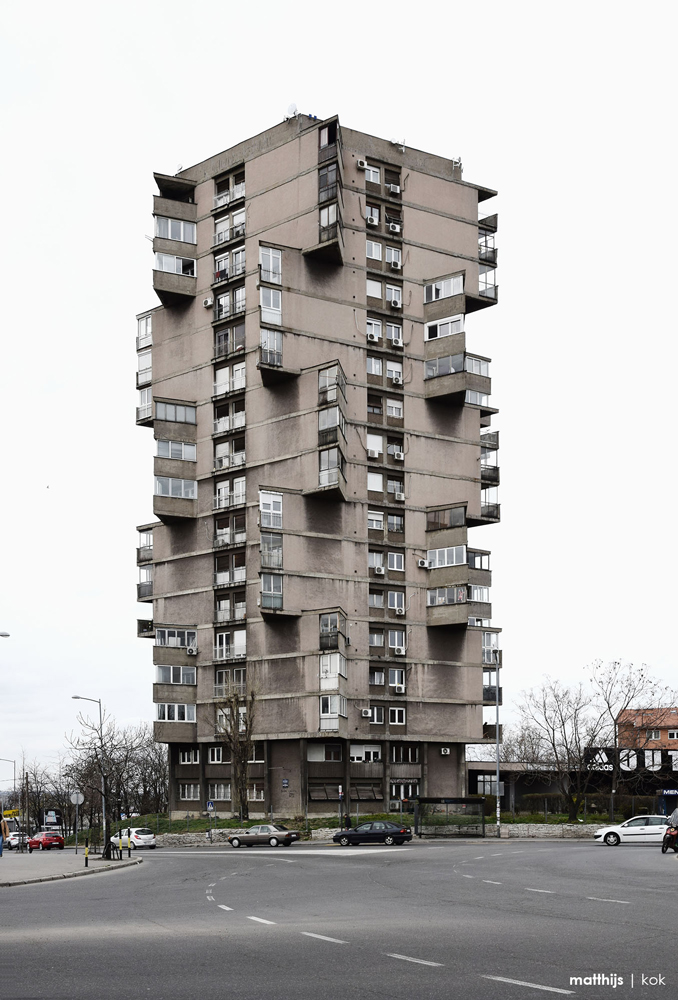
All images Courtesy of Olivier Waltman Gallery
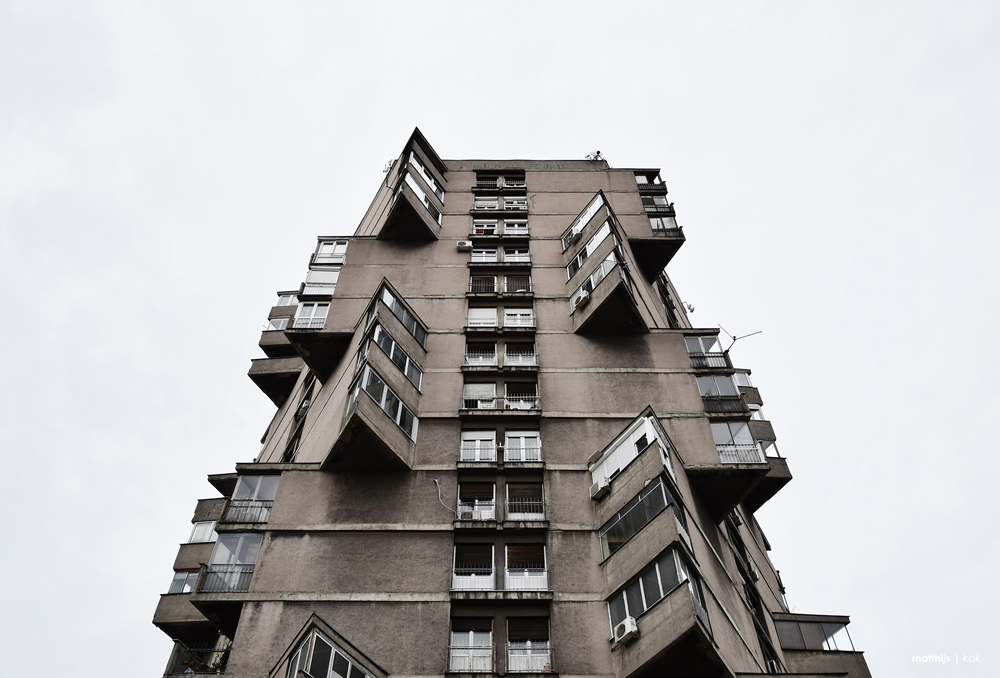
Visit Philippe’s website 

At Photo London Fair 

On Instagram @philippecalandre


A retro-futurist vision Hatoya Hotel, Itō, Shizuoka

A retro-futurist vision

Hatoya Hotel, Itō, Shizuoka


orange walkway Hatoya hotel


Every generation sees the future through its own style prism. The Takenaka Corporation, which designed the Hatoya Hotel, has arguably been doing exactly that since 1610, when their founding father Tobei Masataka built his first shrine.

spaceage walkway
view into the internal walkway


From an original 1947 hotel built by a magician with a thing for pigeons, the Hatoya Hotel expanded five-fold in the early 1970s under the guiding hand of the corporation. Today the bird motif is carried throughout the development.

Futurama, Norman Bel Geddes 1939 New York World’s Fair exhibit and ride and Walt Disney’s Tomorrowland in 1967 and all the Streamline Moderne design in between, were iterative representations of an optimistic future.  Technology would raise the standard of living, make the world a better place. Walter Disney commented,

“Tomorrow is a heck of thing to keep up with…”

We become nostalgic for those outdated versions of the future. The Hatoya Hotel triggers just that response.


Hotel Floor Directory


external walkway 70s vibes hotel decor 1970s furniture in Hatoya hotel


All photos of Hatoya Hotel are the Copyright of Takayama

Follow Takayama on Instagram @hi_takayama

The history of Takenaka Corporation. 

Hatoya Hotel Shizuoka, 1391 Oka, Itō, Japan

Paul Goldberger: Back to the Future: A new look at Modernist hero Norman Bel Geddes, designer of the original 1939 Futurama


advert for shell petroleum company

Through the City of Tomorrow Without a Stop: Advertisement for Shell 1937 by Norman Bel Geddes

Zaha Hadid’s Port House, Antwerp

ANTWERP PORT HOUSE

ZAHA HADID MULTI-FACETED JEWEL


There is a scene, often imitated, in the Sci-Fi movie Independence Day when a vast alien spaceship breaks through the roiling clouds to descend effortlessly and hover over a city. Nothing good follows for the film’s characters, Zaha Hadid’s brilliant and dramatic repurposing of the Antwerp Port House, the Havenhuis, has created something of the character of a massive alien ship hovering. However, everything that follows has been good.

Is the Antwerp Port House Modernist? Perhaps not, but the city loves their Zaha Hadid building, which is a coup as Antwerp has the reputation for being conservative and old-fashioned.


In Zaha Hadid’s untimely death in 2016, aged only 65, the world was robbed of a great (female) architect long before she exhausted her ideas. On the curve of the docks in Antwerp, Belgium sits one of Hadid’s last commissions, the Antwerp Port House.

A convert to the Russian Suprematists’ way of thinking would instantly understand the building with its great planes of light and diagonals cascading into one another. Though to a modern viewer, it is a perplexing statement, albeit an elegant and whimsical reminder of the possibilities of Hadid’s mind.

Entering an architectural competition to win the commission, Zaha Hadid and her team were tasked with keeping an old fire station that lay on the site intact. Ironically, her first building to come to fruition was a working German fire station. However, it didn’t work because the environment was simply too mind-bending and discomforting for the firemen. Lessons learnt, she spent $62 million and set about making sure that the solid Victorian structure she encased functioned as well as her brooding new extension with glass that’s held aloft with powerful steel encased columns.

Huge in scale, the sheer amount of glass circling the structure means the interior is theatrically lit up by the weather patterns. In the same breath, the glass casing is monumental and also gossamer-like. It is no simple geometric object but a complex mathematical sum of faceted windows.


british architect Zaha Hadid Antwerp Port House, supporting pillars


Many think the design for the Antwerp Port House must have been inspired by Antwerp’s long involvement in the diamond industry, but those involved in the work deny this. Antwerp is still one of the world’s most important ocean traders and the extension to the Antwerp Port House is perhaps a ship, its prow pointing to the sea, its bow cutting through a winter sky.


view from beneath of the antwerp port house by zaha hadid


The interior doesn’t disappoint.  There are echoes of Eero Saarinen’s TWA flight centre, the interior has an almost organic feel, like its grown, budded from the trunk and boughs of those great, uncompromising columns. Up one goes in a panoramic lift, leaving the original building behind sealed by a glass roof pierced by those reassuring black pillars and one enters a vessel, self-sufficient to meet every need during a voyage. The corridors stretch on, all around the extension, straight but with a geography of movement following the dynamic design of the extension, a geometric object that doesn’t fall within the description of any shape I was taught about at school.


antwerp belgium Zaha Hadid Antwerp Port House glass elevator to the roof of the Port House


From some views, the extension leans over into a wind, from others it seems thrusting at the sky while from the inside the windows are each like a monitor viewer over a city made small by the height.


Interior of Zaha Hadid extension to the Antwerp Port House Interior view of futuristic Zaha Hadid extension to the Antwerp Port House Antwerp port house Interior of Zaha Hadid extension to the Antwerp Port House diamond designed windows of Interior of Zaha Hadid extension to the Antwerp Port House


Across most pictures of the interior and exterior, the supporting columns obtrude. They’re a constant reminder of a deep muscularity required to achieve the suspension of the extension with such elegance.

Beating gravity has a price and we are reminded of it all the time. Excess seeps from every corner and crevice of this structure, from the quantity of steel used to the mosaic of cut glass windows. Hadid spent until the 1990s designing structures that failed to be built so perhaps having gone for so many years without feeling this sense of fruition Hadid struggled with the reductionism sometimes necessary to build a brilliant design.


view towards Zaha Hadid Antwerp Port House extension

Our thanks to Reinhard Byl and the Port House and the Port of Antwerp for their great kindness and the opportunity to visit the Antwerp Port House.

Book a Tour: Contact the visitor centre 

Address: Zaha Hadidplein 1, 2030 Antwerpen


Verner Panton, the Danish architect and designer who took a generation on a psychedelic trip

Verner Panton

The Danish Architect and Designer who took a Generation on a Psychedelic Trip

‘One sits more comfortably on colours one likes’


Danish design by Verner Panton

Restaurant Varna, Arhus Design by Verner Panton ©Verner Panton Design AG


When international design mavens first saw Panton’s universe in ’58, it stopped them in their tracks. It was a game-changer.

Panton was a pioneer, his ‘whole world’ approach an uncompromising break with the convention. Fascinated by ‘colour psycologie’ from early on, and more than a little obsessed with blue, Panton used colour as a tool applied to his geometric forms and layered patterns creating something worthy of the space age.


Privathaus Binningen,Switzerland Design by Verner Panton, ©Verner Panton Design AG


Born in Brahesborg-Gamtofte on the island of Fünen in Denmark in 1926,  educated at the Odense Technical School, Panton graduated as an architect from the Royal Academy of Arts in Copenhagen. There he met Tove Kemp, the step-daughter of architect and designer, Poul Henningsen. While their marriage was short-lived, Verner’s relationship with Poul Henningsen continued, creatively and personally, throughout his life.


Light and Colour Trapholt Museum 1998 Photo Poul Ib Henriksen ©Verner Panton Design AG


Fresh from the academy, two years in Arne Jacobsen’s design office followed, which could have been route one to a predictable career, working with one of Denmark’s most highly respected designers, but Verner was anything but conventional. Perhaps he was a product of his age, a designer growing up in the immediate aftermath of the War, acting on his vision with urgency rather than waiting for a right moment to present his idea, a moment that might never come. That energy translated into his designs, they demanded then and demand now, immediate attention.

Panton left Jacobsen in 1952 to embark on a series of road trips with Hans Ove Barfoed, criss-crossing Europe in a VW camper van doubling as his draughtsman’s office, a pre-digital nomad. The trips were highly productive laying the foundation for lifelong business relationships. Connections were forged with the highly respected firm Fritz Hansen who produced Panton’s Bachelor chair and Tivoli chair, another with Louis Poulsen the lighting company.


Iconic photo revisited

Trapholt Museum, Verner in his Cone Chair: Design by Verner Panton © Verner Panton Design AG


It was Panton’s father, the manager of a successful traditional, if somewhat sleepy, inn, who, determined to find a public showcase for his son’s vision, commissioned his son to redesign and extend the Kom Igen Inn on the Island of Fünen in 1958. And ‘come again‘ they did, in their droves. Verner designed every aspect right down to the staff uniforms and in the process launched the Cone Chair and very particular geometric hanging lamps. Frankly the designs knocked the socks off the design world; a commission from the Astoria Hotel in Trondheim Norway swiftly followed – allowing Verner to create a fabulous futuristic ‘total environment’ with curvy transparent plastic furniture, carpet, foam shaped forms, curtains and lighting.


Danish design by Verner Panton

Restaurant Varna, Arhus, Design by Verner Panton, Design by Verner Panton ©Verner Panton Design AG

Panton’s visionary aesthetic was spreading, his rise meteoric, he had devised a whole new language that spoke to a generation.


‘The main purpose of my work is to provoke people into using their imagination and make their surroundings more exciting’


Anyone who had the good fortune to visit or work in a space that had been subjected to the Verner Panton makeover was in for a fully immersive, almost trippy assault for all the senses –  think that Oasis song ‘slowly walking down the hall faster than a cannonball.’  Verner’s world was not the exclusive the domain of the rich. His designs spread and flowed into every aesthetic nook informing product design at all price points, internationally.


Der Spiegel Office

Der Spiegel Cantine Design by Verner Panton© Verner Panton Design AG


Mathias Remmele, the author of Vernon Panton, the collected works, noted, ‘In the 1960s, Stern was among the best-known consumer magazines with the highest circulation in West Germany … in 1962, Stern evidently found Verner Panton’s furniture collection developed with Storz&Palmer so interesting and indeed pioneering that it featured these pieces in a multi-page extravaganza. Verner Panton himself was exclusively commissioned to be part of the photographs. The result remains impressive to this day. Not only, but also, because Marianne Panton appeared as a model – a part she was to play on several future occasions. And Panton? He meanwhile succeeded in smuggling a few more of his designs into the pictures. Those with eyes to see will recognize the Topan lamp, the Barboy and the Studioline furniture system.’

It must have been a blast to be in Verner’s creative orbit. Two stand outs are the installation for the Chemistry Company Group at the 1968 Cologne Furniture Fair which offered up Visiona O nicknamed the Dralon Ship, a boat on the Rhine extravagantly fitted out in dralon fabric for pharmaceutical company Bayer AG, and the interior design of offices for German publishing house Spiegel in 1969.


fabric covered foam forms

Visiona 2 1970, for Bayer textiles Design by Verner Panton ©Verner Panton


Panton’s revolutionary work translated into a career punctuated by awards and plaudits for designs immediately recognisable today more than 60 years later.

Today the Panton brand is looked after by Carin, Verner’s daughter, and his wife and life-long design collaborator Marianne Pherson-Oertenheim. Carin was brought up in what might be called a ‘Vernovision’ in the Binningen neighbourhood of Basle. A ‘room high live-in sculpture’ (today part of the permanent collection at the Pompidou) created in ’72 for the Kill Company, and was later placed in the family’s home in Binnengen.


Panton family home Switzerland

Privathaus Binningen,Switzerland Arhus, Design by Verner Panton, ©Verner Panton Design AG

family home Panton family

Privathaus Binningen,Switzerland Design by Verner Panton, ©Verner Panton Design AG


The energy Verner Panton created and applied as he experimented with form, colour, pattern and texture continued for another twenty years until his passing in 1998, a matter of days before an exhibition featuring his Light and Colour design project was due to open.

Selection of projects

Weekend family home 1957 with an update in the ’70s

Astoria hotel in Trondheim, Norway 1960

Varna restaurant near Arhus, Denmark 1970

Spiegel Magazine offices, canteen, swimming pool  1968-9

Guner and Jahr publishing house Hamburg, Germany 1973

Mira X Switzerland


Interier of the historic Circus Building

Cirkusbygningen Copenhagen Verner Panton Design AG ©Verner Panton Design AG

Just some of those designs ….

Series K Kraemmerhusstole 1959 produced by Danish company

Cone Chair 1960 (later developed outside Denmark with Vitra).

Shell lamp 1964 introduced at Heimtex in Frankfurt

Flying Chair 1964 International Furniture Fair Cologne

S Chair 1956

Flower Pot Lamp

Landscaped interior for Kaufhof 1965

Use of Dralon plastic fabric for Bayer

Viebert chair for IKEA 1993

Pantoflex and Panto Swing chairs 1994

Awards

International Design Award three times and others too numerous to detail!

All images the Copyright of Verner Panton Design AG ©Verner Panton Design AG

Find out more about Verner Panton designs www.verner-panton.com

Exhibitions

A segment of the Spiegel-Verlag Canteen is held in the permanent collection of Museum für Kunst & Gewerbe Hamburg

Palazzo di Giustizia di Matera


Palazzo di Giustizia di Matera

Do not mess with the strong arm of the law


When people think of Matera their mind naturally turns either to the Sassi homes dug out of rock, which have been occupied as dwellings for thousands of years ,or to “No Time To Die“. Fans of James Bond have an ah-ha moment recognising Matera as a location in the movie. However, what people may well be missing out on is this fabulous brutalist building in the downtown area. Its architect, Vincenzo Baldoni, has his fingerprints all over Matera, a key figure in the creation of the post-war General Town Plan.


Spotted recently by architect and photographer, Carlos Fumarola, its ‘massive presence’ stopped him in his tracks. The Palazzo di Giustizia di Matera is the local court and ‘as it is meant to be’, Carlo muses, sends out the clear message, ‘do not mess with the strong arm of the law!’

Images Copyright of Carlo Fumarola

Find Carlo on Instagram @carlo1978

Ludwig Hirschfeld-Mack More Than A Bauhaus Artist

Ludwig Hirschfeld-Mack: More Than A Bauhaus Artist

A name that needs to be much more widely known, one of Modernist Germany’s most influential artists. His life bound up with Oskar Schlemmer, Hans Scharoun, Paul Klee, Kandinsky and other greats


Postcard Weimar 1923, ‘Bauhaus Ausstellung Weimar Sommer 1923’ lithograph Courtesy Kaj Delugan and Christopher Bell


His journey took him from Weimar to Berlin, from Welsh mining communities to the most English of public schools, to being wrongly classified as an Enemy Alien. His final humiliation was being arrested, interned and sent to Australia on the infamous HMT Dunera – and while on board, witnessing inhumane treatment by guards. Now the subject of a meticulously researched book, Ludwig Hirschfeld-Mack: More Than A Bauhaus Artist

Resi Schwarzbauer and Chris Bell (Ludwig’s grandson) have given us the opportunity to learn about how a German artist ended up as a much-loved secondary school teacher in Australia, turning down the opportunity to join his friends and colleagues Walter Gropius and Josef and Annie Albers, in America. And how unexpectedly, it was in Australia that he found peace and fulfilment.


Bauhaus Ausstellung Weimar Juli August September 1923 Courtesy Kaj Delugan and Christopher Bell


‘Hirschfeld-Mack is often described as a Bauhaus Artist, but really he was much more than that, explains Resi Schwarzbauer. ‘He was a musician, inventor, performer, pacifist, and deep thinker. For most of his life, Ludwig was a teacher and James Darling, a former Headmaster of Geelong Grammar School, commented that:

‘He inspired dozens of boys with his integrity and enthusiasm. He was an almost perfect man . . . a beautiful character and an original teacher’

Born in Frankfurt am Main Germany in 1893, Ludwig was the eldest son of Ernst and Clara (née Mack). His father was the wealthy owner of a leather factory that had a presence in England. The family frequently visited and even had English students staying with them in Germany;  His childhood was idyllic with loving parents and four younger siblings. It was in 1911 in Frankfurt that 18-year-old Ludwig met Elenor Wirth, later to become his first wife.


Ludwig and his brother Gustav in uniform with the remainder of their siblings


He began his art education in Munich in 1913 at William Debschütz School, the Instructional and Trial Workshops for Applied and Fine Art; he continued until the outbreak of war, a war he witnessed at close range that was to leave an indelible mark on his life. He returned as a fervent pacifist and remained true to that view throughout his life. In 1917 he married Elinor and like so many at the end of the war contracted influenza in the pandemic of 1918-19. By April 1919 the Bauhaus was founded.

Art as a tool to improve the world was always at the centre of his thinking, Hirschfeld-Mack was immediately attracted to Walter Gropius’ 1919 Bauhaus Manifesto which set out a vision for a better world

“… which can embrace architecture and sculpture and painting in one unity….”,

Among the first students to enter the Weimar Bauhaus; in the 1922-23 term he conducted colour seminars for fellow students which were sometimes attended by Bauhaus teachers Wassily Kandinsky and Paul Klee.

One of Hirschfeld Mack’s first woodcuts produced at the Bauhaus was titled

“Völkerbund” – A League of Nations striving for world peace


“Völkerbund” – A League of Nations striving for world peace.


It is little wonder that his friend and Bauhaus founder Walter Gropius described him as


‘ein geborener Lehrer – a born teacher’


Farbenlichtspiele, colour light plays

It was here at the Bauhaus that his creativity and musical ability came to the fore and he developed his Farbenlichtspiele, colour light plays which consisted of shapes in various colours and hues, with the colours moving across a screen in harmony with (the) music. This led to his invention of a colour-light apparatus, used in many colour-light play performances in Germany and Austria and in his becoming one of the contributors to the Der Absolute Film, in Berlin, where he appeared alongside luminary early film producers such as Hans Richter, Viking Eggeling, Walter Ruttmann, Fernand Léger, Francis Picabia and Renée Clair.

With a combination of knowledge and artistry, he was able to adapt his invention so it could be used as an advertising apparatus and a kaleidoscope for theatrical productions. This black and white composition below depicts the different shades of colour.


Scene from Farbensonatine II Rot (colour sonata red) 1923/24 . 8.6 x 11.4 cm. Photographer unknown, Melbourne University Archives, item no. 1971.0009.0044.


Durckdrückzeichnung

Another invention was a groundbreaking new approach to printing which he called Durckdrückzeichnung  – a monoprinting method, utilised by Paul Klee, he also developed the use of calsomine.


1976.39 The musicians 1962 calcimine and watercolour on canvas 42.3h x 47.3w cm Geelong Art Gallery, accession no. 1976.39  Gift of Mrs Olive Hirschfeld, 1976 © Chris Bell


Shortly after the closure of the Weimar Bauhaus in 1925, Ludwig began teaching young children at the revolutionary co-education school Freie Schulgemeinde in Wickersdorf.


Students from the Freie Schulgemeinde Wickersdorf with Ludwig Hirschfeld Mack

Lanternfest construction with Ludwig Hirschfeld Mack. Wickersdorf Free School 1926. Courtesy Kaj Delugan and Christofer Bell


This was followed by a teaching contract at Otto Bartning‘s Bauhochschule in Weimar before he secured a professorship at the Teacher Training Colleges in Frankfurt an der Oder and Kiel. It was in Frankfurt an der Oder that he developed a friendship with the educational reformer and advisor to the Prussian Minister of Culture, Adolf Reichwein. Sadly, Reichwein was executed in 1944 due to his association with the Hitler resistance movement.


Adolf Reichwein at the Musikheim in Frankfurt/Oder


After the closure of these colleges by the Nazis, Ludwig moved to Berlin in March 1933 to seek employment. However, Nazi antisemitic legislation made his life extremely difficult, due to his Jewish heritage.  He struggled to find a permanent position though he was able to earn some income by conducting private classes in instrument making. This brought him into contact with the composer, Carl Orff, and music educator, Fritz Jöde.


Ludwig in his studio in Berlin with a painting of women surrounded by gas-like substances


After spending three challenging years in Berlin, Ludwig finally had no option but to leave Germany for England in 1936,  His long-term goal was now focused on moving to America to join friends and fellow Bauhausers Anni and Josef Albers and his sister-in-law, Irma, who were already there. His niece, Waltraut, shared that he was concerned that as a recipient of an Iron Cross in WW1 he might be called up to “fight for Hitler”, and this was the last thing he wanted to do.

It was increasingly clear to Ludwig that Hitler was a threat to peace and during his time in Berlin he produced a number of powerful images that reflected his thoughts at the time.


a man in a prison cell Oil on linen – 90 x 60 cm Private Collection © Kaj Delugan


The decision to leave his wife Elenor and their three children in Germany was not an easy one and was made even more difficult because his wife had developed multiple sclerosis; however, the move had her full support. Nevertheless, there would have been some comfort for her in that also living in Berlin Siemensstadt were their dear friends the Schlemmers, as well as Hans Scharoun, one of the architects involved in the Siemensstadt project, and his wife Anna. Ultimately, two of Ludwig’s daughters followed him to England, one stayed on while the other returned to Germany, tragically committing suicide a few years later.

While it is uncertain how a friendship developed between the Hirschfelds and the Scharouns, it seems very likely that the connection was made through their close friends Oskar and Tut Schlemmer. Hans Scharoun and Oskar Schlemmer had both been at the same academy in Breslau (now Wroclaw in Poland). When Elenor had to leave Berlin to receive full-time care, Anna Scharoun was instrumental in finding Ludwig’s school-age daughter, Ello, accommodation and it was the Schminke family who agreed that she could stay with them in the home they had commissioned Hans Scharoun to build for them.


Haus Schminke©


After his arrival in England and while waiting for employment opportunities in the U.S, Ludwig accepted a position with the Quaker Subsistence Programme in Wales which involved teaching unemployed miners new skills. He was put in charge of the woodwork classes, and supervised the construction of an open-air theatre. When this programme was abandoned he returned to London towards the end of 1937 where he was offered employment at the Peckham Health Centre teaching children craft activities and instrument making. It was at this time that he invented his colour chord instrument that enabled children with no other knowledge of music to easily play; the method associated musical chords with a colour indicator – best described in the newspaper article below. In 1939 he was offered a position with Dulwich Preparatory College in London, his time at the highly regarded public school took a dramatic turn when, at the school’s evacuation camp in Cranbrook in Kent, he was detained as an Enemy Alien.

An article in the News Chronicle after Queen Mary visited the Peckham Health Centre and played the instrument. In England Ludwig chose to use his mother´s maiden name Mack, a German family name which the English associated with the Scottish Mac.


It could have all turned out quite differently; Walter Gropius wanted Hirschfeld Mack to join him in America, they had both fled to England – Gropius moving on to Harvard in ’37. Josef and Anni Albers were by now at the Black Mountain College in North Carolina, where ironically, Ludwig had been offered a position just before his arrest and detention in 1940.


Sent to Huyton Internment Camp near Liverpool, regardless that he was entirely innocent saw him living in packed conditions with, according to other internees’ recollections, only enough coal for a hot bath every two months and no furniture. He was then moved to Douglas on the Isle of Man, which eventually led to his deportation to Australia on the notorious HMT Dunera. After his internment at Hay, Orange and Tatura, he finally found refuge in 1942 as the Art Master at Geelong Grammar School, in the State of Victoria, at the invitation of its visionary Head Master Sir James Darling. Hirschfeld-Mack remained at the school for fifteen years in spite of receiving an invitation to join the staff of the New Bauhaus in Chicago.


Abstract 1962 Watercolour and pencil over monotype on woven paper, 28.7 x 22cm Gift of Mrs L. Hirschfeld Mack 1976
Collection: Queensland Art Gallery | Gallery of Modern Art, Brisbane © Chris Bell
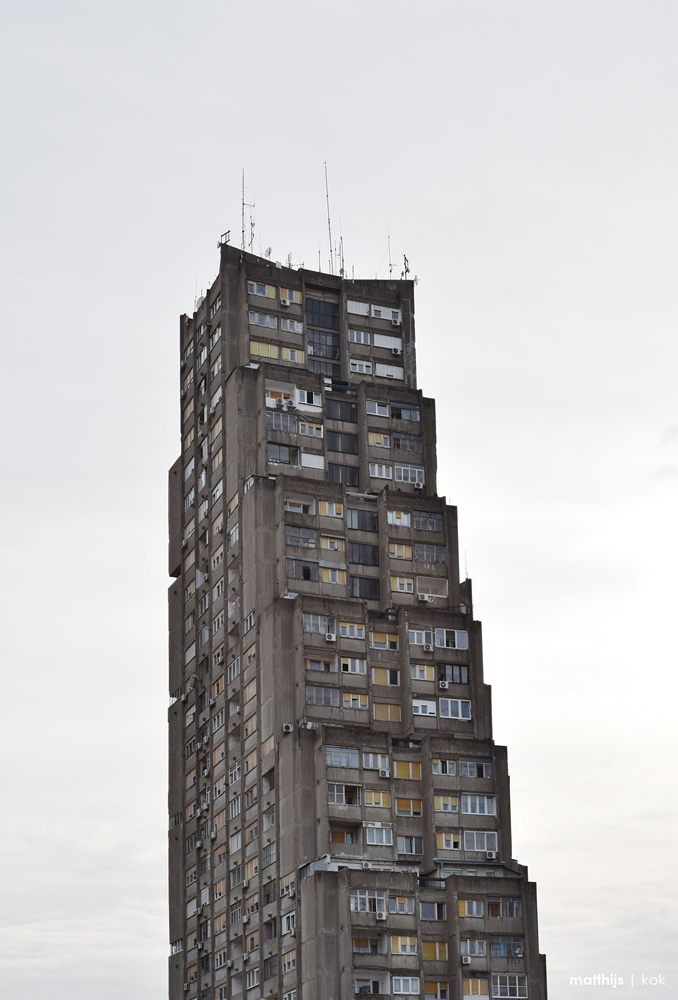
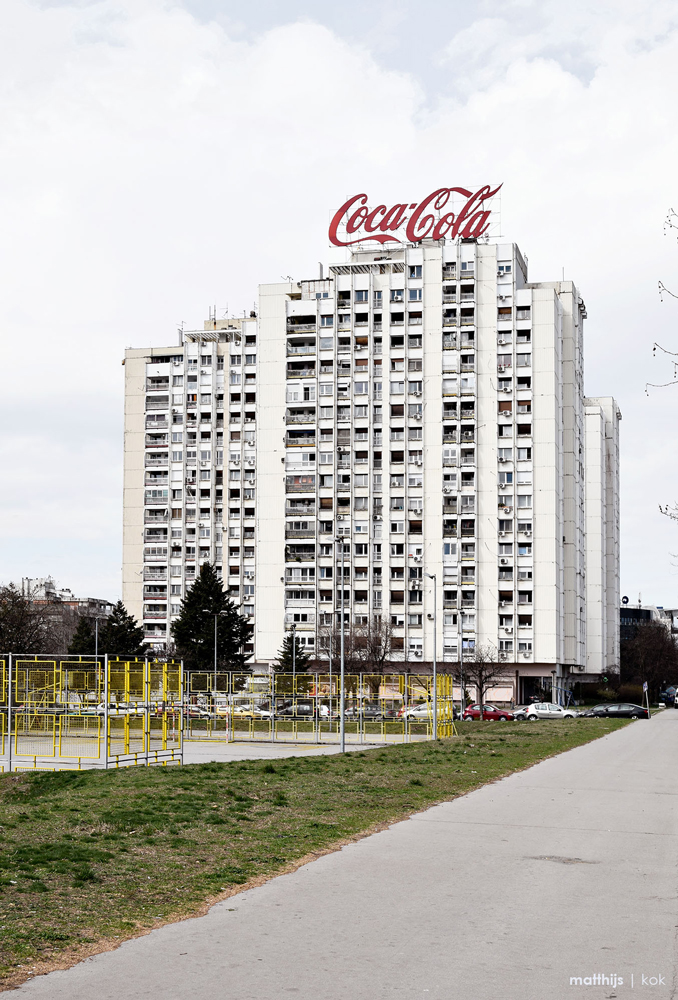
 

After leaving Germany, Ludwig was always mindful of the need to reunite his family after the war and his original plan was for them to move to the United States, where his wife´s sister Irma had settled. Deportation to Australia changed the location of the reunion to Australia. Sadly Elenor was too sick to undertake the journey and passed away in 1953, however his youngest daughter, Ello, did visit him but then chose to return to Germany. In contrast, his oldest daughter, Marga, who had joined him in England before the war, went on to marry an Englishman, Kenneth Bell who, after the war, he managed to arrange the emigration of the Bell family to Australia.  Later, he married Olive Russell, a Quaker, whom he had met during his internment at Tatura.


Four Geelong Grammar boys working on straw construction (material studies) with Hirschfeld University of Melbourne Archives 1971.0009.0057 © Chris Bell


In Australia, he left an indelible mark on the lives of a number of his students, many of whom have very fond memories of the time they spent with him. One student, Daniel Thomas, later became an art historian and curator while other students went on to become architects and art teachers. Furthermore, at Geelong Grammar School, Ludwig and his students left fond reminders of his time at the school, including among others the Art Room frieze and the Art School Gates.


I think it is my destiny within my limits, to give and expect nothing in return 

Ludwig Hirschfeld Mack June 1963


Ludwig´s contribution to the school culminated in the naming of the new art building in 2003 the Hirschfeld Mack Centre Photographer Matilda von Bibra


The biography, Ludwig Hirschfeld-Mack, more than a Bauhaus Artist, has been described as the culmination of two decades of research drawing on extensive family archives and oral histories and relying heavily on material in Australia, Germany and the United States. It also draws on the memories of former students and friends. More than that it’s a terrific read and important addition to the history of the Bauhaus School. It makes clear the effects the two World Wars had on Ludwig’s life, as well as on the lives of his family and friends.


Ludwig in front of his studio at Redro in Ferny Creek. Photographer unknown


© Images from the private collection of the descendants of the Hirschfeld family, unless otherwise stated are the Copyright of the grandsons of LHM  – Chris Bell, Australia and Kaj Delugan, Austria

Images cannot be reproduced without the permission of the family, author or relevant archives


Burkina Faso: Adventures in Ouagadougou

Burkina Faso: Adventures in Ouagadougou

Mathew Jones sits in the category of serious architecture hunter-traveller tooled up with a camera and a pen. Years of deep dive visits to Africa has given him a specialist insight underpinned by having studied urban design and architecture. Greyscape asked him about his trip to the West African state of Burkina Faso and why the Ouaga 2000 district of the capital city, Ouagadougou, is home to some of the planet’s most otherworldly architecture built in questionable circumstances


Ouagadougou Mémorial Aux Héros National Monument Burkina Faso Architecture African ARCHITECTURE

Image Matthew Jones


Burkina Faso, an OHADA member state, gained independence from France in 1960 and remains Francophile. The capital, nodding to its past, is also known as Mossi or Wagadugu and the best way to describe its development is ‘work in progress.’ Interwoven in the narrative is a historically complex relationship with Libya which has continued despite the revolving door of incoming and toppled leaders in both countries.  City plans are still to be completed, but what is already built includes some head-turningly unusual architecture, clearly a form of rejection of Eurocentrism, speaking defiantly for an emerging country that wants to express itself and make a statement about its place in the world, on its own terms. Some of the city’s architectural designs are simply brilliant and others are teetering into the territory of Dictator Chic, the brilliant expression coined by Peter York.

Ouaga 2000 district is not without controversy and has the late Muammar Gaddafi’s fingerprints all over it, a new neighbourhood (the project was unveiled at a French-African summit in 1996), located 10 kilometres to the south-east of Ouagadougou, it is now home to embassies, ministries and lux homes. Dependent on who you ask it was either a blueprint for the future or a vanity project of the now-deposed dictator.


Ouagadougou Mémorial Aux Héros National Monument Ouaga2000 African architecture

Image Matthew Jones


When I first saw Mathew Jones’ photos of Burkina Faso on Instagram I immediately remembered a brilliant exhibition at MoMA in New York of the late Congolese sculptor and visionary Bodys Isek Kingelez, called City Dreams. Kingelez made the most extraordinary imagined cities out of styrofoam, paper, foil, stickers and cardboard, he described himself as ‘Someone who dreams of what doesn’t exist’. His designs were all about a new African vision in a post-colonial, post-cold war world. Seeing Ouaga 2000 was like looking at a super-sized segment of one of Kingelez’s dream cities.


Bodys Isek Kingelez City Dreams

Image Greyscape


We needed to ask Matthew more;

What made you decide to visit Burkina Faso? 

It’s always been on my bucket list and I’m keen to travel widely in Africa.  Several years ago I was doing a lot of work in Ghana, just to the south, and I finally had some free time to fly up to Ouagadougou. I was in the region again at the end of 2018 and had a chance to pass through a second time.

Was it how you expected it? sounds a naive question but people often have pre-conceived ideas that are blown away …or not.

I didn’t exactly have specific expectations, but the country is quite distinct from Ghana, and from the other parts of West Africa that I have visited. Burkina Faso is French-speaking, so there’s a very different atmosphere to Ghana, and it is in the drier Sahelien region, whereas coastal West Africa is very green and forested. I was definitely quite blown away by it, especially in terms of the distinct modern architecture of the city centre.


Place_des_cineastes_Ouaga 2000 Burkina Faso Architecture

Place des cinéastes, Ouagadougou, Burkina Faso Image Sputniktilt CC BY SA 3.0


Does the Place Mémorial Aux Héros National Monument stand out in contrast to other buildings in Ouagadougou? 

The monument itself is probably the single most unusual building in Ouagadougou, but despite being tall it is not especially prominent as it is not located in the historic centre, instead, it can be found on a very desolate, under-used roundabout in Ouaga 2000, the newer planned quarter of the city. You sort of have to make an effort to drive along the correct road to see the monument, it is quite possible to not come across it even if you are relatively close to it, it is not very noticeable until you are right upon it.


Ouagadougou African Architecture memorial des Martyrs

Image Matthew Jones


You’ve described the memorial as reminding you of something between a UFO and the Eiffel Tower. Intriguing!

To be honest, using the UFO metaphor is often very tired, overused and a rather thoughtless expression to describe an unusual-looking or futuristic building, even when there is nothing about the building that really looks at all like a flying craft. Yet, with the Mémorial Aux Héros National Monument, there is something that seems to me that has an obvious emotional connection to the Eiffel Tower. Let’s be clear, whereas the Eiffel Tower is a fanciful, wrought-iron skeleton, the Mémorial Aux Héros National Monument really looks like a cartoonish, child’s toy rocket ship, and so for once, the UFO metaphor really is relevant. It also has something of the soft-edged, plastic child’s toy version of an Eiffel Tower about it with its four sloping legs, midriff enclosed platform, and observation capsule at the crown. Given that this is Francophone West Africa, the reference seems unquestionable. Yet the gorged-to-bursting muscularity of the tower contrasts with the spindle-thin steelwork of its Parisian parent.


Monuments des Martyrs Ouagadougou architecture tower

Image Matthew Jones


What do you think was the design inspiration?

As disco-fabulous as it is deserted, the Monument of National Heroes in Ouagadougou certainly suggests the designs of an earlier age; the era of missile-inspired architecture surely ended with the Cold War, and here is a specimen with bell-bottomed pillars at the base, plaid-patterned in mirrored glass, and topped off with the classic car fins like visor shields. These might conjure guesses of a 1970s or early 80s effort, but amazingly the monument only started to rise in 2002.

Although still young in building-years, this rocketship is hardly ready for take-off, as the elevator has been defunct for at least a half-decade. Instead, the ascent is achieved via stifling stairwells, to which the guards will happily accompany visitors for a few dollars. The substantial-looking legs of the tower are revealed to actually be hollow, unenclosed shelters for the staircases. The corpulent mezzanine level was meant to be a museum but is undecorated.

You reach the top by way of a seemingly endless, dizzying spiral stair, finishing at the monument’s viewing gallery. Guests are invited to climb a long ladder to the mechanical roof to enjoy the highest view between Algiers and Accra.


Ouagadougou capital city of Burkino Faso

Image Matthew Jones


Is the Monument really a post-modernist folly of a delusional now fallen leader or an attempt at forging a new vision for a city? 

The Ouaga 2000 quarter fits the category of a dictator’s grand vision for a monumental edifice, and thus is really a folly. There is nothing new, innovative, or democratic about the plan, and indeed the quarter is an isolated, elite diplomatic, governmental enclave, attempting to move the privileged away from the older city centre. However, if you look at historic Ouagadougou, it is home to a wonderful collection of innovative, mid-century, post-independence African modernist public buildings that do an excellent job representing a more optimistic and democratic period in the development of the city.


Fespaco Panafrican Film and Television Festival of Ouagadougou Burkino Faso Africa

Image Sputniktilt CC BY SA 3.0


You mentioned something about the half-realized bigger plan, can you explain that as it’s such an interesting notion. 

Ouaga 2000 is really only half-realized, in particular, the huge radial park, whose centrepiece is the Monument. The area is quite barren, with too many empty spaces in prominent positions. It was the grand project of deposed President Compaoré and was meant to glorify the revolution (we’d call it a coup) that brought him to power in 1987. The planned quarter is the major public landmark of the strongman’s bigger pet dream. After President Compaoré was deposed in 2014, the monument was rededicated to the martyrs who died in that conflict.


Ouagadougou architecture west africa

Image Matthew Jones


Do you have a dream destination to visit or that you have seen that really struck you? 

One of my top places that I really am eager to get to in the region is Yaoundé, the capital of Cameroon, which has an amazing collection of African modernist buildings and ministries. Nearly every Francophone post-colonial capital has an array of unique modern buildings, built roughly between 1960 to 1980 ie in the immediate post-independence era when there was a need for new ministries and government facilities. These are still in use today in capitals from Dakar to Brazzaville. From my research, Yaoundé in Cameroon has some especially noteworthy examples, and I’d just love to go there.


Ouagadougou capital of Burkina Faso Mémorial Aux Héros National Monument Ouaga2000 west African architecture

Image Matthew Jones


What camera do you use?

I have a Canon G3X, which I use almost all the time. Not the most sophisticated camera but it is quite small and compact, with an amazing 25x optical zoom. It is really handy to have in a place like Ouagadougou where photography is frowned upon, so when I’m shooting on the street I really want to try to minimize the attention I receive. I can’t be lugging around a large piece of equipment, I need something that virtually fits into my pocket.

Favourite moments in Burkina Faso?

When I first went in 2014, I made friends with a taxi driver who showed me around. I had trouble contacting him before I returned for my second visit. I needed to figure out how to find him so I started telling taxi drivers that I was looking for him and within a few hours he showed up at the hotel. Having a friend show you around—and especially having a local run interference when you want to take photos—is really priceless. I definitely wouldn’t have had the same experience without his friendship.

Insider traveller tip? 

I keep to a pretty strict schedule when I visit a city to photograph: I am up and outside at sunrise, the city is quiet, so there will be fewer people and cars detracting from architectural photos, and most buildings will be unguarded so fewer people will try to stop you or harass you for taking photographs. And of course, the light is much better. In equatorial Africa, the “golden hour” truly only lasts for about 60 minutes; the sun gets high fast in the morning and sets very quickly in the afternoon, so you have limited time. While I still keep photographing at midday, sometimes I will take a break as it is too hot, and the sun is too high, and the city streets are too crowded to get optimum photographs.

One that got away? The photo you wished you’d taken or taken better?

There were so many that got away! Many places in West Africa, for various reasons, frown on photography, especially of governmental buildings. Such an act is viewed with suspicion, and security guards or even police will intervene, and it can get quite unpleasant. This is especially true in Ouagadougou, which has in recent years suffered some horrible terror attacks, and even walking down any street with a camera arouses consternation. So, there were lots of amazing, prominent buildings in Ouagadougou that I just couldn’t photograph at all, or I could only quickly point my phone at for a moment, rather than lining up a shot with my camera. It was disappointing, but that’s how it is sometimes.


Burkino Faso Monuments des Martyrs

Image Matthew Jones


Find Mathew on Instagram at www.instagram.com/bauzeitgeist/

Bauzeitgeist http://bauzeitgeist.blogspot.com/

All Matthew Jones images are his Copyright  


Galerie Berinson and the Emergence of Modern Photography

Galerie Berinson and the Emergence of Modern Photography


Discovering Berlin’s Galerie Berinson was a moment of exhilaration.  It made me feel so much better about my obsession with ‘German’ avant-garde photography.

avantgarde photography berlin 1930

Bahnhof Zoo 1930 György Kepes


That’s actually a loose term, as so many of the photographers came from some other place than Germany but were drawn to Berlin in the 1920s,  one of the world’s most cosmopolitan and open-minded cities. Galerie Berinson’s owner, Hendrik A. Berinson, has been collecting and exhibiting photos since 1986 and, really, there’s no one better to have onside to help on a journey of discovery of the era’s immense cultural icons and luminaries.


bauhaus architecture

Streetview of the Bauhaus Masters’ homes, Lucia Moholy 1926

To understand why Germany matters so much in the development of avant-garde photography just look at the cultural climate, the zeitgeist. Or perhaps the Berlin gestalt to adopt the name of the then-popular school of psychology, the whole was so much more than the sum of the parts. In the hands of experimenters aided by new technology, photography was advancing beyond static, traditionally posed studio images.

Photographers like Martin Munkácsi arrived from Hungary and captured the essence of a population with a voracious appetite for magazines and news media. His street, fashion and sports photography inform our image of interwar years Berlin, freed from the grip of Germany’s imperial and imperious rulers, a crucible of creativity in painting and the arts, Futurism, Surrealism and Dadaism and political extremes


schocken department store

Kaufhaus Schocken Catalogue image Albert Renger Patzsch


In the 1920s Germany published more illustrated magazines than any other country. According to the Metropolitan Museum of Art,

  ‘In Berlin alone, there were forty-five morning and fourteen evening newspapers. In addition, hundreds of newspapers and magazines catered to special interests.’

By the mid-1920s Germany had become a testbed for new ideas and home to the world’s finest lens manufacturers and lighting technicians. Zeiss was ‘at the leading edge of photographic lens innovations’,  optic design and the designing of precision measuring instruments. The work of these photographers who broke every rule and ignored every boundary had a long reach and revolutionised the development of modern photography.


galerie berenson bauhaus

Bauhaus weaving workshop, Lotte Stam Beese 1928


Whilst not considered a study subject in its own right at the Bauhaus, Hungarian-born Lásló Moholy Nagy, was already writing extensively about it and published Malerei, Photographie, Film in 1925. Bauhaus student and masters’ son, Lux Feininger was never without a camera in hand, regardless that he was at the school to study painting.


surrealist photography

‘Self with navel monocle’ Hans Arp 1922


Berlin expanded its city limits in 1920 through the Groß-Berlin-Gesetz, the Greater Berlin Act, creating a city with more than two million residents, a magnet for young photographers. Annelise Kretschmer, Ilse Bing and Gerda Taro were typical of a class of newly emancipated German women unconstrained by the social rules and regulations that smothered their mother’s lives.


Ilse Bing female photographers

Ilse Bing self-portrait with Leica Camera 1931


The Weimar renaissance was a game-changer for them and they channelled their creative energy into experimental photography, producing images that define a short-lived era before dreadful calamity overtook Germany and the world. It wasn’t just photos that were cutting edge, expressing the mood of a growing cosmopolitan left-leaning middle class, the creative energy influenced film, art and music.
a proletarian tells

Cover for ‘Ludwig Tureck. Ein Prolet erzählt’ 1930 designed by Otto Coenen


With an acute sense of self-awareness of their role in the shaping of the genre, two landmark exhibitions were staged, Fotografie der Gegenwart organised by Kurt Wilhelm Kastner, travelled in Germany and arrived at the Whitechapel Gallery in London in 1929 and Fifo Film and Foto was in Stuttgart in 1929 and travelled as far as Japan. David Campney, curator, writer, and Managing Director of Programs at the International Center of Photography, New York explains,
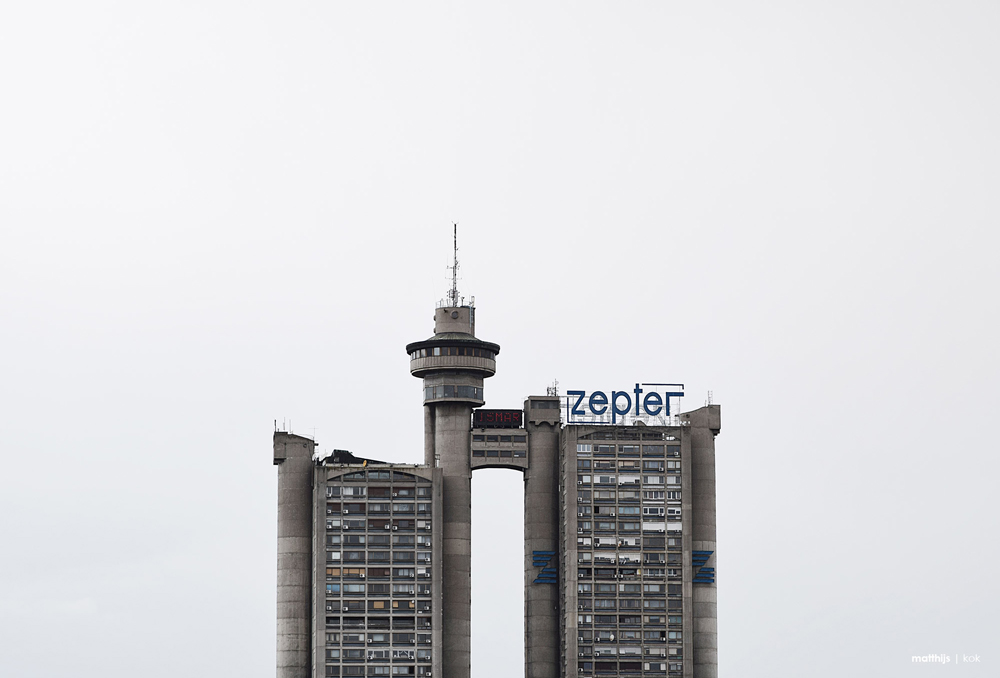
FiFo … put aside anxieties about the status of photography as Art, capital A, to look instead at its comprehensive redefinition of modern vision and its diverse roles in society. Photography had become central to science, architecture, fashion, advertising, reportage, tourism, and more. Yes, it could be framed on walls, but it could also be used in the streets on posters and billboards, in books, journals, and magazines. And, of course, photography was a fundamental ingredient of filmmaking.
modernist architecture Wroclaw

Hostel for Single People, Breslau architect Hans Scharoun, Photo Heinrich Klette


This brings us back to Galerie Berinson’s role in introducing those photos to a new generation. The photos are fresh and vital and invariably leave the viewer with more questions than answers. After all, is it possible to look at photography from the Weimar era without adding on the layer of knowledge that we simply cannot unknow?


Visiting Galerie Berinson

Address Schlüterstraße 28 D-10629 Berlin
Galerie website 
On Instagram @berinsongalerie 
All images the copyright of Galerie Berinson

Camino Real Polanco, Mexico City

Camino Real Polanco

Ricardo Legoretta’s Trippy City Hotel for México 68


Uncompromising, in-your-face geometry combined with the brilliant use of colour and natural light, this was the formula Ricardo Legorreta used to dazzling effect in Camino Real Polanco. Talk about a counter to corporate beige; there was nothing muted or unchallenging or inoffensive, the tonal design language of the traditional business hotel.

The hotel opened in the summer of ’68, a few months ahead of the México Olympics. The architect and city planner Pedro Ramírez Vázquez, heading the city’s organising committee, had a vision; to fuse together Aztec and Mayan designs, trad folk art and tripping-out psychedelia. And he achieved it in spades, using the artistry of fellow architects such as Modernist Ricardo Legorreta, Félix Candela and the King of Logos, graphic designer Lance Wyman.

What Camino Real Polanco does so brilliantly is pay homage to Legoretta’s Mexican heritage, leaning into Vázquez’s vision. The hand of his friend and mentor Luis Baragan is also clear. The pair met when Legorreta was Baragan’s student at UMAN. They forged a lifelong friendship.


fountain
mexican modernist hotel

Fountain of Eternal Movement by Japanese-American landscape architect Isamu Noguchi,


Integrated into the design is a series of works by important artists including Mathias Goeritz’s sculptural wall and Abstracto en Dorado mural, the continuingly churning Fountain of Eternal Movement by Japanese-American landscape architect Isamu Noguchi, the subject of a major retrospective at the Barbican in Autumn 2021.

I wanted a very discreet and mysterious entrance sequence for the hotel, something to be discovered little by little as you penetrate the building. Part of the first discovery would be water, so I thought of a fountain – like many patios in Mexico, there would be a fountain. Then the concept grew in my mind of an aggressive fountain, one that provoked a reaction – vigorous, thrashing water there within the shelter of the hotel.

Ricardo Legoretta

Not forgetting a Rufino Tamayo mural and Six Adivinanzas de un Astronauta Hindu by the surrealist Piedro Friedeberg. Whilst the original Calder sculpture Untitled with Olympic themes has gone, sold at auction for a huge sum along with the Annie Albers wall hanging, there remain some amazing pieces in a stunningly beautiful space, not to be missed.


Today the original Legorreta Aquitecos firm founded by Ricardo in 1965 continues to thrive. And, if you’re into Sam Peckinpaw movies, the once seen never forgotten, Bring me the head of Alfredo Garcia a film hairdressers need to watch on Halloween was partly filmed in the hotel, as was Mozart in the Jungle.


mexican mid century hotel

Matthias Goeritz Mural


Go see for yourself: Map location 

All images the Copyright of Christopher Iwata © Find Christopher on Instagram @seaeye1

Legorreta quote via Mexico — Fond Memories of Place: Luis Barragan and Ricardo Legorreta

Kugelmugel Affairs of State In The Republik

Kugelmugel

Imagine a republic in a spherical house located on a small hill.

There you have it, a Kugel on a Mugel

view of the original kugelmugel Sphaera 2000


Edwin Lipburger was an artist with a dream. Born in Vorarlberg, Austria, his 1969 dream developed into something real, a spherical space that could be inhabited, it even had a name, Sphaera 2000, inspired by the ancient Greek for ‘ball’.  Riffing about spheres was a very 60s kinda thing (think Melvyn Sokolsky’s iconic photos of models floating down the Seine in bubbles).  Together with his son Nikolaus he built a 7.8-meter diameter kugel (a globe or sphere) in 1970, in a peaceful meadow, on private farmland, in Katzelsdorf, just south of Vienna, in Austria (already a republic). This hardly resonates as an aggressive act however it fell foul of the law but not in the way you might imagine, yes there was a planning issue but not just about right to build, it was about the shape of the building.  Lower Austria bans spherical dwellings.

Chris Mavric, a curatorial board member of the Die Republik Kugelmugel, has been an invaluable resource in understanding a story 40 years in the making that puzzles anyone unfamiliar with some of Austria’s more arcane laws.

At first the authorities must have been mystified watching from the sidelines, because you have to wonder how the building of the sphere managed to be completed, the kugel was gently cooking (in Yiddish “kugel” is a dish made from potatoes), but then the atmosphere began to get distinctly overheated when Edwin Lipburger was ordered to tear the ‘illegal structure’ down. So many possible courses of action in response and Lipburger chose a novel one, he declared his sphere had township status and called the place Kugelmugel, meaning sphere on the hill (or potato’s dish on the hill).


republic of kugelmugel street signs with klaus lipberger newspaper article kugelmugel


Chris shares, ‘Father and son created their own street signs surrounding the sphere, which were very similar to official signage issued by the Austrian government. However, it was not their intention to found their own republic at the outset. Once they embarked on their journey Kugelmugel became the “tenth state of Austria” and eventually the Republic of Kugelmugel. This did not go down well with the authorities.

The situation spiralled out of control. Chris reveals that reports suggest as many as 25 police with dogs and armed with machine guns, raided Kugelmugel only to find that Lipburger was not at home, he was down the road in the pub. What went down that day, he suggests, has become folklore. Lipburger ended up in jail for eight weeks in ’79 (two weeks short of his ten-week sentence). The Austrian authorities got him for putting up imitation Austrian street signs. He was later pardoned by President Kirchschläger, however, his name was not fully cleared and he was actually not rehabilitated.


lipburger arrest at kugelmugel


‘It is important to understand that Lipburger’s resistance and his founding of the Republic of Kugelmugel itself was an artistic intervention” Chris notes, “done in order to protect the spherical house from being demolished. Out of an act of resistance came energy which sparked interest in creating Kugelmugel art and design including the famous 1978 (and 1994 edition) Kugelmugel stamps (close inspection showed an overlay on existing Austrian Stamps), the ‘ball hill’ paintings photography and even flags’.


A breakthrough came in 1980 when politician and later Mayor of Vienna, Helmut Zilk, hearing that the kugel was going to be demolished, suggested that a suitable location for the Republic could be in the Vienna Prater, a large well-known public park, familiar to film buffs as its home to the Ferris Wheel where Holly Martins agrees to meet Harry Lime in The Third Man. Lipburger accepted the suggestion although he innately did not like the location (surely he cannot have pictured his republic in close proximity to an amusement park however sophisticated it is) but by now he was in no position to negotiate if he wanted to save his project. Arguably the finding of a solution was not as one-sided as it might seem, the state had a hot potato (kugel?) on its hands and needed a quick fix as the national conversation had turned to the right to artistic freedom of expression.


interior view of the kugelmugel in the vienna prater designer edwin lipburger


Chris recalls ‘Essentially all 128 wooden elements were taken apart and reassembled in the Wiener Prater. Access to tap water, electricity and sewers were promised as part of the move, and that was essentially the reason why the Lipburgers went for it. The promises Zilk made were never fulfilled which is a key reason why Kugelmugel is in the midst of a long-running dispute with the City of Vienna’. Zilk later became embroiled in accusations that during the 1960s, at the height of the Cold War, he had passed information to the Czechoslovakian Secret Police. If I were writing a sequel to The Third Man I’d definitely weave into the plot a well-known politician creating of a bolt hole in plain sight beyond the jurisdiction of the police; a kugel instead of the Vienna sewers used by Harry Lime.


edwin lipburger kugelmugel vienna prater


As early as 1982 Lipburger disliked the sphere’s location close to the Wurstelprater, where the Ferris Wheel and amusement park is situated. This placed Kugelmugel with family attractions rather than the artistic act of resistance that it had evolved into. Today  Kugelmugel remains in the same location within a small square protected by a barbed wire border. Its address, which has been formally adopted, created by the artist is 2.,Antifaschismusplatz.

Edwin Lipburger died in January 2015 and his son Nikolaus Lipburger assumed the Presidency, today presiding over its 600+ citizens.


republic of kugelmugel in wiener prater


Chris, clarifies  ‘Citizenship is an “idealistic” one and not a physical one, as all of the citizens could not fit in the Republic at the same time’

Since 2016 Chris Mavric together with Markus Sigl has been creating a rich programme of performances and exhibitions.


exhibition inside the kugelmugel in weiner prater


Need To Know Before You Go

  • Visiting the interior of the nation is strictly by arrangement or when it is open for exhibitions
  • The current Head of State is President Nikolaus Lipburger who succeeded his father Edwin
  • It has 600+ citizens
  • Official language German
  • Currently unable to process new passports
  • State Emblem features Lipburger’s image in black on a white circle
  • National Flag shares the same colours as the Austrian National Flag

All images Copyright © of Kuratorium Kugelmugel


A must-have book, ‘Walter Gropius: An Illustrated Biography’ by Leyla Daybelge and Magnus Englund

A must-have book,

‘Walter Gropius: An Illustrated Biography’

Any consideration of Modernist design, in fact, the direction of design since the establishment of the Bauhaus has been deeply influenced by the genius of Walter Gropius.  A new biography by Leyla Daybelge and Magnus Englund tells Gropius’ amazing story


Walter Gropius, Spain, circa 1907. (page 28) Originally published in Gropius: An Illustrated Biography of the Creator of the Bauhaus, Reginald Isaacs, Bullfinch Press, 1991. In 1907, Gropius received a substantial inheritance from a great-aunt. He left the Technische Hochschule without completing his examinations and spent a year travelling around Spain with his friend Helmuth Grisebach


In their ‘Isokon and the Bauhaus in Britain’ Magnus Englund and Leyla Daybelge showed us how Britain’s modernist heritage is profoundly enriched by the Isokon Building, aka Lawn Road Flats in Hampstead. It wasn’t just a revolutionary design in ‘30s London but an expression of a social ideology, to architecturally fix a new way of communal living. The Isokon became a centre for the avant-garde and for Walter Gropius and the Bauhaus in its London exile. Leyla and Magnus have now authored a large format, sumptuously illustrated biography of Walter Gropius, the founder of the Bauhaus, ‘Walter Gropius: An Illustrated Biography’. It’s packed with photographs, many not previously seen and others not at all well known, as well as drawing on letters and sources undiscovered or unexplored by previous biographies.  The book follows the extraordinary life of Gropius from his traditional Prussian youth before the Great War, through his service in the horrors of the Western Front and the founding of the Bauhaus.  The book details Gropius’ exile from Germany following the election of the Nazis and the forced closure of the Bauhaus, his time in London and then his fruitful years in the US, his enormous influence on the next generation of designers and architects and that continued influence.

Leyla Daybelge has a background in news and current affairs journalism and broadcasting and is a well-known writer on travel and culture. Magnus, also a writer, is from a retailing and design background; he founded the Skandium interior design store chain.

Since we opened ‘Walter Gropius: an Illustrated Biography’ we’ve been learning and made to think anew about much of this giant of twentieth-century design. So we were so pleased to put some questions to Leyla and Magnus, now, undoubtedly, leading commentators on modernism and the Bauhaus. Asked what is the lasting influence of Walter Gropius, said, ‘First and foremost, the curriculum for post-war design and architecture schools, lasting to this day, where creativity and experimentation is allowed, instead of top-down feeding of established facts to the students. Then it’s the linking of art, design and architecture, making it parts of a whole. He had the vision to see this very early on.’


You and Magnus have different backgrounds, and both have different successful careers; how did you meet and decide to collaborate?

We were introduced by a mutual friend, Adrian Pritchard, grandson of Jack Pritchard, who commissioned the Isokon Flats in Hampstead. We were both fascinated by the rich history of the building and its celebrated residents. At the time, Magnus was living in the Penthouse. We also discovered we shared a some-might-say nerdish interest in the world of 1930s design.

You have previously, together, written “Isokon and the Bauhaus in Britain”, was it during that project that you decided to write “Walter Gropius an Illustrated Biography”?

During the research for our first book, we became aware that little was known of Gropius’ life in Britain. He lived in London at the Isokon Flats in Hampstead, from October 1934-March 1937 at the centre of an extraordinary artistic community. Often in accounts of his life, this period is entirely ignored, skipping from his life in Berlin as an independent architect after he left the Bauhaus, directly to his role as the head of the Graduate School of Design at Harvard.

Initially, we considered writing a book about Bauhaus buildings in Britain but were commissioned by Phaidon to write a Gropius biography, with a brief to include as much visual material as possible, which, as it transpired, was a much more interesting project.

What, to you, is the importance of Walter Gropius, not just in terms of architecture and design but more widely as well?

Gropius is best known as a pioneer of Modern architecture and the Founder of the Bauhaus, the world’s most important and influential school of design and architecture. First in Weimar and then in Dessau, rather like a premier league football manager assembling a dream team, he put together a world-class teaching faculty, employing leading artists including Paul Klee, Wassily Kandinsky, László Moholy-Nagy, Josef and Anni Albers, Marcel Breuer and Marianne Brandt.  The Bauhaus graduates, in turn, helped change the face of 20th-century design. Many dispersed globally, in the run-up to the Second World War and their work influenced architecture, art, furniture design, graphics, textiles, ceramics and theatre design. Later, as head of the Graduate School of Design at Harvard University, Gropius inspired a new dynasty of architects, including IM Pei, Philip Johnson and Harry Seidler.

There are a number of books about Gropius; what does your biography add?

We aimed to produce the first in-depth biography, which anatomizes not just Gropius, the man and the architect, but also the product designer, the educator and the mentor. We have included new material on his time living in London, which is often overlooked and also his later years in the US working at Harvard and in the TAC partnership. Produced in a large format, our biography has almost 400 images, including plans, drawings and blueprints, but also previously unpublished private photographs, correspondence, ID documents, menus, ephemera and contracts. Phaidon has done a beautiful job with the book’s design.


Chapter 7: USA and the World, 1952-1969. Clockwise from left: Walter and Ise visiting Britz-Buckow-Rudow in Berlin, June 1968; Drawing for the community centre at the Britz-Buckow-Rudow development; Drawing for the shopping street at the Britz-Buckow-Rudow development (pages 282-283)


Gropius was married for some years to Alma Mahler; how influential was she on his ideas and career? Do you feel she has been well represented in the Gropius and Bauhaus story? Have her personal achievements and talents been overlooked because she was a woman?

Alma Mahler grew up in a bohemian Viennese household and was a gifted amateur musician and composer. Her ambitions were largely thwarted by her first husband, the composer Gustav Mahler, whom she married at the age of 22. Nineteen years her senior, he belittled her efforts and demanded that Alma put her talents on one side to support his career instead. A complex and passionate woman, she became a muse to a string of important 20th-century artists, amongst them, Gropius, an architect, the painter Oskar Kokoschka and writer Franz Werfel (her third husband).  During the early stages of their marriage, she drove Gropius on relentlessly – ambitious for his, and by extension her own, success. However, rather than influencing his ideas per se, her social status and the artistic Viennese circles she frequented, were important for Gropius’ career. For example, it was at one of her soirees that he met the controversial artist Johannes Itten, whom he would later employ to run the Preliminary Course at the Weimar Bauhaus.

In recent years the image of Gropius as dry has been contradicted; so you consider that he was passionate, emotional? What was his personality like?

We can’t quite put our finger on where that image of Gropius came from, maybe because he didn’t hold the egos of Mies or Corb but instead worked as part of groups, both in his various practices and at the Bauhaus. But it doesn’t make him a dry person, just more diplomatic. It’s quite clear from his love life, not just with Alma Mahler but also with other women, that he was deeply passionate, and he surrounded himself with some of the greatest artists of the 20th century.

How did you research the biography? How long did the book take to write?

We used a large number of previous books, probably a hundred, and then went deep into the various archives in Germany, Britain and the US that hold original material. We also spoke to members of the Gropius family and people who worked at TAC, his last firm. It took us the best part of two years.

How do you write together? What are the mechanics?

It starts off with a shared journey down quite obscure rabbit holes, tracing the unknown or the obscure, until we start to frame the many parts into a narrative. It’s a book rich in illustrations, and we prefer images that brings out the human side where possible.

Would you have liked Gropius? Do you admire him just for his design genius?

Yes, we think he would have been a wonderful person to be stranded with on a desert island! He seems warm, funny and generous but also very serious and sometimes sad, as he faced so many obstacles and hardships in his life. He comes across a man with a good moral compass, who cared about people and the world around him.,

If the Nazis had not come to power, what would have happened to the Bauhaus and Gropius?

The Bauhaus would not have left Weimar for a start, which means that the famous buildings in Dessau would never have been built. He would probably not have left the school in 1928, and never left for England and then for America. Modernism under a democratic Germany would have developed during the 1933-1945 period uninterrupted and benefitted many people who instead came to suffer or even die.


Chapter 5: London, 1934-1937. Clockwise from top left: Gropius and Fry, Dormitory Block, Christ’s College Cambridge, 1935–6; Menu card and seating plan for a dinner in Gropius’ honour at the Trocadero restaurant in Piccadilly, London on 9 March 1937; Departing England, Walter and Ise were bid farewell at Waterloo Station in London by Moholy-Nagy and Jack and Molly Pritchard on 12 March 1937; Gropius and Fry, Mortimer Gall Electricity Centre, Cannon Street, London, 1937 (page 198-199)


What are your three favourite works of Walter Gropius?

There are some key buildings, of course, like the Werkbund building, Fagus factory and Dessau school. But personal favourites include the wooden Sommerfeldt house in Berlin (destroyed in WWII), the American embassy in Athens, and the Brutalist glass factory for Rosenthal.

Have you decided on a new project?

Yes, we have two equally exciting books under discussion, and if both happen, we will be very busy for the next few years. Both are about people who combined architecture and furniture design, and one is a woman, but that’s as much as can say at this stage!

Published by Phaidon ‘Walter Gropius: An Illustrated Biography’ is available from the Greyscape shop.

Communist Border Signs or How To Make the Road Your Destination

Communist Border Signs or

How To Make the Road Your Destination

A journey through Romania is a journey through the political change of a country signposted by road signs


roadside sign Galati and Vrancea border

Galati bordering Vrancea County, Romania


Roberta Curcă could not have imagined the evolution of her art project, Border Marks. The beginning was the taking of a series of photos in 2014, which led to a PhD research topic in 2016 and today is exhibited internationally, most recently in the current exhibition in the Zina Gallery in Cluj-Napoca, historically one of the cities she visited during her mapping of border signs. The images take us on a journey which starts close to home in Craiova, a large Romanian city a few hour’s drive from Bucharest, eventually taking in the Czech Republic, Moldova and beyond.
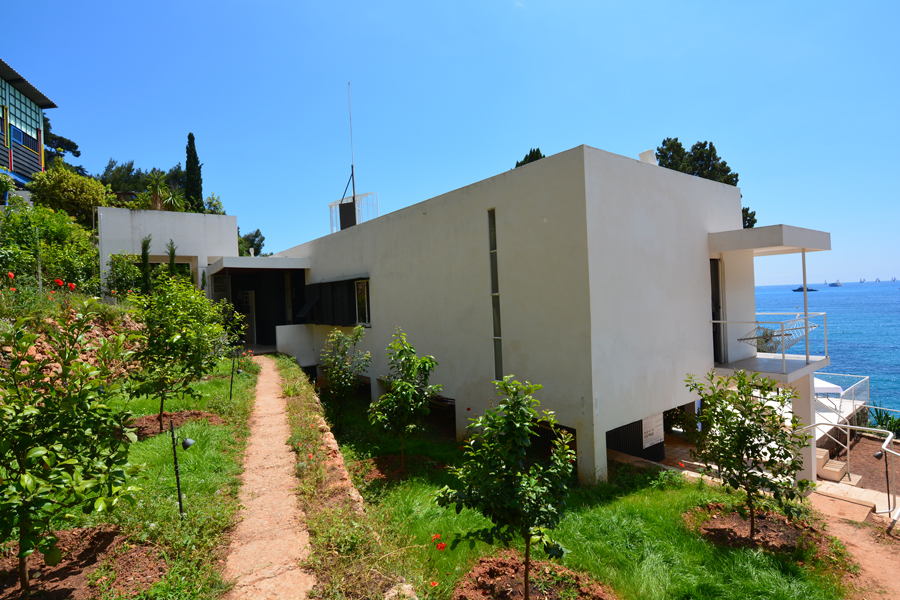
 

Lalomița County Sign


Zina Gallery poses the question to visitors to the exhibition, ‘ “Bordermarks” displays fragments from the impressive collection of more than 100 signs documented, catalogued and systematised …. What kind of patrimony are these ghostly constructions that have the appearance of brutalist relics? What does their presence say? To whom do they speak now? Can we call them art? ‘
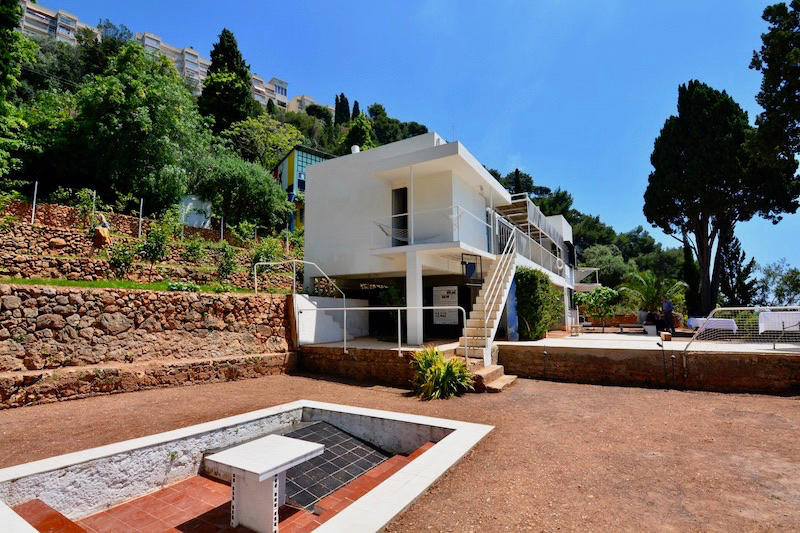
It is hard to separate the history on the ground. Most of the signs were erected in the 1970s and 1980s during Nicolae Ceaușcu’s harsh regime when the country was in the vice-like grip of his cult of personality. Now they are considered part of the architectural heritage ‘produced under the ideology of the former political regime.’


Râșnov Brașov County

What Roberta’s photos are doing is alerting us to changes at the boundary, be it the county line or from one national space to another. The signs mark a spot where culture, language, art, territorial rights, and migratory routes intersect, meet and change. But borders are often contentious, marking a nation’s perception of itself. They are fascinating and significant.


roadside signs slatina

Slatina Romania 2015

romanian roadsign arad county

Arad County Romania


Cataloguing visual Signs of the Communist Era

‘I decided to research border signs by chance.’ Roberta shares,  ‘I’m a fan of the photos of Bernd and Hilla Becher and the way they catalogued water towers and industrial buildings. Socialist architecture is fascinating and is a much-covered topic. However, no one seemed to have spotted how endlessly fascinating border signs are and how wrapped up they are in the visual signals of the communist era. Somehow I began to fall in love with the idea of capturing a fragile typology, one that dates back to Socialist times. This topic is not without controversy. As an artist, I want to try to separate up the politics so as not to detract from how interesting the typology is, in of itself. That does not mean I am dismissing the political aspect. We need to recognise that these signs are slowly disappearing in precisely the same way the structures photographed by the Bechers disappeared from our landscape.


Odorheiul Secuiesc Harghita County


The more I documented the signs, the more it occurred to me that these are very different in character to bus stops or water towers. Think of them as extremely large fixed-to-the-spot greeting cards.’
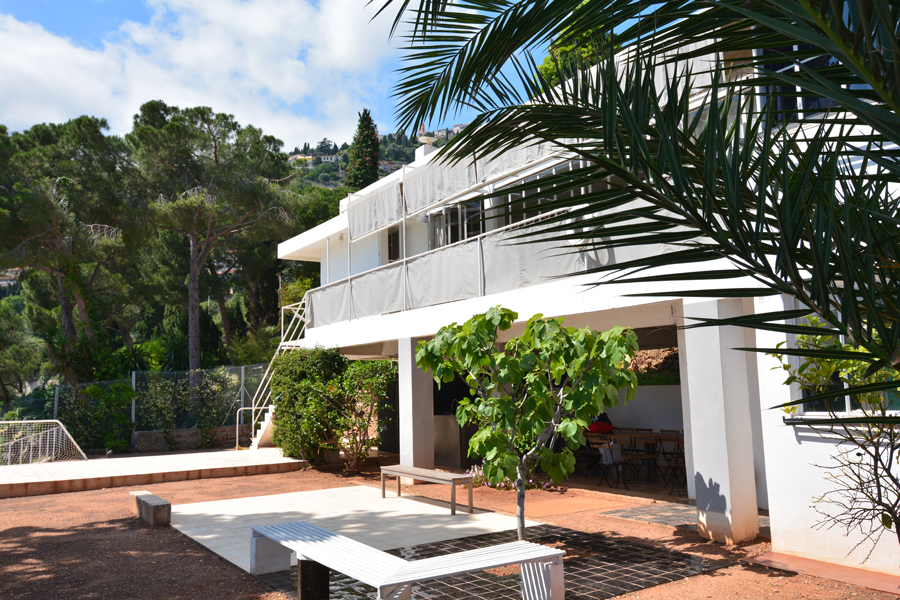
‘A ‘welcome’ message from a place rather than a person, which has underpinning it, ownership of the land where a wooden or metal stake has been forced into the ground’.

Roberta notes, ‘Bound up in their identity is a reminder of the individuality of large territorial units, regardless of labels such as Europe or the EU. This will surely always make them politically appealing. They act as markers on the road, familiar structures indicating that you are home, you have arrived or will arrive soon. They shouldn’t be thought of as threatening; instead, they are personal or nostalgic.’


Targoviste roadsign

Târgu Frumos, Lasi County Moldavia, Romania


Buzau roadsign

Buzāu Muntenia Romania


Roberta was born in 1991, two years after the revolution.  ‘Stories of my childhood were peppered with comparisons. The before and the after.

I did not live through or experience Communism

My childhood experiences with my parents were very different from what had gone before. One of my early childhood memories was our family car a light blue Dacia 1310, which took us on our first road trips.  It is, in a way, a bridge between what existed before and after the revolution. The journeys have become more than symbolic for me but without political trappings. It is wrapped up in my independence and artistic development. I have no memories of life under Communism, only my parent’s memories, which always seem bittersweet. There is always some good amongst the bad or maybe the bad was not that bad.’
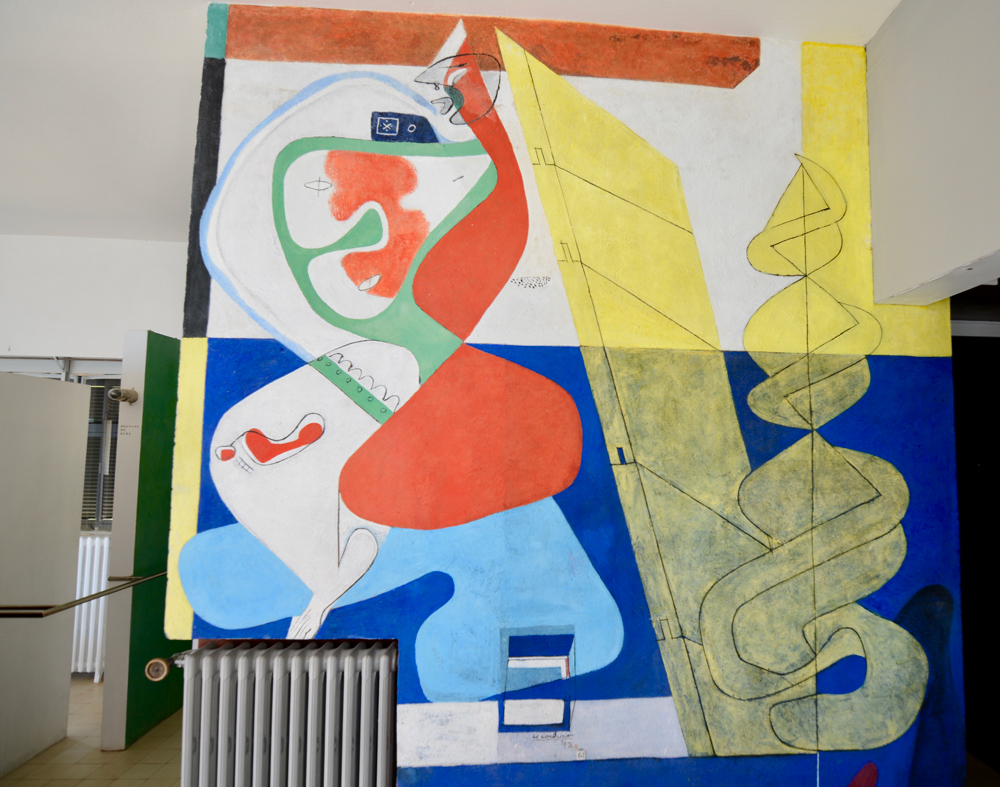
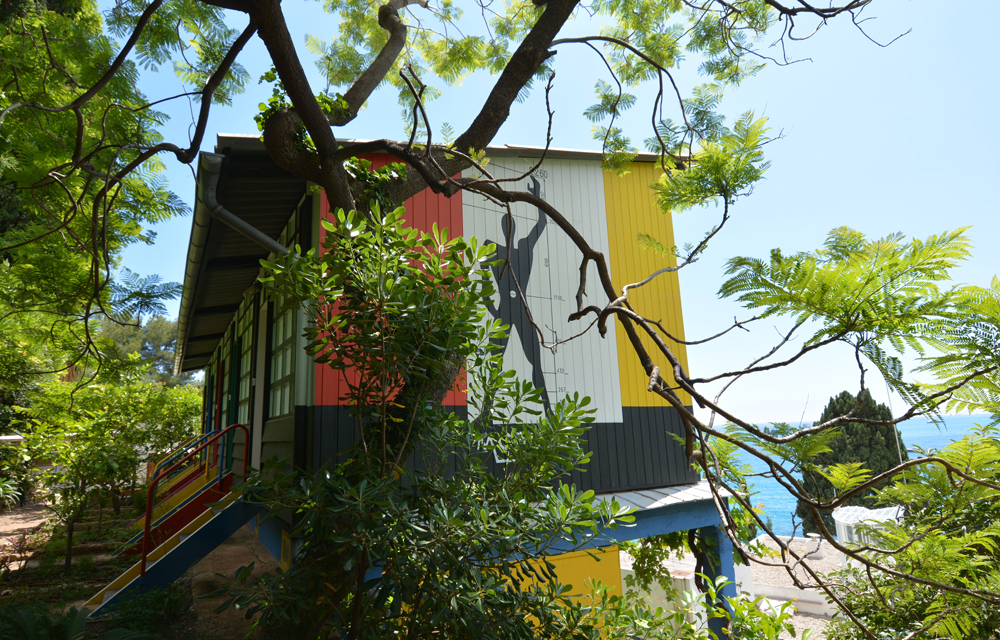
 

Even controversial architecture has its own beauty and cultural value

What the collection of images makes clear is that Roberta covered tremendous distances – taking in most of Romania along the way. The mapping, however, captured more – the desire of a region to upgrade and improve its connectivity.  ‘The desire is for faster mobility and better links between cities. However, this progress comes at a price. What development ignores and downgrades is the importance of seeing a country properly. A simple detour on a scenic route can give a truer sense of identity and culture.’


Roadside signs romania Gorj County

Bumbești-Jiu, Gorj County, Romania 2018

road sign Lasi Jassy

Iasi, close to Moldovan Border


Signposting modern history 

‘Today’s border signs can be seen as a bridge between what happened before the 1989 Revoluția Română and what happened after it’, Roberta adds, ‘ They reflect the political transition as well as signposting the conflict about identity evident in modern-day Romania – a country trying to find a way to understand its heritage and deal with its memories fully.  Whether historic or recently erected, the border signs reflect 30 years of political change and evolution in Romania. A journey through Romania is a journey through the political change of a country signposted by road signs.’


roadsign Targu Romania

Târgu Mureș Romania


About Roberta

Roberta Curcă (b. 1991, Romania) is a Bucharest-based artist working with drawing, photography, objects, and artist books. Her visual documentation projects include the online photographical archives of the Instagram accounts @border_marks_archive and @tiles.and.tiles.

She studied in the Graphic Arts Department of the National University of Arts and is currently a PhD candidate at the Centre of Excellence in Image Study (CESI) in Bucharest. Her artworks have been shown in exhibitions at the Accademia di Romania in Rome, Kunsthalle Bega and Spațiul 2/2 in Timișoara, Lateral ArtSpace in Cluj, Arcub, Victoria Art Center and Tranzit in Bucharest, as well as in exhibitions by the young artists’ group Nucleu 0000. She participated in artist residencies such as Electroputere Air in Craiova, Romania and in the 2017 Mobile Biennial.

Her favourite book is The political lives of dead bodies by Katherine Verdery

Roberta’s favourite films are Jára Cimrman’s 1983 Lezící Spící Lying, Sleeping, a Czechoslovak comedy directed by Ladislav Smoljak and her favourite photos are from the Water Towers series by Bernd and Hilla Becher, 1972

All images are the Copyright of Roberta Curca

Zina Gallery
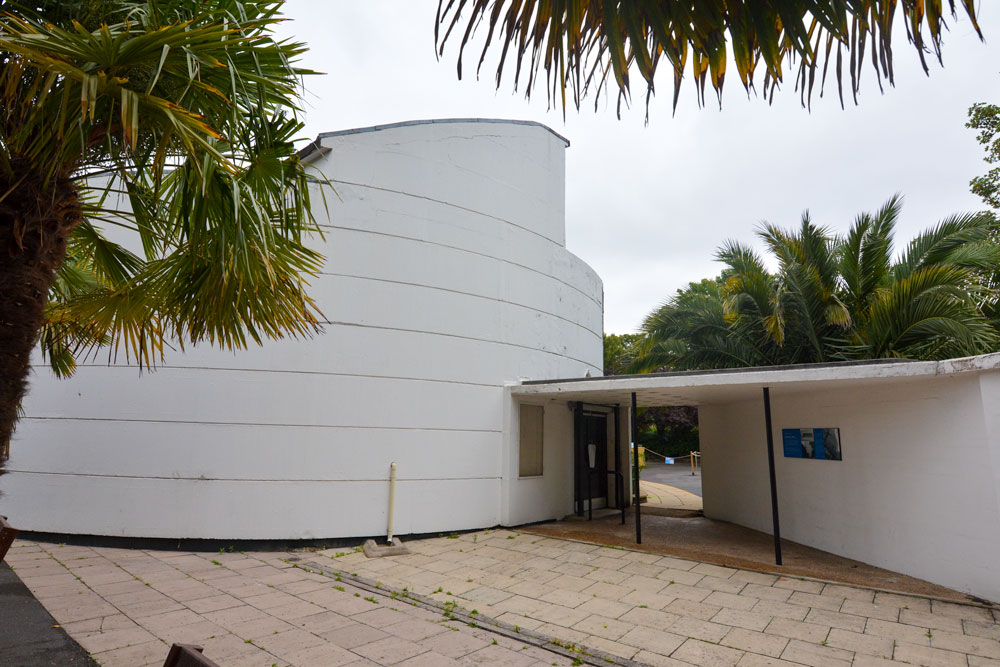
Axente Sever 14 A, Cluj-Napoca, România +40744261058
www.zinagallery.com

Book Publishing under Fire – Osnovy, publishing books in Kyiv

Book Publishing under Fire – Osnovy, publishing books in Kyiv


Ukrainian Railroad Ladies: Svitlana Oleksivnia Yevstihnieieva, 24 years service

Kyiv-based Osnovy Publishing is nearly as old as modern, independent Ukraine. Now focusing on art and architecture, Osnovy has played an important part in the simple desire of a free people to read what they like rather than what the state compels them to read.  So Osnovy’s books have covered DIY balconies, Ukrainian erotic photography and Soviet-era buildings.  Greyscape is very pleased to sell Ukrainian Railroad Ladies an unexpectedly topical and poignant book, but let’s come back to that.

Notwithstanding the Russian invasion, Osnovy has not left Kyiv and hasn’t stopped and will not stop publishing books. Every book published is an act of resistance.


Greyscape had the chance to speak to Dana Pavlychko, daughter of one of the two founders of Osnovy, and now its owner

Tell us about book publishing in Ukraine

Ukraine is a small market so we began to publish in English to expand the appeal of the works.  And among the first books we produced for the international market was Alex Bykov’s Soviet Modernism and Shana Nikforov’s Ukrainian Soviet Mosaics.  Then Covid hit so it was a really tough two years and then the war followed. But the thing is, this has made us focus on what we really want to publish, architecture, photography.  We are planning a re-launch in September with a book of ironic photography from the war and another on Ukrainian country houses.


Orthodox Chic, Stryzhlyka Zhytomyr region


How difficult is it to produce a physical book in Ukraine in the middle of the war?

It’s a team effort.  Most of the team have remained in Kyiv. Covid taught us how to work together when everyone can’t be in the same room.  Our new Creative Director has made some great changes in the process of how we go from idea to publication, it’s something involving the whole company.  We all participate in that creative process, everyone, for example, our accountant because the accountant is a team member.  Our strategy is to concentrate on exceptional, beautiful books.


‘We just got through one day at a time, adapted and found solutions’

After the invasion, March was a month of shock.  Even our bank was inactive but after that it was, as far as possible, business as usual. Business has to function, wages must be paid, everything needed to run the business had to carry on.  Little by little, we reorganised the work, the team, and our goals. We wanted everyone on board who was willing to work.  Of course, for some people their priorities changed, they might have left the city, gone abroad, to take their children out of the immediate zone of danger.  We just got through one day at a time, adapted and found solutions.  Luckily, we have a united team.  For us this is our front, where we are fighting because it’s important to be successful, for people to have jobs doing something they love.  And then you deal with the tactical issues, which are very complex. You must find workarounds and yet be creative at the same time.


Orthodox Chic

And how hard has the war been on your people?

It continues to be tremendously hard on the team.  People work under air raid sirens. It’s working while you have a gaping wound in your heart, even if you’re out, abroad, away from the fighting, it’s a tragedy, your heart is permanently broken.  But we’re in a marathon and we must win, and we have to create products and ideas and tell stories for the world to be excited about and to support us and Ukraine.


Ukrainian Railroad Ladies: Halyna Vasytivna Zhanora 39, 21 years service

So that takes us to Ukrainian Railroad Ladies, the latest Osnovy book that we are carrying in the Greyscape shop

There’s a fascination with the railroad. It has a faded glamour, a bit like looking back to air travel in the ‘60s and there’s a fondness for the railway staff. But now we see these ordinary workers through the lens of war, a war in which the fact that they have continued to work tirelessly going into and places under attack and rescued countless thousands of innocent civilians, makes the photographs of these women, proud in their uniforms, more poignant and moving. The railway people are my heroes. They’ve done a phenomenal job and now we see these railroad ladies in a new light.


Orthodox Chic

How should we now view the built legacy of the communist era in Ukraine?

It’s a very complex topic. The people who had an appreciation of this architecture pre-war weren’t simply from the Russian-speaking Ukrainians but a sliver of the population, many of them Ukrainian-speaking, architecture buffs and urbanists.  A lot of them are people involved in counterculture.  But most people thought the buildings hideous.  There were some hardcore patriots who thought these buildings were just symbols of the communist regime and that we should have no sympathy for them at all.

‘Many people are now questioning what should be done with all this heritage’

However, there are a lot of different kinds of art; there were monumental buildings with clear hammer and sickles.  Then there are monumental buildings that were, actually, anti-regime, but the communists didn’t notice because the signs are really subtle.  After the war began everyone became intensely patriotic.  Russian speakers started speaking Ukrainian and the country is united. Many people are now questioning what should be done with all this heritage.  It isn’t just the war destroying buildings, but it will be new developments.  People want rid of the hammer and sickle and the government isn’t going to distinguish between the undoubted communistic buildings and those that tell another story.  Right now, in the middle of a war, there’s no appetite to criticise the government for not protecting communist-era buildings with true architectural or artistic merit from the plans of developers.

Our takeaway at Greyscape is that we take for granted that we can read the books we want to on the subjects that interest us. This is one of the hallmarks of a society that believes in freedom and  Dana and her dedicated team at Osnovy Publishing show a quiet determination to preserve this freedom.


Meet the Osnovy Team


Dana Pavlychko Owner

Dmytro Yarynych Creative Director

Helen Vorobiova CEO

Learn more about Osnovy Publishing House 

Osnovy store in Kyiv 4B Lypynskoho street, Kyiv.

All images the Copyright of Osnovy Publishing ©


Neue Nationalgalerie, Berlin

Berlin Neue Nationalgalerie, Three Way Piece No. 2: The Archer» by Henry Moore


Ludwig Mies van der Rohe was already living in America when he was commissioned by the Berlin Senate in 1962 to build the Neue Nationalgalerie a new home for 20th Century modern art in the heart of West Berlin.  The International Style building opened in ’68.

Fifty years took its toll, a refresh, repair and upgrade was needed to meet the expectations of the modern gallery visitor alongside a desperately needed upgrade to the fabric of the building. Berlin’s Monument Authority, Landesdenkmalamt, commissioned architect and 2023 Laureate of the Pritzker Architecture Prize,  David Chipperfield to ‘preserve the landmark’s visual appearance and to retain as much of the historical building fabric as possible.’ In August 2021 (can there be a more challenging time to welcome people to freely roam a public space) the Neue Nationalgalerie at the Kulturforum reopened.

Virtual tour: 360 view

In person: Potsdamer Str. 50, 10785 Berlin, Germany

Image: A.Savin Fal 1.3

David Hoffman ‘the riot photographer’s riot photographer’

David Hoffman ‘the riot photographer’s riot photographer’


Youth Faces Police Brixton 1981


Victoria Park, East London, now a calm, somewhat gentrified, tranquil spot for a conversation with David Hoffman, a photojournalist who has made a career documenting what David refers to as ‘the increasingly overt control of the state over our lives’. Through his lens, we see 50 years of social conflict, homelessness and protest. Today his work is not only a profoundly important record of the currents of class and race but used as much by theatre designers and the press for authentic and searing images of Britain in a time of transition, under pressure and underfunded.


Boy in Squat


The East End he photographed has changed almost beyond recognition. Flats are regularly sold in excess of £750,000 on streets that were once the battleground for stand-offs between the police and squatter activists. This was a time when empty houses were cynically left to rot whilst families were descending into absolute poverty. The crisis was captured on TV in Cathy Come Home, a play first shown in 1966 but still resonating with the public when it was broadcast again in 1976. It shows a problem unresolved with local political and community leaders not sufficiently interested to improve the lot of the homeless.


East End Squatting


It’s hard not to be cynical; how did things get so bad?

‘Contracts were being given for new estates’ David recalls, ‘and when they were built they were crappy with high maintenance costs. Money borrowed from the City to pay for construction had to be repaid at high interest rates from the rents, leaving little for maintenance.’ Meanwhile ‘beautiful housing was being demolished – but occupation by squatters saved whole streets – still standing and highly valued today’.


Kingsmead Estate

Kingsmead Estate


The activists were vilified in the press, labelled as layabouts and unemployed – a far cry from reality. Today our understanding of activism, conservation and protection of historic areas and houses is more nuanced.


David photographed by Gabrielle Motola


Filmmakers Steve McQueen and James Rogan raided David’s archives for images as a backdrop for their three-part BBC documentary ‘Uprising’ about Black people’s experience in London in 1981. From the New Cross fire in January which led to the deaths of 14 young Black people to the Black People’s Day of Action in March to the uprisings of April and July caused by deliberately oppressive racist policing, David was there, his camera capturing the outrage of people ill-served by government and police finally boiling over. David’s work focuses on the wider social issues while never losing its respect for people as individuals, living tough lives in tough urban landscapes.


Barbican 1975


Purchase David Hoffman’s prints – Greyscape is delighted to offer several of David’s photographs in a variety of sizes please contact us for more details 

To purchase David’s photobooks for Cafe Royal books, please visit the online shop at Greyscape.com

Dancing boy


More about David Hoffman – in his own words:

‘I’ve worked as an independent photojournalist since the 1970s. It didn’t take long for me to discover that documenting the increasingly overt control of the state over our lives was what motivated me. I soon decided to run my own photo library, giving me the freedom to choose my own subject matter. My work sheds what some might see as an unforgiving light across racial and social conflict, policing, drug use, poverty and social exclusion.’


All images are the Copyright of David Hoffman


Slovak Radio Building, Bratislava

Slovak Radio Building, Bratislava

An antidote to Social Realism


Shaped like an inverted triangle, two pyramids one within the other, a testimony to the determination of its architects to build something profoundly different, an antidote to social realism. The architects, Štefan Svetkom Štefan Durkovič and Barnabáš Kissling, who won a competition to build it, after the original winning design by Miloš Chorvat was rejected, recalled the development of their vision for the Slovak Radio Building in Bratislava;


“We kept correcting the draft due to the need for an expressive expression. This building was not supposed to look like any other institution”


An early steel building in Bratislava, from the off, the construction did not run smoothly not least because the construction team were simply not sufficiently familiar with the materials. In the Eastern Bloc the architectural landscape was invariably concrete. Design faults quickly appeared and the builders were not motivated to work speedily or with respect for the materials. The architects recall spending weekends ‘cleaning tiles soiled with mortar’.


the Transverse Axis was to be a thoroughfare

The original vision was for a light and airy interior with a sense of openness, terraces were to be wrapped around the building but never made the final cut. Certain elements were incredibly important to the project, excellent soundproofing was a must, in order for the recording rooms – one the size of a concert hall, to function properly. Overriding everything was the role of the building in reconfiguring the district it was built in, to create a new connection between the historic Old Town of Bratislava and the post-war New Town. The Transverse Axis was to be a thoroughfare, 90 meters wide linking the Central Railway Station to this new area. It was never realised save for a few elements such as the Slovak Radio Building.

Ultimately the project dragged on for years 1967-1983 – to think that a matter of a few years later, twenty years after the original idea was conceived, the political system collapsed and State Radio’s importance entirely changed. Equipment that made perfect sense in the 1960s was outdated and of little use – the building was sold to an anonymous buyer.


Image Copyright of photographer and videographer, Oliver Skukalek

Follow Oliver on Instagram @_oli001


Barbican Open Air Cinema Daughters of the Dust


Barbican Open Air Cinema: Daughters of the Dust

Beyonce’s inspiration


Julie Dash’s groundbreaking masterpiece concluded the short 2022 Outdoor Cinema season at the Barbican. The temporary screen was set up in Frobisher Court, a spectacular Brutalist setting on the north side of the Barbican Arts Centre. A  stunning block, the only one in the Barbican to be curved into an elegant crescent, Frobisher’s louvred window blinds are raised like the gun ports on a galleon.


Daughters of the Dust notwithstanding its gentle, ethereal, perhaps, mystical quality, tells the story of a family of the children and grandchildren of South Carolina slaves, members of the Gullah people, sharing their last family dinner before leaving their island and moving ‘North’. The Gullah have preserved more of their African heritage, customs and beliefs than other descendants of the huge numbers of Africans brutally kidnapped into slavery. It was the first film by an African American woman to have a full theatrical release.


Julie Dash ‘Career Girls CC BY 3.0’

It broke the mould of how African Americans were commonly portrayed in American cinema


Made on a modest budget in 1991, it broke the mould of how African Americans were commonly portrayed in American cinema. The stereotypes of Blaxploitation of the 70s and, as Julie Dash describes, those of the “urban testosterone films” have no place in this work with its respectful depiction of a dignified family with aspirations and ambitions to leave behind the poverty of their island, while concerned to preserve their rich heritage.


Lemonade

To Julie Dash’s surprise, the look and feel of Daughters of the Dust appeared to inform the design of Beyoncé’s music video Lemonade. Julie, while welcoming that the effect was to mainstream her film, again, notes that Beyoncé’s production team never contacted her before or after Lemonade was made. However there is absolutely no rancour, Julie is pleased that her seminal work provided such inspiration to a huge star.


Frobisher Court is named for Sir Martin Frobisher, long considered a hero of Tudor England helping to defeat the Spanish Armada; his life was entwined with three other famous Tudor seamen, Sir Francis Drake, Sir John Hawkins and Sir Walter Raleigh, all of whom were active in the slave trade.


Frobisher Court Cooling Tower


All images unless otherwise noted, Howard Morris ©


Thinking outside the Box: The demolition of the Nakagin Capsule Tower

Thinking outside the Box:

The demolition of the Nakagin Capsule Tower

And its possible reconstruction in the metaverse


And so it sadly came to pass, the threat of demolition looming large over this iconic residential building for so many years became a reality with an unexpected twist.


Nagakin between the capsules

Image Howard Morris


By Spring 2022 it was clear that regardless that local activists had put up an almighty fight to save it, the breaking up of Kisho Kurokawa’s Nakagin Tower in the heart of Tokyo was beginning. Soon the space where the local landmark once stood was barely recognisable.


Ginza architecture icon

Image Howard Morris


What remains of that building is a group of 23 individual capsules untethered from the mothership – despatched around the world mostly as museum pieces.


However, and this really depends on how you feel about the metaverse, the Nakagin Tower will exist in a virtual form and possibly even be rebuilt if Kisho Kurokawa Architect and Associates and the Laetoli Corporation have their way.  To many people’s surprise, they announced in July 2022 their intention to auction the rights to reconstruct Nakagin Capsule Tower utilising NFT and Real Space technology, separately they are also selling the rights to recreate (one assumes) in a new location. The auction is now closed, and it is not yet clear what will happen next.


Perhaps this is not the outcome Akiko Ishiamaru expected, one of the leading activists behind the Nakagin Capsule Tower A606 Project, which was set up to try to stop the demolition. She is now working with other volunteers to ensure the pods find good homes.  Akiko notes that this was an idea explored by the architect Kisho Kurokawa in his book Homo Movens.

However, what’s not clear at this stage is who would pay for the long-term maintenance of the capsules. It is still a work in progress.


Kisho Kurokawa’s original idea was to reimagine the concept of living in a residential apartment. When he completed the building in 1972 he proposed that each capsule, home for a ‘salaryman’, would be replaced every 20-25 years. The design was intentionally flexible and adaptable, it was simply a matter of swapping a capsule in and out as required – easy to build in a factory in Shiga Prefecture. However, underestimating the difficulty in achieving that meant the building was basically doomed. It became clear that the removal and installation system didn’t function properly and had some fundamental structural problems. It would have been impossible to slide out one capsule without removing the rest simultaneously, and an action of that magnitude would require the agreement of all the capsule owners. So, the fabric of the building crumbled, and unsurprisingly, the property owner wanted to sell. Missing in the story is the Japanese Architectural Preservation Society; it’s baffling how a building hailed as an important example of the Metabolism Movement couldn’t be saved.


Now, the A606 team is in a position to judge the condition of the capsules and assess the level of damage occurring as a result of the removal process. She commented immediately prior to the demolition, ‘The capsule cannot be removed without destroying the bolt around which the shaft (tower) and capsule are secured. It is expected they will need repair after removal from the tower. The asbestos contained in the paint used to coat the capsule’s steel walls is a real problem. This carcinogenic material must be removed before the capsule is transferred, a process which is likely to cause considerable damage.’ 


It’s an interesting moment for fans of the tower – to know that the architectural practice of the very firm that built the original building are on centre stage with this new project. So what can we conclude? When it comes to Nagakin Capsules -the story is far from over.


Nakagin Tower Interior Image Howard Morris


All images, unless otherwise noted the Copyright of the Nakagin Capsule Tower A606 project

Haus Schminke Löbau’s Glorious Modernist ‘Noodle Steamer’

Haus Schminke

Some scientists believe that memories are passed down the generations in our DNA.

Could the same theory be applied to concrete, bricks and mortar?


Architect Hans Scharoun

Image Marcel Schroeder ©


Haus Schminke seems to give some truth to this idea. It’s a very special house created by a family whose choices took them on a journey to unexpected places and in what seems like the closing of a circle, the story of the most unlikely descendant.

Charlotte and Fritz Schminke’s request was simple, they wanted  “A modern home for two parents, four children and occasionally one or two guests.”  They sought somewhere of substance to be built next door to their pasta factory. They hired architect Hans Scharoun, at the top of his game when he accepted the commission in 1929. It turned out to be his final important project before the Nazis came to power and by many, it is considered his most brilliant.


Image Ralf Ganter

“A modern home for two parents, four children and occasionally one or two guests.”


Scharoun came to the commission an already highly respected Modernist who carefully interpreted the Schminkes’ request. He took, you could say, a bottom-up approach; his design reflected the needs and curiosity of the four Schminke children Harold, Gertraude, Erika and Helga. As it turned out the house was road-tested by a fifth youngster Ello Hirschfeld, the daughter of artist and teacher Ludwig Hirschfeld Mack. Forced into exile in England in 1936, Hirschfeld Mack had been an important figure in Bauhaus and Modernist circles. His wife Elenor had multiple sclerosis and when her health deteriorated her friend Aenne Scharoun stepped in to care for her youngest child, Ello, who was then sent to Löbau to live with the Schminke family. She stayed in the house from 1941 until late 1944. Later in life she became a furniture designer, married an architect and her two grandsons also became architects.

The success of the house’s design from a child’s perspective is evident in Charlotte’s joyful family photos. An avid amateur photographer she took many photos during construction, and with Fritz’s short films on Kodak Normal-8, there is a significant collection.  Other important photos that help us understand the nature of the house not as a monument but as a family home, were taken by Hans Scharoun’s official photographer on the project, Alice Kerling. Follow the link at the bottom to the work of Klaus Kürvers to see a selection of these photographs.

Height and space were calculated with a child in mind, imaginative use of coloured glass and a staircase that by chance, or perhaps not, worked very effectively as a child-sized slide.  These design decisions would make a luxury designer home equally suitable as a refuge for children in the aftermath of the coming war. Scharoun’s design plan was complete, every aspect became part of the whole, from the light fittings to the colour palette of the house.

Charlotte like many Germans before the war was enamoured by the dietary recommendations of  Swiss physician Maximilian Bircher-Benner.  According to Architectural Historian Klaus Kürvers, this was reflected in the landscape and interior architecture, the design of vegetable patches, greenhouses, the planting of fruit trees and insulated storage spaces allowed for fresh fruit and vegetables to be available year-round. Peter Blundell Jones attributes the garden design to Herta Hammerbacher and Hermann Matern although it should be noted that this is speculative as there is no clear evidence.

Celebrated Swiss manufacturer Salubra, who worked with Corbusier, created the wallpaper and Bauhaus student Otti Berger (later murdered in Auschwitz) was hired to design the furnishing and curtain fabrics. Oskar Schlemmer was asked to submit artwork and correspondence exists that confirms that it was seen in draft form. Ultimately the work was not commissioned and, unfortunately, the draft of Schlemmer’s proposed work is missing.

Haus Schminke fully embraced the tenets of New Objectivity, an unsentimental style that emerged in Germany. The house was a project close to Scharoun’s heart; he later fondly described it as his ‘dearest’. Locally the house was nicknamed der Nudeldampfer – the noodle steamer, a name which has stuck to this day. For Scharoun the design clearly represented something important. With its use of curved steel and glass it nodded to the era’s fascination with travel and machines and, most of all, the great liners. Scharoun was born in Bremerhaven home of the SS Bremen, then the world’s fastest ship and recipient of a westbound Blue Riband. The nautical impact on the architect’s upbringing, the Schminke Foundation notes, left a mark on him. Klaus Kürvers describes the photo montage in the children’s playroom, ‘Scharoun has documented this connection between house and ship for everyone to see. In addition to the world map there is a large photo of the ‘Bremen’ and an aerial view of the port facilities of Bremerhaven and the red and white checkered Speckflagge, the city flag of Scharoun’s hometown. What ships are to Scharoun, are to Fritz Schminke, who trained as a pilot in World War 1, airplanes…The photographs show the engineering achievements for which Germany was internationally respected and admired’.

Kürvers goes on, ‘The flag with the swastika was missing from Scharoun’s draft, but Fritz Schminke has it inserted to correspond to the flag chosen by Scharoun’, Kürver spots that in a perfect rounding of the whole – the brand name of the pasta factory was Anchor (Anker in German)..

May 31st 1933 was an extraordinarily exciting day for the family – the day they move into their new home in the presence of Hans Scharoun. He sketched the family and the house in the first two pages of their new guest book and wrote:


“The new ship of life is under steam”


Architect Hans Scharoun

Wintergarden Image Marcel Schroeder


As the country changed course and embraced fascism, so did the family. Brothers Fritz and Joachim ran the Anker business, Fritz, in the senior role, and, for a short time, a member of the Nazi party, after which he joined the Luftwaffe with Joachim then taking up the reins.

When the Soviet army advanced to Löbau they occupied the house. By some peculiar turn of events, rather than ransacking the house as a spoil of war, the Soviet military commander for the region saw its worth, moved in and gave orders that nothing be removed. That was the saving of the house but not of Fritz Schminke. Fritz was a prisoner and not released until 1949. According to the Foundation Haus Schminke ‘Fritz Schminke left the GDR in 1950, since he was now considered a war profiteer: his company used to supply the Wehrmacht with pasta’.   Charlotte was allowed back in the house in 1946 when the Soviet commander moved out. The house, so well designed for children, was repurposed by her as a temporary home for children displaced by the terrible bombing of Dresden.

With communist rule, the family lost their business and the factory became an ‘enterprise belonging to the people’ (Volkseigener Betrieb) newly named VEB Anker-Pasta.


Architect Hans Scharoun

Image Marcel Schroeder ©


While houses remain rooted to the spot people do not. Displaced by history, in the early 1950s, Fritz departed to live in Celle in West Germany – later followed by Charlotte who left the house in 1951. On May Day that year the city administration assigned the house to the state-run Kreispionierhaus – Pioneer House for teenagers used by the Freie Deutsche Jugend, an ideological youth movement. According to Klaus Kürvers, ‘the city paid the lease to Fritz for one year, on July 18 1952 on the basis of Ordinance on the Protection of Assets passed the day before declared (the house) public property. The removal of the family’s connection to the property was complete.

From generation to generation

Conservationists were well aware of the house’s architectural merit regardless of which side of the wall they sat and according to Klaus Kürvers as early as 1961 questions about it were posed to Hans Scharoun. Meanwhile, life went on… Gertraude Schminke married and moved to Bochum where her daughter Tina was born. An inheritor of that weighty legacy, Tina joined Action Reconciliation Service for Peace (a German organisation founded to confront the legacy of Naziism) and visited Israel in 1973 with the organisation as a medic. Perhaps she had not intended to stay but she met and married the child of Holocaust survivors, converted to Judaism and vowed to never speak another word of German.


Architect Hans Scharoun

Haus Schminke Image Ralf Ganter ©


Haus Schminke was given Monument status in 1978 but it wasn’t until a few years after 1990 reunification that Fritz’s daughters tried to get the family home back. That process is known as Rückübertragung was and remains, a huge challenge in reunified Germany, unpacking who occupied properties and to whom they should be returned. Ultimately the sisters gave up and handed the house to the City of Löbau. Once again the family’s connection to the house was removed in all but name. This takes us back to the question of who is the keeper of the memory of a house – is it in the concrete, the brick, the wood, glass and steel or is it in the memory of individuals and passed down from generation to generation?

‘preserve the house, transform it into a cultural venue for art and architecture buffs from around the world’

What the future held for the house now was unclear,  maintenance was carried out on an as and when needed basis but what it was missing was a proper plan. The location, deep in the former ‘East’ did not put it on any architectural tourist map and there were far more important calls on local authority funds in the wake of a seismic change in the country. The first significant step in Haus Schminke’s restoration was taken in 1999/2000 helped by the Wüstenrot Stiftung. The baton was passed to a group of determined conservationists out of this, the Haus Schminke Foundation was established in 2007. Their task, to ‘preserve the house, transform it into a cultural venue for art and architecture buffs from around the world’. Pandemic notwithstanding,  they are doing an excellent job. But, the story of Haus Schminke was far from over.

Image Marcel Schroeder

Tina’s daughter discovers unexpected family history

Tina’s  Israeli daughter, Anael Berkovitz, a video artist – was brought up knowing nothing of her family history or the house. She discovered her heritage while on a visit to New York as part of her Master of Fine Arts degree in 2016. This changed the course of her artistic life and gives us further pause for thought. Anael contacted Merte Stork of the Haus Schminke Foundation and was invited to visit and stay overnight in the house.


The kitchen Image Anael Berkovitz


Anker brand reimagined by Anael Berkovitz


In a three-month residency at the Bauhaus in Dessau that followed, Anael created a video and used photos to compose a work focusing on the memories of her mother, her own experience of visiting the house in Löbau and, by connection, her own relationship to Germany and her mother, through the prism of the house. She selected a theme with familial significance, Oskar Schlemmer’s Triadic Ballet (her mother Tina is a trained ballerina), as a means to approach her German family history.  Using film made with the school, Anael speaks vividly about lost identity both willfully (her mother) and by virtue of history (her father’s family) and her experience of visiting and staying in the house for the first time, grappling with the enormity of what was lost and what was found.
Anael’s journey continued she exhibited in a 2021 exhibition at Scharaun.de, the art and architecture space in the former Berlin family home of Hans Scharoun. It was called Heimweh, the gallery’s accompanying commentary explains:


Architect Hans Scharoun

Haus Schminke with view of grounds image Marcel Schroeder

‘Identity, memory, place and context play an important role in Berkovitz’s work. At Scharaun the biographical culminates in the video… which in a unique way underlies individual mythology in collective as well as cultural memory with the artist’s own family architecture.

You wouldn’t bet on this being the end of the story of the house Hans Scharoun built – now considered one of the most important examples of New Objectivity in Germany. The research goes on and while it may not be giving up secrets on the scale of Anael discovering her family history, the house will reveal more of a time and a vision that but for the evil and tragedy of Naziism, may have continued to develop a wonderful aesthetic.

And a final thank you to Simone Unglaub, who stayed at the house. If it wasn’t for her we at Greyscape would not have begun the journey that led to researching the house and to meeting Anael and Julia Bojaryn of Stiftung Haus Schminke.


Images Marcel Schroeder ©

Visiting Haus Schminke

Supporting the work of the foundation, contact Julia Bojaryn:https://www.stiftung-hausschminke.eu/en/Contact/
All images the Copyright of Haus Schminke and the noted photographer

Sources:

Stiftung Haus Schminke 

Architectural Historian: Klaus Kürvers
Resi Schwarzbauer: author – together with Chris Bell of Ludwig Hirschfeld Mack: More than a Bauhaus Artist 

Looking back, Looking forward to a New Year

Looking back, Looking forward

What has been lost and what can still be saved

Buildings endure but they really aren’t indestructible and in recent years we have lost to thoughtless development and needless destruction some treasures.


Images Nakagin Capsule Tower A606 © Demolished 2022


Others are in danger, and all the time, weather and wear and tear take toll of our built heritage.  Let’s do what we can to preserve and value the buildings that have been left in our care.


The Twentieth Century Society, C20, has joined with local campaigners to campaign against what they call a ‘greedy’ scheme’, the 72 Upper Ground commercial office development on London’s Southbank.

During the opening statements at the Public Enquiry, the Southbank was described as

‘one of the worlds most recognisable urban vistas’, containing ‘the most important collection of modernist buildings in the country’

– no less than four listed postwar buildings and bridges.

C20, as it always does, is putting all its energy into defending a precious architectural treasure. It’s another campaign that we all can and should support.


roman wall city of london

Barbican Estate, Roman Wall


Bastion House remains under threat (Image Howard Morris)


And here’s a thank you from us for your support. Visits to this website, our Instagram, Twitter and now on Mastodon have continued to increase way beyond our expectations when we first started posting photos of our home spot, the Barbican.


We wish you all a happy, healthy and creative 2023

Join the conversation:

Twitter www.twitter.com/barbicanL

Mastodon Greyscape 

Instagram www.instagram.com/barbican_city_of_london/

Facebook www.facebook.com/greyscapeworld/

C20 Society https://c20society.org.uk/


Kharkiv 2022 – What Shall We Do with These Buildings?

Kharkiv 2022

What shall we do with these buildings?


Shot in September 2021, What Shall We Do With These buildings, Jonathan Ben-Shaul’s film about Soviet-era buildings in Kharkiv, is innocent and prescient, tragic and terrible, the passionate controversy between modern Ukrainians’ ambition to ‘Ukrainise’ Kharkiv and Russian-speakers’ pride in and affection for, buildings that to them symbolise their culture, heritage and historic achievement. Months into a horribly destructive and cruel war, this is no longer a debate, the people of Kharkiv are now united in a struggle to survive the Russian bombs and missiles that don’t distinguish who speaks which language.


Derzhprom Building, Freedom Square, Kharkiv What shall we do with these buildings


Each Soviet-era public building is introduced by local voices, Russian speakers, Ukrainian speakers. This film isn’t polemic, it’s not propaganda, it’s a patient observation, an illustration of the challenges of dissonant heritage; what do cities do with buildings when the political system and dominant culture for which they were constructed, is over?

The film weaves together concrete, people and movement

There is a wistfulness about the film, an effort to express the issues other than simply in words and in the eloquence of the buildings themselves.  Mykola Naboka, the film’s producer, an actor trained in movement, mime and physical theatre, who until the invasion was teaching a movement course at Kharkiv’s School of Architecture, allows us, together with Igor Klyuchnik, to experience the power of these concrete edifices in a very physical way, as the film weaves together concrete, people and movement.

Kharkiv, Ukraine’s second city and the first capital of the Soviet Socialist Republic in 1919 (replaced by Kyiv in 1934), has been at the centre point of an epic tug of war.  It was a battlefield in the Great Patriotic War against the Nazis and now it’s under siege again. We don’t know which of these buildings still stand; we don’t know what’s happened to the people who appear in the film.


Students’ Palace, School of Nutrition, Kharkiv. Oleg Drozdov, Architect and Founder of Kharkiv School of Architecture


The filmmakers have pledged all proceeds from the film to support humanitarian aid on the ground


The city revealed in the film goes to the heart of the dissonance dilemma; how should Soviet-era architecture be considered? If that question was relevant when the film was made it is even more pressing now. The discussion about the post-war reconstruction of Ukraine is well underway – decommunisation was already enshrined in the law On the Condemnation of the Communist and National Socialist (Nazi) Regimes, and the Prohibition of Propaganda of their Symbols. Buildings have potency and all across Europe buildings from communist and fascist regimes still exist, are still used, too expensive to re-purpose, too controversial to demolish but we must not underestimate their symbolic power.

Where to see the film What Shall We Do With These Buildings

Ukrainian Film Festival in Berlin  26th-30th October

Arquiteturas Film Festival, Porto  27th September-1st October

The filmmakers have pledged all proceeds from the film to support humanitarian aid on the ground.


Lecture Block U-2 Kharkiv Polytechnic Institute (formerly Lenin Polytechnic) 1977, with Yuriy Brayko


The film-makers:

Jonathan Ben-Shaul – Director / Choreographer

Jonathan is a movement, theatre and film director from London. Previously he studied at Cambridge University, and L’École Internationale de Théâtre Jacques Lecoq. “What Shall We Do With These Buildings?” was the result of a two-month residency supported by Kharkiv Literary Museum, during which he also taught at the Kharkiv School of Architecture. At the moment, he works with Akimbo Theatre Company and helps run community arts engagement projects (in the form of lantern parades) in the UK and in France with La Septima.

Mykola Naboka – Producer / Performer

Mykola is an actor and producer from Kharkiv, Ukraine. Initially, he studied acting at The Lir National Academy of Dramatic Art at Trinity College Dublin in Ireland. His passion for physical and devised theatre brought him to Paris and to Lecoq, where he also finished the L.E.M. course in experimental scenography. Before the invasion, Mykola joined the pedagogical team at Kharkiv School of Architecture, where he runs a movement course. He has since temporarily moved to Lviv in western Ukraine where he works to resist the Russian invasion, both by organising fundraising events and through the arts.

Louis Norris – Co-producer / Editor

Louis is a filmmaker from London. His short films have been shown at festivals worldwide (most recently at the BFI in June, as part of the London Short Film Festival), with one award (Best UK Film, Dirigo Film Festival, Bristol, 2019). Another short was given a feature in Film International last year. He’s worked in cinema programming (for the Garden Cinema, London) in digital art production (ZINC, Marseille), and as a projection designer in theatres in the United Kingdom and Iceland. He’s currently doing a master’s in Political Sociology at the London School of Economics while working as a freelance filmmaker and editor.

Follow the filmmaker’s progress

Instagram @wswd_buildings

Facebook @WhatShallWeDoWithTheseBuildings


All images are the Copyright of What Shall We With These Buildings ©

The Graphic History Of The British Music Scene, One Sleeve At A Time

The Graphic History Of The British Music Scene

(One Sleeve At A Time)

by Lucy Morris


Collect your NFTs. Go, hoard your baseball cards and stamps. Jonny Trunk – author of ‘A-Z Record Shop Bags’ – has cornered the niche on amassing meaningful ephemera.

It’s the little things, the nik naks, like swing tags and packaging, which speak volumes about society and design. And, in Trunk’s case the music industry too. Trunk, over the course of 30 years, has been gathering one particular nik nak: the carrier bags produced for record shops between the 1940s and 1990s. Arguably the salad days of these stores, before everything went digital and Urban Outfitters swooped in to corner the ‘vinyl revival’ market.


Both a window into materials and branding, these bags weren’t designed to last. They were there to get your product from A to B, to show off to all the passers-by where you snagged the hottest hit, that was it. But, for Trunk, they’ve come to signify more.

With Fuel Publishing, Trunk has unwrapped the creativity of a forgotten industry. Often candy-striped pink or grey, these bags, that protected precious LP records, were often repurposed from sweet shops. Others are stamped with bubbly 70s fonts or punchy graphics. Each individually recalls a forgotten independent business and in turn the changing face of our shops and society.


Take the Epstein family business, for example. Once, furniture makers, they pivoted when electronics began to impact the average household and expanded their store’s range. This pathed the way for NEMS, North End Music Stores, where their son Brian was put in charge. And, who knows if we would have had the Beatles if they’d kept selling ‘new and exciting furniture and upholstery’?


What Jonny gives us is a flavour of the unexpected history of our high street, but also of folk art, nostalgia, inspiring graphics and more’ he’s spot on when he shares,

‘The chances are you’ll see the bag from the first record shop you visited, or that much-loved, long-gone, local hang out, or even stumble across the four-storey record superstore just off Oxford Street that you never knew existed.’ 


In Jonny Trunk’s capable hands, the book is a gem underpinned by real knowledge of the growth of the British Music Scene. The forward is by Jon Savage, who wrote a history of the Sex Pistols and Punk, England Dreaming.

A-Z Record Shop Bags is available now from Greyscape.com and will be shipped on publication day 28 April 2022.


All images are the Copyright of Jonny Trunk ©
Follow Jonny on Instagram @jonnytrunk
and Fuel Publishing at @fuelpublishing
and Jon Savage on twitter at @JonSavage1966
Other titles by Jonny available from Greyscape, Own Label; Sainsbury’s Design Studio 1962-1977, A Wrappers Delight, Auto Erotica

Reclaiming Public Space: Whitecross Street Party July 2022

Reclaiming Public Space WXSP

Whitecross Street Party is one of the best reasons to take a detour if you are heading over to the Barbican


Artist Lours

Lying a few minutes walk from London’s brutalist icon, one weekend a year, Whitecross Street Party is a rare opportunity to see multiple street artists creating at the same time up and down a street more familiar for its foodie scene.  Market stalls are repurposed as workshops and art activities and the whole area becomes a creative platform, bringing together cutting-edge street artists, to paint live over two days, alongside community-led projects performed across two stages, art installations, and participatory workshops.

This year the party is taking inspiration from the late Olive Morris, a black community and feminist activist in South London in the 1970s. Dying of cancer aged 27 in 1979 she left behind an inspirational legacy. Reclaiming public spaces nods to Olive who fought for housing rights and education. Julia Pond of WXSP explains

‘WXSP connects the theme to the tradition of street artists who claim public spaces for art. It also references the right to gather peacefully whether to party – or protest, a right that has been threatened this year with the Policing Bill. A leading female street artist, Lours, also a co-founder of female street art collective Womcollective, was commissioned to create the poster.’

Started by Teddy Baden, a street artist who lived locally, the party has kept its non-conformist spirit into its 12th year. Some of the UK’s top street artists paint live, this year including Perspicere, Voyder, Eine, Sophie Mess, and more.

Perspicere will create a world-record size circular piece clocking in at 3m wide, using an estimated 45 miles of string. A community engagement programme titled WXSP Ecological Street Commons, is also connecting artists, creative practitioners and communities to create projects that explore climate issues within EC1’s urban environment. These projects include City Pollinators (mobile planters) zero waste cooking, Sweatshop (clothes upcycling). 


Need to know before you go:

Its a free event!

July 9th and 10th 2022, 12pm-6pm

Nearest tube: Barbican, District, Circle, Metropolitan Line

Farringdon (Barbican exit) Elizabeth Line

On Instagram www.instagram.com/wxstreetparty/

Find us on Instagram at www.instagram.com/barbican_city_of_london/ 


Brazilian architect Lelé’s big bold vision Centro Administrativo de Bahia Salvador Brazil

Brazilian Architect Lelé’s

Big Bold Vision


Centro Administrativo de Bahia Salvador Brazil

Lelé’s vision and his magnificent concrete structures are loved by us and every fan of brutalist architecture. Best illustrated by CAB, Lelé created a complex in Bahia that comprised a chapel, an exhibition centre and an administrative centre that defies explanation. Yes, you can note the striking cantilevered suspended concrete forms, but it has to be seen to be fully appreciated.

Born in Rio de Janeiro and later a resident of Salvador, Lelé will always be best remembered for his contribution to the well-being of fellow Brazilians. He made choices early on about how he wanted his knowledge and expertise to be used to the best advantage, he chose public projects over private and had a particular interest in industrial architecture.


As a young student, under Professor Aldary Henriques Toledo, he was introduced to a circle early on that had a huge impact not just on him, but on Brazilian architecture, locally and globally. Toledo introduced Lelé to Oscar Niemeyer, with whom he later worked as a site engineer on the creation of the new capital Brasilia, and the anthropologist and later Dean of the new University of Brasilia, Darcy Ribeiro.


In 1963 Lelé and Ribeiro toured parts of the Soviet Union, Poland and Czechoslovakia to see the effects of large-scale use of reinforced concrete in mass construction in housing and factories. A year later that trip would not have been possible as the left-wing government of João Goulart was overthrown and a military junta took control. Less than two years later in 1965 along with 209 fellow professors and staff of the University of Brasilia, Lelé left his job in protest of the repressive activities of the new government and the forced resignation of Dean Ribeiro*.


He relocated to Salvador, far from the seat of government. The effect of the repressive regime on Lelé was clear; projects were chosen that had a clear and direct benefit to the public, for example (recommended by Niemeyer) he became the chief architect of the 1967 project to build Taguatinga Hospital, which turned out to be the first of several hospital projects. The beautiful patterns used on tiles and surfaces are by painter and sculptor Athos Bulcão – who frequently worked with both Niemeyer and Lelé.


In creating RENURB – Companhia de Renovação Urbana de Salvador in 1979, Lelé focused on improving the conditions of the people living in the favelas in Bahia. Further, RENURB factories opened, all aimed at improving drainage, schools, public areas and walkways. Another later example was the creation of a rural community school in Abadiânia. But that didn’t mean he shied away from big projects in the public eye; a notable one was the 1988 plan to improve the historic district of his home city Salvador together with Lino Bo Bardi, the architect of SESC Pompéia Factory.


His body of work continues to enrich Brazilian architecture.

Architect and accademic João Filgueiras Lima aka Lelé (1931-2013)

Photographed here

Igreja do Centro Administrativo da Bahia (1974)

Secretarias do Centro Administrativo da Bahia (1973)

Centro do Exposições do Centro Administrativo da Bahia (1975).

*Architecture and Nature by Abilio Guerra

Photos Panos Karageorgos ©

Find Panos on Instagram https://www.instagram.com/panoskarageorgos/


Platinum Jubilee Flypast Over the Barbican

Platinum Jubilee Flypast Over the Barbican

Seventy planes passed over the iconic Barbican, itself built on the ruins of bombing.

Less than a minute on the flight path to Buckingham Palace, they flew to honour Queen Elizabeth II, seventy years as Monarch.


June 2nd 2022

The Queen’s Platinum Jubilee Flypast route

Heading into London from the Wash, the pilots flew over the North Sea, passing Southwold on to Southend, Swaffham, Thetford and Colchester. They flew directly over the Barbican, in the City of London, before heading a moment later down the Mall and over Buckingham Palace. The dispersal took place to the South and West of London taking in parts of Kent, Surrey, Berkshire, Buckinghamshire, Oxfordshire, Gloucestershire and Wiltshire.


All images the Copyright of Howard Morris / Greyscape ©

Will the redevelopment of Cumbernauld Town Centre be another case of Fire and Forget

Will the redevelopment of Cumbernauld Town Centre be another case of

Fire and Forget


Image Architectural Press Archive /RIBA Collections #RIBApix and #RIBACollections.


In March 2022, North Lanarkshire Council announced that it had agreed to the sale and redevelopment of The Centre, Cumbernauld, this decision has been met with widespread outrage by conservationists who recognise that Cumbernauld Town Centre in Irvine represents an important part of Scotland’s post-war cultural heritage.

It feels like a case of what could have been and what transpired. Opened with great fanfare, too quickly it fell victim to insufficient care and maintenance and became a twice winner of the Carbunkle Award. However, anyone who applauds the demolition will be going against a tide of important voices deeply disappointed by the decision.

Architects, historians and fans of brutalism are countering the notion that it is a project that ran its course and ran out of road and is simply beyond saving. What is clear is that if lessons learned from the demise in recent years of other large scale projects such as Robin Hood Gardens the most recent chapter in its history could read very differently.  Some say that there is still an opportunity, with vision, to turn the decision to demolish on its head and repair and reimagine.

Created as part of the ‘New Town’ project, it was one of 27 across the UK built in response to drastic post-war housing shortages. Born at a time when the creation of mega-malls was a cause for celebration, at capacity the multi-storey car park could house 3500 cars. What it brought to the area is precisely what is needed today job security, “a new way of living to hundreds of thousands of people” underpinned by  “good housing, new jobs and opportunities for leisure”.

Will the new project offer anything anywhere this vision? We do not know yet the true ramifications of war on European soil. The World Bank has used the word ‘catastrophe’ with prices of everything set to soar. Could there be a worse time to decide to demolish and rebuild when the prices of raw materials are simply unknown, when anchor tenants for a shopping centre may simply halt any plans to expand?


Architects: Cumbernauld Development Corporation Dudley Robert Leaker l Sir Lesley Hugh Wilson

Image Architectural Press Archive/RIBA Collections 1967


The Barbican Centre, Happy Happy

The Barbican Centre, Happy Happy


The City of London was in desperate need of a post-war plan. Blitzed by the Nazis, financially hobbled by six years of war, the Corporation, the City’s governing institution dating back 1000 years needed to bring people and business to the Square Mile. People were needed in order that the City retained political influence through representation in Parliament and business, well, because employment and taxes were needed. The support of the Conservative Minister of Housing in Sir Anthony Eden’s government (1955 – 1957), Duncan Sandys (Winston Churchill’s son-in-law and the rumoured ‘headless man’), paved the way to the building of the Barbican Centre, an arts hub.


We thank the Barbican Archive team and film-maker Jack Wormell for this video (Barbican Archive © ). Do visit the archive and support their work.

To get a sense of the bombing’s devastation,  Sir Nicholas Kenyon, the former Managing Director of the Barbican Centre, vividly describes the terrain in Building Utopia, a new book celebrating the Barbican’s 40th birthday on March 3rd 2022.

‘The buildings around and to the north of St Paul’s Cathedral, miraculously not including the Cathedral itself, had been comprehensively destroyed, which (as Pevsner noted) ‘allowed one to walk for over half a mile without passing a single standing structure’. 

Agreeing that the best way forward was to create a community and an arts centre rivalling its counterparts in other major Western European cities is one thing – getting there – to the Queen laying the Foundation Stone in November 1982, was fraught, punctuated with setbacks, escalating costs, disagreement and strikes.


Image Howard Morris


Architects, Chamberlin, Powell and Bon were on board from early on. Geoffry Powell had won the competition to build Golden Lane Estate. In June 1955, the trio proposed, according to Elain Harwood, moving the Guildhall School of Music and Drama ‘to its own advantage as well as to the benefit of the residential estate.’ A theatre and a school became part of the equation and of course the concert hall. And what they created is today’s arts centre surrounded by and integrated into the residential estate, a magnificent example of brutalist architecture, proving to critics of ‘ugly architecture’ that there can be real beauty in concrete.


brutalist estate captured by street artist Sam Kerridge

The Barbican by Sam Kerridge


That didn’t stop the arts centre from undertaking makeovers and decoration and lovers of the Barbican Estate will have felt, for years, that the Centre’s management was at best equivocal about their brutalist citadel of the arts.  That’s all past, now (we hope), as the Barbican Centre feels comfortable in its building albeit not free from other important controversies as it, like us all and all institutions, must become truly diverse and inclusive.


Barbican Lake February 2021 Image Greyscape

Living here at the Barbican means becoming used to encountering visitors peering into their phones trying to figure out where they are – after all they are looking for a destination – we know that the Barbican Centre and Barbican Estate are for all intense purposes a district and a district influenced in its design by medieval walls and fortifications.  Many think that it is deliberately not easy to navigate.  We’d agree.


Image Howard Morris


Barbican Rooftops


Whats on at the Barbican 

Barbican Archive collaboration with Bishopsgate Institute Out and About 

All images Howard Morris©


Chernobyl, the tragedy continues

Chernobyl

 The irradiated heart of the nuclear power plant is, again, an open wound

We might have thought Chernobyl a dangerous relic, a lesson about the arrogance of the USSR attempting to control the most fundamental and dangerous forces in nature. But here we are in March 2022 with the invading Russians having shelled Chernobyl and other nuclear sites in Ukraine; a mad Russian Roulette to prove Putin can’t be tamed, will take wild risks with the lives of millions. Chernobyl is not a radioactive wasteland going through a rewilding, anymore.


room with soviet astronaut mural


Pripyat is seared into our collective memory as the home city of Reactor No 4 of the Vladimir Illyich Lenin Nuclear Power Plant. The 1000 sq ml area, the now ironic Chernobyl Exclusion Zone, has been until everything changed so dramatically the epicentre of a “secretive ‘stalker’ subculture. Before the Russian invasion of Ukraine, the zone was one of the most visited tourist destinations in Ukraine, in places dressed like a movie set of dystopian ruin to provide photo ops for curious visitors. British writer, guide, urbex-hunter and photographer Darmon Richter’s 2020 book, Chernobyl: A Stalkers’ Guide, took the reader into the site, not just the darkness and the horror and the sacrifice of lives courage that saved us from a far worse disaster, but the remains of a Soviet ‘atomgrad’, atomic city. How much of abandoned Pripyat has been further destroyed is unknown. Darmon now isn’t focused on writing but on extending help to his friends in Ukraine.

The book gives voice to people who were there in the early hours of April 26th 1986 when a routine safety test went catastrophically wrong, and to those who came later from scientists and policemen to the people who had to leave their homes in Pripyat never returning.

control room cherynobyl Pripyat

We’ve revisited our 2020 interview with Darmon, to see what Chernobyl then, the disaster that led to its evacuation, might say about the new tragedy for Chernobyl. 

The first time he went to Chernobyl, Darmon came home with a memory card full of shots of beautiful, melancholy decay: crumbling furniture covered in ivy, children’s toys in abandoned nurseries and decaying books. But it isn’t authentic. Many of those scenes were staged by other post-disaster visitors or sometimes by the tour companies themselves, who profited from this sensationalism more than anyone else.


abandoned bus cherynobyl ukraine abandoned building with wild dog


Over the course of his many visits Darmon became far more interested in the concrete heritage of the place – both figuratively and literally. Pripyat had been an unusual city. It was established as an ‘atomgrad,’  the name given to cities involved in the USSR’s nuclear programme. But while the other Soviet atomgrads had changed and evolved over time, often being adapted for new industries, and a different style of living, Pripyat was frozen in time. Pripyat’s streets were meant to be the model of a Soviet utopia.

So Darmon’s photographs focus more on the design of Pripyat, its streets and buildings; on the synthesis of new and old technology at the power plant; and also on the monuments that were raised to commemorate war heroes in all the villages of the Chernobyl region. He created images that de-sensationalised the Chernobyl Zone, de-mystified it, and instead offered an honest record of its shapes, forms and colours. of course it was impossible to ignore the decay of the buildings and the streets.  Now, marked by Russia’s war against a fellow Slav nation, Pripyat speaks eloquently of how far from the ideals and lofty ambitions of the Soviet Revolution Russia has fallen.


peeling soviet era wall art propoganda

Tourism and HBO

Darmon first visited in 2013 as part of a Russian-language package tour, returning more than 20 times since watching the evolution from the site of the world’s worst nuclear disaster to a dark tourism destination.

Visitors have got to Chernobyl by one means or other since the early 2000s, but the real tourism boom started sometime around 2015. That year saw a 90% increase in visitor numbers compared to the year before… the next year, it went up by 125%. In 2019, the year the HBO miniseries about Chernobyl aired, there was a 72% visitor growth. Chernobyl seemed to be a piece of history, to be visited, to be photographed for holiday snaps, to be printed on caps and shirts.

‘Tour guides always had to carry a dosimeter, but recently each individual tourist had a radiation meter to hang around their neck… while the guides had to carry a GPS tracker too, just to make sure they were not taking tourists anywhere they were not supposed to!’  

Chernobyl became the highest-grossing tourist attraction in Ukraine.


walking with guide in exclusion zone woodlend in Exclusion Zone

Is the site decontaminated?

‘An incredible amount of decontamination work has already been done at Chernobyl’, Darmon notes, ‘However, there are still a number of ‘hotspots’ around, which are often caused by the presence of tiny particles of fuel, or debris leftover from the disaster. Pripyat Hospital still contains the bandages used while treating firemen and other first responders at the power plant, and these materials are still heavily contaminated’.

It is unlikely that all of these waste particles will ever be found and contained, and it’ll take thousands of years for all of them to naturally decay to safe radiation levels. The Russian army’s trucks and heavy equipment roiled the surface and the radiation spike recorded after the Russian army’s advance into the Zone was, it is thought, caused by all those particles being disturbed.


view towards encased reactor chernobyl soviet era block chernobyl

After the disaster back in 1986, a concrete and steel sarcophagus was assembled over the destroyed Reactor 4 to contain the worst of the radiation. It was designed to have a safe lifespan of around 30 years, which has now expired. In 2016 a new structure called the ‘New Safe Confinement was installed over the top of it. The plan was to crack open the old sarcophagus within and begin dismantling the contents. That wreckage is believed to contain hundreds of tons of uranium fuel, much of it now melted and mixed with other materials. It all needs to be separated and sorted using remote-controlled cranes, before sealing it inside secure containers that can then be taken out of the structure, and transported to nuclear waste storage facilities elsewhere.

The New Safe Confinement is one of the most fascinating structures  – and Darmon was lucky enough to be taken inside and given an exclusive tour of the secure area under the arch. The New Safe Confinement was designed for a hundred-year lifespan.

Although Reactor 4 had been destroyed the three remaining reactors continued to generate power until the last was turned off in 2000. Their radioactive fuel is stored in cooling ponds that are now without their diesel-powered cooling systems.  Experts believe that the fuel is sufficiently degraded not to be radioactive enough to boil away the cooling water and that their building will contain the danger.  There will be no plume of radioactive fallout carried on the wind, at least from Chernobyl.


buttons in control room Chernobyl Nuclear Power Plant control room chernobyl


dog by city sign pripyat

What now

Darmon has been working on other projects but right now his only focus is helping his friends in Ukraine. We look forward to peace when he can resume those projects. In the meantime, enjoy his photographs.

All images the Copyright of Darmon Richter

Follow Darmon Richter on Instagram at www.instagram.com/ex.utopia

Darmon recommends visiting https://how-to-help-ukraine-now.super.site


chernobyl with guide and urban explorer

Chernobyl: A stalkers Guide Darmon Richter Fuel Publishing


Villa Kaplansky Antwerp

Villa Kaplansky Antwerp


oval window interior view villa kaplansky


I once spoke with someone who lived in a seriously grand house, one passed down through the generations. She explained the difference between a house and a home,  ‘one is the custodian of a house’, whereas one lives in one’s home.’ Her comments go to the heart of the story of Villa Kaplansky or Villa Kleinkramer, its original name. The expectation that one will be in a home for as long as one wishes and that home will be cared for and passed from generation to generation.

Dirk Engelen of B-bis architecten in Antwerp was hired in 2011 to renovate the Villa, 77 years after it was designed by Nachman Kaplansky for the Kleinkramer family.  The Villa was a triumph, a beautiful modernist family home with all the hallmarks of what had made Kaplansky the go-to architect.

Born in Belsz in the Russian Empire in 1904, Nachman arrived in Antwerp with his family in 1925 via a pit stop on Allenby Street, Tel Aviv Mandatory Palestine and it was in Tel Aviv,  a new city planned by the British rulers, that he honed his appreciation of early Modernism and International style architecture.


curved staircase antwerp interior view modernist antwerp home


Antwerp was a magnet for millions of emigrants who pass through on route to the New World care of the White Star Line. It was and is a world-class port city and, perhaps, this was a place of transition for the Russian Kaplansky family, which for a time suited them perfectly.

Nachman’s 1924 travel pass was issued in Jerusalem enabling him to ‘continue his architectural studies in Belgium’. However, in a sort of stop-start back-to-front fashion, Kaplansky left the Antwerp School of Fine Art to accept commissions. Having already completed a series, in Dirk’s opinion, of ‘very art deco’ projects, he returned to complete his education at the Royal Academy of Antwerp. In 1927 he married Henia Baharaw, who’d followed him from Jaffa, in 1925. By the 1930s he had designed several prominent apartment blocks and individual family homes and in the matter of one decade had created Dirk says ‘an amazing practice and portfolio’.

Very possibly Villa Kaplansky (as it is fondly called by the B-bis team) could have slipped into oblivion. The occupants and the architect more or less disappear from the story post-WWII. By the late 1930s, the Kleinkramer and Kaplansky families were watching dark events unfold over the border in Germany.  Antisemitism was spiking in Antwerp and it led a prescient Nachman Kaplansky to walk away from a thriving practice in 1938 and return to what was then British Mandate Palestine. What happened to the Kleinkramers at the time of writing is not known but as they, too, were Jews, it won’t have been good.

Spin forward to 2011 and what Dirk and his team found was a house that desperately needed renovating.  Had it not been for the new owners and Dirk’s vision, the stunning interior would have been lost. Kaplansky is known in architectural circles in Antwerp for his  ‘brickwork modernism’, and as an ‘early modernist’ whose style was ‘still close to art deco’.

Once the B-bis team got stuck in, it became clear that much of the original design had been lost long before heritage and protection of buildings became a hot topic. Significant parts of the interior had been altered unsympathetically in 1962. Dirk explains that his first inspections showed,

‘an interior with a 70s feeling in a 30s shell.’

B-bis searched out all the original blueprints and documents they could find and saw clearly that the villa had all the hallmarks of a Kaplansky house. It was, Dirk describes,  ‘very art deco inspired, with boat-like rounded volumes and round windows. In the 50s, another wing was added which considerably altered the character of the building. It became more cubist-like in its style (the architect is unknown). In the late 60s, the interior was completely destroyed and replaced with a sort of new-world 60s /70s style’.  As the team peeled away the layers they noted that it was quite shocking the extent to which the original design was lost.


interior view of Villa by Nachman Kaplansky

interior with concrete walls villa kaplansky interior with concrete villa kaplansky


The post-war iteration gave the outside a Bauhaus cubist feel more or less losing Kaplansky’s version.

The B-bis approach was to redesign the interior creating a more open plan feel, reshaping it ‘with Kaplansky in mind’ but with the knowledge and innovations of a 21st century home and way of living.

With a firm nod to the heritage of the project, elevations were restored, with new steel windows and details. ‘A new, round window was added in the side elevation, to bring in more light on the one hand, but to bring the 30s spirit back in as well’.  The transformation is spectacular.

Given that most of us aren’t Flemish speakers – the decision to add in the B-bis video goes with the comment – I know you can’t understand what Dirk is actually saying! However, it’s honestly the best way to experience the house, which is in private ownership.


antwerp modernism by B.Bis villa kaplansky with brown couches

But what of Nachman Kaplansky? The story becomes more complicated.

It’s proving to be a real challenge to find out what happened to Kaplansky, the gifted architect from Russia. We know he returned to Tel Aviv but it seems he was not able to replicate his former life in Antwerp building luxury homes. He would have found himself in a city that suffered from an Italian bombing campaign in 1940, and post 1945 in a soon-to-be nation-state, in a city with a desperate shortage of raw materials and time and money to spend on ambitious architectural projects.  Could it be that a typical Kaplansky home would not have sat well amongst the more than 4000 Bauhaus-style buildings designed between 1920 and 1940?

What we do know is that aside from a number of smaller projects together with local architects, he built a new dining hall on Kibbutz Ginegar in the Jezreel Valley in the mid-1950s and that his Histadrut House in Kfar Saba was demolished and there the trail ends ….for the moment.


Kaplansky homes

Antwerp:

Belgiëlei 166 – Max Swart house, from ‘33

Belgiëlei 44 – apartments, from ‘38

Prins Albertlei 22 – apartments, from ‘36

De Merodelei 37 – apartments, from ‘37

Sorbenlaan – Villa Kleinkramer

Sorbenlaan 29 – apartments

Rijckmansstraat 10 – house

Meerlenlaan 53 – house, from ‘38

Van Notenstraat 17 – house

Prins karel laan 35 – house, from ‘35

Jaak Blockxstraat 85 Mortsel – house

Eglantierlaan 11 – house, from ‘39

Generaal Capiamontsraat 12 – from ‘34

Harmoniestraat 29 – apartments

Lanonierestraat 204 – apartments

Bruges:

Gulden Vlieslaan 58 – from ‘36

With thanks to

Dirk Engelen of B-bis Architecten

Yoav Shiber Ph.D

Jackie Schwarz, Antwerp

All images the Copyright of ©Ilse Liekens

Follow B-bis architecten on Instagram @B_bisarchitecten

https://b-bis.be/articles/villa-kaplansky-x-greyscape


Nachman Kaplansky house in Antwerp

Getting Fired Up The work of Ceramicist and Artist Xavier Monsalvatje

Getting Fired Up

The work of Ceramicist and Artist Xavier Monsalvatje


The art of recording the every day and also the heroic in ceramics is an ancient medium.  Think of those Ancient Greek hoplites and Etruscans marching around urns. Brought to Spain in the 14th Century by the Arabs, upgraded by Philip II in the 16th Century, who shipped in a community of expert Flemish ceramists, Spain dominated decorative ceramics for centuries. Xavier Monsalvatje is continuing the tradition and uniquely so.


La Ciudad Contolada, The Controlled City


Born in Godella, ‘a small town near the city of Valencia in Spain’, he grew up in a family with a strong appreciation of the arts.  Regardless that his father wanted him to study architecture (and you could argue that the influence is apparent), Xavier was drawn to the study of ceramics whose heritage remains deep-rooted in Valencian culture. He studied at the Escuela de Artes Aplicadas y Oficios Artísticos, the Central School of Art and Design in the afternoon whilst working in a ceramic factory in the morning.

Xavier draws on a wide array of influences

He uses ceramics and drawings to reflect his insights into the contemporary society in which he lives.  Xavier explains, ‘We could ask ourselves what is left of the ancient Greek culture and some other ancient cultures and the answer would be its philosophy, its architecture and its ceramics, and it is precisely through the narration on ceramics that we have come to know those lost cultures a lot better.  Obviously, in my ceramics of a more narrative nature, you will always find my personal imprint’.

Xavier draws on a wide array of influences, ‘Keith Haring, Diego Rivera, George Grosz to Charles Sheeler. In the field of ceramics, my teacher and friend Enric Mestre …. in sculpture are Miquel Navarro, Isamu Noguchi and Jorge Oteiza; When it comes to architecture, I’m interested in Luis Barragan, Josep Luis Sert and Le Corbusier…. films by David Lynch, Stanley Kubrick and Andrei Tarkovsky’.

If, in looking at The Controlled City above, your first thought about Xavier’s style is Fritz Lang’s film Metropolis, you won’t be alone, ‘Critics have always placed me between the graphic expression of Lang’s film, art in comics and metaphysical painting. I don’t mind saying it is not a bad definition at all! Personally, I can’t bring myself to define my style, I usually work on very diverse projects and each one has it’s own particular aesthetic, although on the other hand, from a conceptual point of view there is always a common thread that links all my works.’

Then contrast the industrial landscape of The Controlled City with the three following drawings.  They’re seemingly traditional landscapes picturing ferroconcrete used for its darker purpose of military fortification.  Notwithstanding, Xavier still finds a beauty in them. But there’s none of the whimsy of The Controlled City.


En Primera Linea, First Line

En Linea de Playa

Refuge

La Ciudad Especular The Spectacular City


Projects can be a stand-alone ceramic or multi-faceted,

‘some continue to evolve although others end up in a dead-end. Obviously, there is a lot of planning in almost all the pieces, the previous sketches, the readings, the composition, the tests, since every time I face a new project I try to investigate how to obtain the right images that give meaning to what I wish to convey. Alas, it is true that there are some pieces in which the process is more intuitive and direct’.


La Ciudad del Ruido, The City of Noise


And yes, The City of Noise is ceramic.


The Forgotten Landscape Project is Monsalvatje’s response to the changing landscape he sees around him.  Today, China’s manufacturing dominance cannot be underestimated, and in ceramics, it has become the world’s largest supplier of tiles. The ramifications are profound on the once-thriving Spanish ceramics industry of Valencia. Xavier shares,

‘The Forgotten Landscape Project ‘is a compilation of abandoned industrial spaces. I grew up in a decaying industrial area next to the river, and little by little, those spaces became the central theme of my drawings of my walks, during which I took photographs and videos to later work on in my studio. I was interested in creating a painting and where to fit, as an icon, those constructions that have modified the landscape and society until they became the cathedrals of the 20th century as visual symbols of progress and power. It was also a way to stop time and value those constructions that did not have any level of patrimonial protection. When painted, this fully functional and rationalist architecture acquires greater visibility and also a permanence in time, since many of these buildings were finally demolished.’ 

The project forms part of a series, Memory Containers, Discontinuous Cities, illustrating the impact urban planning had imposed on the landscape.


‘The influence of  ‘the city and urban planning as well as abandoned industrial spaces’ is clearly evident’ 


Deuteronomy 19/20

We Can Do It

valencian ceramic artist

I don’t know


Xavier still lives in Valencia where he uses his works to support and safeguard the city’s industrial heritage – founding La-Corporación a co-op with other artists in 1998 and later joining the Valencian Industrial Heritage Association. He is currently combining his work in his studio with the teaching of ceramic courses.

A member of the International Academy of Ceramics, his works have been exhibited in Spain, Portugal, Mexico, USA, Finland, Austria, Chile, Denmark, Sweden, Norway, Holland, England, Canada, Germany, Japan, Taiwan, Korea, China, Mali, Argentina, Ukraine, Croatia, Namibia, Italy, Turkey and Taiwan, among other countries.


Be careful what you wish for

Turn a deaf ear to fake news.

Visit Xavier’s website: www.xaviermonsalvatje.com


Warsaw Packed with architectural gems. Lets walk and talk with photographer Artur Bednarczyk, blok by blok.

Warsaw

Packed with architectural gems

Lets walk and talk with photographer Artur Bednarczyk, blok by blok


Image Artur Bednarczyk

Ruda Estate, Bielany, Warsaw Architect Zdzisław Łuszczyński 1970s

Greyscape featured Artur’s photos in 2019, in the intervening period Warsaw continues to evolve like a city on speed and if the direction of travel continues could it be barely recognisable in a matter of years? Add into the mix a change of national government and that elephant in the corner of the room, the pandemic. Clearly, it was time for a well overdue catch-up, an excellent excuse for another look through Artur’s len with this hand-picked selection of buildings that are much more than great subjects for photos, they are a perfect illustration of Warsaw’s evolution.


Image Artur Bednarczyk

Karowa Street 18, Warsaw Architects Henryk Dabrowski, Jerzy Kużmienko, Janusz Nowak and Piotr Sembrat 1978G ‘endless facade’

mage Artur Bednarczyk

Kozia 9, ‘a magnificent modernist building, each angle gives a new perspective’


Is Warsaw an easy city to live in?

Constantly evolving, something I experience first hand as I’m living next to a metro construction site! It’s my lifelong hometown and I love it. I was born and educated here and now it’s where I work. It has a rich history, diverse architecture and there is the amazing wild Vistula River running through it. The city feels unique and always full of possibilities.

Your photos exclusively focus on Warsaw’s architecture. How is it on the ground? To the outsider it can seem like the city has a split personality, towering residential ‘blok’ estates and elegant modernist villas?  It’s hard to get a sense of the proximity of one to the other. 

Warsaw is a reasonably logical city with a historic centre surrounded by districts with bloki. We also have districts that mainly consist of modernist villas, such as Saska Kępa or Żoliborz. However recently I have got the impression that it is getting more chaotic in the public arena. Developers wedge new builds between older buildings, disrupting the old order. Regardless that some of the older buildings are from the 19th century, the date of construction has become irrelevant.  

Like all major city’s Warsaw is in the grip of consumerism and hand in hand with that is a boom in advertising. The city is in danger of becoming overwhelmed with large hoardings which completely cover the facades of buildings. The good news is that the fight isn’t over as non-profit organisations have sprung up bringing together fans of Warsaw’s architecture who are determined to raise awareness of this problem.  These groups are relatively new and do not reflect the views of the general public yet – more time will need to pass before the majority of Poles come to appreciate the importance of and become more sensitive to the aesthetics of public space.

Are the bloki in Warsaw in private ownership and what condition are they in?

In Poland, they are owned by Homeowner Associations.  Technically, the blocks are in very good condition. However, there is a phenomenon called  „Pastelosis”- painting the blocks in pastel, bright colours, so from the aesthetic point of view, the blocks have entirely lost their original, modernist elegance.


Image Artur Bednarczyk

Bródno estate, Targówek, Warsaw Architects Henryk Dabrowkski, Janusz Nowak and Piotr Sembrat 1978  ‘my home estate’

Image Artur Bednarczyk

Kozia 9. Warsaw Architects Jerzy Kuźmienko and Piotr Sembrat 1974-1976

Does local politics impact renovation projects?

In the case of bloki, everything dependents on the decision of the Homeowner Association and yes, local politics can complicate things. A recent controversial decision was the potential relocation of the Emilia Pavilion – a symbol Warsaw’s modernist heritage.

Greyscape note: The Pawilion Emilia, built in 1970 was the showroom of the Warsaw Provincial Furniture Trade Company, designed by Marian Kuzniár, Czelaw Wegner and Anna Lewicka  After the fall of communism, it became the temporary home of The Museum of Modern Art. It did not have protected status but it was a state-owned building, regardless, it was sold to a private developer who, Artur explains, ‘planned to build a skyscraper on the land occupied by the pavilion’ A hasty application to protect the pavilion, by placing it on the Register of Monuments, was submitted but turned down by the General Conservator of Monuments. A public outcry led to the original sale being referred to the Public Prosecutor’s office. Today, several years later the architecturally important pavilion has not been rebuilt, though the promise that it will be on a new plot of land remains on the table.

Is it possible to buy a flat in Warsaw these days or have prices skyrocketed in prime locations?

Warsaw is perceived as a desirable prestigious city to live in which means there is constant demand as almost everyone wants to own their own apartment, consequently prices in Warsaw remain very high, regardless of location. Recently we’ve seen developers buying entire blocks, demolishing them and building new homes on the plot.  Bear in mind the only people building homes at the moment are private developers. An overarching desire for profit will lead to the deterioration of the quality of housing and a squeeze on public spaces. The question is why have politicians left this important matter in the hands of developers.


Image Artur Bednarczyk

Ruda Estate Warsaw Blok ‘largest housing block in the city and original facade – no pastelosis’

Image Artur Bednarczyk

Blok from Za Żelazną Bramą Estate Architects Jerzy Czyż, Jan Furman, Andrzej Skopiński and Jerzy Józefowicz 1965-1972 huge development using Corbusier’s Plan Voisin, built on the site of the Warsaw Ghetto. A symbol of modern Warsaw. Used as a location for several popular 1970s Polish comedies such as „Hydrozagadka” „The Woodpecker” and (a personal favourite) „I Hate Mondays”.


What projects do you have coming up in 2022

I am currently preparing an exhibition of my photos here in Warsaw, my images have been used in pop videos and one has been translated into a unique tattoo. I am an engineer by training and as well as photography I enjoy cycling and running, my target for 2022 is to run the Warsaw Marathon.

Your photos are very popular and you have a large social media following – what is it that you think appeals to people?

It’s hard to say, but I think people like straight lines, symmetry, geometry and harmony that can be found on the facades of photographed buildings. Also, I consider myself very lucky to be part of a generation of Poles that did not experience the atrocities of the communist regime, born in 1995, it was six years after the fall of communism in Poland. Consequently, I have a certain detachment that enables me to unemotionally admire post-war modernist architecture.


Ruda Estate Warsaw Blok Architect Zdzisław Łuszczyński

warsaw architecture

Gocław Estate, Warsaw. Surprising arrangement of balconies


photo Artur Bednarczyk

Hotel Felix, Omulewska 24, Warsaw Former hotel for communist workers, currently owned by a hotel chain.


Only a local would know:

Best Cafe

Bar Kawowy- a place where time stopped in the years of the People’s Republic of Poland. Really amazing.

Best Bar 

Bar Ulubiona. The cheapest and probably the smallest bar in Warsaw. You can meet both businessmen and poor students here.

Best Bookshop

Księgarnia Główna Naukowa im. Bolesława Prusa. The bookstore is located in a building with a particular literary reference, the setting of Lalka ‘The Doll’ a highly regarded Polish book by Boleslaw Prus

The photo you have to take if you are in Warsaw

Standing on the Gdański Bridge. From here you will see the most characteristic symbols of the city: the Vistula River, Old Town, skyscrapers, the Palace of Culture and Science and some modernist architecture. And all this in one frame!

Best film about the city 

Nie lubię poniedziałku (I Hate Mondays). Really funny comedy film from 1971 with a fantastic soundtrack. 


photos by Artur Bednarczyk

Russian Embassy staff residential blok Warsaw. ‘a mysterious relic still owned by the Russian embassy – the Polish government keep trying to take it back … so far unsuccessfully’

Image Artur Bednarczyk

Kobielska Estate Warsaw ‘huge, unique design, sitting on the right bank of the River Vistula’


All images the Copyright of Artur Bednarczyk©

Follow Artur on Instagram

See his photos in spring 2022: Ośrodek Kultury Ochoty (Ochota Cultural Centre)

Haludovo Palace Hotel, Croatia

Haludovo Palace Hotel, Croatia

Penthouse Magazine founder Bob Guccione had one hell of a party on the island of Krk which came with a $45 million dollar price tag.


brutalist architecture former yugoslavia

Haluudovo Palace Hotel, Croatia Image Reginald  Van de Velde


To set the scene, it was a time when Yugoslavia was selling its particular brand of socialism to the outside world, in the spirit of detente visa restrictions had been lifted.  Any wrinkles that might get in the way of foreign investment were magically smoothed over. Elsewhere, Las Vegas was in ascent and Guccione, more familiar with the porn industry wanted to get a piece of the action. Yugoslavia had no problem awarding him a gambling license and Bob was a man with a plan.

Bringing together his Penthouse vibe and perhaps considering a challenge to the Playboy brand, now armed with a casino on the beautiful Adriatic island of Krk, inside the lux Haludovo Palace Hotel, he launched the Penthouse Adriatic Club in 1972.


Haludovo Palace Hotel in its heyday

Vintage postcard via Donald Niebyl, Spomenik Database


An easy excursion from the mainland and the capital city Zagreb, Guccione’s target audience were foreign holidaymakers and international high rollers.  Legend has it that visitors included the likes of Saddam Hussein, Olaf Palme and Silvio Berlusconi. However, the project rather than being a license to print money became a bottomless pit into which money was thrown, reportedly $45 million dollars. The notion of foreign money being poured into the socialist state wasn’t unusual, Secretary-General Tito had found a formula to bring investment, and tourism, successfully marketing the state as user-friendly and open to the outside world and in that vein why not encourage  ‘pavilions for games of chance.’


Image Boris Magaš CC BY SA 4.0

original slide belonging to the architect

Image Boris Magaš CC BY SA 4.0

hotel in former yugoslavia

Villa on Hotel Haludovo property image Boris Magaš


The casino was an unmitigated failure. According to a report by Fundación DOCOMOMO Ibérico, ‘The result was a disaster: the endless parties driven by extravagance and excess left the casino bankrupt after just a year’. From there the complex limped from one disaster to another deteriorating at each turn and then, of course, there was a catastrophic war in the region.  Bankrupt and abandoned by the late 1990s and so it has remained until now.

Guccione didn’t fully put to bed his curiosity about casinos which resulted in two Penthouse investigative journalists publishing links between the alleged mobster Moe Dalitz and casino activity.

What resulted was, according to Rolling Stone Magazine,  ‘the largest libel suit in history—$630 million—against Penthouse magazine’  The story also offers us a glimpse of the opening night at the Penthouse Adriatic Club

A fan of the abandoned hotel for at least a decade is photographer Reginald van der Velde who has been documenting the site. ‘Each visit I see the site deteriorate a little more’, nevertheless, he says ‘its beauty and grandeur’ is retained. ‘The location came onto my radar as early as 2010’ he explains. ‘I knew about it but wanted to see it in real life and planned a trip that included seeing Spomenik. Brutalist architecture and former Yugoslavian monuments weren’t in the limelight back then. When I asked photography friends to join on this trip, literally no one wanted to tag along.  Everyone mocked me and someone even replied, and I quote ‘good luck with your concrete stuff over there. So I went solo.’


Haludovo Palace Hotel in its heyday

Vintage postcard via Donald Niebyl Spomenik Database


It clearly lived up to Reginald’s expectations, ‘Seeing Haludovo in the flesh was a dream come true. The enormous lounge was breathtakingly beautiful. The ceiling had this massive light dome and all around were hundreds of wooden blocks in different sizes, protruding from the ceiling. The bar, as a centrepiece was still in very good shape. Lounge sofas all around, in their distinctive retro style’.

It seems that it did not fall victim to vandalism although original photos showed that marble had been removed from the central staircase.

‘I first stumbled upon the indoor pool, in a pristine state. From there you have access to the outside pool, with the very distinct concrete cascade. What a magnificent sight! I wondered if water ever flowed through these’. Legend in fact has it that at one memorable party the pool was actually filled with champagne

Reginald shares about capturing the light, ‘After I took all my shots and finished the shoot, the sun was so low it actually illuminated the entire lounge area at a horizontal angle, creating this warm and bright colour palette that only lasted for a couple of minutes.’

I loved this place so much I returned many times in Spring, Summer, Winter and sometimes even without my camera.


Haludovo Palace Hotel bar

Vintage postcard via Donald Niebyl Spomenik Database


slide from Boris Magaš original collection

Lighting designed by Boris Magaš CC BY SA via Michaela Magas CC BY SA 4.0

How to get there:

Krk island, Primorje-Gorski Kotar (county) 51511

Malinska, Dubašnica

Haludovo Palace Hotel from a distance

Image Arne Müeseller 2021 CC BY SA 4.0

Facts:

The ground was broken in 1969 and the project was completed in 1972

Architect:  Boris Magaš, 1930-2013 architect and academic, Professor of Architecture at the University of Zagreb. Amongst his well-known buildings, Polijud Stadium Split, Museum of the Revolution of Bosnia and Herzegovina in Sarajevo. His daughter is Michaela Magas who is the Croatian-British recipient of the EU Prize for Women Innovators, Chair of Industry Commons Foundation, Croatia and United Kingdom and founder of the Music Tech Fest.

Haludovo Palace Hotel featured in Concrete Utopia exhibition MoMA 2019

Images unless otherwise stated are the Copyright of Reginald Van de Velde © @suspiciousminds

Vintage postcards via the Spomenik Database

The Gingerbread City 2022

A temporary city has sprung up in London made entirely from Gingerbread

The Gingerbread City 2022


Luke Hayes © Luke O Donovan ©


This is the sixth year of a project that brings together the skills of some mighty clever bakers, 100 leading architects, engineers and urban planners. Madeline Kessler, Urban Planner of the project offered architects a choice of climate zones to work in. Polar, Temperate, Continental, Desert and Tropical – their task ‘to show what a sustainable future could look like’. She explains, ‘we offer plots which have specific dimensions and height restrictions. What’s so exciting is that really don’t know what the designs look like until set up begins and we see Gingerbread City come to life’.

The annual gingerbread fest is the brainchild of Melissa Woolford, founder of the virtual Museum of Architecture, a charity dedicated to finding new ways for the public to engage with architecture and to encourage entrepreneurship within architectural practice to stimulate learning, collaboration and action. MoA is actively addressing the climate crisis through its programming. It provides opportunities for architects to collaborate with other industries and communities to be better informed about the places and people for which they are designing. Melissa shares;

“I am so excited to un- veil this year’s Gingerbread City and be able to showcase so many brilliant ideas for how to tackle the challenge of building for different climates. By bringing all these ideas together Museum of Architecture hopes to inspire meaningful conversations around how we can act to help save our planet.”


Luke Hayes © Luke O Donovan ©


From 3rd December for a month you can visit the pop up on Motcomb Street in Belgravia. Tickets are £10 – do buy tickets in advance so as not to be disappointed!

How the cookie is crumbling this year!

Liquorice Library (UHA) – in the continental zone, designed using CLT with glulam beams this library has a low-carbon diet and contains over 1500 books and 84 visitors
Mille-Feuille Square (PRP) – residential complex designed to adapt to London’s changing temperate climate with vertical gardens, aquaculture pods and green- houses

Santa’s Wagon Wheel Workshop (Arup) – Santa’s workshop was once on the ice but now it is surrounded by desert. Reindeers are replaced by camels and Santa is in Speedos!
Glacier Mint Plaza (Chapman Taylor) – landscaped waterfront plaza in the polar zone with ice-skating, saunas, hot tubs and cable car

Cotton Candy College (BDP) – university campus dedicated to achieving a circular economy in the continental zone
Bio-Doughm (Stride Treglown) – a new self-sufficient community in the polar zone Fish_Do (If_Do) – an arctic harbour powered by renewables

Willy Wonka Wetland (Alexandra Noble Design) – a new eco-system for London, protecting against floods, droughts and pollution
Micelium Splash (Barr Gazetas) lido and reservoir – using mushrooms and myceli- um as primary materials, the pond collects, filters and purifies the water

Parfait Palmeraie (Aterre Studio) – eco-community using desert permaculture tech- niques to recycle water
Meringue Market (Gustafson Porter + Bowman) – sustainable agriculture providing a fair income for all inhabitants in the tropical zone

Super Tree Gumball Gardens (Zaha Hadid Architects) – tropical vertical gardens made in collaboration with Brik Chocolate
Liquorice Train Station (AHMM) – solar panels, wind turbines and rain water har- vesting in the temperate zone

Treat Tops Nature Reserve (Group 19 x Spark Structures) – look out points in re- wilded tropical nature reserve
Museum of Marshmallows (Kevin Kelly Architects) – a tribute to the most unlikely building material in the temperate zone

Fruit Loop Farm (Outerspace) – harnesses scarce rainfall in the desert zone with a goal to ‘close the loop’ on waste

Exhibition: The Gingerbread City 2022

Location: 6-7 Motcomb Street, London SW1X 8JU
Nearest station: Knightsbridge Underground
Tickets: from £10 via thegingerbreadcity.com


Modernism Was Framed: The Truth About Pruitt-Igoe

Modernism Was Framed: The Truth About Pruitt-Igoe

Why ‘July 15, 1972, at 3:32 pm (or thereabouts)’ wasn’t the day modernist architecture died

“The Pruitt-Igoe Myth”

collapsing Pruitt Igoe demolition 1972


One of the vaunting ambitions of modernist architecture, indeed a central tenet of its philosophy was to meet the pressing need for public housing. From the hundreds of manifestos and declarations published by its advocates between the end of the Great War and 1932, Professor Paul Greenhalgh, Director, Sainsbury Centre for Visual Arts, Professor of Art History, extracts 12 defining characteristics of modernism,  one being “social morality”. Population growth, emigration from the country to cities to labour in the continuing industrialisation, led to vast numbers of people by the early twentieth century reduced to living in wretched, squalid urban slums.  St Louis, Missouri, like so many other cities, was faced with the need for affordable housing for the population the city had attracted.


aeriel view of Pruitt-Igoe 1968

Film-maker Chad Freidrichs’ documentary movie“The Pruitt-Igoe Myth” nails the persistent fallacy that the demolition of the massive Pruitt-Igoe public housing project in St Louis was just that.

Watch the 2-minute free trailer + link here to the full documentary

After a number of false dawns, in 1950, Minoru Yamasaki of Leinweber, Yamasaki & Hellmuth began the work of designing what became the Pruitt-Igoe development of 33, 11-storey blocks containing 2,870 apartments over a 57-acre site. Yamasaki applied the design precepts of Le Corbusier. Government funding was available and the city acquired the massive site using its powers to compulsorily acquire lots where necessary.  There were great ambitions.

The residents had communal spaces, attention was paid to the outdoor areas, laundry rooms, skip-stop lifts, broad corridors, all intended to create community. The first residents moved in during 1954. But a number of key design elements had been nixed as too expensive. Originally the project was to be racially segregated but by the time of completion the Jim Crow laws allowing this had been made unlawful by the US Supreme Court. The project lasted 18 years.

ww2 airman remembered in the naming of the development

Wendell O Pruitt, Tuskagee Airman

Too soon the blocks began a slide into decay. Tenants couldn’t afford the rents and the authorities were unable or unwilling to maintain and repair.  This is a story familiar in many places. Now, all that remains is a massive, almost abandoned site reoccupied by grass and trees, grainy photographs and the memories of those who wanted and struggled to keep a home.

On March 16, 1972, the first Pruitt-Igoe block was dynamited, the last demolished in 1973. By then the project was depopulated,  decayed, unfit for habitation, infested with rodents and pests and crime.

It was Charles Jencks, cultural and architectural historian and post-modernist who famously declared in his 1977 book, The Language of Post-Modern Architecture, the demolition on July 15 1972, as the death of modern architecture. And that pronouncement stuck. Modernist architecture was blamed for the failure of the project.  Jencks’ opinion played into the biases of many opponents of the public housing project. Ignoring the economic reasons for failure, the constraints on cost, the flaws in the construction, the unaffordable maintenance and repair bills, the Jencks’ analysis became the received wisdom.  And for many who considered Pruitt-Igoe had too strong an odour of socialism and disliked the whole idea of public-housing together with a deep and embedded racism, made it all too easy and expedient to blame the large number of Black American residents.


The completed Pruitt-Igoe development

Home for thousands, Pruitt-Igoe

It was nearly 20 years before a reassessment of Pruitt-Igoe methodically dismembered the Jencks’ conclusion. The truth emerged in a paper by Katharine Grace Bristol of the University of California at Berkeley.

This paper is an effort to debunk the myths associated with the demolition of the Pruitt-lgoe public housing project. In the seventeen years since its demise, this project has become a widely recognized symbol of architectural failure. Anyone remotely familiar with the recent history of American architecture knows to associate Pruitt-lgoe with the failure of High Modernism, and with the inadequacy of efforts to provide liveable environments for the poor. It is this association of the project’s demolition with the failure of modern architecture that constitutes the core of the Pruitt-lgoe myth. In place of the myth, this paper offers a brief history of Pruitt-lgoe that demonstrates how its construction and management were shaped by profoundly embedded economic and political conditions in post-war St. Louis. It then outlines show each successive retelling of the Pruitt-lgoe story in both the national and architectural press has added new distortions and misinterpretations of the original events. The paper concludes by offering an interpretation of the Pruitt-lgoe myth as mystification. By placing the responsibility for the failure of public housing on designers, the myth shifts attention from the institutional or structural sources of public housing problems.”


The decay of the Pruitt-Igoe development

It wasn’t modernism that led to the decay of the Pruitt-Igoe project

But there isn’t a single Pruitt-Igoe myth.

Removing the layers of distortion needed Chad Freidrichs.  He is an independent filmmaker, a description that barely does his invention and creativity justice. Aside from a technical competence in every area of movie-making from cinematography to editing, he produces, write and directs. But it was teaching at Stevens College in 2008 that led to his feature-length documentary,“The Pruitt-Igoe Myth”. Teaching was an epiphany for Chad. It enabled him to look at his work and art and develop insights as he taught film making.  Pruitt-Igoe was discussed at the college and that was the start of Chad’s project.


The optimism of Pruitt-Igoe

The vision of Pruitt-Igoe, children visiting the library


Chad’s The Pruitt-Igoe Myth features a series of interviews with former Pruitt-Igoe residents. It is the witnesses who unfold the reality of what happened and what went wrong. These accounts credibly explode any idea that the residents of Pruitt-Igoe were feckless indigents, that they didn’t strive and fight to make the project a success that they or the design were to blame for the failure of the project. Or, worse, because of their colour they were incapable of respecting and caring for a decent home.


The plan for Pruitt-Igoe

Pruitt-Igoe sought to apply Le Corbusier’s principles

Observing, exploring and recording is what Chad does. This isn’t polemic. It is an evidence-based investigation and its narrative carries the viewer along.  The film lays to rest not just a single myth but three: first, what Chad calls the “local level myth” that the failure of Pruitt-Igoe was because it housed poor Black Americans. Then there is the “architectural myth”, originating from Charles Jencks’ critique.  Thirdly, at the broadest level, is an anti-welfare critique of public housing, the myth that public housing is innately socialist and therefore, wrong.


The ambitions for Pruitt-Igoe

Pruitt-Igoe was the hope of and for, many


One of Chad’s interviewees is Sylvester Brown Jr who lived in Pruitt-Igoe between 1964 and 1968. At first, the modernity of the family’s apartment, the space for each child to have her or his own bed, the appliances and conveniences were a revelation.  But the problems were inescapable.  Sylvester’s father, because he was able-bodied, couldn’t live in public subsidised housing and so when he spent the night with his family, had to do so secretly.  The great wave of immigration to the city had in fact gone into reverse and the white working-class population were moving out as St Louis’ industries crumbled and to get away from the poor Black American population leaving the South and looking for a better life.  The rents were unaffordable and there wasn’t the public money available.

As an adult, Sylvester became a columnist for the St Louis Post-Despatch and has written and spoken much about Pruitt-Igoe, about the good memories and the violence and decay as families lost a battle to make a home, a battle that was unwinnable.


Child sitting in front of a Pruitt-Igoe block


series of images as the demolition progresses

Pruitt-Igoe collapse U.S. Image: Department of Housing and Urban Development (Second demolition)


The Pruitt-Igoe Myth is available on Vimeo.  It is just one of Chad’s movies, which include The Experimental City an account of how, in the 1960s, a scientist and a team of experts, set out to develop a domed metropolis that would eradicate the waste of urban living. But  locals and environmentalists rose up in protest, doubtful of the project’s utopian promise.


The remains of a street in Pruitt-Igoe today

Nature has reclaimed the abandoned Pruitt-Igoe site


And what of the architect? Yamasaki’s misfortune wasn’t over.  He regretted getting involved in the project. That wasn’t the end of Yamasaki’s association with destruction; it was he who designed the World Trade Towers in New York, destroyed in the 9/11 terrorist attacks.

Projects like Pruitt-Igoe are a thing of the past and it’s suggested that only a third of project residents get an apartment in the  developments built in their place.

It would be fatuous to argue that the design played no role in the problems of Pruitt-Igoe, the alienation of residents, the challenge to build a cohesive community.  After it all, it wasn’t the only well-intentioned social housing project that fell very much short of its ambitions, for example, Robin Hood Gardens in London. But it isn’t proof that modernist design is fatally flawed in meeting that central ambition of social morality.

Watch the full documentary: Link

Images 1 & 2: Pruitt-Igoe Image U.S. Department of Housing and Urban Development Office of Policy Development and Research Creative Commons

La Muralla Rosa, Bofill’s Spanish Bastion

Bofill’s La Muralla Roja, a Spanish Bastion

What better way to remember Ricardo Bofill


 La Muralla Roja is a colour drenched citadel, a mid-century Camelot with a dream-like quality. But don’t be deceived, it’s so much more than a playground for the fashion pack


blue building La Muralla Roja

At first glance, it’s as if a very smart artificial intelligence made the final decision about the colour mapping and geography of these iconic 1968 residences in Alicante. Visitors are drawn to the maze of walkways, bridges and balconies all interlocked to great effect, created by Ricardo Bofill who passed away on 14th January 2022.

What La Muralla ‘the red wall’ does so successfully is to give a sense of the whole – of something complete that envelops the visitor. Casbah is frequently mentioned suggesting that Bofill drew on North African Arabic themes for inspiration, that is clearly true but that expression g0es deeper than a mere vibe. In North Africa, casbah is the Arabic word for the central bastion of a city, a last-place of defence. Sitting within the Taller de Arquitectura’s La Manzanera development in Calp, Spain, La Muralla clearly acknowledges the Arab history of the region.

Zurich-based Architect Lukas Schlatter has captured the spirit of the 1968 estate in a beautiful collection of photos that go a long way to explain why it has become the darling of Generation Z.  Lukas has painstakingly documented La Muralla, part of a project to map ‘monumental’ buildings in need of protection.  This is not Lukas’ first foray into documentary photography. He has previously catalogued the old town of the Swiss city of Zug for an inventory database.


tri coloured buildings calpe by bofill


tri coloured buildings calpe by bofill


tri coloured buildings calpe by bofill

What were your first impressions?

When I visited La Muralla Roja in Calp, I was staying for a couple of nights in the apartment just below the cross-shaped rooftop and swimming pool. The view from these apartments with their small terraces facing towards the sea is stunning. Although the project has a very high density, you still get a real sense of privacy from within your individual apartment. I got the sense that it wasn’t just that I happened to be in what felt like the best apartment in the development- it was more that every apartment had that feeling about it.
Did you have the sense that Ricardo Bofill had a particular inspiration?
The complex is reminiscent of a virtuosic labyrinth. Despite the sheer size of the cluster, there are many small private retreats. Ricardo Bofill was inspired by North African fortress typologies. He planned various developments in Calp. La Muralla Roja is in my opinion probably the most impressive of all his works. Close to the cliffs, the colourful complex reaches up into the air. When you arrive it is like you are entering a new world unfolding before your eyes. 
rose building detail La Muralla Roja


La Muralla Roja and coast
If you had to describe the design to someone who hasn’t seen it before, what would you say? 

High towers and striking vertical lines meet a complicated horizontal topography and stair landscapes.

The design is best understood from above. It is designed in the shape of a Greek Cross with intersecting arms, at the crossing point at the heart of those intersections (at the service tower)  is the engine room of any home – the kitchen and the bathroom.
What are its special qualities?
Bearing in mind that it was built as a prototype, it shows perfectly how the interplay between private and communally used spaces can represent an increase in cultural value. It also has a brilliant way of showing how architectural design contrasts with the natural environment as well as imitating it.
Why does it work so well? 
Its surprisingly well preserved and maintained. The success of the development is very intertwined with the relationship between the individual and the community. Fortunately, the project seems to have attracted a lot of attention in recent years and is celebrated by the art and fashion world for its cinematographic and photogenic qualities which add to its allure.
Here at Greyscape, we can’t help be struck that there are two great modernist residential developments that reference and draw from medieval castellated architecture, La Murallo Roja, of course, and the Barbican in London.
La Muralla Roja


rooftop la muralla Roja Richardo Bofill


apartments overlooking sea


Architects architect; who do you admire most? Which architect (current or historic) do you admire most?
I was both influenced by and admire the Belgian architect, Juliaan Lampens. I had the privilege of staying in the Van Wassenhose House. Probably the most radical house I’ve ever experienced. Its the use of simple, raw materials in favour of a more precise structure. This all emphasises the spacial experience and atmosphere. Here is somewhere that unites Mies van der Rohe and Alvar Aalto’s philosophies.
ose building stairs detail La Muralla Roja


blue door La Muralla Roja


rose building La Muralla Roja


Are you a Wrightian? 
Yes! I drove the six hours from NYC to Bear Run to visit Frank Lloyd Wright’s Falling Water. I’ve form undertaking these treks. I visited the Orange County Community Center designed by Paul Rudolph. which later was the subject of a controversial conversion. 

What is influencing you at the moment

Something that has influenced me for some time is the theory of Transparency by Colin Rowe and Robert Slutsky, in the translation and comments by Bernhard Hoesli.
blue building La Muralla Roja


La Muralla Roja and coast


Are you reading anything interesting at the moment?
A history of philosophy” by Richard David Precht.
Fav comfort food, we all need one now!!

A family recipe – a spaghetti gratin with cheese, tomato sauce, meat and mushrooms.


rose building detail La Muralla Roja


Entrance to area of La Muralla Roja


block by coast Calpe

All images are the Copyright of Lukas Schlatter ©

Find Lukas on Instagram

Arcosanti an interview with Calvin Seibert

A pitstop in Arcosanti, Arizona’s experimental proto society with Calvin Seibert

Hitching a ride with Calvin on Instagram is an off-road and more often off the track experience. The artist known for his fabulous brutalist sandcastles has been on a major road trip capturing Americana through his lens.


We caught up with him in Arcosanti, the experimental town in Phoenix Arizona conceived by Paolo Solari in the 1970s.

What drew you to visit Arcosanti?

I was about 14 when I first saw pictures of Arcosanti and back then the story of volunteers building such an amazing fantasy was quite alluring. Still, I wasn’t about to run away and join the circus just yet. Later when I had a drivers license and started roaming the west I might have visited but by then there had been a fire in 1978 that exploded a number of cars, an accident that felt like a kind of madness and of things out of control. In art school, I came to see Arcosanti as being more akin to the land art projects of Michael Heizer or Will Insley. All along it had a place in my imagination and eventually, it had to be visited.


It’s described as a town – is that a good description? Is it a place people pass through or is there a sense of something settled and growing?

New construction doesn’t appear to have occurred in years which made me think of the stalled Crazy Horse Monument in South Dakota, now mostly a gift shop with an amazing view. I also thought of Le Corbusier’s Unite d’habitation in Marseille, while there are still people living there, it is also now part hotel, part bookshop, and part Airbnb. The commercial arcade at Unite d’Habitation is empty but for a single bakery. There were never enough residents to support a shoe repair business for example. In my mind, Arcosanti could only qualify as a town if it had a general store with a range of practical merchandise, otherwise, it is really just an apartment complex. Any mining town that eventually built an opera house started out with more practical needs. Arcosanti more or less went straight for the opera house, and so the whole place feels more like a Cinecitta set for Jesus Christ Superstar than a successful kibbutz.


So often, we the viewer of photos of Arcosanti, do not get the sense of what it is like in terms of the larger landscape – can you describe what is around it and your immediate impressions as you arrived?

While not right off the Interstate highway like a well placed fast-food franchise, Arcosanti is still conveniently located just a mile away. Looking back from the parking lot one has a clear view of the Love’s Travel Shop, a giant truck stop with twice the footprint of Soleri’s project. It’s not a horrible thing given the distance, a space filled with high desert sage, but imagine if Soleri’s people had built and operated the truck stop themselves? Arcosanti would have derived income from the truck stop and more importantly had control over the light pollution and its presence on the land. Of course, such enterprise would have taken his vision somewhat astray. Arcosanti, I understand, owns enough of the surrounding land to be a decent buffer. Only a small part is actually built on.


arizona experimental town

Can you describe the architecture? It struck me as a place designed to effect change to what degree do you think it achieved what it set out to do?

The public spaces utilize precast concrete parts with silhouettes reminiscent of medieval weaponry and the profiles of Viking ships. They establish the language for the greater unrealized project like the completed edge of a puzzle just started. The attached dwellings are a less exciting 70’s resort condo brutalism, concrete boxes with circular windows. The oddest thing though is that the solid symmetrical grand spaces are not connected by a street equal in design, but by narrow organic pathways established over time. In a way they are reminiscent of Paolo Soleri’s earlier constructions from the ’50s, work that is more handmade and rough-hewn, reflecting the personal toil involved in the making and I think more interesting. Perhaps all along Soleri knew in his heart of hearts that an Italian hill town was far more charming than the megastructure he set out to build.


Cosanti Foundation

Was it built ahead of its time and if the project was created now what would be added that is missing?

That’s easy, money. Walmart billionaire, Marc Lore, has a futuristic city planned, possibly in Arizona, and he has enlisted the architect Bjarke Ingels and some visuals have been created which already feel dated for their cheerfulness. I imagine more security walls and gardens with sophisticated drip systems are going to be needed. At Arcosanti, I was surprised how few solar panels I saw and also the amount of green lawn and Italian Cypress trees up on the mesa where it is naturally dry. I think all along it has been more of a personal artistic endeavour couched in environmentalism, and not really a science-driven answer to the world’s problems.

Is the visitor experience positive? – how much of it do you have access to? Was it possible to join any of the classes?

I found my key in my room, along with a paper bracelet which identified me as a paying overnight guest and allowed me to go pretty much everywhere in the complex. I wandered around on my own and rarely saw anyone. A couple of open-air classroom spaces were roped off but completely visible. Only the private residences could not be visited but one got a sense of them through other indoor spaces like the communal kitchen that I had to myself, as well as my own room. Midweek in October was a perfect time to visit.


It’s been fascinating following your travels on Instagram, how much planning happens in advance?

While I typically have a destination in mind, I do try to dig up other things along the way or nearby that look interesting, so I definitely do research. I write down directions and create maps so that I can make the most of my time. If I drive into a town to see one house I don’t necessarily want to spend an hour looking for it when I still have 600 miles to go that day. That said I often learn of things I missed after the fact.

Did Covid change your plans?

I typically drive and camp and get takeout, so my routine hasn’t changed much.

What image makes it to ‘publicly viewed’ in your feed?

At this point, I mostly take pictures with Instagram in mind. While in the past I chose a single shot, I am now more often posting bundles of shots of the same subject. I want people to understand a place a bit more, to get a bigger picture. That said, a recent post of a library in Los Alamos, New Mexico did not include parts of the front side of the building as I found the signage and security conduits so horribly placed I couldn’t even take a photograph.


1970s architecture

Where next?

I’m thinking of Des Moines, Iowa with stops in Lincoln, and Omaha, Nebraska.

And where’s home these days?

An early 50’s suburban ranch house in Denver, Colorado.

Best songs for a road trip?

Jim Croce’s, I Got A Name

Arcosanti: A town with a history

Ideas that today don’t seem entirely out of place, banishing cars from a town best experienced on foot, incentivising the community to work towards the greater good were all in the blueprint of  Turin-born, Paolo Arcosanti’s dream community, which naturally took his name. The man who conceived the notion of arcology a fusion between architecture and ecology joined Frank Lloyd Wright’s practice in Arizona in 1946 before he went his own way to put his theory into practice – his vision Arcosanti 5000, an indicator of the size of the community he hoped to attract overtime, evolved as an idea for more than 20 years before he could afford to buy a plot of land outside Scottsdale Arizona in 1970. The name, a combination cosa and anti, meaning against things.

He was a hugely talented architect, sculptor and inspirational teacher to some and to others a difficult and challenging figure.  The resident numbers didn’t get anywhere near the dream in his lifetime but that doesn’t mean the community wasn’t successful it was perhaps an indication that the original idea was overly ambitious. Could something so intertwined with the personality of its founder stand-alone beyond his lifetime. And then the wheels came off the bus four years after Paolo’s death in 2013 his daughter who grew up in the town accused her father of sexual abuse. It’s not unreasonable to say that it took time for the ramifications to sink in and be properly acknowledged.

Today the Cosanti Foundation has made Arcosanti a welcoming experimental learning environment ‘promoting the empowering impact of “learning by doing” ‘

Follow Calvin Seibert on Instagram @calvinseibert 

Need to know before you go:

Book: Arcology: The city in the image of man by Paolo Soleri 1969

Cosanti Foundation website https://www.arcosanti.org/cosanti-foundation/

ALL IMAGES COPYRIGHT OF CALVIN SEIBERT ©

Concrete and Clay, Unit Four Plus Two: The Barbican’s First Music Video Unit Four Plus Two

Concrete and Clay, Unit Four Plus Two:

The Barbican’s First Music Video


Concrete and Clay the 1965 hit song by the pop band Unit Four Plus Two was always going to be a perfect match for the emerging Barbican Centre and Barbican Estate.


Video with thanks to British Pathé


This was filmed for Pathé Pictorial part of British Pathé on the very new building site of the Barbican which was just beginning its construction.  Keep an eye on the background of the film for a perfect view of Great Arthur House, Golden Lane Estate with its distinctive roof detail. Listen to the sounds of the building site and, there’s another great moment for brutalist fans when the camera pans onto a transistor radio propped on an oil drum which naturally is playing Concrete and Clay.

The Barbican Estate was built on a 35-acre area devastated by a catastrophic raid on the night of 29th December 1940 when bombs rained down on the City of London. By the end of WW2, a void had been left by the war which left the Corporation of London with both a problem and an opportunity. Post-war planning allowed them, through the 1947 Town and Country Planning Act, to secure the site and then they needed to figure out precisely their future vision. Western Europe was grappling with the same issue and Corbusier had created the béton brut Cité Radieuse Marsailles (1947-52), the notion of large scale housing estates and a new way of living was a hot topic.

By the early 1950s, the population in the heart of the historic City of London had plummeted to a little over 5000 residents, the debate began in earnest. What one might arguably describe as dipping of a toe in the water, the Corporation created a competition in 1951 to design a  small estate social housing estate. That competition was won by Geoffry Powell in February 1952. He formed Chamberlin, Powell and Bon with fellow Lecturers in Architecture at Kingston School of Art to complete the project.  The three had agreed that should one of them win the competition, they would invite the other two to take part in the project.


barbican architects 1953

Chamberlin Powell and Bon


Spin forward five years to another historic moment on the 19th September 1957.  The Court of Common Council voted favourably to create a residential estate on the larger site, today known as the Barbican Estate.

Building began in 1965, when Unit Four Plus Two paid their visit, the architects, Chamberlin, Powell and Bon who followed on the success of their starter project, Golden Lane Estate which today sits to the side of Beech Street (which between Spring 2020 and September 2021 became London’s first Zero Emissions road), were named the project’s architects. To think about it in today’s terms it was of the magnitude of the Crossrail project, digging deep into deeply historic London and reconfiguring a chunk of the City of London. As they say … the rest is history

Eleven years later the project was completed in 1976, though the estates official opening happened in 1969 and the Barbican Centre in 1982.


Geoffry Powell and Jean Chamberlin

Geoffry Powell and Jean Chamberlin at the official opening of the Barbican Centre 1982 (Image with thanks to Polly Powell)


Today the iconic Brutalist, Grade II listed estate is home to more than 4000 residents in more than 2000 flats and a few houses.

As for Unit Four Plus Two, the song was a massive hit promoted heavily by pirate radio DJ Kenny Everett and ‘Wonderful Radio London’.


Take a video tour of the Czech and Slovak Embassies in London

Virtual Tour of the Czech and Slovak Embassies in London

Brutal Beauty


brutalist czech embassy west london

Czech Embassy London Image Alžběta-Kovandová ©


Join Owen Hatherley and the Czech Centre in London for a virtual tour of the Czech and Slovakian embassies in London. Brutalist beauties indeed, historically designed as one building before the fall of communism and the break up of Czechoslovakia, today the building is separated into the Embassy of the Czech Republic and Embassy of the Slovakian Republic

This unique event has been organised by the Czech Centre London in collaboration with the Czech and Slovak Embassies.


brutalist czech embassy west london

Embassy of Czech Republic


Follow other events on the Czech Centre YouTube channel 


slovak brutalist architecture in london

Embassy of the Slovak Republic in London

Images Alžběta-Kovandová ©

2020 Vision: An Interview with Gérard Grandval

2020 Vision: An Interview with Gérard Grandval

Gérard Grandval, who died on 2 December 2021, is best known for his design of Les Choux de Créteil, ten highly unusual towers fondly nicknamed ‘Les Choux’… Cabbages in English, planted in a suburb of Paris known for its market gardens and a sauerkraut factory.

In honour of Grandval’s work we publish, again, this interview with the great architect and artist.


view of the building of the towers creteil black and white imag 1971

Quartier du Palais Créteil 1970


view of three partially built towers in black and white creteil 1970

Quartier du Palais Créteil building site 1970


A Parisian, Gérard Grandval attended the École National Supérieure des Beaux-Arts, studying under Emmanuel Pontremoli and André Leconte. His career took him to Philidelphia where he interned at the dawn of the ’60s at the Institute of Urban Planning in Philadelphia. Returning to France, from the mid-’60s until the early ’70s he became a Project Manager for the Department of Cultural Affairs with a special focus on the development of Niort (’66 to ’70). The Cabbage project began in 1969, a year after Paris rioted and was completed in 1975. He followed this with a significant period in Algeria working on urban planning from 1975 to 1980.

The creation of Créteil was more than a project to increase social housing units, it upgraded Créteil to the status of Préfacture of the newly created Val-de-Marne Department in the Ile de France. The population increased 10-fold from 11 – 91,000. Many and varied projects followed including the Fashion Centre at the Louvre accompanying several senior roles in the French Academy of Architecture.


prototype of a choux tower

les choux de Créteil prototype 1970s


Greyscape asks Gérard:

Why did you choose to be an architect?

I was seduced and influenced by Paul Valéry’s book “Eupalinos or the Architect” published in 1921. (Eupalinos was a Greek engineer credited with building the Tunnel of Eupalinos, considered a major achievement of the ancient world).

How would you describe Les Choux – organic architecture, brutalist or something else?

All descriptions work; bound into the design was the following, a refusal to create urban spaces lacking in identity (a warehouse for humans, in a no-man’s town). A refusal to accept the dichotomy between mineral and vegetable. A refusal to deny residents an outdoor and yet nonetheless private space. A refusal to create an unsafe space for the residents or foist on them a high maintenance programme

In summary, …

‘my position was to choose a voice diametrically opposed to that of the architects of my generation’

Who did you imagine would be the residents of Les Choux when you were designing it?

Typically, people looking for accessibly-priced housing. The towers also caught the attention of people who in of itself appreciated their design. 


colourful ground plan showing the towers and city centre of creteil

Ground Plan Créteil


aerial view of Creteil looking at school and towers

Créteil 1971


I read that you had originally intended that the residents of Les Choux would have plants growing from the balconies and that you later discarded the idea. Can you tell us about this?

My vision went further, I wanted the towers to be identified by plants which would give the effect of the towers changing their skin and colours according to the seasons. My ambition was only partially achieved but has largely contributed to influencing the current trend: to reconcile mineral and vegetable, an idea I was developing fifty years ago. I did not reject this idea but the developer did not allow me to carry it through.

You are famous for Les Choux de Créteil is that the work of which you are most proud?

It is certainly my best-known work which has reached a large audience. I am actually personally more involved in visionary projects that I have not realized but which I would like to put more emphasis on.


ground floor of Les Choux showing balcony detail


detailed image of les choux balcony


Like all architects you made designs for projects that didn’t proceed; which of those would you have most liked to see built?

Les Portes de Paris: (the City gates of Paris) a project to cover Le Périphérique (the Garden Ring Road) and create buildings over twelve access points ‘Les immeubles portes’ to Paris.

The Fluvial Arc: to create a route on the Seine providing access to the main museums and monuments of Paris with the exception of Montmartre

The Place de l’Europe project: a plant-covered constructed walkway using ‘La Petite Ceinture’, the former circular railway line running between Saint-Lazare station and Porte Champerret.

We often read about Les Trente Glorieuses – did you recognise it as something particular at the time?

I was ambitious. General Billotte, the Mayor of Créteil, proposed to General de Gaulle the idea of creating Créteil as a real city instead of replicating other dormitory cities previously built. He challenged me, ‘Show me that you can do something different!’ 

Henri Michaux, the French poet, wrote, “Qui cache son fou, meurt sans voix”  (He who has rejected his madness dies without a voice). A slogan from ‘May 68 was,

‘Soyons raisonnables, demandons l’impossible!’

‘Let us be reasonable, let us ask for the impossible!’.


These ideas were stimulating. In Eupalinos or the Architect, the buildings fall into three orders: musical buildings, buildings inspired by reason and mute buildings. I did not want to build a silent city.

What do you think of the legacy of post-War French architecture?

A period dominated by the obligation to rapidly rebuild largely demolished cities with limited means and uneven successes.


Thoronet Abbey France view from cloisters

Cistercian Abbey Thoronet Image SiefkinDR


Who are the architects you most admire?

Hector Horeau, Henri Sauvage and the unknown architects of the Cistercian Abbeys of  Silvacane and Thoronet

Your drawings and sketches, a number of which are on your Instagram are very striking, are you an artist as much as an architect?

For me drawing is a design and writing is a thought.

gerard grandval at his desk with pen and green ink

Gérard Grandval at his desk with pen and ink

What was your inspiration for your work at the Louvre?

I first devised a project to bring the creativity of fashion to the Louvre. To make a convertible area sitting somewhere between performance hall and exhibition space. Somewhere flexible which allowed for a wide variety of layouts, where encounters could happen … an escalier théâtral


Gerard Grandval with green trousers on and blue jacket


lower floors of a Les Choux with turquoise cladding


Which city do you live in?

Paris

Your favourite film?

The Night of the Hunter – Charles Laughton (1955)

Your favourite building?

La Grotte de Robinson Crusoe (Robinson Crusoe’s cave:) 

Your favourite song?

Les gymnopédies d’Erik Satie

Gérard Grandval:

Winner of the Prix de Rome and Knight of the French Order of Arts and Letters


gerard grandval black and white family ski holiday chalets

1960s Ski Chalets Image Gérard Grandval


black and white photo of model of chalet 1960s

Architect’s model by Gérard Grandval


Selection of Projects:

Electronics Lab Plaisir 1962

Cannes Sports Centre

Franconville Youth Club and Ski School Hautes Pyrénés 1966

Chalets in La Plagne 1968

HQ for Cacharel fashion group Paris 1970-80

Les Choux de Créteils towers and infrastructure 1969-1975

Niort 1966-70

Les Tonnelles in Frontenay Rohan 1980

Urban planning Peyresourde

Algiers airport 1978

Early Years centres in Algiers 1980

HQ Bobe Ore in Montreal 1982

Societe de Transport aeronautiques Algiers 1982

Louvre Fashion Centre Paris 1993

Neva Hotel and commercial centre St Petersburg 1995

Ecological project Nice 2018

All images with thanks to Gerard Grandval (all images are Copyright) plus three Greyscape images ©

Nostalgia for the Future

Vertical City India

Nostalgia for the Future


Nostalgia poster


Indian Modernism has developed a distinctly inventive architectural language.  And there is no better way to get an understanding of its story than to watch Rohan Shivkumar and Avijit Mukul’s Kishore films. Mumbai-based architect Rohan Shivkumar’s collaborations with film-maker and cinematographer Avijit Mukul Kishore make Indian Modernism understandable and accessible. Bringing together their two disciplines their documentary films enable the international audience to get an Indian perspective on Corbusier’s contribution to Indian architecture, a country in the aftermath of partition and independence going about the business of nation-building.

Nostalgia for the Future

Shivkumar and Mukul explain the movie is about ‘Indian Modernity, the making of the citizen and the architecture of the home’. Made in 2017, it focuses on four important buildings:

Le Corbusier’s Villa Shodhan in Ahmedabad

Sabarmati Ashram in Ahmedabad

Lakshmi Villa Palace built in the 19th Century in Baroda

A social housing project in Delhi built in the immediate aftermath of partition to house refugees and civil servants.

Using archival footage the filmmakers describe as ‘state propaganda films and mainstream cinema’ spliced with new colour film.

Lovely Villa

2019 focusing on Charles Correa’s 1970s Lic Colony development.
Lic Colony
Lovely Villa by Avijit Mukul Kishore and Rohan Shivkumar

Images courtesy of Charles Correa Foundation


Vertical City

2010,  ‘In a far suburb of Bombay’, the film explains, ‘ residents from slums are moved into high-rise apartment complexes with the promise of a better life. While these complexes are built allegedly to house the poor, they have been seen as moves to free prime slum land for commercial development. The complexes soon degenerate into places worse than slums. The film lets the viewer experience the living conditions of places hidden away in a 21st-century metropolis’.

Certified Universal 


2009, part of Mumbai’s Project Cinema City initiative. ‘The city of Mumbai is a living film set that provides the backdrop for screen lives and real lives to unfold. ‘Certified Universal’ is a short film that looks at the city’s engagement with image and image-making. The omnipresence of the cinematic image and people’s desire to perform their own lives in this iconic city interest the film-maker. The film celebrates and also deconstructs images – both cinematic and urban, which have lived off each other and evolved over a hundred years’.


Vertical City, Mumbai

Greyscape recently had the pleasure of ‘zooming’ with Rohan and Avijit

Indian modernism played a role in the nation’s state-building after Independence; how would you describe that role. Is the Indian modernist legacy valued properly and are the buildings being cared for properly?

Architecture was enlisted in the early nation-building period as one of the important instruments through which India would claim its modernity. The building of new cities, factories, mass housing and the making of new institutional systems were all made tangible by adopting a Modernism for this context. Indian architects trained by the Masters of the Bauhaus, and those who had worked with Le Corbusier on the making of Chandigarh brought a modernist aesthetic to the language of the State. It was imagined that this language would help in uniting a notoriously varied nation- climatically, geographically, religiously and linguistically. Modernism was to become the language of democracy. As utopian as that urge was it cannot be denied that it also alienated people from the specifics of their culture and context. The much-vaunted efficiency that modernism was meant to create soon crumbled into mediocrity and bureaucratic ennui, and modernist architecture also came to represent everything that was wrong with the highly centralised state. After 30 years of the gradual and steady growth of the neoliberal economy, one can find within many realms a longing for many of the values systems that modernism represented. You see in this the nostalgia for music, advertising, television shows and architecture of that time. There is now a nascent movement to look at the modernist architecture of the nation as a heritage asset representing that particular period of history. However, because they represent a history that is also being rewritten many of these buildings are under threat of demolition. Most visible of this was the destruction of the Hall of Nations building in Delhi. There was a big furore among architects and the citizens of Delhi to protect it. However, the building could not be saved. But, in Chandigarh, the work of Le Corbusier has recently been added to the world heritage list and the city is now seeing a greater awareness of its modernist legacy.


Vertical City


Tell us about your background, where you were born, where you went to school and what were your childhood ambitions?  Rohan, were you always interested in a career in design and architecture? Mukul, was film always calling to you?

Rohan: I have always been a Bombay boy. Although I was born in Hyderabad, I grew up mainly in suburban Bombay- a suburb called Borivili in a colony designed by the great Indian architect Charles Correa. This colony was built by the state insurance company, the Life Insurance Corporation of India, as a way to provide investment opportunities as well as low-income housing for urban residents. In many ways it represented the kind of life that was imagined for the citizens of a socialist secular India. The housing was designed with ample open spaces for the children to run free, there were terraces for gardens, and mainly there was no income based hierarchy in the master plan. In fact a combination of different income groups was encouraged by mixing varying sizes of apartments within one building. While growing up these seemed natural for me. It was only when I discovered how segregated most other housing societies in the city were that I realised the anomaly that I was living in – a utopia as it were. I think it might be that kind of idyll – a spatial manifestation of the desires of the utopian imaginations that were at the heart of the making of the nation that fascinated me. Not so much its final form, but rather the desire for the making of a loving, fair future. The seduction was there- the chimera of the possibilities of a better world, and the desperate attempts that we make to get there, and architecture’s role in it. It was a terrific story.


Vertical City film Indian modernism

Vertical City

Nostalgia for the future still

Nostalgia for the Future ‘shanties and high-end residences in Gurgaon


Mukul: I was born in Lucknow and grew up in Delhi. I spent most of my childhood in a housing colony built for refugees from Pakistan after independence. I grew up in a time that marked the tail end of what we refer to as the ‘nation-building’ years in Indian history when our national identity as a progressive, inclusive and secular welfare society was being shaped. Studying History in college further cemented this utopian ideology in me, even as Hindu fundamentalism was on the rise and India was undergoing tectonic shifts in the late 1980s and early 1990s. At this time, I was part of a theatre group, Music Theatre Workshop, that shaped the thinking of most of its members as thinking, questioning and slightly mad creative people, with eminent theatre person and educationist Feisal Alkazi leading us. Film was a calling to me fairly early. I wanted to make educational films when I was in college, to use film as a medium of instruction. I went to Film and Television Institute of India and studied cinematography. After 25 years of practice across various disciplines — fiction, documentary, television and visual art, I think my films have finally become that — ‘educational films’, as a commentary on culture, nationhood and identity.

Rohan, where did you go for your senior education?

Rohan: I did my architectural education in a school of architecture in Bombay from the late 80s to the mid-90s. This was period in which the country radically transformed. From a socialist economy we opened out the market. My school was one of the three architecture schools in the city 1989, but by the time I left, many more had opened up because of the privatisation of education. Ideologically my understanding of architecture straddled these two rather different imaginations.


Le Corbusier in India

Nostalgia for the Future: Capitol Complex Chandigarh designed by Le Corbusier


How did you start in your careers?

Rohan: After my under graduation in India I went to the United States to do my Masters in Urban Design. The fascination for me with cities might have to do with the fact that cities seem to represent the best and the worst of society. They are great places which allow for people to write their own stories. The spaces make for rich encounters, conversations. My interest in cities was this – the way that they  work as scaffolds upon which we make the best that we can of our lives. I felt that conventional imagination of what is a ‘good’ city needed to change. In a country like India, a good city for me was one that provided the infrastructure (formal or informal) for someone to explore new horizons of becoming. I got back  from the United States in 1997 and started teaching almost immediately. I also started working with many governmental organisations, civil society organisations and urban research organisations that were, at that time, trying to find ways of intervening within the city for ‘improvements’. Some of these I found to be very problematic too – especially in the way that some of these civil society organisations used their financial and cultural capital to rid their neighbourhoods of what they considered to be ‘unsightly’. It was these contradictions to the idea of the democratic that I was struck by. I felt it was more and more important to start engaging with the world of ideas, to be able to clarify and articulate what it meant to participate in architectural and urban processes. What is the ‘good’ in good architecture? Or like I mentioned earlier- what is a ‘good’ city? At the school where I teach, we are interested in asking these fundamental questions from our unique position as being a school in Bombay? Being able to problematise the universalised aesthetics, logic and theoretical frameworks that underpinned much of architectural practice in the country. There is a research and consultancy wing in the school called that Design Cell that I was heading and through there we worked with slum communities, fishing communities, governmental organisation on projects for transportation, heritage, environmental issues, etc.


Charles Correa Mumbai complex

Lic Colony Mumbai


Mukul: I started as a broadcaster on State radio and television while in college. There was only State broadcast media then. After studying cinematography at film school I did assorted jobs assisting other cameramen (yes, it was a very gendered profession then but I am delighted that it is not so anymore) on advertising and television projects. I also started shooting documentaries for some filmmakers. I found myself drawn more towards dealing with real people through documentaries than the scripted realities of fiction film, though my training was entirely in fiction films. I also had a great learning on my own medium through working with eminent visual artists on video art projects that opened up my mind to the possibilities of the medium as well as the strictures of the feature film industry. I did shoot a fiction feature film but was simultaneously working on my first film as director – Snapshots from a Family Album. So, the first seven or eight years of my practice shaped my profession as someone who shot, directed and worked in inter-disciplinary projects on a variety of media from celluloid film to digital video.

When did you meet?

Rohan: Mukul and I have been friends and collaborators for two decades. We have many common friends and interests in the art and culture circuit of the city.

Who were/are your role models? Did either of you have mentors?

Rohan: I don’t think I can point to any particular person as a mentor, honestly. In terms of role models there have been many people I have admired for the ways in which they have led their lives and the work that they have done. None of them are conventional ‘role models’ in the sense that I model the role that I play in the world on them, but there are certain aspects of each of those that I find admirable and do wish I could have some of those personality traits, whether those are their passion, their freedom, their warmth or their generosity. These people come from all kinds of fields, pop stars, politicians, architects. From each I find a part to admire, maybe emulate consciously or unselfconsciously.

Mukul – The list of role models becomes longer with time. For me, these need not be from film alone. To name a few;  SNS Sastry, documentary and experimental filmmaker; JS Bach, for his ability to marry supreme complexity with sublime beauty in deceptive simplicity; Andrei Tarkovsky, filmmaker; Vanraj Bhatia, composer;  Derek Jarman, filmmaker, for beauty and love; Charles Correa, architect and Nilima Sheikh, painter. My mentor would have to be Feisal Alkazi, theatre-person and educator.

What do each of you think brings you together?  Is it right to say that you are both deeply interested in pedagogy?

Rohan: I am interested in the world of ideas. I also do believe in architecture as the place through which people write their own stories. It is an enabler for narratives. These narratives tell stories of citizenship, family, love and loss. I think it may be this that might be why I am also deeply interested in Cinema. Architecture and Cinema both seem to present to us images – architectural drawings, moving pictures on a screen. They seem to be like mirrors into which we enter to write our own stories. They seem to capture what it means to be human, the desires and the desperations. I think that may be the place where Mukul and I find our common interest. In the role of the image and its relationship with the world.


Rohan Shivkuma and Avijit Mukul Kishore

Lovely Villa Architecture as Autobiography


Mukul: I agree with Rohan and will add a desire to look at films through the frameworks of our respective disciplines and their specificities.

Tell us about your work together, how you decide on a project, how you divide the work?  Assuming there are disagreements how are they settled?

Rohan: Mukul and I have been collaborating intermittently for a long time. It is only in some of his later works that were explicitly about architecture or the city that I was more actively involved. For the earlier films I was more of an audience, it was later that I started becoming more excited about the possibilities of film as a medium of exploration. As someone who recognises the importance of disciplinary training I trust Mukul largely with the decisions concerning the film-making itself. I am more involved in the conceptualisation and scripting process. I do suggest ideas for larger structural issues and some visual references but trust Mukul on making final calls. As far as disagreements are concerned, they do not usually occur as we both know what we can contribute. I might have some ideas that may sound right on paper that don’t work visually at all and, on the other hand, there may be certain ideas that need to be articulated because they are important for the film and we have to find ways of making them a part of it.

Mukul: We have been part of several projects together, even outside of our film work. In addition to what Rohan said [above], there are occasions when films have to evolve over time and you have to invent them as you observe them. It is an exciting though unnerving process. But I have a stage personality. It switches on under the spotlight, as if in performance, even while making a documentary. The brain begins to function differently with a camera in your hands in a live situation. Then you draw from your life’s learnings and experience to respond to it and consciously construct your film as you watch things unfold before you.

Are you still friends:)

Rohan and Mukul: Yes.

Your work has received a lot of critical acclaim; has that helped other projects?

Rohan: I think that Nostalgia for the Future do as well as it did was a pleasant surprise for us. We discovered that in spite of the film’s rather specific issues and abstract structure, it was able to elicit responses from a variety of different kinds of people around the world. This was very heartening to know.

Mukul: The response to Nostalgia for the Future has indeed been very affirming. It also validates my firm belief that the audience is very sensitive towards and receives the most complex of works, with a great deal of eagerness. Unfortunately, the majority of production and distribution systems annoyingly insist on over-simplifying films, especially documentary, dumbing them down. It is my attempt to make films in a way that I never get tired of my own work and find newer meanings in it each time I view it. That requires a certain density and emotional resonance in the work.

Do you have more projects in the pipeline? Can you tell us something about them?

Rohan and Mukul: We do have a new project that we have started work on. It is interested in the relationship between ritual and space. We are exploring the making of sacred domains and the performance of the body through festivals North and North East India.

What are your favourite Indian buildings?

Rohan and Mukul: There are too many to list here if one looks at the incredible history of the country- from the ancient Buddhist Cave Temples in Ajanta, to the temples at Khajuraho, the Mughal capital of Fatehpur Sikri and colonial buildings like the Victorian Gothic Ensemble in Bombay. In the modern era Charles Correa’s work has been exceptional in the way he has attempted to evolve unique solutions to questions concerning housing, public spaces and institutions. These include his low-income housing schemes like the Artists Village, Kanchenjunga apartment building, Bharat Bhavan, Bhopal and IUCAA, Pune.

Quick fire questions:

    • Favourite movies –
    • Rohan: Am eclectic and omnivorous when it comes to films and music. My tastes range from Marvel superhero films and Bollywood blockbusters to Arthouse classics and experimental film.
    • Mukul: Derek Jarman’s The Garden, Jean Genet’s Un Chant d’Amour, Satyajit Ray’s Nayak, SNS Sastry’s This Bit of That India, Bergman’s five hour version of Fanny and Alexander.
    • Favourite music
    • Rohan: Almost everything on shuffle – pop, rock hindi film music, world music, western and Indian classical.
    • Mukul: Bach, Glenn Gould, Poulenc, Hindi film music.
    • What do you do to relax?
    • Rohan: Watch at least one movie a day and listen to music constantly. And make sure I index them on my List.
    • Mukul: Watch movies, doomscroll on social media, have long text conversations.
    • Favourite books –
    • Rohan: Oscar Wilde, Tennessee Williams, and histories.
    • Mukul: I’m mildly dyslexic, so it is hard for me and my reading is slow! But — Amitav Ghosh, Oscar Wilde, film criticism.

Catch those films

Certified Universal

Hindi, English and Marathi (with subtitles), HD video, Colour and B/W, 15 min, 2009

Vertical City 

Hindi and English (with subtitles), HD video, Colour and B/W, 34 min, 2010

Nostalgia for the Future 

Hindi and English (with subtitles), 16mm film and HD video, Colour and B/W, 54 min, 2017
English and Hindi (with subtitles), 32 min, 2019

About the Directors

Avijit Mukul Kishore is a filmmaker and cinematographer based in Mumbai, working in documentary and inter-disciplinary moving-image practices. He is involved in cinema pedagogy as a lecturer, and curates film programmes for prominent national cultural institutions. His films as director include Snapshots from a Family Album, Vertical City, To Let the World In, Electric Shadows and Nostalgia for the Future, and as cinematographer: Kumar Talkies, Kali Salwaar, John and Jane, Seven Islands and a Metro, Bidesia in Bambai, I am Micro and An Old Dog’s Diary’.


Cinematographer and director Avijit Mukul Kishore

Avijit Mukul Kishore


Rohan Shivkumar is an architect and an urban designer practicing in Mumbai. He is the Dean of Research and Academic Development at the Kamla Raheja Vidyanidhi Institute for Architecture and Environmental Studies. His work spans architectural and interior design, to urban research and consultancy on issues concerning housing, public space and sanitation. He is interested in exploring the many ways of reading and representing the city, and is co-editor of the publication on a research and art collaboration – Project Cinema City. He also curates film programmes and writes for Anarchytect (blog) on cinema and urban issues. He is working on a book discussing approaches to the design of homes among Indian architectural practices’.


architect and director Rohan Shivkuma

Rohan Shivkuma

Okinawa: Where Brutalism Becomes Zen

Okinawa: Where Brutalism Becomes Zen

A virtual road trip to Okinawa Prefecture, Japan is a must for brutalist architecture fans. Local photographer Paul Tulett is the perfect guide


facade brutalist detail

Naha Prefectural Museum | Okinawa | Ishimoto and Niki Architects | 2007 Image @brutal_zen Paul Tulett ©


It was on the tropical islands of Japan’s Okinawa prefecture where the Allied forces landed in 1945 for an 82-day battle. And, it is here, where only 10% of pre-World War II buildings survive, that Japan’s brutalist experimentation has taken place.

Before the Second World War, Japanese buildings were traditionally made of wood and natural materials  After occupation, the Americanisation of Japan filtered through not just food, culture and language but architecture, too.

Photographer Paul Tulett, who runs the popular Instagram account @brutal_zen, lives with his wife in Okinawa. He has been shining a virtual torch on the underrepresented brutalist architecture of this prefecture.

Where’s home?

I live in Nago, which is on the Japanese prefectural island of Okinawa.

Greyscape Factoid: The name Okinawa is shared by both the prefecture or Tortodōfuken of Japan and also the largest of the region’s 150 islands, in the East China Sea.


brutalist home japan

Private residence | Nago | Okinawa  Image @brutal_zen Paul Tulett ©


brutalist apartment block with flash of pink on balcony

Apartment block アパート | Nago 名護 | Okinawa 沖縄 Image @brutal_zen Paul Tulett ©

Why is it a great place for brutalist architecture fans?

An abundance of concrete architecture set on an island paradise. The brutalism here is borne of necessity given Okinawa is seasonally battered by typhoons.

Best time of year to visit? 

Probably spring or autumn as the summer is typhoon season and exceptionally humid.


facade of museum

Naha Prefectural Museum | Okinawa | Ishimoto and Niki Architects | 2007 Image @brutal_zen Paul Tulett ©


Is the architecture appreciated locally? 

I am often approached by people wanting to know why I am shooting concrete ‘monsters’ that, I guess, they take for granted. A local architectural historian believes Okinawans are ambivalent about much of the architecture here. Criticism of mainland architects operating in Okinawa focuses on their perceived over-zealous effort to represent the islands – its misplaced, if not condescending. It would be akin to London architects presenting a design for a Scottish Town Hall that mimics a croft dwelling.


triangular design elderly care home Japan

Elderly daycare centre in the world  | Nago | Okinawa  Image @brutal_zen Paul Tulett ©


concrete tower

Komazawa Olympic Park Control Tower | Yoshinobu Ashihara | 1964 Image @brutal_zen Paul Tulett ©


What’s the story behind the name of your Instagram platform, @brutalist_zen?

It actually happened by chance, I was in the middle of my Masters in Urban Planning, and was focusing on Okinawa. Issues surrounding the demolition and preservation of brutalism became a key point of discussion. When I actually arrived, what was immediately striking was the dominance of concrete architecture. And even more surprising – it was hardly covered here in Okinawa. It seemed like a perfect photographic niche for me.


What city would you consider a successful example of urban planning? 

Having visited India, I saw first-hand the merits of urban planning in Chandigarh – originally planned by Albert Mayer but later contributed to by Le Corbusier.


facade concrete detail

Nago Labour Welfare Center | Okinawa  Image @brutal_zen Paul Tulett ©


external concrete staircase apartment block

Apartment block stairs | Ginoza  | Okinawa  Image @brutal_zen Paul Tulett ©


And the “Zen” part?

It’s explained by my feeling that there is something Zen-like in the pared-down visuals of brutalist architecture and my regard for the writing and lectures of Zen and aesthetics expert Alan Watts.

I see my role is to showcase local concrete architecture somewhat in the style of an objet trouvé photographer – despite a bit of Photoshopping! Through this process, I am developing a mental map of Okinawa’s béton buildings with subcategories: school, Civic Hall, village office, private residence, hair salon, theatre, apartment block, etc. Over time, I aim to present a comprehensive photographic record of Okinawan brutalism. There’s plenty more to come…


entrance to company headquarters

Sunwell Muse | Tokyo | Takato Tamagami Architectural Design | 2008 Image @brutal_zen Paul Tulett ©


Get to know Okinawa Brutalism

The most important buildings:

Naha Prefectural Museum

A joint venture between Ishimoto and Niki design houses, the Naha Prefectural Museum appears as both a cascading, multi-tiered limestone waterfall and immovable monolith – the result of a geological phenomenon aeons ago. A large footprint coupled with steeply slanted precast sides render it strangely squat, yet soaring. Its appearance borrows from ancient Okinawan fortresses (gusuku) yet is simultaneously futuristic with gentle curves, rectilinear geometry and stacked forms.


facade of museum and entrances brutalist architecture

Naha Prefectural Museum | Okinawa | Ishimoto and Niki Architects | 2007 Image @brutal_zen Paul Tulett ©


Nago City Hall     

The 1979 design brief for Nago City Hall was to create a critical response to the modernist ethos and a  homage to Okinawan culture in concrete – a true, inclusive expression at a time of renewed hope for autonomy.  The result is probably Okinawa’s most famous building. It is a tumbling agglomeration of colonnades, pergolas and terraces set upon a floorplan that resembles the outline of a B2 stealth bomber. The colonnades are formed of porous vermillion and grey concrete blocks.  Tilted concrete screening slats set within the pergola roofs absorb ambient moisture and provide a breeding ground for moss. The whole structure exudes an earthy pungency that is tempered by the fragrance of weaving bougainvillaea. The place smacks of an undiscovered jungle ruin.


roof top concrete detail

Nago City Hall  | Okinawa  | Elephant Design Group  | 1981   Image @brutal_zen Paul Tulett ©


Nago Civic Hall & Centre

Across the road from the City Hall, by Nago Bay, sits a U-shaped complex of the civic centre, public halls and general welfare centre. Recognisable modernist features evoke a Corbusian rationality triumphing over nature.


interior of civic hall with orange seating system

Nago Civic Hall  | Okinawa | Niki Architects | 1985 Image @brutal_zen Paul Tulett ©


National Theatre

Gaining a National Theatre was a huge coup for this often overlooked prefecture. Again, though, the design was by a “mainlander” who, almost predictably, deployed critical regionalism. Hence, an aesthetic that mimics the traditional perforated wall known as chinibu – used to simultaneously provide ventilation and protection from harsh sunlight. The four sides of this building soar as one integral latticed curvature. To be fair, it is most impressive.


detail of facade of national theatre

Okinawa National Theatre | Image @brutal_zen Paul Tulett ©


The at-risk ones

Naha Civic Hall is a brutalist – traditional hybrid gem now permanently closed and slated for demolition due to the cost of making it earthquake-proof. It holds much symbolic value as it was the site for the ceremony commemorating Okinawa’s return to Japanese sovereignty from the US in 1972.


staircase of at risk Naha Civic Hall

Naha Civic Hall | Due for Demolition | Image @brutal_zen Paul Tulett ©


Nakagusuku Hotel

An unfinished 1970s concrete complex set within a hillside forest. Deemed to be an eyesore within view of Nakagusuku Castle (a UNESCO World Heritage Site), it was unfortunately demolished recently.

And the rest…..

Your favourite city 

Simply for the plethora of concrete architecture, I would have to say Tokyo.


kenzo tang architecture in Tokyo

Shizuoka Press and Media Building | Tokyo | Kenzo Tange | 1967 Image @brutal_zen Paul Tulett ©


interior buddist temple

Modern Buddhist temple | Shinjuku Ruriko-in Byakurenge-do | Shibuya | Tokyo | Kiyoshi-Sei Takeyama | 2014 Image @brutal_zen Paul Tulett ©

Fav travel app 

It’s an old school “app”: Blue Crow Media’s Concrete Tokyo Map. (WE LOVE IT TOO!)

Must-have travel item?

My Ricoh GR; it is a small camera ideal for travel and with a pukka lens.


stairwell of buddhist temple

Modern Buddhist Temple Stairwell | Shinjuku Ruriko-in Byakurenge-do  | Shibuya | Tokyo | Kiyoshi-Sei Takeyama, 2014 Image @brutal_zen Paul Tulett ©


Book: Barnabas Calder’s Raw Concrete: The Beauty of Brutalism is a compulsory read for anyone interested in brutalist architecture. On Photography by Susan Sontag has helped me greatly in my understanding of the art, as has Araki’s Self, Life Death. The merits of honing your photographic and architectural interests are perhaps best exemplified by Bernd and Hilla Becher’s Basic Forms of Industrial Buildings. In terms of fiction, I go for anything like The Trial by Franz Kafka.

Record: Drukqs by Aphex Twin and anything by Boards of Canada.

Fav film: One Flew Over the Cuckoo’s Nest.

Local bar to hang out in Probably Nana Nana (‘77) in Nago for its suave bar service, pool tables and dartboards.

All images are the Copyright of Paul Tulett

Find Paul Tulett on Instagram @brutal_zen

slats of light on concrete

St Anselm’s Meguro Church | Tokyo | Antonin Raymond | 1954 Image @brutal_zen Paul Tulett ©


Social Condensers – changing society through architecture

 Social Condensers – changing society through architecture


architect Konstantin Melnikov

Svoboda Factory Club

Between 1926 and 1929 a wave of workers’ clubs across the USSR were established by the trades unions. Their purpose was revolutionary.

The Soviet Constructivist architect Ivan Leonidov said in 1928* 

“We need not merely new clubs, but clubsinventions, insofar as these are not clubs for playing whist and dancing the quadrille, but clubs designed for brand new, previously unheard-of human relations, new “Social Condensers” of our time.”


avant garde architecture
avant garde soviet architecture

Kauchuk Factory Club Moscow, Konstantin Melnikov


In that first decade following the Bolshevik revolution, everything was ostensibly aimed at achieving the goal of a new society. In 1928, Moisei Ginsburg, architect of the Narkofin building in Moscow, used the expression “Social Condenser”  in a speech at the OSA group conference. He announced,

“the principal objective of constructivism…

is the definition of the Social Condenser of the age.”

The worker’s clubs’ role was multi-purpose; a place where the workforce could relax, be taught explicitly or by stealth, indoctrinated with socialism, and where, the set up allowed, somewhere for the whole family unit to visit. The design of the clubs was intended to mark them out as dramatically modern, for the worker and, by their design, to make solid the egalitarian, socialist precepts of the revolution.

Konstantin Melnikov was one of the favoured architects for the project. He’d shown his vision in his design for the USSR’s Pavilion at the 1925 International Exhibition of Modern, Industrial and Decorative Arts in Paris and was chosen to design four clubs for the Chemical Workers Union and two for the Municipal Workers Union.

Ultimately the clubs’ evolution tracked changing policies in the Soviet Union. Lewis H Siegelbaum, who wrote The Shaping of Soviet Workers’ Leisure: Workers’ Clubs and Palaces of Culture, explains the clubs had a

‘crisis of identity in the late 20s and early 1930s’ … ‘The massive influx of peasants into urban areas combined with the shutting down of commercial establishments that previously had catered to workers meant that public facilities, among them clubs, would have to absorb new functions and engage in new organizational arrangements to meet the new, unexpectedly large urban population. Thus, architects who thought they were anticipating the future suddenly were confronted by an unstable present that wrought havoc with their projections’.


factory clubs soviet union

Frunze Factory Club Moscow, Konstantin Melnikov


With Stalinism’s increasingly authoritarian grip the clubs, like every other organisation and institution, had to conform to a rigid political dogma and societal discipline.

Ultimately the clubs survived but by and large the architects faired less well.

Images Denis Esakov © 

Denis is a ‘contemporary artist and architecture photographer, approaching the world through architecture and patterns. Sorting the urban landscape of buildings, parks, squares, streets, and transport communications,’  Born in Kyrgyzstan, he spent his youth in Central Asia later moving to Moscow and has lived in Berlin since 2018.

* Quote with thanks to Dr Michal Murawsky for Strelka Magazine

Claude Parent — Visionary Architect.

Claude Parent

Curating the legacy of a visionary architect


Claude Parent 2014 © Emmanuel Goulet


Where do you even start when you are faced with a ‘colossal’ volume of materials to catalogue and digitalise? The problem designers Chloé and Laszlo Parent face is to some degree self-inflicted but we all end up the beneficiaries of the work. Claude Parent, a man who went his own way, bringing the oblique angle into the language of architecture, produced a huge body of work in his 70-year career.

Interviewed by Greyscape, the celebrated French architect’s daughter and grandson describe their relationship with Claude, who died in 2016, his collaboration with Paul Virilio (ending in consequence of the 1968 Paris riots), his influence on a new generation of architects and their book Claude Parent — Visionary Architect. 


claude parent sketch - potentialism - what might be possible

Le Potentialisme Claude Parent Archive ©


And where better to start than clearing up the meaning of a certain key expression:

… Fonction Oblique

Fonction Oblique is an architectural theory conceptualised and developed by architect Claude Parent and French philosopher Paul Virilio as early as 1963. Claude Parent continued pursuing the approach in many of his projects (built or not) including his own home after his collaboration with Virilio ended in 1968.  The central concept of Oblique Function is the tilting of floors and walls to open up the enclosed space rather than limiting and closing it. By creating an architecture using ramps and slopes as main vectors and structures it made surface more important than space. The theory rejected the orthogonal rule (that objects or vectors should be perpendicular to each other) and was a break from modernism and its orthogonal vocabulary. Oblique Function was revolutionary and changed the way we live in and experience public and personal space. It’s also a theory that considers the effects of ramps on the body (dynamic vs. static, effort vs. ease, experiencing unbalance vs. stability). It envisions new human and social interactions by transforming the urban landscape as well as the habitable unit: ramps allow city dwellers to walk freely above or under the habitat, without being stopped by a vertical obstacle. Lastly, the theory changes the relationship between the site and the city by incorporating it harmoniously in the natural landscape, without interrupting it or destroying it, but rather by unfolding it gently above.


Claude Parent

Commercial Centre Sens Image Giles Ehrmann ©


Would Claude Parent recognize the label ‘radical’, which often prefaces his name?

At the time of his breakthrough work, Parent was labelled an “experimental architect” or “utopian” (a term he disliked because utopia “expressed the notion that it wouldn’t be built”). The word “radical” has been more recently associated with his name, and Parent accepted that. But he never really agreed with labels (brutalist, deconstructivist, utopian, etc…). The only title that Parent claimed mattered to him, was the one of “architect”. A title he had to fight for when he dropped out of the Beaux-Arts school without a diploma, revolted by its outdated academism. It’s only in the mid-60s that he was awarded the title by the French Architectural Board (Ordre des Architectes) which had finally acknowledged that not only he was indeed an architect but also contributed greatly to the reputation and status of French architecture through his projects and writings.


Sainte-Bernadette du Banlay church,

Sketches of Sainte-Bernadette du Banlay church, Nevers Claude Parent Archive ©


brutalist architecture france
interior of Sainte Bernedette Church Nevers

Sainte Bernadette du Banley, Nevers © Gilles Ehrmann


Did you know him well?

Yes, we were both very close to him and he transmitted to us his love of architecture, drawing and concrete!

Was Parent aware in his life time that he had been cited as an influence of so many highly regarded architects?

Yes, he was aware of this (often in disbelief, sometimes even amused by it), especially from the mid-2000s until his death in 2016, as more and more people regarded his work as groundbreaking and pivotal. His built work and extraordinary drawings were being re-discovered by a new generation, and many of those who had originally tried to disassociate from him, finally wrote about his influence. Jean Nouvel of course (“his spiritual son”) but not only. Outside of France, where people were less shy to acknowledge that his work was fundamental, architects, such as Daniel Libeskind, Thom Mayne, Frank Gehry, Wolf D. Prix, Michele Saee, Zaha Hadid and more, talked about his direct influence and the importance of the Oblique Function. Rem Koolhaas even paid tribute to Claude Parent in the RAMP section of his “Elements of Architecture” exhibition when he curated the Architecture Biennale in Venice. This was of course very important to Claude who had faced criticism or rejection from his peers for so long. The 2010 retrospective at the Cité de l’Architecture et du Patrimoine in Paris, curated by Francis Rambert and Frédéric Migayrou and designed by Jean Nouvel, confirmed the unique position of Claude Parent in the history of architecture. His induction to France’s Fine Arts Academy was also an important milestone in this public and professional recognition. Now institutions, students, architects and artists from all over the world contact us to know more about his work. We are grateful that he could witness this change during his lifetime.


claude parent

La Ciotat, Provence-Alpes-Côte d’Azur, © Pierre Bérenger

To what degree was his vision, which now seems aeons ahead of its time, understood when he was practising as an architect?

At the time when Claude Parent and Paul Virilio started conceptualising, writing and implementing the Oblique Function, and later when Parent continued to develop and apply this theory by himself, it was mostly viewed as a curiosity with no future, an eccentric, irrational theory. Even in the architectural world, few architects paid attention and understood the extraordinary value and power of this new theory. Even fewer people in the general public were interested. But that would not stop him from believing it was the necessary direction for architecture (which was looping in its own fossilising system) and he was right, of course. There were architects who acknowledged it, even in its infancy, such as Bruno Zevi, Juan Daniel Fullaondo, Peter Cook, Hans Hollein and a few more who were involved in what was called “experimental architecture” at the time. A few other personalities in the cultural world, even people like the Abbé Bourgoin who defended the Saint-Bernadette du Banlay church against its detractors. But the general reaction back then was not so supportive of the Oblique Function.

Who were Parent’s contemporaries at the École des Beaux Art?

His friend and colleague Ionel Schein whom he met in 1949. It’s with Schein that he opened his first studio and their partnership lasted until 1955. They were both so outraged by the academism of the Beaux-Arts school, that they left before getting their diplomas and started practising architecture on their own. Claude also briefly worked for Le Corbusier but ended up frustrated by the whole experience.

Can you describe his relationship with the Groupe Espace?

The Groupe Espace was founded by André Bloc and Félix Del Marle in 1951 and gathered artists, architects and engineers together. I think Nicolas Schöffer, who was part of the group, introduced it to Parent and his colleague at the time Ionel Schein. After the pair wrote a letter criticising the group for not talking about the younger generation of architects, Bloc invited them to participate. For Claude, it was the start of a 15-year collaboration lasting until Bloc’s death in 1966. Claude discovered and worked with many abstract artists of the group, which shared his experimental visions and desires of freedom, and these artists also contributed to some of his buildings (for instance as mosaics artists or colourists). He later broke away from collaborating with artists because he wanted to reaffirm that architecture and art are not the same disciplines (many artists in the Groupe Espace wanted to do architecture) but he always left the door open for some of them to collaborate.


claude parent

Villa Drusch, Versailles © Joly & Cardot

view to the side of Maison Drusch

Villa Drusch, Versailles Claude Parent Image Christopher Iwata ©


Can you explain more about the collaboration with Paul Virilio and why did that end?

Claude, who had already experimented with the oblique in some of his projects like the Villa Drusch, met Paul Virilio through his long time friend, painter Michel Carrade. Speaking together, they realised that they had the same interest in tilted bunkers, ramps, speed, and contemporary architecture breaking away from modernism. Together, they envisioned the Oblique Function theory and founded, with Carrade and sculptor Morice Lipsi, the Architecture Principe group and the manifesto of the same name. Virilio, a photographer and philosopher, who was also a stained-glass master at the time, was passionate about urbanism, something that Claude had already worked on for his projects (Les Villes Cônes, 1960, with Lionel Mirabaud, Paris Parallèle in 1959 with André Bloc) or when collaborating with artists like Yves Klein or Nicolas Schöffer). Parent and Virilio produced some exceptional work together, including the Sainte-Bernadette du Banlay church in Nevers, which is now registered as a Historical Monument. The split happened after the student-led protests of May 1968 in Paris. Virilio wanted to get involved in politics and started organising protests with the students of the Sorbonne. Claude, who was never interested in politics and had a certain distrust of politicians, did not want to follow along. He was sympathetic to the students’ movement, but this was not his battle. He fought for his vision of architecture and he wanted to keep this focus. This put an end to their collaboration, but Claude said several times that he never had such an intense and productive collaboration as the one he had with Virilio.

Was he involved in creating the archives?

No, he wasn’t. He was never preoccupied with this kind of endeavour. The archives were started a long time ago in an informal way by Claude’s wife, Naad. She put together all the press books starting from 1959, when they got married, and neatly organised and categorised every document in little black boxes still around today. Claude had donated the majority of his architectural plans, models, photos and early drawings to the IFA (Institut Français d’Architecture), the Centre Pompidou and the FRAC Centre. We are now digitalising and recording all the work, publishing books, organising events, meeting researchers and students, participating in exhibitions around the world to present Claude’s work and the book (recently at SCI-Arc Los Angeles, Vitra Design Museum, MAXXI Rome, Casablanca School of Architecture) and hopefully more in the near future…


claude parent

Venice Biennale, French Pavilion 1970 © Gilles Ehrmann

How did you approach tackling such a large body of work and making it accessible?

There is no simple way. Claude’s architectural production may not seem enormous at first glance (although it is in fact very substantial), but the scale of his graphic work and written work is colossal. At the moment we are focused on creating a database of his drawings and sketches, which we have recorded over one thousand of so far.

Let’s talk about the Venice 1996 Architecture Biennale

Frédéric Migayrou, who was at the time director/curator in chief of the FRAC Centre in Orléans, was chosen to curate the French Pavilion at the 1996 Venice Architecture Biennale. Frédéric was the major force in establishing the connection between Claude Parent’s work and contemporary architecture. He showed clear evidence of the lineage, establishing Claude’s work historically but also in connection with younger architects by demonstrating its importance and influence. We owe him a lot for bringing this legacy, or “paternity”, into the spotlight. But in the ’90s he was probably a lonely voice. Although a rising generation of French architects such as Odile Decq and Benoît Cornette or Frédéric Borel knew his work, read his books, went to his lectures and acknowledged his influence, it was never documented or established historically. Frédéric Migayrou’s French Pavilion gathered them all under the same roof, showing everyone that Claude was indeed the disruptive factor, the architect who made the change happen, breaking away from modernism to open the way for one of the most creative forms of contemporary architecture. He also asked Claude to design the grand entrance of the Pavilion (otherwise an unremarkable neo-classical building) while Odile Decq and Benoît Cornette were in charge of the exhibition design and scenography, creating a particular space in which this legacy was even more obvious. They were rewarded with the Biennale’s Golden Lion for their work.


claude parent venice 1970

Monolithe Fracture, Venice Biennale 1996

Venice Biennale, French Pavilion 1996 © Naad Parent

Writing the book

One of our long-time projects was to publish a book about Claude Parent’s drawings and graphic work in English. With the support of the LUMA foundation, fashion designer Azzedine Alaïa and publisher Rizzoli New York, this book finally exists. It contains the personal written contributions of many architects close to Claude, such as Jean Nouvel, Frank Gehry, Odile Decq, or Wolf D. Prix. It was not easy to make a selection though, as there are hundreds of inspiring drawings and sketches that we wanted to show. We had to narrow down the selection to some of the most iconic ones, ranging from the 1960s all the way to 2016, with many never seen before. Our intent was also to have Claude’s own voice about his drawing process and mindset introducing each section. So we researched his books, articles and interviews to provide the reader with an insight into what drawing meant to him during each period of his life.

Do you have a favourite ‘Parent’ building or design?

Too many: Villa Drusch, Maison Bordeaux-le-Pecq, Sainte-Bernadette du Banlay church, Villa Bloc in Antibes, Fondation Avicenne (previously Maison de l’Iran), the supermarkets in Sens and Ris-Orangis…


claude parent architecture

Villa André Bloc, Cap d’Antibes Image Gilles Ermann ©

claude parent

Fondation Avicenne, formally Maison de l’Iran at ‘CiuP’ Paris Claude Parent Archive © Gilles Ehrmann

Your favourite architectural styles?

Brutalism, Bauhaus, Modernism, Constructivism, Deconstructivism, Art Deco, Art Nouveau, Japanese Metabolism, Industrial, Experimental and Radical architecture.

Your home city

We share our time between Paris (where the archives are located in Claude’s Studio), Los Angeles and Casablanca. 

Discover the Claude Parent family archive:

claudeparent.fr

Insta: @claudeparent_architect
Facebook: @claudeparentarchitect

Claude Parent 1923- 2016

Claude Parent — Visionary Architect Rizzoli New York

Snapshot Bucharest 

Snapshot Bucharest


spiral staircase in residential building

Downtown Bucharest 1930s


What better way to see a city than through the eyes of a local tour guide who’s willing to,

‘dig deep to discover the past history exploring, documenting and exposing the real and raw face of Bucharest’

For more than 15 years Cristi Radu has been showing the great city of Bucharest to visitors from around the world.

From the belle époque, turn-of-the-century iconic Victory Avenue downtown also with some 1930s Manhattan influences to the new Civic Centre, a 1980s totalitarian utopia turned current dystopia dominated by the surroundings of the largest Parliament in the world, this city is an eclectic collection of bold and subtle architectural styles reflecting its history over more than 550 years.  Between the two great wars of the twentieth century, Bucharest’s love of modernist architecture and sophistication led it to be called Paris of the East.

While war and communism destroyed much of this architectural heritage much has survived as Cristi’s photo show.


Bucur Maternity Hospital downtown Bucharest


bucharest architecture

Bucharest residential building entrance hall 1930s


1950s housing project in Northern Romania


Interwar years architecture Romania

Adriatica Tower, part of a historic Insurance Company in the former financial district of Bucharest Old Town 1933 Architect Rudolf Fraenkel


upview inner courtyard Bucharest

The inner courtyard of a 1930s residential block, rectangular balconies connect the apartments to the former servants quarters.


1940s residential Modernist block, Vatra Luminoasa Bucharest


bucharest residential building

Socialist-Modernist collective housing project in Vatra Luminoasä district. Four floors four different decorative styles.


spiral staircase Bucharest

Art Deco, residential block with mosaic paved floor, downtown Bucharest early 1930s


Clock Tower of North Station Bucharest 1930s (clock not working)


Raiden Bucharest


Modernist architecture Romania

Downtown Bucharest with a vintage car


residential appartments Bucharest

Corner Residence downtown Bucharest I930s


Bucharest Architecture

Inner courtyard of a collective housing project 1959-1960 downtown Bucharest


Residential Building in the former Jewish quarter, Bucarest 1930s


All images the Copyright of Cristi Radu. You can find him on Instagram at @raidenbucharest

Curators Talk at Venice Biennale: Mäusbunker & Hygieneinstitut

‘Thinking Forward Through the Past’

Curators’ talk at the Venice Biennale: Mäusbunker & Hygieneinstitut


side view of brutalist mausebunker at risk building in berlin

Photo: Felix Torkar


For the new the old must sometimes give way. But, this can be painful when striking and unique buildings, built for a utopia that never happened are slated for demolition. To erase buildings like Berlin’s Mäusbunker or the city centre of Kelenföld removes more than a concrete relic, it removes part of a city’s cultural heritage.  The notion of ‘thinking forward through the past’, figuring how to build for the future without losing architectural legacy (even if it’s a difficult legacy) is a dilemma for urban planners.

Berlin’s Mäusbunker and Hygieneinstitut were earmarked for demolition until public outcry postponed their destruction. After a prolonged campaign the Department of Heritage Protection announced the decision in May 2023 to list the Mäusbunker as a historical monument and reprieve it from demolition. It is still not clear what will happen to the to the Hygieneinstitute building. Their story featured in a 2020 exhibition at BDA Gallerie Berlin curated by architect Ludwig Heimbach.

The pace at which change in cities is happening is illustrated by Hungary’s Pavilion. That exhibition, Overnity looks at Kelenföld city centre, a district of Budapest, a communist-era construction   As recently as September 2021 a chunk of the district has been sold to a private developer who will demolish buildings to make way for something new.

Join Ludwig Heimbach on September 23rd at 5.30pm at the Architecture Biennale in Venice 2021. He’s brought to Venice

Register via this link Curator Talk 


The Panel

Nuria Schoenberg        President of Fondazione Archivio Luigi Nono
Kozo Kadowaki             Curator of the Japanese pavilion
Ryoko Iwase                   Architect – Japanese pavilion
Attila Róbert Csóka     Curator of the Hungarian pavilion
Ludwig Heimbach       Architect and curator of the exhibition
Francesca Ferguson     Moderator

If you cannot attend once a recording of the event is available we will update this post providing a link.

Art from the Street

Art from the Street

VOYDER

If you have a hankering to experience the vigour, invention and imagination of world-class street art a short walk from the Barbican Centre then head for Whitecross Street. Each year the Whitecross Street Party brings street artists together to create live street art over a weekend. The 2021 event has lived up to the reputation with 25 artists taking part including Gent48, Voyder, Doodleman, Mr Cenz, Oliverr, Nerone, Spore and Bleach, Onion, Vibes and more. And there’s a wonderful juxtaposition between the sophistication and unavoidable establishment feel of the Barbican Arts Centre and the re-purposing of the working Whitecross Street as a celebration of a very immediate artistic and social event.


street art london

MATT SEWELL


The street is actually steeped in London history. It’s named for a 15th Century white cross sitting between the Barbican and Old Street. Whitecross Street is home to one of the city’s oldest markets, which remains to this day a vibrant weekday foodie scene. Its origins were in a frowned upon 17th Century Sunday Market – trading on the sabbath, entirely against church doctrine, obviously the crowd who frequented it and the street’s bawdy pubs were generally considered a bad lot. But clearly the people loved it and the market has survived all these centuries.


street art london

MR CENZ, Futuristic Space Funk


Today we think of theatre as a place of high art but in the Elizabethan era, it was the most popular form of entertainment. The Fortune Theatre, built in 1600 and closed a little over 40 years later by the Puritan Parliament in 1642, decreed all theatres should close, was on the street.


London street art

NERONE


Whitecross Street was considered a suitable location for a prison and Whitecross Street Debtors’ Jail operated from 1815 – 1840 as a sort of overflow from the infamous Newgate Prison which sat within the historic City of London near the Old Bailey, Central Criminal Court. It is no surprise that cheek by jowl with the location of the former prison, people lived in extreme poverty, which made it a target area for social reformer George Peabody.  The Peabody Estate or The Peabody Donation Fund as it was known in 1862, a charitable organisation founded by the American-born Londoner, focused its attention on the street and addressing acute housing problems built a series of dwellings more than 150 years ago. They still have a significant presence in the street.


Gent 48 in London

GENT 48


In 2021 Whitecross Street is squeezed between the Barbican Estate, which scooped up the southern end of the street renaming it Silk Street, and the creeping gentrification of the Islington side of the street.

Whitecross Street Party September 11th & 12th 12-6pm, the party will end but the fabulous art will remain, as with the nature of all street art…. for now!

Haus Marlene Poelzig – erasing women from history must stop

Haus Marlene Poelzig

Erasing Women From History Must Stop


Is there a moment when someone’s role is so diminished by events and malign politics that their contribution disappears? For women in architecture, their work, reputation and legacy is precarious. Marlene Moeschke-Poelzig might have been erased from history if not for a group of determined campaigners who want to save the home in which she lived and worked with her husband Hans Poelzig.


Marlene Moeschke Image: Dr. Heike Hambrock, Poelzig Estate


In doing so they aim to highlight the more than 100-year contribution of women to architecture in Germany. Marlene’s story shows the insecurity of even the most talented female without an established male ally and even more so in the face of a cruel and patriarchal regime.


hans and marlene poelzig family home

Image Architekturmuseum, Technische Universität Berlin

Marlene and Hans Poelzig (far right and left of image)


Marlene married renowned fellow architect Hans Poelzig in 1930. The pair had already worked in full partnership for almost a decade creating and building Studio Poelzig together. In the industry, it was fully accepted that they were a team and they worked on important buildings such as the now-demolished Haus der Rundfunks (think Berlin’s radio city), the 3500 seater Grosses Schauspielhaus for Max Reinhard, the Berlin Exhibition Grounds and a family home in Stuttgart’s revolutionary Weissenhof Estate.
What makes the house in Berlin’s Westend district so fascinating is that it is an early example of a space where a family could work and live. To design a house with this balance in mind was far-sighted and envisaged developments in the approach to and the technology that enables work.  The time in lockdown has taught us how unsuitable many contemporary designs are for these allied purposes. The idea was far from usual at the time of conception. The design and building of the home was clearly the Poelzigs’ baby and also proved to be the perfect medium to showcase Marlene’s sculpture.   ‘It served as a residential and studio house for the family’, explains one of Haus Marlene’s fans,  ‘with their three children and, thanks to its room concept specially tailored to the needs of the Poelzig family, offered the sculptor and architect the opportunity to practice professional life, artistic activity, family life and bringing up children in a completely new way to unite the ambience’. The garden was designed by landscape architect Hertha Hammerbacher in 1931.


1930 marlene poelzig house

At the round table on the terrace Marlene Poelzig Haus 1930. Image Wasmuths Monatsheft architecture magazine via Architekturmuseum, Technische Universität Berlin


Hans Poelzig was a sought after architect whose commissions crisscrossed between large scale buildings, theatres and even set design; the town in Paul Wegener’s Der Golem is a stand out example. He suddenly died in 1936 after a deeply unhappy period harassed by the Nazis for his criticism of the party. With his passing, Marlene’s career was cut short. Germany was changing dramatically and an independent female artist, tainted by association, didn’t fit the ideal mother’s model of the National Socialists. A fulfilled woman’s life focused on “kinder und küche” and any woman who wished to express herself through art, abstract, the avant-garde or, even worse, modernism would have been, at best, ostracised. Marlene was forced to close Studio Poelzig and get out of Berlin. She moved with her children to her birthplace, Hamburg.

The house did not remain empty.  The new resident was an increasingly prominent film director, Veit Harlan who benefited hugely from Jewish and anti-Nazi film-makers having to leave Germany. Harlan, a controversial figure, is best known for his repellent film Jud Süß. Researchers note that Harlan didn’t actually pay Marlene for the house until ‘much later when the value of the money was greatly diminished’. He added a screening room. This most open-minded setting for creativity now became the place where Harlan would ‘edit his movies, many of which were propaganda films for the Nazi regime’.

Harlan’s life became incredibly complicated after the war and in 1954 he sold the house to Westfälische Transport AG. The new owners instructed architect Willi Schreiber to make extensive changes, giving the modernist house a traditional ‘German-country style’ vibe (you can only wonder what the Poelzigs would have made of this) and along with more tweaks and change of ownership along the way, that is how it remains today. Well, sort of, because a campaigner described the house as in a ‘ruinous’ state. Nothing can ever simply remain frozen in time. The roof, or lack of, means every time it rains the building gets a further battering.

The post-war architectural changes are now an obstacle to putting in place measures to protect the house. Applications to place the house on the heritage list have been turned down on the basis that the alterations have substantially changed the fabric of the original design.


Marlene Poelzig Haus

Demonstration by conservationists


Marlene Poelzig Haus sign on fence denoting its importance

Coupled with this, campaigners are increasingly concerned that the owner may want to simply demolish the Poelzig family home. What would be lost would be more than just the house but a tangible means to remember Marlene’s and Hans’ shared contribution to architecture and as one activist put it,

‘a unique monument of the history of emancipation in architecture.’

It all speaks to the issue of what does heritage protection mean? It’s easy to understand when talking about bricks and mortar or poured concrete but shouldn’t it go further, should it independently take into account the whole life of former occupants of a building of note? Again, tricky; should Harlen also be recalled?  ‘The house unites many narratives and historical time layers, including uncomfortable ones…making the house so special today.

When so few examples of female modernist architects are available can one simply stand on the sidelines watching one salvageable example sink under the weight of bureaucracy?

The Women in Architecture Festival took place in Berlin in June 2021 and their response is the Marlene Poelzig Scholarship Programme, created to address the shortcomings of the architecture industry in its support of women. Underpinning this is  “Mother of all Arts” a series of physical and virtual events.


Like to find out more?

www.hausmarlenepoelzig.de

Sasha Braulov and the Inspiration of Constructivism

52 Stitches

Combining a fascination for Russian avant-garde architecture and a love of embroidery, Sasha Braulov recreates the monumental forms of constructivist buildings in traditional needlework techniques


embroidery by Sasha Braulov

The Tower of the ‘Krasny Gvozdilshik’ (‘Red Nailer’) Ya.Chernikhov. 1930-1931. Saint-Petersburg


Sasha honed his skills as an embroiderer as a small child in Leningrad. It was a kindergarten staple to learn the skill. Emroidery calls for patience and calm but around Sasha everything was imploding as the state and the system came to an end. This was bound to have an impact.


embroidery by Sasha Braulov

Red Flag Textile Factory, by Erich Mendelsohn. 1926. Saint-Petersburg.


Wind forward to 2015, together with his wife Nastya Kopteva, Sasha founded 52Factory

‘Its mission is to give a tangible form to lost, collapsing and unrealized architecture and to draw attention to the problem of the disappearance of unique buildings of an era of innovation and experimentation’.

52Factory has been designing a range of objects referencing that period and scored a big hit with their City Perpetual Calendar, a staple in the MoMa Store in New York. However, Sasha was looking for a different expression and returned to embroidery four years ago building a bridge between architecture and the decorative arts.


embroidery by Sasha Braulov

The White Tower, by M. Reicher. 1929. Yekaterinburg


He explains,

‘I have been embroidering both famous and little-known projects from the 1920s and 1930s. The objects are geographically scattered throughout the former USSR – from Minsk to Khabarovsk and from Murmansk to Tashkent. Some of them were demolished or significantly rebuilt, and some remained at the design stage’.

It seems that embroidery as an art form is evolving; once the sole domain of women, today, Sasha explains ‘more and more men are interested in this craft’.


embroidery by Sasha Braulov

Melnikov’s own residence, by Konstantin Melnikov. 1927-1929ss. Moscow.


Each embroidery (and there are more than 230) takes up to two weeks to complete. What’s so fascinating is the way that they are referencing the urban landscape in an entirely new way. They bring together Russia’s rich history of embroidery and apply it to 20th Century architecture.

For Sasha, the architecture of the avant-garde is an ‘inexhaustible source of inspiration’ ,


‘I’m still fascinated by the flight of ideas and the emotional uplift with which people of that time created amazing projects that still cannot be built because the technology is not yet at a sufficient level of development. And all this was created in very difficult times, the Russian empire had collapsed, the First World War recently ended, there was a civil war in the country, there was a famine… It’s amazing’.


embroidery by Sasha Braulov


Sasha shares, ‘I really love the architecture of that era and I want more people to become interested in it. Unfortunately, these unique architectural monuments are often demolished in Russia, which makes me very sad. Perhaps this project will help change the situation, at least a little. As to people, Sasha has embroidery works documenting their lives, too.


embroidery by Sasha Braulov

Shukhov Radio Tower Moscow


Stitching it all together with Greyscape 

We asked Sasha

Your home City Saint-Petersburg (Leningrad)

Is there a particular architect whose work you are particularly interested in? 

This is a very difficult question. Because I have a lot of them and the list keeps growing: K.S.Melnikov, the Vesnin brothers, Ya.Chernikhov, O.A.Vutke, A.Nikolsky, N.Trotsky, M.Ginzburg… N.F.Demkov and Ivan Leonidov stand apart. The first one created several projects in my native St. Petersburg (Leningrad). Since the mid-1930s, when the avant-garde began to criticize the authorities, he completely stopped doing architecture. During the siege of Leningrad (1941), he died of starvation. A very tragic life.

None of Ivan Leonidov’s projects were implemented. But he gave such a powerful impetus to the development of architecture in general that modern architects and designers are still inspired by his works.

embroidery by Sasha Braulov

The Mergasovsky’s House, by P.T. Speransky, S.V. Glagolev. 1928. Kazan


How are the arts supported in Russia?

There are various foundations and organizations that support artists. Festivals are often held and exhibitions are arranged in galleries and museums. To a greater extent, this is all done by enthusiasts.


embroidery by Sasha Braulov

The House-Commune ‘The Paris Commune’, by O.A.Vutke. 1931-1933ss. Smolensk


Regional food you think we must try? okroshka

Favourite film There are a lot of such films. The five most important ones for me at the moment are:

Ivan’s Childhood (Andrei Tarkovsky),  My Friend Ivan Lapshin (Aleksei German), 

Akira (Katsuhiro Otomo),  Love Actually (Richard Curtis), Porco Rosso (Hayao Miyazaki) etc

Fav book  I really love Russian classical literature. especially such authors as F.M.Dostoevsky, I.S. Turgenev, A.P. Chekhov… I also like the books of Kobo Abe, James Joyce, Kafka, Virginia Wolf, Yasunari Kawabata, Yukio Mishima etc

Where in the world would you like to visit  Many places! Japan, Great Britain, Chile, Uzbekistan. I would also like to travel more actively in Russia. I would still be happy to return to those places where I have already managed to visit: Hong Kong, Georgia, Cuba… but first on this list is Japan


embroidery by Sasha Braulov

Pavilion of the Soviet Union, by Konstantin Melnikov (destroyed). 1925. Paris.


Finding Sasha

Instagram @sashabraulov

https://vk.com/sashabraulov

Facebook @sasha.braulov

If you would like to purchase one of the embroideries direct message Sasha and Factory52.

embroidery by Sasha Braulov

The Factory-Kitchen, by Eketerina Maksimova. 1931. Samara.

Interview with Barnabas Calder

Interview with Barnabas Calder

Dr Barnabas Calder, author of the seminal Raw Concrete: The Beauty of Brutalism has, in his latest book,  Architecture: From Prehistory to Climate Emergency? set architecture and construction in an aeon spanning perspective leading to the human race’s existential climate emergency and architecture’s role in causing and solving the crisis


©B.Calder


‘from Uruk, via Ancient Rome and Victorian Liverpool, to China’s booming megacities… from the Parthenon to the Great Mosque of Damascus to a typical Georgian house’ along the way explaining how each was was influenced by the energy available to its architects, and why this matters. There is a direct line between buildings and energy consumption and the climate crisis we find ourselves in’.

Greyscape asks;

Why this topic, now? You’ve written a sweeping history, full of fascinating detail, and the connections between building design and construction, political, economic and social history and its role in changing the world’s climate.

We stand at a crossroads in history, where, if we don’t take the path to rapidly reaching zero carbon, we are likely to be remembered by the few remaining generations of humans as the people who knowingly connived at the destruction of all that was good about our planet. If we do take the necessary steps, in particular escaping from our dependency on burning fossil fuels for energy, we will have achieved the most important collective act in human history.
Knowing how vital energy is to architecture today (39% of greenhouse gas emissions come from constructing and running buildings) I wondered how energy and architecture had been related in the past. In 2015 I did a quick back-of-an-envelope calculation for the biggest monument of the ancient world, the Pyramid of Khufu – over 5 million tonnes of stone, requiring a decade or more of hard work from perhaps 20,000 labourers at once. To my shock, I found that all that work amounted, in energy terms, to less energy than any seven average modern American citizens will use in their lifetime at current rates. The most powerful human on the planet in 2500BCE had only as much energy at his fingertips as an American extended family does now.
From there I read lots of energy history and realised that energy – food, labour and fuel – was the biggest story not just in today’s architecture, but in all of architectural history, and that’s the story I tell in the book, from ancient mammoth hunters’ homes – the earliest architecture known anywhere – through to today.

How did you become a historian of architecture?

My parents used to take me to old churches and stately homes as a child, and it just clicked – I’ve always been drawn to buildings, initially as a child by finding them beautiful, with intellectual curiosity about them growing over the years that followed. I’ve been amazingly privileged to be able to make that into a career.
The story of architecture is the story of humanity. The buildings we live in, from the humblest pre-historic huts to today’s skyscrapers, reveal our priorities and ambitions, our family structures and power structures.
Of the many you’ve written about, is there a building that stands out as a perfect example of Brutalist and Modernist design
I don’t associate the word ‘perfect’ with Brutalism. ‘Perfect’ suggests completeness, order and essentialness when for me the joy of Brutalist buildings is their diversity, their punch, their messiness, their incomplete attempt to achieve a whole new world starting from each new project. It’s absolutely the architecture of a moment when no one realised the harm fossil fuels were doing, but architects could see the revolutionary improvements coal and oil were bringing to human life. Fossil energy furnished the miracle materials concrete and steel, which could make any shape and size of building possible, and the powerful, reliable servicing which meant you could build great agglomerations of building like the Barbican, where the arts venues are buried deep in the ground, with roads, railways, parking, flats and gardens heaped above and around them. Yet subterranean auditoria can be safely and reliably ventilated and lit in a way that no earlier generation could have achieved.

Barbican Estate London, © Gingerhead Designs

Tell us about your project about Sir Denys Lasdun.


I was fascinated by the National Theatre as a child, not understanding why it looked like wood but felt like stone – it seemed like the result of some mythical petrification. When I came to choose a subject for my PhD I returned to it, and spent three years in archives and libraries tracing its extraordinary design history. I then went on to catalogue much of Lasdun’s archive at the RIBA, and have been working ever since on a big complete works, funded by the Graham Foundation. It’s been a huge project and I can’t wait to get it out to the public. He was a remarkable architect – brilliant, irascible, and dedicated to architecture with punishing completeness – and his archive includes an extraordinary body of memoranda that record his immediate responses to the twists and turns of his big, challenging projects as they fought their way through client changes of mind, funding and planning processes. It makes for a remarkably human and engaging story, as well as one which reaches from the heights of political powerbroking to the flats of some of London’s poorest people.


©B.Calder

A dinner in a diner – three guests plus you, and they have to be architects …from any period, who would you invite?
1. Any architect from sixth-century Rome. After the fall of the western Roman Empire the city had lost its immense grain imports from Egypt, and its population had collapsed. Farmers were using palatial ruins as barns, and the few new construction projects, like churches for a papacy growing in political power, were pulled together from dismantled older buildings. I find it a period of hypnotic interest – of destruction, abandonment, and a struggle to reinvent a proud city amongst such overwhelming built evidence of decline and retraction. I’d love to hear from an eyewitness how it felt to be in Rome whilst it fed on itself, energy-starved and riven with crises.
2. Sinan, the greatest of the Mosque designers from the golden age of Ottoman architecture. The chapter on mosque architecture in my book has left me wanting to know a great deal more, not only about the spectacular decorative arts that are the focus of so much writing about Islamic religious architecture, but also about the nitty gritty of how such big projects were organised and run – the administrative and logistical challenges were the real heart of construction then and now, and the great projects of the Ottomans have a lot to teach us. They were zero carbon, beautiful, and have lasted for centuries.
3. Charlotte Perriand. It would be amazing to meet one of the heroes of the formative period of Modernism. The 1920s and ’30s saw architects and designers bubbling over with excitement at the potential of new energy carriers (oil and electricity) to transform every aspect of how we live. They had no idea of the harm CO2 emissions would eventually do to our climate, just the thrill of starting a new architecture and urbanism based on the new energy rules. A comparable challenge lies before today’s architects, designing a zero carbon future. It would be great to have Perriand’s insights on how to change the world for the better.
Barnabas Calder historian latest book
What are you reading at the moment?
My next book will be a history of the ways that our energy use has shaped all of human culture, worldwide, so I’m reading an amazing diversity of stuff from evolutionary biology to archaeology and anthropology of hunter-gatherer groups to nineteenth-century food history to history of recent popular music. It’s amazingly interesting and fun, though boiling it into a clear and coherent narrative is a big challenge.
About Barnabas Calder:
Barnabas Calder is a historian of architecture at the University of Liverpool. He is author of Architecture: From Prehistory to Climate Emergency (Pelican, 2021) and Raw Concrete: The Beauty of Brutalism (William Heinemann, 2016). He is a specialist on the work of Sir Denys Lasdun and is a Trustee of the Twentieth Century Society.


Find him on Twitter/Instagram @BarnabasCalder.

Futuro house

Futuro House

If you spotted a Futuro Pod in need of some serious care, could you just walk on by? Craig and Jane Barnes decided they couldn’t.


Futuro moored in Somerset

Futuro at Marston Park


It’s anyone’s guess how a dilapidated Futuro House came to be parked in a sleepy backwater in South Africa. But for Craig and Jane they fell under an irresistible compulsion to rescue it and get it back to England …. somehow.

This was no mean feat as the Barnes were due to fly home to England the very next day. While the design looks like a 1960s vision of the twenty-first century from Thunderbirds or an alien spacecraft in Star Trek with its acceleration-like couches ranged around the interior, it sadly couldn’t fly.


stripped back Futuro

During renovations

16 separate segments


Now we spin forward eight years, that’s eight years of grit and persistence and today the Futuro House has been beautifully restored and ‘lives’ in Herefordshire. This summer it will be parked in Marston Park, Somerset. The exciting bit is that there is the opportunity to stay in it.

Along the way the saucer has had pit stops in Matts Gallery in East London, a permanent home for a time at Central Saint Martin’s School of Art in Kings Cross, London, and even a trip over the ocean to Le Havre’s summer arts festival in 2019. Today the Futuro House is one of only 68 and a half known to have survived.
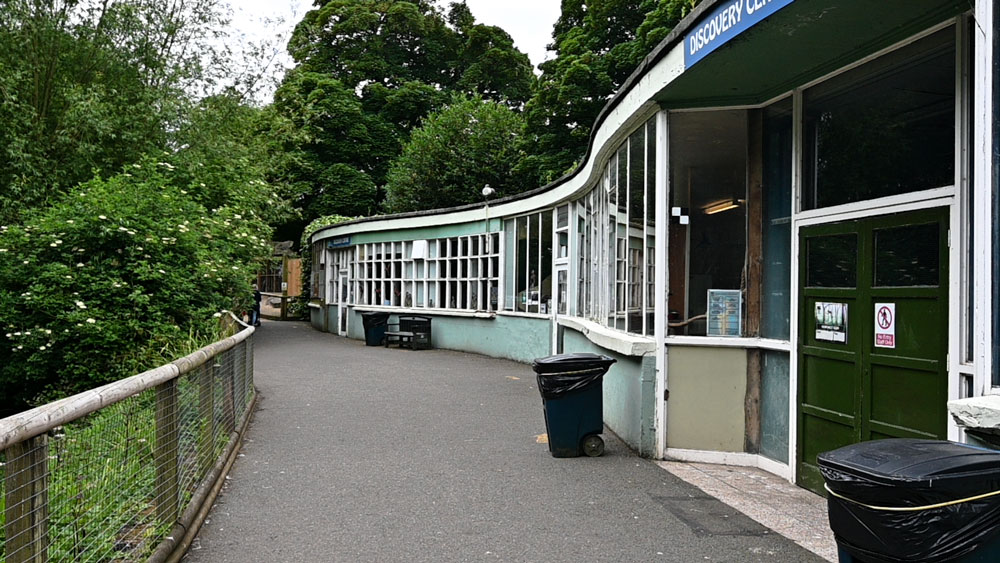
 

futuro pod with top off


The English countryside couldn’t be further from Matti Suuronen’s 1968 commission to design a ski hut for Dr Jaakkoo Hiidenkari. That became a prototype for the Futuro House or Pod, a cleverly designed 16 segment prefabricated kit designed for self assembly, made of fibreglass reinforced plastic with a polyurethane insulation to retain heat. These materials were to ’60s and ’70s design what plywood was to the ’30s, from egg chairs to daleks, fibreglass and plastics offered strength, plasticity and seeming affordability.


futuro moored in Somerset

Futuro at Marston Park, Somerset

Craig explains;

“the Futuro in my opinion is the only object that embodies the zeitgeist of the late 60’s pop culture in design, architecture, interior design, culture and lifestyle. Yes there are more successful objects both commercially and practically in each of these fields, but there is no other comparable product that rolls all of these into one immersive experience both inside and out. It was a beacon of belief in there being other and better ways to be at a time when optimism was in plentiful supply. Now more than ever, we need these talismanic artifacts to teach us not just of the failings of the past, but imbue us with their sense of possibility”


The renovation needed herculean determination and, looking back, designer Craig freely admits he had no idea of the level of complexity involved in getting the necessary materials, sympathetically renovating the Futuro and finding a semi-permanent home for it.


futuro house lit at night on a hillside

Le Havre, image Laurent Lachèvre ©


There are many factors that contributed to the demise of the Futuro House; big money got involved hoping to roll the kit out by the thousand, which of course was always an overestimation about the interest levels, and the spiking cost of raw materials during the mid ’70s oil crisis.

And so thanks to the commitment of Craig and Jane this wonderful design concept made real has been saved.  There’s something so pleasing about the shape and design and curiosity about a pod for living in.


futuro pod lands for a picnic

In Le Havre, image Laurent Lachèvre ©

night lights from the window of a Futuro

Image Laurent Lachèvre ©


Useful stuff

Reasons to go to Somerset this summer includes the possibility of getting up close and personal with a Futuro House (which btw is available for photo shoots too). Here’s how 
Stay up to date with the development of the Futuro House with Craig Barnes www.craigbarnes.co.uk

Learn more about artist, curator, technician and restorer of Futuro Houses, Craig Barnes 

https://www.futurohouse.co.uk/post/greyscape

Craig on Instagram

All images Copyright of Craig Barnes unless otherwise noted


Futuro moored in Somerset

High and Over

Britain’s First Modernist Country House


the first modernist house in britain


A visitor to Amersham, between Oxford and London, will find a place emblematic of plump, comfortable middle England and so won’t be surprised that the building of the first country house in the modernist style between 1929 and 1931 caused a stir.  High & Over, the brainchild of the brilliant academic and classical archaeologist and art historian, later the director of the British Museum, and his friend from the British School in Rome and collaborator, New Zealand architect Amyas Connell, were architectural pioneers.  Visitors today are struck by the house’s beauty.


Katharina Harlow, artist and art historian, who owns the house with her artist husband, Paolo Guidi, and who has, over the last ten years, poured heart and soul into taking the house back to what it was in its heyday, notes the influences on High & Over’s design, the Emperor Hadrian’s villa on Capri and the modernism of Corbusier in the Paris Exhibition and one can also see the Villa Noailles.


modernist house in England


Ashmole and Connell shared a vision, but turning that into reality took time, hard work, patience and ingenuity. No doubt, as Katharina muses, it must have been ruinously expensive. The only contractor working in concrete construction at the time was making Wembley Stadium. So, like other great breakthrough buildings, for example, the Melnikov House in Moscow, more venerable techniques had to be mobilised.  In High & Over there is a brick infill to the concrete walls. That’s turned out to be a good thing as we’ve learned over the years since building that this mixed construction technique avoids many of the problems of a pure concrete shell.


Grade 11* listed modernist house


The fusion of classical Roman design and modernism moderates the rigour of Corbusier’s approach.  This has bothered some purists of the modernist canon but the result is a large house that nonetheless sits lightly on its hill, reflects and welcomes the sun a statement of the optimism of modernism. From above, the house is shaped like the two arms of the letter “Y” with a spacious roof terrace covered by two canopies. Connell’s influence on and advocacy for modernism influenced subsequent architects, including the Smythsons.


Ashmole created the 12-acre gardens himself. He’d come home from work and dig, by hand, and schlep.  This great former soldier and academic excavated the romanesque swimming pool himself, by shovel and wheelbarrow. The gardens are beautiful but much smaller than they were as in the 60s, the house was sold to a developer and an estate of family houses were built and which surround High & Over on two sides. Step onto the drive and it is like entering another world.  the original gardens were carefully planned and formed in terraces down the hill towards the clutch of modernist sun houses at the foot of the hill on which High & Over stands.  The gardens radiating in triangles echoed mystic designs.


modernist interior


Ashmole was a Great war veteran, he’d been awarded the Military Cross, but when the Second World war came in 1939 he volunteered, again, this time for the RAF. Katharina relates the story that the Greek campaign was run from High & Over’s library.


interior view

During the war, the Ashmoles took into High and Over refugees and evacuees from the bombing of London.  That bombing destroyed the plans and drawings of the house posing problems for its later restoration.


masterpiece of British modernism


After the war the Ashmoles sold the house. Perhaps even their immense energy had been drained by years of intense activity and the house was bought by Mays, a cartoonist for the popular magazine Punch.


In the ’60s a developer acquired High & Over and a chunk of the gardens was sold for building. The plan was for the demolition of the house.  However someone in the local authority saw to it that a preservation notice was filed saving High & Over.  Instead, the house was divided into two homes and it was like that when bought some 10 years ago by Katharina and Paolo.  They made it one house again and while they had the advice of a number of leading architectural and engineering experts it was a local architect  who thought like a builder and understood the idiosyncrasies of concrete and carefully drew up drawings in place of those burnt in the Blitz.


curved front of house High and Over


Katharina describes herself and Paolo as “architecture junkies”.  They’ve lived in and cared for a series of striking homes and fans of modernism and the International Style owe them a debt of gratitude for the care they’ve devoted to this gem.  Now it is hopefully safe, Grade II* listed by English Heritage.  And there is an opportunity to live in this magnificent home as Katharina and Paolo now plan to move on and the house is on the market.


modernism in England

Interior photos by kind permission of Savills | Exterior photos Howard Morris Greyscape


Remembering Gottfried Böhm whose 100th birthday was celebrated in 2020 with the exhibition: The Concrete Cathedral of Neviges

Gottfried Böhm at 100

Remembering Gottfried Böhm whose 100th birthday was celebrated in 2020 with the exhibition: The Concrete Cathedral of Neviges. 

In June 2021 the famed Pritzker prize-winning German architect Gottfried Böhm passed away. The previous year, frankly one of the most momentus in living memory, a pandemic swept across the world. Curator Miriam Kremser, in collaboration with curator Oliver Elser had planned for a very different 2020 when they created the exhibition Böhm 100:  The Concrete Cathedral of Neviges for Frankfurt’s Deutsches Architekturmuseum (DAM). The year should have been celebrated with events across Germany, as it turned out the exhibition was for a time virtual until visitors could visit in person.
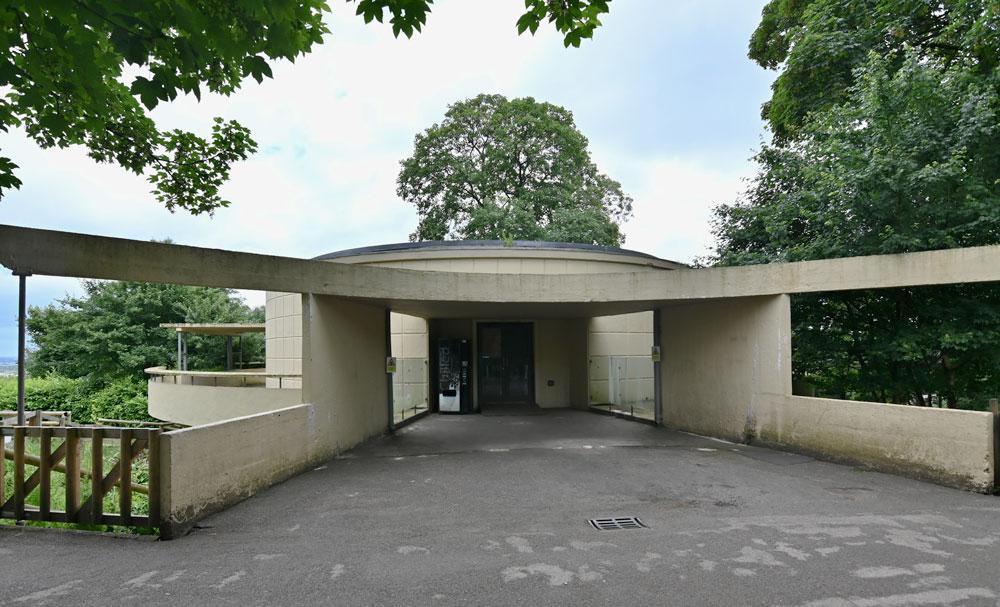
 

view to church of Neviges Bohm from a short distance

Image: Seier + Seier CC BY SA 2.0

interior detail

Gottfried Böhm: Pilgrimage Church  ‘Maria, Königin des Friedens’, Neviges / 1963–68 Image: Gregor Zoyzoyla, 2019 ©

It was always going to be a fascinating choice to make the focus of the exhibition the Cathedral of Neviges. Well-known by fans of brutalist architecture, a crowd with a niche obsession, this church, the so-called Mariendom was consecrated in 1968. Dedicated to Maria, Könign des Friedens ‘Mary, Queen of Peace’ it is tucked away in a remote village in the western part of Germany in the arch-diocese of Cologne and is the perfect way to celebrate Böhm’s artistry.


image of Mary fused into the wall of the church
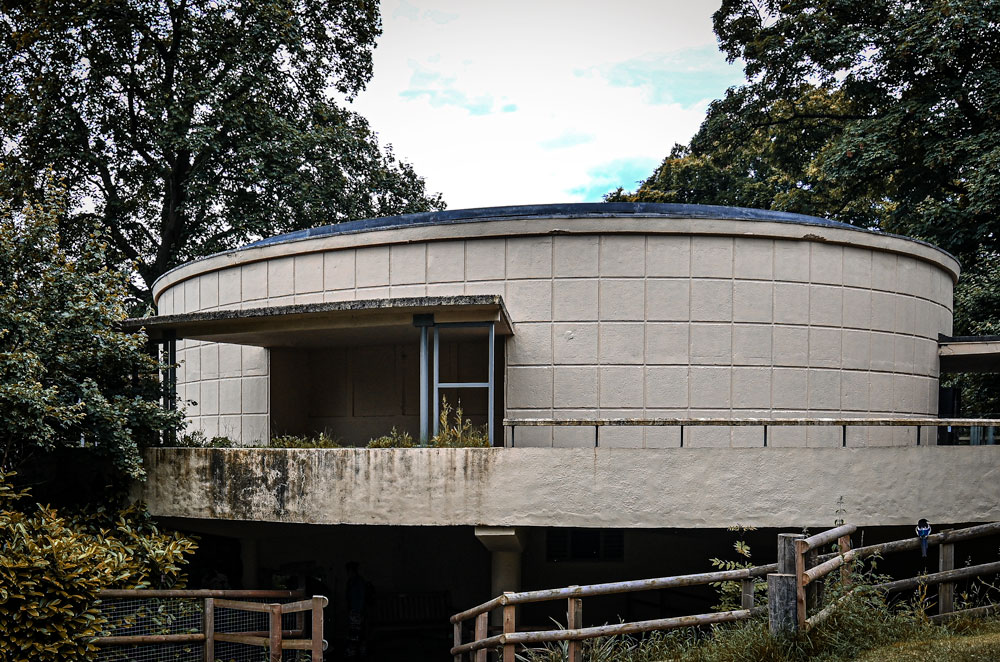
nuns walking across courtyard of church

Gottfried Böhm: Pilgrimage Church ‘Maria, Königin des Friedens’, Neviges / 1963–68 Image: Inge und Arved von der Ropp /Irene und Sigurd Greven Stiftung, ca. 1976 ©


A small image of the Virgin Mary, protected by the resident Franciscan monks had drawn pilgrims to Neviges since the late 17th century. After the First World War and again post-1945, the number of pilgrims rose significantly. With the support of Cardinal Frings, archbishop of Cologne, the Franciscans developed the plan to create a new sacred space capable of welcoming large numbers of visitors.”
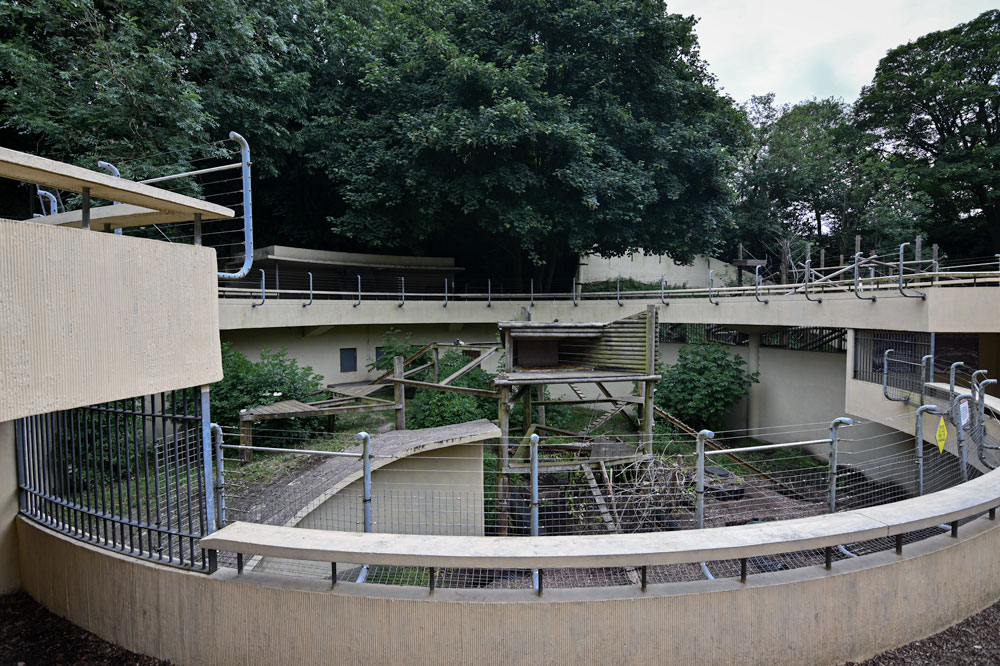
The ultimate winner of the competition (with a revision round) was the renowned architect, sculptor and artist Gottfried Böhm, the son of Dominikus Böhm.


CC BY SA 2.0

charcoal drawing of church

Gottfried Böhm: Interior of the pilgrimage church. Signed charcoal drawing. Photocopy on tracing paper, DAM 028-062-002©

Greyscape asked the curator and art historian Miriam Kremser about the exhibition, Böhm’s legacy and the extreme challenges 2020 year brought.

This interview was conducted before the passing of Gottfried Böhm in June 2021

Gottfried Böhm portrait

DAM Gottfried Böhm Image: Christian Schaulin 2008©


How would Gottfried Böhm like to be described, as an artist or an architect?

Possibly as an artist-architect. First, Böhm wanted to become a sculptor. This is why as a young man, he enrolled at the fine-arts academy, parallel to his studies in architecture at the Technical University of Munich. Finally, he chose an architectural career. Still, it is undeniable that Gottfried Böhm is both – an architect and a sculptor –  in his constructions, not to mention his expressive drawings.

The reconstruction of Cologne: I read that Böhm worked on this with Rudolf Schwarz. The bombing of the city was noted in Britain because of its extremity and later recorded in Cologne in a 1947 exhibition; Singing in the furnace. Cologne – remains of an old city and referenced in Trümmerfotografie.  Böhm would have been a relatively newly qualified architect – did he write or comment about the project and the experience of dealing with the enormity of the devastation both artistically and emotionally?

Some principles that became important for him may have developed at this time. For example, Böhm attaches particular importance to building in context. After the bombing of Cologne, 80% of the city was considered destroyed. This left the architects with a huge task. With the municipal reconstruction society under Rudolf Schwarz, Böhm was commissioned to design his very first autonomous project in 1947: to build a chapel around a wondrous undamaged Gothic statue of Mary, which together with a few walls was leftover from a bombed-out church. Later, he said in his Pritzker acceptance address that no matter if he had to deal with a small chapel or big scale city planning, there have been the pretty much the same challenges in every project: to achieve that

“New buildings should fit naturally into their surroundings, both architecturally and historically, without denying or prettifying the concerns of our time.”


Building churches in post-war Germany – some historians have noted that the Federal Government favoured the building of churches in the immediate aftermath of the war. Had Böhm intended at the outset to become a church architect or was he propelled towards it by virtue of his background and circumstances?

I guess fate has brought him there through several circumstances: His father Dominikus Böhm, who was also an architect, is known for having significantly influenced and revolutionized the modern church building. At home, the young Gottfried spent hours in his father’s office drawing plans and church window designs, and thus laid early foundations. Then, Gottfried got more interested in Fine Arts. As churches are considered as a field of experimentation for architects, this offered him even more possibilities to bring together his talents. The post-war period’s demand in the field of church building may have catalyzed everything. However, the churches in Germany were independent of the government after the bad experiences in the Nazi era.

As the creation of museums became very active in West Germany did Böhm get involved?

Together with the Archiepiscopal Diocesan Museum in Paderborn and an extension for the Historical Museum of Saarbrücken, Gottfried Böhm built two museums, meanwhile, he built approximate 75 churches – he was clearly engaged on another front.


exhibition showcase DAM with brutalist model

Image: Moritz Benouilly DAM ©

There is a story that when the Archbishop was presented with Böhm’s design for Neviges, he favoured it because he was able to sense the design so strongly when he ran his fingers across the model for the proposed church. Was Böhm already sensitive to the Bishops condition and did it impact his design?

The Archbishop of Cologne, Josef Cardinal Frings was sight-impaired. He was the most senior figure presiding over the competition to design the pilgrimage church in Neviges and would use his hands to examine the architectural models. Gottfried Böhm model was made by hand in plasticine. Indeed, it seems to be a genius coincident, that in return this was speaking even more directly to the sight-impaired archbishop’s hands. As Gottfried Böhm is a citizen of Cologne and had an extensive network in church circles, he probably was familiar with Frings condition. But his design choice was certainly not influenced by that as sketching and working out his architectural ideas through sculpture already has been Böhm’s usual practice.

I love this anecdote with the model, however, through our research we could not verify it. Perhaps it’s just a good story.

Were Gottfried’s sons involved in the Böhm 100 project?

During the preparation for this exhibition, we were in close contact with his son Peter Böhm. There were some great exchanges about the current renovation as well as about the history of the original construction in the ’60s. He enabled us to display his father’s wonderful cardboard model (which featured in the documentary film about the family) here at DAM. Beyond that, the plan had been for the Böhm 100 project to be celebrated by many institutions in Cologne on the occasion of his birthday in January and throughout 2020.  Unfortunately, then there was corona… The lifting of some restrictions has enabled us to extend our exhibition here at the DAM, Böhm 100: The Concrete Cathedral of Neviges until the 15th November 2020.


rose motif used throughout the church

Rosenfenster, Rose Window Image: Gerda Arendt


Is it true that there is a red motif on all of Gottfried’s designs as a nod to his late wife Elisabeth?

Not on all of them. But it is definitely a trademark for Gottfried Böhm to smuggle his family members as figures into his perspective drawings. The figure of Elisabeth Böhm can be identified with a red scarf. Another example: On almost every drawing that includes people, you can find the old Dominikus Böhm with his walking stick next to the tall Gottfried Böhm, often in a gesture of showing his father his building.


rose window and interior bathed in rose colour

Gottfried Böhm: Pilgrimage church „Maria, Königin des Friedens“, Neviges / 1963–68 Image: Gregor Zoyzoyla, 2019 ©

rose design for windows

Gottfried Böhm: Design for the window in the sacrament chapel. Coloured paper drawing on tracing paper 12.9.1967, DAM 028-062-029 ©


There has been much written about the forgotten wives in architecture duos. Did Gottfried’s wife Elisabeth work on any projects with him and if she did, should she have got equal billing?

To give context, Elisabeth Böhm and Gottfried Böhm got to know each other during their architecture studies in Munich, from which she graduated with distinction. She was a co-worker in the Böhm office and is jointly responsible for numerous realized Böhm buildings,  for example, the WDR Arcades in Cologne, and there has been a number of unrealized own projects, including numerous visionary urban design projects. Kristin Feireiss published a book about her work to shed light on it. But according to Feireiss, Elisabeth Böhm has seemed not to be interested in making a fuss about herself.


View towards chuch of Neviges
Detail church windows

Image: (1) Seier & Seier (2) Rabinus Flavus CC BY SA 2.0

Gottfried is often noted as Germany’s most important living artist – how has that impacted on his life and creativity?

Haha, that would be Gerhard Richter. But, yes, speaking of architecture, he and Frei Otto are among the most important. Regarding the impact on his work, Böhm must have the special talent to ignore such labels. He seems to be a good example of what it means to follow one’s own creational path: a modest man with a healthy dose of stubbornness in order to fulfil his visions.


church of neviges with scaffolding

Image; Zairon CC BY SA 3.0

view towards rose window

Gottfried Böhm: Pilgrimage Church ‘Maria, Königin des Friedens’, Neviges / 1963–68 Image: Inge und Arved von der Ropp /Irene und Sigurd Greven Stiftung, ca. 1968 ©


What are the highlights that the research in preparation for the exhibition discovered? 

We were able to track down, in their entirety, the 15 original photographs of the designs for the competition for the Pilgrimage Church. Both the first and second round of the competition process. This enabled us to present the backstory more comprehensively than previously possible. When looking at the competition models from all participants, it quickly becomes clear that Böhm stood out from the very beginning: not only because of his refined concept with the ascending pilgrim’s path leading to the church but also through his hand-kneaded competition model created out of plasticine.

Did Böhm mention his meeting with Mies van der Rohe and Walter Gropius in his memoirs?

When Böhm met them in 1951 during his educational trip to the States, they, of course, made an impression on him. Mies van der Rohe and Walter Gropius were the architectural icons of his generation. But according to a conversation in 2006 between Gottfried Böhm and our former director of the DAM, Wolfgang Voigt, Böhm said that these encounters had less impact on him as on the oeuvre of his father.

He has been described as ‘post- Bauhaus’ can you explain?

In the 1960s, when the Bauhaus while still in vogue was already controversial, the architectural competition for the Pilgrimage Church in Neviges reflected that changing taste.  At first, the jury chose a design resembling a modernist box by architect Kurt Faber. But this was rejected by the Cologne archdiocese. A symbolic quality for the church was wanted. Böhm, who had already designed churches with this quality in the 50s, won the competition in a second, revision, round. Modernist functionalism was clearly passé.


drawing of church

Gottfried Böhm: West View, Pencil drawing on tracing paper, 9.5.1967, DAM 028-062-031

If you had to describe Gottfried Böhm’s Neviges church to someone with impaired vision how would you describe it?

Imagine the small, rural village of Neviges with tiny traditional houses with gabled slate roofs. In the middle of it arises a structure completely different in nature: the pilgrimage church with large exposed concrete peaks, monumental, solemn in character. From the walls to the roof, it is worked monolithically out of exposed concrete so that the construction appears almost surreally, almost like a mountain range or a tent. When one enters, the mysterious space opens up like a dark cave, with rays of light entering through small skylights. Then, when one’s eyes adjust to the darkness, the extraordinarily vibrant colourful church windows from the side chapels emerge. They were also designed by Gottfried Böhm. One of them shows a red rose as a symbol of the Virgin Mary to whom the church is consecrated. Another one shows a dead snake, symbolizing Mary’s triumph over evil.

He is said to have many churches being ‘cleft looking’. Can you enlarge?

One significant characteristic of the pilgrimage church is the folded exposed concrete roof that evokes the association with rock mass, stone that tectonically slides into each other and creates summits and clefts. However, others have interpreted this as tent-like or as the Virgin Mary’s protective mantle. Böhm has also employed this idea in other churches, similar but distinctly different. Artistically related would be the concrete chapel in his Bethanien Children’s Village in Bergisch Gladbach or the St. Matthäus Church in Düsseldorf. But it seems important here to mention that Böhm had not intended the churches to be seen as shaped like mountains. The mountain metaphor is more what the reception made out of it.


Image: Moritz Benouilly DAM ©

Deutsches Architekturmuseum (DAM)

Schaumainkai 43, Frankfurt am Main

Video, with thanks to DAM©

Visit the Cathedral in Neviges

Nevigeser Wallfahrtsdom

Eberfelder Str. 12

42553

Velbert

Germany

All images and video, unless otherwise noted, are the Copyright of DAM

Follow #SOS Brutalism

Website http://www.sosbrutalism.org/cms/15802395

Instagram https://www.instagram.com/sosbrutalism/

church of neviges wintertime rooftops

Image: Kenta Mabuchi CC BY SA 2.0

Urbex: The Accidental Obsession of Modern Architecture Lovers

Urbex: The Accidental Obsession of Modern Architecture Lovers

While it’s likely you’ve never heard of Urbex before, if you find yourself reading this, there’s a good chance the word applies to you.


urbex in vast abandoned building in Guangdong China

Guangdong China, Image Evan Chang and Yoel Taomas ©

urban exploration photography

Beneath the City of Kyiv Ukraine


In the words of Evan Chang, an Urbex photographer from Guangzhou in Canton China, it’s about, “capturing huge, lonely architectural structures with my camera. Trying to find the traces of human life at the same time as grappling with the history of their construction.”

The lure of Urban Exploration Photography, Evan explains, is that, “Each visit to a building is hugely meaningful, altering the facts on the ground and forging the connection between people and architecture. The photos I take are a way of looking at the present and looking at the past.”


Urbex 'Urban Exploration' Abandoned Chinese Theme Park

Guangdong China


While Urbex can function simply as pointing and shooting a built structure it has mutated over its existence into something darker. For Urbex fans the Venn-diagram of ruin and decay with history and anthropology is fascinating. Detroit’s deterioration was catapulted into the public sphere when photographers from around the world descended on the city and documented the degeneration. Hence, it’s nickname from the media, ‘ruin porn’.


ruin porn urban exploration china

Office in an abandoned Factory Hubei, China

ruin porn captured by an urbexer

Abandonment Guangdong China


We got a glimpse of this just this week as Notre-Dame burst into flames. Suddenly the fragility of landmark architecture, even that protected by both church and state, became abundantly clear.


Notre Dame small detail on facade pre fire 2019

detail of gargoyles on side of Notre Dame pre 2019 fire

Notre-Dame de Paris pre 2019 fire


So where does the catastrophe leave the conversation about urbex? Does a building have to be abandoned to be an appropriate subject? What about somewhere highly distressed but for a limited period of time? We’ve all been fascinated by the photographs of the damage to the interior of Notre-Dame and perhaps that gave us all a sense of the fascination of Urban Exploring?  Notre-Dame doesn’t fall within the Urbex canon, it’s not been abandoned, its users and visitors are known and so there’s none of the fascination of imaging and trying to picture who inhabited it, who used an abandoned building.


urbex inside huge damaged dome

Buzludzha Monument, Bulgaria

urbexers exploration photo

Cooling Tower, Charleroi


Photographers are always looking at ways to capture the spirit of a design something different, next layer down, what happened at Notre-Dame proved that one shouldn’t be so casual about the longevity of any building including the incredibly well known and taken for granted. Visit Evan on Instagram www.instagram.com/yifangchang_no_menu/

All images copyright of Yifang Chang 张一方 ©


Cityscape bathed in pink light urbexer

Guangdong China

Venice Architecture Biennale 2021, How Will We Live Together

Venice Architecture Biennale 2021

Architects and artists, dreamers and visionaries grapple with a question vexing all of us

How Will We Live Together?


venice biennale

Padiglione Centrale Giardini_Photo by Francesco Galli_Courtesy of La Biennale di Venezia


The Curator of the Venice Biennale Architettura, Hashim Sarkis’ theme takes the form of a question. His statement reveals his thinking;

How: Speaks to practical approaches and concrete solutions, highlighting the primacy of problem-solving in architectural thinking.

Will: Signals looking toward the future but also seeking vision and determination, drawing from the power of the architectural imaginary.

We: Is first person plural and thus inclusive of other peoples, of other species, appealing to a more empathetic understanding of architecture.

Live: Means not simply to exist but to thrive, to flourish, to inhabit, and to express life, tapping into architecture’s inherent optimism.

Together: Implies collectives, commons, universal values, highlighting architecture as a collective form and a form of collective expression.

?: Indicates an open question, not a rhetorical one, looking for (many) answers, celebrating the plurality of values in and through architecture.


Between now and November Greyscape will be featuring how the answer is interpreted in national pavilions. We’ve begun with …

British Pavilion: The Garden of Privatised Delights British Council

Hungarian Pavilion: Overnity


British Pavilion venice biennale

Image Francesco Galli Courtesy of La Biennale di Venezia


If you are heading to Venice (the biennale runs to November 21st) why not grab a copy of the newly launched Modern Venice Map from Blue Crow Media, edited by Marco Mulazzani and Elisa Pegorin with original photography by Alessandra Chemollo. Blue Crow explain, ‘The guided map includes the Pavilions of the Venice Biennale, the Vatican chapels, examples of public housing, museums and more. This guide map features works by an array of international masters, including Carlo Scarpa, Santiago Calatrava, Aldo Rossi, David Chipperfield, MAP studio, Tadao Ando, Renzo Piano, Rem Koolhas, Norman Foster, Alva Aalto, James Stirling and others as well as an introduction and texts are in English and Italian’.

Get the Map £8.00

Images courtesy of La Biennale di Venezia

Jordane Saget is leaving his mark on Paris

Jordane Saget

is leaving his mark on Paris


He’s chalking up a stellar reputation with his highly original patterns which keep popping up in the most unexpected places. Recognised more and more as an important creative voice on the Parisienne arts scene, Jordane Saget doesn’t consider himself an artist in the traditional sense.


lines and circles paris streets

Early experiments were carried out with a pencil, paper and ruler, his work evolved once he decided to take his art out on to the streets of Paris.  Using chalk, crushed Blanc de Meudon in particular, Paris became his canvas. Jordane’s art can be seen in expected and unexpected places. He’s not prescriptive about the choice of surfaces, he works on pavements, in stairwells, on handrails, metro entrances and pretty much any flat surface in the built environment. And we haven’t even got onto fashion collaborations.

paris pavementJordane Saget Lines

Precision drawing is the expression that comes to mind – the lines are always eight millimetres wide and the patterns always have a three-line aspect but think of that as a jump-off point because then the swirls and arabesques begin to emerge.


We had a lockdown conversation with Jordane about how the year has been for him;

How do you describe yourself as an artist, a street artist or ….?

I’d simply say, artist. In France, I have the impression that it is difficult to break out of the framework in which we are placed. I have to be careful not to be boxed in. I would like to be completely free to go in any direction of my choosing. For example, I’m very interested in town planning and street signage and enhancing the appearance of public spaces.


lines on rooftops of paris


What do you like your art to be called street art, graffiti or something else?

I personally call them the lines, you will notice that I very rarely give my works names, I’m trying to avoid putting them in a rigid framework.

Your work is beautiful and original. How did you become an artist?

I didn’t study art but it was clear at a certain point that I had developed into being an artist. It happened on the street. I noticed that putting a few chalk lines in a public space changed that space and impacted on the way people move around it. I understood in that moment that my lines would become a creative tool.


Can you describe your art? Who and what influences you?

Graphically it’s a network of curved and dancing lines. My art is informed by everything around me, I’m a curious person, influences can be anything from the motion of an artisan stonemason to the movement of the branches of a tree. I can look at a magnificent building with as much curiosity as a slab of paving stone. I’m a T’ai chi ch’üan practitioner and read about Chinese philosophy the influence on the lines with their slow curvy movements is clear.

Jordane Saget street art Paris pavement


The word arabesque has been mentioned – what is it and is it an accurate description?

The term, which is used a lot in ornamentation denotes a sinuous and elegant line. I’m okay if it is applied to my designs. Personally, I prefer the lines to self identify.

Do you only work with chalk or other materials and if so are there different types of chalk?

I only use white chalk, the type we used at school. It’s delicate and gives a sense of poetic suggestion far more powerfully than coloured chalk. I also work with Blanc de Meudon mixed with water, applying it using a roller on glass and mirrored surfaces. Historically it was used as a window cleaner at the turn of the century. Once it has dried it leaves a base powder on the surface, I draw by removing some of that surface with my finger.


chalk moved with a finger on glass

What role do photographs play?

There is the work in situ which can be experienced instantly by passersby and then there is the photographic work which allows me to add a particular narration by the choice of my framing etc.

Do you create work outside of Paris?

Yes, if I’m invited or for special projects. The lines are very adaptable and can fit in all kinds of places and on all sorts of architecture. But they have a strong intimate link with Paris, it isn’t simply that they resonate so well with the Art Nouveau style, it is that they are now well known in Paris.

no entry and this side signs on jordan saget decorated traffic island

Traffic Islands Jordane Saget Paris

Do you sell your art in galleries?

I do like the idea that my works are free and numerous on the street and conversely that my original works on canvas or drawings are very rare. I produce very few works suitable for galleries, at the moment I’m not working with them.

What draws you to a particular place and do you have a process before you begin?

I always travel with my materials, ready to draw if the opportunity arises. I am constantly looking around, I have developed a great faculty to recognize where the lines resonate best. It’s often obvious. Over the years I have developed a kind of sixth sense to spot a suitable surface to transform or to dress with my lines.


paris park

You worked with Agnès B – how did you have to adapt to work with a brand?

The first step is for me to meet the person I’m collaborating with and from there the ideas are woven together. In Agnès B (Agnès Andrée Marguerite Troublé) I met someone who an artist and an exceptional woman. I went into that first meeting with my eyes closed, after that everything evolved in a very natural way.

lines on a window Jordane Saget

How has it been for street artists during the pandemic?

During the first lockdown, I thought I’d be able to continue my work as an urban artist. Unable to move, I asked people to send me a photo of the view from their window so I could drop lines using my tablet.  I was able realise this on more than 400 photos.
I decided at the end of lockdown to create a book of all those photos and to sell it for the benefit of the association “Les restos du Coeur”

In the age of Covid, what have you planned for this year?

I am a little lost at the moment in terms of planning and a little overwhelmed. Projects in the pipeline (though I can’t give more information at the moment)  include the stained glass windows of a church, the customization of a car, a stone sculpture, a fresco in a hospital, a new approach on the sidewalks of Paris.

Follow Jordane on Instagram @jordanesaget
Jordane’s websitewww.jordanesaget.com
All images are the Copyright of Jordane Saget ©


detail on stairs that lead to the river