Search

MY BAG £0.00
  • News
  • Locations
    • Explore Locations
    • Lexicon
  • Concrete Community
    • Community Latest
    • Off the Béton Track
    • The Gallery
    • Campaigns
  • Shop
  • Our Story
  • Features/News
  • Locations
  • Explore Locations
  • Lexicon
  • Concrete Community
  • Off the Beton Track
  • The Gallery
  • Campaigns
  • Community Latest:IGTV
  • Shop Essentials
  • Our Story

Showing the single result

  • 12.50
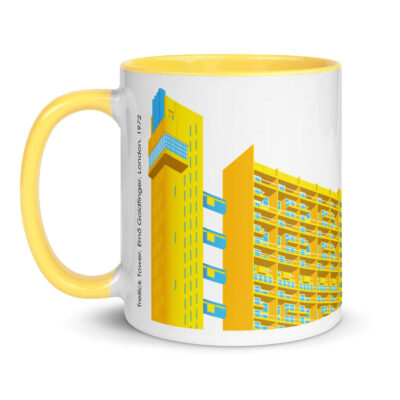
    Trellick Tower Mug by Absolutely ANF, Adam Nathaniel Furman

    Trellick Tower Mug by Absolutely ANF, Adam Nathaniel Furman

    £12.50
    Add to basket

@Barbican_City_of_London

Font envy Font envy
The vision of a modernist with conviction who had The vision of a modernist with conviction who had a short, complicated career, Amyas Connell (1901–1980) arrived in London from New Zealand in the 1920s, studying at the Bartlett before forming Connell, Ward & Lucas. For a brief moment in the 1930s, they were at the forefront of British modernism, bringing reinforced concrete, open planning and European ideas.

Highpoint I in Highgate (1935) remains his defining work, designed by Connell, Ward & Lucas, with Berthold Lubetkin, an émigré architect, acting as a consultant to the project.

Lubetkin was not the architect of record, but he advised during the design phase and his experience of continental modernism informed aspects of the building’s planning and refinement. The commission, design responsibility and authorship sit with Connell and his practice, though that is frequently forgotten in descriptions now. 

Highpoint was built for the developer Sigmund Gestetner. At the time, Connell described the challenges, 

“The problem was to produce luxury flats with the maximum of sunlight and air, and with complete privacy for each tenant.”

It worked. Even Le Corbusier admired it, calling it among the finest modern buildings in the world.

And yet, buildings like Highpoint were the exception. In 1930s London there was little institutional support for modernism, no large-scale state programme, limited backing from bodies like the London County Council, and cautious lenders and planners who favoured familiar forms. Projects like this depended on rare, forward-thinking clients rather than a system ready to support them. By the late 1930s, Connell had turned away from modernism altogether, later working in more traditional styles, a reminder that architectural careers don’t always move in straight lines.

Highpoint, though, remains a triumph. Image CC BY 2.0
The Barbican Estate in all its glorious curves and The Barbican Estate in all its glorious curves and columns. Any guesses where this photo is taken from?

    Contact

    For customer services you can
    email us at
    Info@greyscape.com

    Subscribe to our mailer

    Keep up to date with Greyscape by signing up to our newsletter


    Follow us on social
    #Greyscape + #Barbicancityoflondon

    Customer Services

    Terms and Conditions
    Privacy Policy
    Returns and Refunds

London
New York
Paris
Berlin
Moscow
Tokyo

© 2026 GreyscapeRegistered trade mark

Facebook Instagram Twitter

Site Designed By The Digital Fairy

    Subscribe to our mailer

    Keep up to date with Greyscape by signing up to our newsletter


    Follow us on social
    #Greyscape + #Barbicancityoflondon

Facebook Twitter Instagram

CONTACT US

For customer services you can email us at

Info@greyscape.com

CUSTOMER SERVICES

Terms and Conditions

Privacy Policy

Cookie Policy

Shipping and Returns

© 2026 GreyscapeRegistered trade mark

Site Designed By The Digital Fairy