

Frank Gehry (1929–2025):
His Dreams Built the Future of Architecture

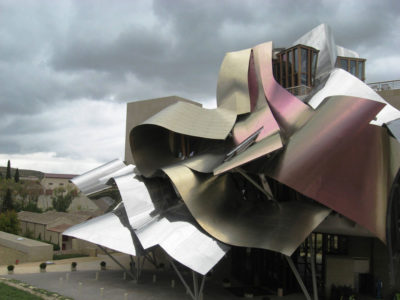
Frederick R. Weisman Art Museum, Minneapolis, Minnesota Image Carol M. Highsmith – Library of Congress
Born Frank Owen Goldberg in Toronto, Frank Gehry has passed away at the age of 96. Widely regarded as one of the most influential architects of the contemporary era, his buildings, lyrical, unconventional and instantly recognisable, reshaped skylines and the public imagination alike.
The intentive mind that later revolutionised architecture first emerged in the 1930s on the kitchen floor of his grandmother, Leah Caplan’s Toronto Home.
‘..one of the first architects to grasp the liberating potential of computer design, went on to create a host of other celebrated buildings, many of them widely regarded as masterpieces, that in their sculptural bravura and visceral power matched or even surpassed the Baroque architecture of the 17th century’
Nicolai Ouroussoff, The New York Times
As Paul Goldberger recounts in Building Art: The Life and Work of Frank Gehry, young Frank and Leah built fantastical structures from odd scraps of wood collected from his grandfather’s hardware store. Gehry later said, “There were round pieces that looked like bridges and freeways before there were freeways. She would play with me on an equal level like an adult.” Those early hours constructing miniature worlds felt, in retrospect, like his first Gehry buildings.
Gehry grew up in a traditional Jewish family whose journey from Łódź, Poland, through New York’s Hell’s Kitchen and Cleveland to Toronto brought with it the textures of Eastern European Jewish life. Among the memories that stayed with him was the family carp, kept swimming in the bathtub until its weekly and mysterious disappearance, always just before gefilte fish appeared on the Friday night table. He would later speak often of how that childhood shock shaped his lifelong fascination with fish forms, curves, and fluidity in his designs.
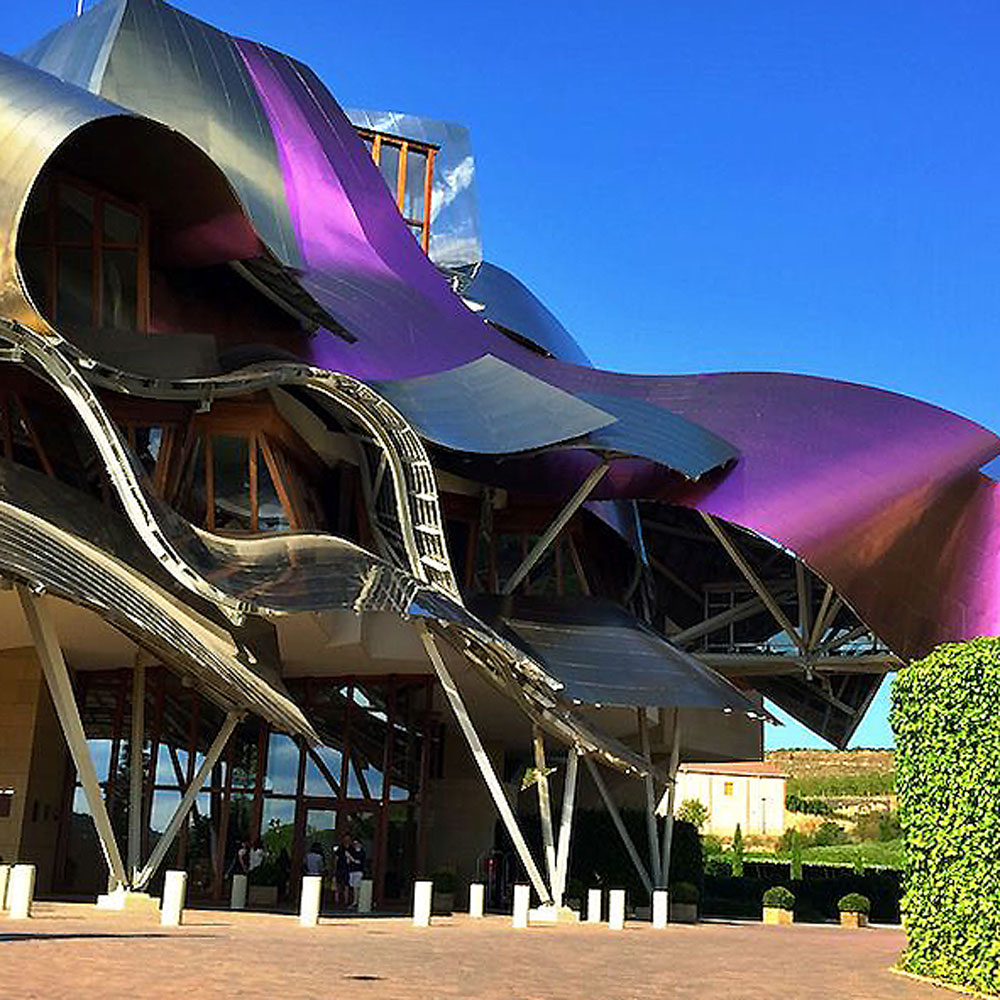
Hotel Marques de Riscal Rioja
Artistic curiosity was recognised early. A pivotal moment came at 16, when he attended a lecture at the Art Gallery of Toronto. Only later did he realise that the quiet, white-haired man showing curved plywood furniture was Alvar Aalto—whom Gehry would come to regard, alongside Erich Mendelsohn and Le Corbusier, as one of the greatest modern architects. That evening, he quietly set his course.
His courage to challenge tradition shaped skylines and minds alike, setting a new standard for creativity in our field. Frank’s legacy lives on in every architect he inspires and every city forever changed by his work.”
Stephen Ayres AIA
When his father became seriously ill, the family moved to California in search of better prospects. Money was scarce. Gehry drove trucks by day and studied at Los Angeles City College at night, where he rediscovered art and architecture. USC soon followed, along with a ceramics class that brought him into contact with real architects for the first time. As he later joked, he was mesmerised by “a guy in a black suit and black beret telling contractors what to do and railing against Frank Lloyd Wright.”
After graduating from USC’s School of Architecture and becoming an American citizen, Gehry worked a range of jobs to support his young family. In 1956, he briefly attended the Harvard Graduate School of Design to study city planning, but left disillusioned, returning to Los Angeles to work with Victor Gruen Associates. His first private commission—the David Cabin—arrived soon after.
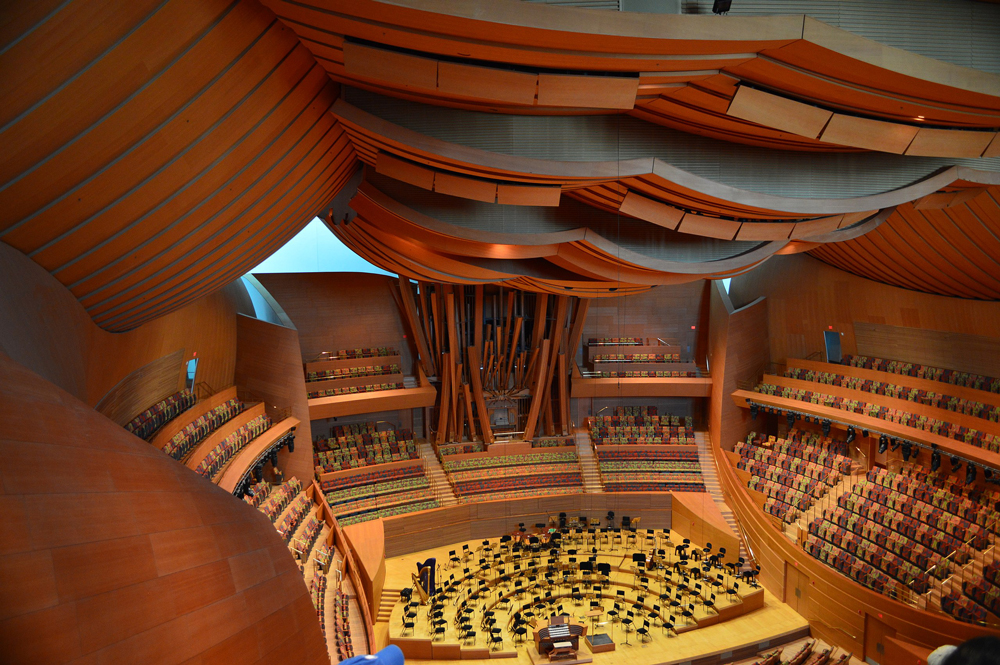
Interior Disney Concert Hall, Los Angeles Image Daniel Hartwig CC BY 2.0
In 1961, he made an adventurous move to Paris to work with André Remondet. His French education and Canadian background served him well, but after a year, he returned to Los Angeles and established his own practice.
A turning point came in 1978 with the radical remodelling of his Santa Monica home. Its bold, deconstructed form—still endlessly discussed—foreshadowed themes that would define his later work. “I was emotionally trapped because it was this icon,” he reflected years later.
By the 1980s, Gehry had entered full stride. He won the Pritzker Prize in 1989, and his first European commission, the Vitra International Furniture Manufacturing Facility and Design Museum, opened the same year. But it was the 1997 Guggenheim Museum Bilbao that propelled him to global fame. Philip Johnson called it “the greatest building of our time,” and the “Bilbao effect” became shorthand for architecture’s power to transform a city.
Major commissions followed worldwide: the Walt Disney Concert Hall in Los Angeles, the Fondation Louis Vuitton in Paris, Prague’s Dancing House, Seattle’s Museum of Pop Culture, and the Cinémathèque Française in Paris, among many others.