Search

MY BAG £0.00
  • News
  • Locations
    • Explore Locations
    • Lexicon
  • Concrete Community
    • Community Latest
    • Off the Béton Track
    • The Gallery
    • Campaigns
  • Shop
  • Our Story
  • Features/News
  • Locations
  • Explore Locations
  • Lexicon
  • Concrete Community
  • Off the Beton Track
  • The Gallery
  • Campaigns
  • Community Latest:IGTV
  • Shop Essentials
  • Our Story
SUBMIT YOUR STORY

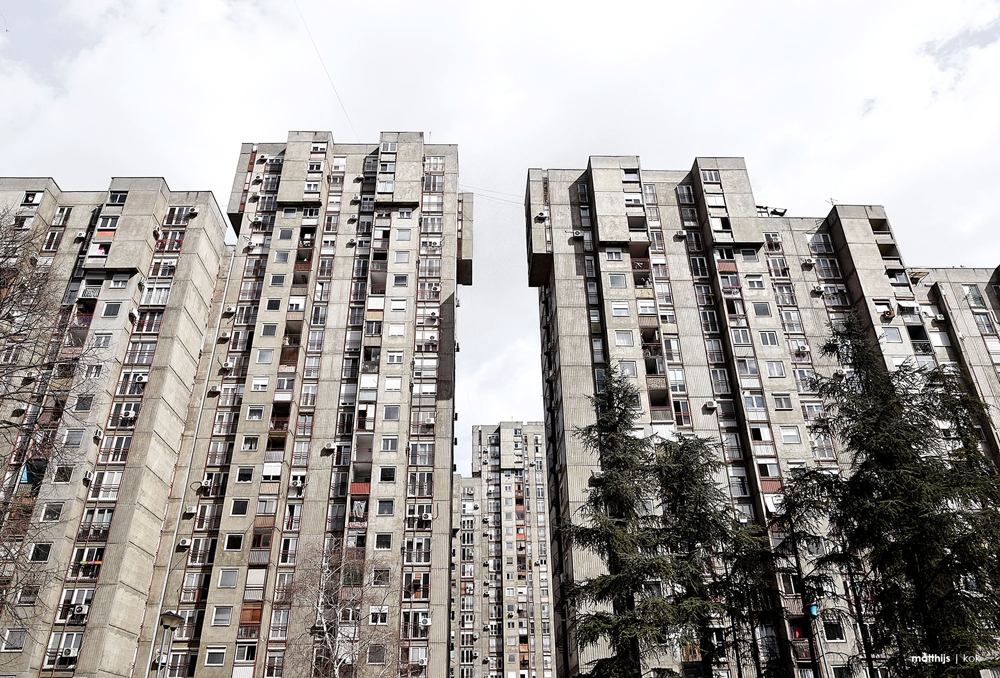
Novobeogradski social housing

Blokovi

Name given to planned, post-war, communist-era social housing high rises in New Belgrade (Novi Beograd), Serbia.

Image: Matthijs Kok

Share on social

Related Products


  • 16.00
    Sale! Brutalist Poland paper Kit

    Brutal Poland: Build Your Brutalist Polish People’s Republic

    £24.99 Original price was: £24.99.£16.00Current price is: £16.00.
    Add to basket
  • 6.70
    Housing. Tower Hamlets & Hackney 1972-1993 David Hoffman

    Housing. Tower Hamlets & Hackney 1972-1993 David Hoffman

    £6.70
    Add to basket
  • 18.00
    Sale! Berlin Architecture

    Plattenbau Berlin: A Photographic Survey of Postwar Residential Architecture

    £22.50 Original price was: £22.50.£18.00Current price is: £18.00.
    Add to basket
  • 19.50
    Sale! front cover Soviet Asia

    Soviet Asia: Soviet Modernist architecture in Central Asia by Fuel

    £24.95 Original price was: £24.95.£19.50Current price is: £19.50.
    Add to basket
  • 30.00
    Ukrainian Railroad Ladies

    Ukrainian Railroad Ladies

    £30.00
    Add to basket
  • 18.00
    Sale! Auto Erotica: A grand tour through classic car brochures of the 1960s to 1980s by Jonny Trunk

    Auto Erotica: A grand tour through classic car brochures of the 1960s to 1980s by Jonny Trunk

    £24.95 Original price was: £24.95.£18.00Current price is: £18.00.
    Add to basket
  • 6.70
    Fashion, Music, London 1980s Jane Simons Cafe Royal Books

    Fashion, Music, London 1980s Jane Simons Cafe Royal Books

    £6.70
    Add to basket

Related Posts


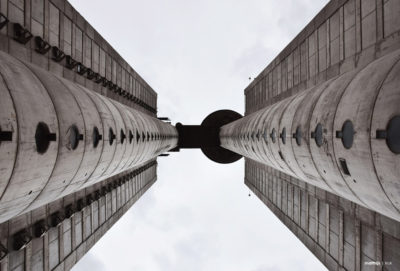
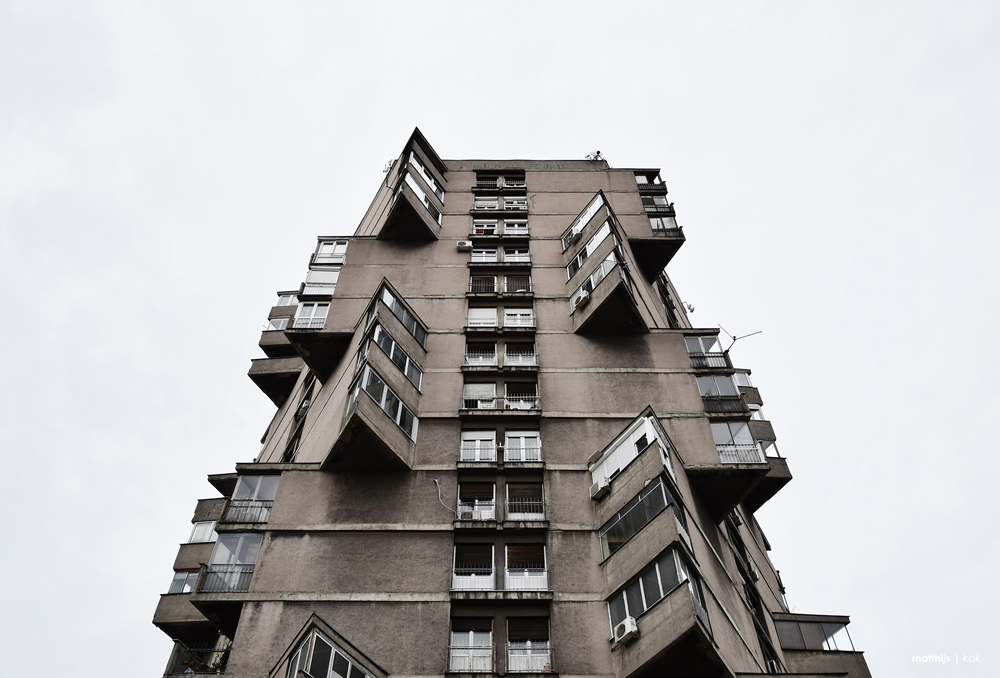
genex tower view from below Belgrade

Brutalist Belgrade

Dream destination for brutalist architecture fans
Saturday October 2019
By Greyscape
brutalist architecture Toblerone Building upper floors

Rista Šekerinski

Saturday October 2019
By Greyscape
gdansk polish architecture

Bloki: Poland’s Architecture Journey Through Communism: From interwar years Modernism to communist bloki through a photographers lens

Saturday April 2019
By Greyscape

@Barbican_City_of_London

Still a landmark of Belgrade, and for many years t Still a landmark of Belgrade, and for many years the tallest building in the Balkans, the Albanija Palace stands at the centre of the city.

Work began in 1938–39, designed by Branko Bon and Milan Grakalić, and was completed by Milorad Grakalić with engineer Đorđe Lazarević. It was an ambitious project, especially for a city without the machinery or funds usually needed for such large-scale construction. The plans even included four basement levels.

To make this possible, Belgrade brought in Russian Kalmyk émigrés, known for their skill with horses. Using horses and carts, they slowly and methodically removed the earth from the site.

Then came an unexpected discovery: the well-preserved skeleton of a mammoth, thought to be around two million years old. It was a reminder that this part of Belgrade was once the edge of a prehistoric lake. The bones, so well preserved that the teeth could be clearly identified, were sent to the Museum of Serbian Land, and work continued.

The building that rose in its place became a symbol of a modern, forward-looking Belgrade.

Image: CC BY-SA
Happy International Women’s Day! Remembering Eil Happy International Women’s Day! 

Remembering Eileen Gray and the terrific work of @capmoderneuk in preserving her legacy. 

Eileen Gray spent almost 50 years forgotten and it has taken the intervening 55 years from the 1970s to return her to rightful recognition as a icon of Modernism. 

Born in 1878 into Irish aristocracy in Enniscorthy, Ireland, Kathleen Eileen Moray Smith, the daughter of an artist was the first woman to be invited to study at Slade School of Art in London. In 1902 she headed to Paris to study at the Académie Colarossi (something of a pitstop) until studied at the highly thought of Académie Julian. 

An interest in the technique of Japanese lacquering and decorative panels had been fostered in London. Eileen met Japanese master of the art, Seizo Sugawara, with whom she trained and opened a lacquer workshop in 1910. In the early 1920s, she opened her own shop Galerie Jean Désert (it is said that she purposefully used a non-gender specific name for the business – a reflection of how female artists were considered at that time). Her co-designer of the store? Jean Badovici, the man with whom she conceived the idea of and built E-1027. Bearing in mind that she was not a trained architect and was by standards of the time, middle-aged – the idea of deciding to build a house on the hills overlooking the Mediterranean spoke not to foolhardiness, rather to everything that makes Eileen Gray, to her fans, rightfully one of the greatest designers of the 20th Century and unhesitatingly deserving of her place in Siobhan Parkinson’s book Rock the System about unique, fearless Irish women. 

We’d like to think she didn’t so much rock the system as break it. She would not let anything be a barrier.
The mighty, abstract concrete “spomeniks” are uniq The mighty, abstract concrete “spomeniks” are unique not just in their vaunting ambition to render in concrete, stone, metal and other materials the horror, the courage and the endurance of people’s resistance against Nazism but that Yugoslavia under Tito, a relatively short-lived unified country, shared a common concept of how to express the inexpressible. 

This is Spomen-Dom, the Memorial House in Kolašin Montenegro, 1971-75, architect Marko Mušič. The building is defined by a dramatic roofscape of interlocking pyramidal forms inspired by the steep roofs of traditional mountain houses in northern Montenegro.

In 2015 American Donald Niebyl happened on Belgian photographer Jan Kempanaers’ images of incredible memorial sculptures the likes of which he never could have imagined. He was instantly captivated and did all he could to learn more about them. These forms were communicating a huge amount of symbolic language and history from a region that to him seemed hopelessly out of reach. 

Determined to learn about the history of these works, who created them, why were they created and why were they situated in such remote locations. Donald then travelled to the former Yugoslavia between jobs to see the monuments for himself. Tracking the locations consisted largely of scouring Google Map satellite images until he spotted them. 

During his first trip in 2016, Donald found about 50 spomeniks, which he meticulously documented while friends he made along the way helped with the history, translating inscriptions and deciphering symbolism. 

This was the beginning of the @spomenikdatabase 

Link to book in our bio

    Contact

    For customer services you can
    email us at
    Info@greyscape.com

    Subscribe to our mailer

    Keep up to date with Greyscape by signing up to our newsletter


    Follow us on social
    #Greyscape + #Barbicancityoflondon

    Customer Services

    Terms and Conditions
    Privacy Policy
    Returns and Refunds

London
New York
Paris
Berlin
Moscow
Tokyo

© 2026 GreyscapeRegistered trade mark

Facebook Instagram Twitter

Site Designed By The Digital Fairy

    Subscribe to our mailer

    Keep up to date with Greyscape by signing up to our newsletter


    Follow us on social
    #Greyscape + #Barbicancityoflondon

Facebook Twitter Instagram

CONTACT US

For customer services you can email us at

Info@greyscape.com

CUSTOMER SERVICES

Terms and Conditions

Privacy Policy

Cookie Policy

Shipping and Returns

© 2026 GreyscapeRegistered trade mark

Site Designed By The Digital Fairy